
When you hop into a 15-seater van for a church outing, an airport shuttle run, or a school trip here in Florida, you’re probably thinking it’s just a bigger version of a car. The reality is, these common vans have some unique and pretty serious hidden dangers. Once you load them up with people, a 15-seater van becomes notoriously top-heavy and much less stable than your family car, making it alarmingly prone to rollovers and other devastating accidents.
Understanding The Dangers Of 15-Seater Vans
These vans are everywhere for group travel, but they’ve earned a bad reputation for a reason—and it comes down to physics. Think of a fully loaded van like a small boat getting hit by a big wave. Its high center of gravity makes it want to tip over during a sudden turn or even just on a sloped road. This built-in instability is a huge reason why we see so many of these vans involved in horrific crashes on Florida’s highways.
And there’s no denying how popular these vehicles are. Globally, 15-seater vans are a slice of a massive van and minivan market valued at over USD 300 billion. That number is only going up, thanks to the constant demand for shuttle services, school transportation, and group tourism. As more of these vans hit the road, the risk of accidents naturally climbs, which means more people will find themselves trying to figure out what to do after a complex, multi-passenger crash.
Key Risk Factors You Should Know
The danger isn’t just some abstract concept; it’s baked right into the van’s design and how it’s used on a daily basis. If you’ve been hurt in one of these crashes, knowing these specific risks can help you understand exactly what might have gone wrong.
Here are the key vulnerabilities:
- High Center of Gravity: The tall, narrow body of these vans makes them far more likely to roll over during a sharp turn, a sudden swerve to avoid something in the road, or even just in a strong crosswind.
- Weight Distribution Challenges: How the van handles changes drastically with every person who gets in. A van carrying 10 or more people has a rollover risk nearly three times higher than one with just a few passengers.
- Tire Requirements: These heavy vehicles put an incredible amount of stress on their tires. Underinflated or old, worn-out tires are a primary cause of blowouts that can make a driver lose control in an instant.
A 15-passenger van has 15 total seat belts, including the driver’s. Every single passenger added, especially those sitting in the very back, raises the van’s center of gravity and makes the whole vehicle less stable.
While our focus here is on the specific issues with 15-seater vans, it helps to know they are part of a larger class of multi-passenger vehicles, which includes various 14 to 24 seater minibus options. Recognizing these inherent design flaws is often the first step in building a personal injury claim, especially when an owner or operator’s negligence was a factor in the accident.
Why These Vans Are So Prone To Rollovers

When you see tragic headlines involving a 15-seater van, it’s rarely just a case of bad luck. The truth is, these accidents are often the predictable result of basic physics. The very design of these vehicles makes them uniquely vulnerable to rollovers, turning what should be a routine drive into a potential catastrophe. To understand why these incidents happen so often on Florida roads, we need to look at what makes these vans so unstable.
The core of the problem is the van’s high center of gravity. Think about trying to balance a tall, skinny book on its edge versus a short, wide one. The tall book topples with the slightest nudge. A 15-seater van is essentially that tall book on wheels. Its height, combined with a relatively narrow wheelbase, makes it inherently top-heavy. All it takes is a sudden swerve to avoid debris on I-4 or a sharp turn taken just a bit too fast to shift the van’s weight past its tipping point.
The Danger of a Full Van
This built-in instability gets dramatically worse with every passenger who climbs aboard. An empty van handles one way, but a fully loaded van is a completely different beast. The weight of all those passengers, particularly those sitting in the higher seats toward the back, raises the vehicle’s center of gravity even further.
The data is pretty startling. The risk of a rollover is nearly three times higher when a 15-seater van is carrying ten or more people compared to when it’s carrying fewer than five. This creates a dangerous paradox: the vehicle becomes most hazardous when it’s being used exactly for its intended purpose—transporting a large group. The steering, braking, and overall handling become sluggish and unpredictable, a situation that can easily catch an experienced driver off guard.
A full load completely changes the vehicle’s dynamics. The van isn’t just top-heavy; it also needs a much longer distance to come to a complete stop, which is a critical factor when trying to avoid a collision.
This creates a treacherous scenario on busy highways. A driver might be used to how the van feels with just a few people inside, but then find themselves wrestling for control of a top-heavy, fully loaded vehicle during an emergency. It’s a critical piece of the puzzle, and our article on the topic provides more context on why rollover accident deaths are on the rise.
The Critical Role of Tire Safety
There’s a third, often-overlooked factor that adds to the risk: tire integrity. The tires on a 15-seater van are put under enormous stress, far more than on a typical car. Keeping them properly maintained and inflated isn’t just a good idea—it’s absolutely essential for safety.
Underinflated tires are a primary culprit in catastrophic failures. When a tire is low on air, its sidewalls flex too much, generating an intense amount of heat. This heat can cause the tire’s internal structure to break down, leading to a sudden, violent blowout. Imagine that happening to a rear tire on a fully loaded, top-heavy van at highway speeds. It can instantly throw the vehicle into an uncontrollable spin or slide that ends in a rollover.
Here’s why tire pressure is non-negotiable for these vans:
- Supports immense weight: Each tire has to bear a huge portion of the van’s weight, which can easily top several tons with passengers and luggage.
- Maintains stability: Properly inflated tires create the stable base the van needs to counteract its high center of gravity, especially during turns.
- Prevents blowouts: Keeping tires at the right pressure is the best defense against the heat buildup that destroys them from the inside out.
When you combine a high center of gravity, the destabilizing effect of passenger weight, and the risk of a tire blowout, you get a perfect storm for disaster. These aren’t just abstract engineering concepts; they are the real-world forces that can turn a group outing into a life-altering tragedy.
What Causes a 15-Seater Van to Crash?
While the design of a 15-seater van certainly makes it prone to rollovers, the vehicle itself is rarely the only problem. When one of these vans is involved in a devastating crash, it’s almost always the end result of a chain of preventable human errors and outright negligence. These aren’t just random accidents; they’re tragedies built on a series of poor decisions that turn a simple trip into a disaster on Florida’s roads.
The single biggest factor, time and time again, is the person behind the wheel. Handling a fully loaded 15-seater van is a world away from driving a family car or even a minivan. It demands a completely different set of skills to manage its immense weight, high center of gravity, and surprisingly long stopping distances. Unfortunately, it’s all too common for organizations to put someone with little to no specific training in charge of these challenging vehicles.
The Driver in the Hot Seat
An inexperienced driver can make a fatal mistake in the blink of an eye. A sudden swerve to miss a pothole, taking a corner a little too fast, or misjudging the space needed to stop—these are all actions that could have catastrophic results in a big van but might be non-issues in a smaller car. The driver might simply not have the experience to feel how the van will react when it’s packed with people and gear.
This problem is made worse by driver fatigue, especially on long trips for church groups, sports teams, or shuttle companies. A tired driver is a dangerous driver, with slow reaction times and poor judgment. That’s a lethal combination when you’re operating a top-heavy vehicle. On top of that, distractions can easily lead to disaster. You can learn more about these risks in our guide that explains distracted driving accidents in Florida.
Common driver-related failures often come down to:
- Lack of Proper Training: The driver just doesn’t have the specific skills to handle the unique physics of a heavy, high-profile van.
- Driver Fatigue: Long hours behind the wheel without real breaks can be just as impairing as driving drunk.
- Speeding: Going over the speed limit makes it exponentially harder to maintain control, especially around curves or during a sudden evasive maneuver.
- Distractions: Fiddling with a phone or GPS, or even just turning to talk to passengers, pulls critical attention away from the road ahead.
When the Van’s Owner is Negligent
The driver’s actions are critical, but the responsibility often goes higher up—to the owner or operator of the van. Whether it’s a church, a school, or a commercial tour company, these organizations have a legal duty to keep their vehicles safe and their drivers properly prepared. When they cut corners on safety, they put every single passenger in danger.
Overloading is one of the most glaring and common forms of owner negligence. A 15-seater van is engineered to carry a specific number of people and a set amount of cargo. Piling extra luggage inside or, even worse, onto a roof rack, pushes the center of gravity dangerously high. This makes a rollover almost guaranteed in an emergency swerve.
Maintenance is another area where cutting corners can have deadly consequences. These heavy vans put a massive strain on tires, brakes, and suspension components. Skipping routine maintenance checks is simply asking for trouble. Worn-out brakes can fail when you need them most, and an old, underinflated tire can blow out on the highway, causing the driver to lose all control in an instant.
Finally, a simple failure to enforce basic safety rules is a huge red flag. This can mean anything from not having a formal driver training program to skipping pre-trip vehicle inspections. Picture this very common Florida scenario: a volunteer driver with no special training gets behind the wheel of a poorly maintained van. It’s overloaded with luggage for a weekend trip. A sudden afternoon thunderstorm hits, slicking the roads and cutting visibility. The driver’s inexperience, combined with the van’s poor condition, creates the perfect storm for a horrific crash. It’s in moments like these that victims can trace their injuries directly back to a series of negligent choices.
Navigating Florida Law After A Van Accident
Once the shock of a 15-seater van crash begins to fade, you’re thrown into a confusing mess of insurance claims and legal questions. The rules here in Florida are unique, especially when a commercial vehicle is involved, and knowing your rights from the get-go is the only way to protect yourself. This isn’t like a typical fender-bender; a single crash with multiple injured passengers creates a complex legal situation right away.
The first question is often about the person behind the wheel. For personal use, a standard driver’s license is usually all that’s required to operate a 15-seater van in Florida, as long as it weighs less than 26,001 pounds. But the moment that van is used for business—think airport shuttles, church transport, or tour services—the game changes. Drivers in these roles often need a Commercial Driver’s License (CDL), which demands a higher level of training and testing. After a crash, understanding these Florida-specific driving regulations is crucial for figuring out who was responsible.
The Higher Standard of Care for Commercial Operators
When you pay for a ride in a shuttle or tour van, Florida law sees that company as a “common carrier.” This isn’t just a fancy legal term; it means they are held to a much higher safety standard than the average driver on the road.
They have a special duty to keep their passengers safe, which includes:
- Proper Driver Vetting: They can’t just hire anyone. They need to ensure drivers are properly licensed, well-trained, and have a clean driving record.
- Rigorous Vehicle Maintenance: Brakes, tires, and steering don’t get a pass. These vans must be on a strict inspection and service schedule.
- Adherence to Safety Protocols: Companies must have and enforce clear rules against known dangers like overloading the van or letting drivers work when they’re exhausted.
If a company drops the ball on any of these responsibilities and an accident happens, their negligence becomes a cornerstone of your injury claim.
Understanding Florida’s No-Fault Insurance System
Here’s a twist that catches many people by surprise. As a passenger in a 15-seater van, the first place you’ll turn for medical bills is your own car insurance policy. This is because of Florida’s No-Fault law, which requires all vehicle owners to carry Personal Injury Protection (PIP) coverage.
Your PIP is designed to pay 80% of your initial medical bills and 60% of lost wages, up to your $10,000 limit, no matter who caused the crash.
This can feel backwards. You might assume the van company’s insurance should pay for everything from day one. But while the at-fault party is ultimately on the hook for all damages, your own PIP coverage is where your claim starts.
Once your PIP benefits run out, you can then pursue a claim against the at-fault driver’s insurance to cover the rest of your medical bills, lost income, and non-economic damages like pain and suffering.
Critical Insurance Coverages in a Van Accident
Beyond PIP, other insurance policies are critical in Florida. A commercial 15-seater van must carry Bodily Injury (BI) liability insurance, which is what pays for injuries when their driver is at fault. The problem is, when a single crash injures a dozen people, that policy’s limits can be wiped out in a flash, leaving many victims without enough to cover their losses.
This is exactly why Uninsured/Underinsured Motorist (UM) coverage is so important. If you carry UM coverage on your personal auto policy, it can step in and cover your damages when the van’s insurance isn’t enough to go around. A skilled attorney is essential for digging in, identifying every available insurance policy, and fighting to make sure you get a fair piece of the pie before the money runs out.
With the 14–15 seat segment being a fast-growing niche in the passenger van market, these complex situations are becoming more common. More hotels, tour companies, and shuttle services are operating fleets where one bad decision can hurt many people at once, sparking high-stakes fights over limited insurance funds.
Sorting through these claims also means racing against the clock. To learn more about the deadlines for taking legal action, it’s critical to understand the statute of limitations for car accidents in Florida. An experienced attorney can unravel these tangled insurance layers and make sure you get the full compensation you deserve.
What To Do If You’ve Been in a 15-Seater Van Wreck
The moments after a crash are a blur of confusion, noise, and adrenaline. It’s completely normal to feel overwhelmed and unsure of what to do next, especially when you’re a passenger in a 15-seater van. But the steps you take right then and there can make all the difference for your health and your ability to get fair compensation down the road.
Your first move, without question, is to check on your health and the safety of those around you. If anyone is obviously hurt, call 911 immediately. Even if you feel okay, don’t just brush it off. Adrenaline is a powerful painkiller and can easily mask serious problems like internal injuries or whiplash that won’t show up for hours, or even days. Getting checked out by a doctor is crucial.
Gather Evidence While You’re at the Scene
Once medical help is on the way and the scene is safe, it’s time to switch gears into detective mode. The evidence you collect now will be the backbone of your injury claim later. If you’re able to move around safely, use your phone to document everything you possibly can.
Think like a crime scene investigator. Take pictures and videos of:
- The Van & Other Vehicles: Get shots from every angle. Close-ups of the damage and wider shots showing the final resting positions of the vehicles are both important.
- The Surroundings: Capture the whole scene. Look for skid marks on the pavement, broken glass, road signs, traffic lights, and even the weather conditions.
- Your Injuries: Take clear photos of any cuts, bruises, or swelling you have. These pictures can be powerful evidence.
Next, get information. You’ll need the van driver’s name, license, and insurance details. It’s just as important to get the names and numbers of the other passengers—they are your fellow witnesses. If anyone else stopped to help or saw what happened, ask for their contact info, too.
This flowchart breaks down how Florida law approaches van accidents, from driver responsibilities to insurance requirements.
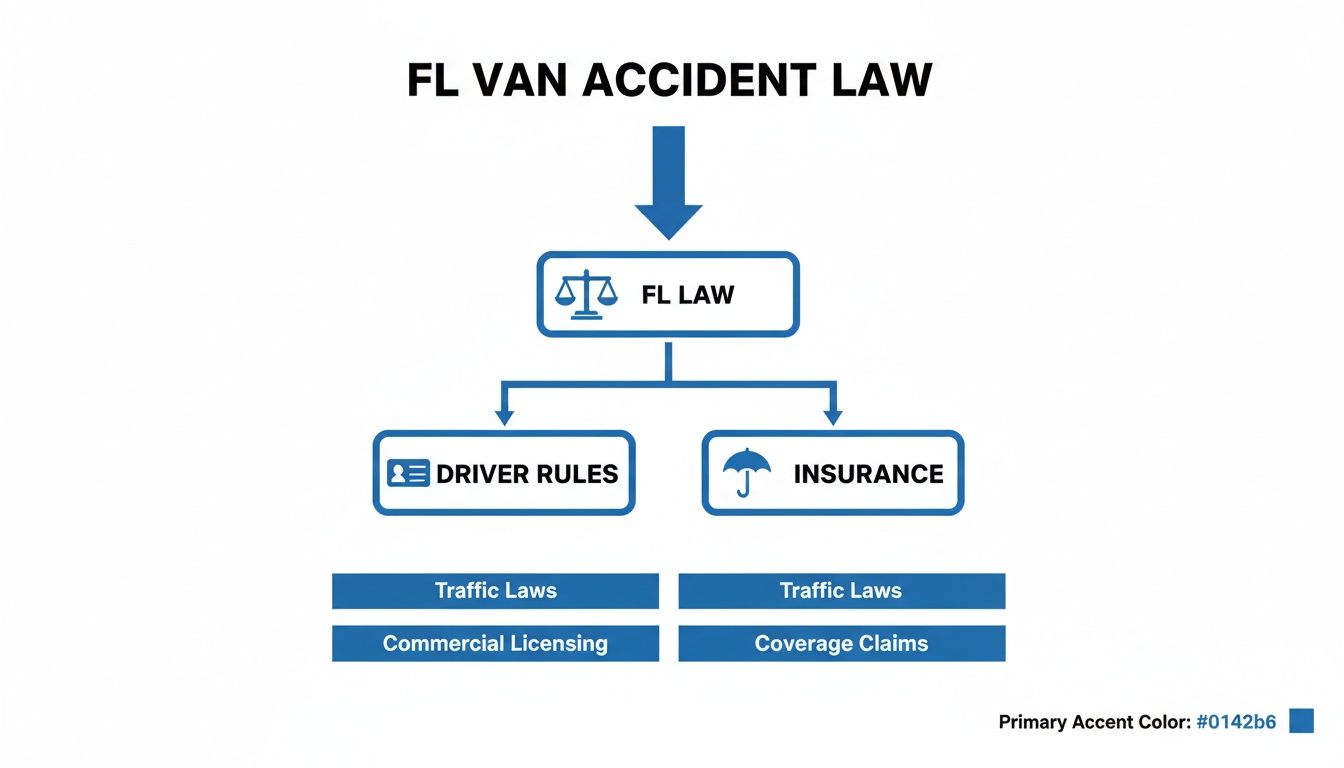
As you can see, the legal process isn’t the same as a standard car accident. Florida has specific rules for these large vans and the insurance they must carry.
Watch What You Say to the Insurance Adjuster
It won’t be long before your phone rings. On the other end will be an insurance adjuster for the van company or its driver, and their job is to protect their company’s bottom line, not yours. They’ll sound friendly and helpful, and they will almost certainly ask you for a recorded statement.
You have no legal obligation to give a recorded statement to the other side’s insurance company. It’s always best to politely decline until you’ve spoken with an attorney.
Insurance adjusters are skilled negotiators. They know how to ask leading questions designed to get you to downplay your injuries or accidentally accept some of the blame. Every word you say is recorded and can be used to poke holes in your claim later on.
Navigating the aftermath of a wreck is tough. For a more complete checklist, we’ve created a guide on what to do after a car accident in Florida. By taking care of your health, documenting the scene, and being cautious with insurers, you put yourself in the strongest possible position to protect your rights.
How A Van Accident Attorney Can Help You Recover
After a 15-seater van accident, it’s easy to feel overwhelmed. You’re trying to recover from injuries and trauma, but you’re also facing a mountain of medical bills. On top of all that, you’re up against powerful insurance companies and corporate legal teams whose job is to minimize their payout.
This is not a fair fight. Having a personal injury attorney in your corner is about leveling the playing field. It’s about having a dedicated advocate who can handle the legal battle so you can focus on what truly matters: your recovery.
Launching A Thorough Investigation
An attorney’s first job is to get the real story. The police report is just the beginning; it rarely captures the full picture of what went wrong. A dedicated legal team will launch an independent investigation to find every single person or entity that could be responsible.
This could include:
- The Driver: Did they have the right license and training? Were they fatigued or distracted?
- The Van Owner: Did the school, church, or company perform regular maintenance? Did they enforce safety policies?
- A Maintenance Shop: Could a mechanic’s mistake—like a shoddy brake job or a faulty tire repair—have caused the crash?
We often bring in accident reconstruction experts who can read the scene like a book. By analyzing skid marks, vehicle damage, and other physical evidence, they can piece together exactly how negligence led to the collision.
Your attorney acts as both your shield and your sword. We handle all the calls and paperwork from insurers to protect you from their tactics, while we aggressively fight to get you every penny you deserve.
Maximizing Your Financial Recovery
Figuring out what your case is worth is much more complicated than just adding up your current medical expenses. A good lawyer looks at the total, long-term impact this accident will have on your life.
This means calculating future medical treatments, the cost of ongoing therapy, wages you’ve lost and may lose in the future, and the very real cost of your pain and suffering.
We gather all the necessary evidence, consult with medical and financial experts, and build a powerful, undeniable case for the true value of your claim. If the insurance company refuses to offer a fair settlement, we won’t hesitate to take them to court. Understanding the benefits of getting a lawyer after a car accident can help clarify why this step is so crucial. By taking on these legal burdens, we give you the space and resources you need to heal.
Common Questions After a Van Accident
When you’ve been in a 15-seater van accident, the aftermath is often a whirlwind of confusion. You’re dealing with injuries, medical bills start piling up, and it’s rarely clear who is supposed to pay for it all. Here are some of the most pressing questions we hear from passengers caught in this difficult situation.
While these answers can give you a starting point, remember that the details of your crash are unique. The best way to get advice for your specific circumstances is to talk directly with an attorney who has handled these complex cases before.
Who Is at Fault If a Church or School Van Crashes?
Pinpointing who is legally responsible can be tricky in Florida, as it’s often not just one person. Liability might fall on the driver for their carelessness, but it could also extend to the organization that owns the van.
For instance, the church or school could be held responsible if they failed to properly maintain the vehicle, didn’t provide adequate driver training, or hired someone with a poor driving record. In some cases, even a third-party mechanic who performed faulty repairs could share the blame. A full investigation is the only way to uncover every party that contributed to the crash.
Do I Have to Use My Own Car Insurance as a Passenger?
This is a point of confusion for many. In Florida, the answer is yes—at first. Our state operates under a “No-Fault” insurance system, which means your own Personal Injury Protection (PIP) coverage is the primary source for your initial medical expenses, no matter who caused the accident.
It feels counterintuitive, but your PIP policy is designed to be your first line of defense. It pays for your initial medical care right away, so you aren’t stuck waiting for insurance companies to argue over who was at fault.
Once your PIP benefits are used up, or for damages like pain and suffering that PIP doesn’t cover, you can then file a claim against the at-fault driver’s insurance.
What if the Insurance Doesn’t Cover Everyone’s Injuries?
This is a very real and serious concern, especially in a crash involving a fully loaded van. With so many people injured, the at-fault party’s insurance policy can get exhausted incredibly fast.
An experienced Florida attorney knows it’s a race against the clock. They will immediately work to identify every possible source of compensation, from the van owner’s policy to your own uninsured/underinsured motorist (UM) coverage. Securing your share before the policy limits are drained by other claims is absolutely critical.
If you were hurt in a van accident, you shouldn’t have to battle the insurance companies on your own. The legal team at Martin Hernandez, P.A. has the experience needed to investigate your case and fight for the full compensation you deserve. Reach out today for a free consultation at https://injurylawyersoftampa.com.