
The 2013 Chevrolet Equinox, a popular SUV on Florida roads, is unfortunately tied to two significant safety recalls from the National Highway Traffic Safety Administration (NHTSA). These aren’t minor issues; they involve critical components that can fail without warning, putting you, your passengers, and everyone else on the road at serious risk.
One recall tackles faulty windshield wipers that can suddenly stop working, while the other addresses an ignition key defect that could let your SUV roll away unexpectedly.
A Florida Driver’s Guide to 2013 Equinox Safety Issues
If you’re a 2013 Chevy Equinox owner in Florida, you know our weather can be unpredictable and our roads can be demanding. That makes understanding these recalls absolutely critical. A vehicle recall isn’t a suggestion—it’s an official notice that a part on your car has a serious safety defect or doesn’t meet federal safety standards.
Let’s put these recalls into a real-world Florida context.
First, the windshield wiper issue. Picture yourself driving down I-4 during one of Central Florida’s infamous afternoon thunderstorms. The rain is coming down in sheets, and visibility is already low. Suddenly, your wipers freeze. In an instant, you’re blind to the road ahead, a terrifying situation that dramatically increases the odds of a devastating crash.
The second recall involves a flaw that allows the key to be removed from the ignition when the transmission isn’t actually in “Park.” This creates a serious rollaway danger. An Equinox that seems safely parked on a slight incline at a Publix parking lot could silently start rolling, endangering pedestrians, hitting other cars, or causing property damage.
Quick Overview of 2013 Chevrolet Equinox Recalls
To get straight to the point, here are the two primary safety recalls issued by the NHTSA for this model.
- NHTSA Campaign Number 16V502000: Windshield Wiper Failure
- The Issue: The ball joints in the wiper module can corrode and separate.
- The Hazard: This causes the wipers to fail suddenly, leading to a complete loss of visibility in bad weather.
- The Solution: Dealers will replace the entire front wiper module at no cost.
- NHTSA Campaign Number 14V447000: Ignition Key Removal Defect
- The Issue: The key can be removed when the ignition is not in the “Off” position.
- The Hazard: This allows the vehicle to roll away unexpectedly if it’s not securely in “Park.”
- The Solution: Dealers will inspect the ignition lock and, if needed, replace the lock cylinder free of charge.
These official notices from GM and the NHTSA are a clear warning that every 2013 Equinox owner needs to take seriously.
Beyond the Official Recalls
While those two NHTSA campaigns are the most prominent, they don’t cover everything. Many 2013 Equinox owners have filed complaints about other troubling problems, like excessive oil consumption and sudden engine stalls. These issues might not have triggered a formal recall, but they are just as dangerous. Imagine your engine cutting out while you’re merging onto a busy Tampa expressway—the outcome can be just as catastrophic as any recalled part failing.
This guide is your complete resource for navigating these issues as a 2013 Chevrolet Equinox owner in Florida. We’re going to break down everything you need to know, so you have a full picture of the risks and your rights.
Here’s what we’ll cover:
- A deeper dive into each of the two official recalls and what they mean for your safety.
- An overview of other common problems reported by owners that can impact your vehicle’s safety.
- A simple, step-by-step process to check if your specific Equinox has an open recall.
- The critical actions you must take if a vehicle defect causes an accident and injures you or a loved one.
- A clear explanation of your legal rights under Florida law when pursuing an auto defect claim.
A safety recall is a manufacturer’s admission that a vehicle defect poses an unreasonable risk to motor vehicle safety. It’s a critical warning that should never be ignored, as the consequences can be life-altering.
Our mission is to give you clear, actionable information without the confusing technical jargon. By understanding these defects, you can take the right steps to protect yourself and your family. And if you’ve already been hurt because of these or other vehicle failures, it’s vital to know your legal options.
You can learn more about how auto safety recalls can become the foundation of a personal injury claim in our detailed overview. This knowledge empowers you to hold manufacturers accountable and fight for the compensation you rightfully deserve.
Digging Into the Official 2013 Chevy Equinox Safety Recalls
When you hear about a vehicle recall, it’s easy to dismiss it as a minor technical issue. But the two major safety recalls for the 2013 Chevrolet Equinox are anything but minor. These aren’t just small glitches; they represent serious failures that could put Florida drivers in immediate, life-threatening danger. Let’s break down exactly what went wrong, the real-world risks, and what General Motors has done to address them.
Each of these defects creates a unique hazard—one that can blind you while you’re driving, and another that can cause your vehicle to roll away when you think it’s safely parked.
Windshield Wiper Failure: A Sudden Blind Spot
The first critical recall, NHTSA Campaign Number 16V582000, tackles a defect in the windshield wiper module. The problem sounds simple, but the consequences are terrifying: the ball joints connecting the wiper arms can corrode and wear out way too soon.
When those ball joints give out, they can pop right out of their sockets. This causes one or both windshield wipers to stop working instantly, without a hint of warning. For us here in Florida, where a sunny sky can turn into a torrential downpour in minutes, this is a recipe for disaster.
This specific recall was issued on August 4, 2016, and also included some GMC Terrain models. The corroding ball joints meant that in rain, snow, or even when trying to clear road grime, the wipers could fail completely. This dramatically increases the risk of a crash on busy Tampa highways like I-275 or Dale Mabry. You can see the full details in the Equinox wiper recall report on Cars.com.
Picture this: You’re driving down I-4 during a classic Florida summer storm, and suddenly your wipers just flop to the side. In an instant, your windshield is a sheet of water. You’re effectively driving blind, unable to see the car in front of you, the lane markers, or anything else.
This sudden loss of vision can easily trigger a catastrophic chain-reaction crash or cause you to veer off the road. The danger is even greater at night or during the heavy, sideways rain we get in hurricane season. GM’s official fix is for dealers to replace the entire front wiper module, free of charge, to prevent this from ever happening. It’s worth noting that wiper and visibility issues were also a problem in the 2012 Chevrolet Equinox recalls.
Ignition Lock Actuator: The Silent Rollaway Risk
The second major recall, NHTSA Campaign Number 16V208000, centers on a faulty ignition lock actuator. This part has one crucial job: to make sure you can’t take your key out of the ignition unless the transmission is safely locked in “Park.”
In the affected 2013 Equinox models, this safety feature can fail. The flaw allows a driver to turn the key to “Off” and remove it, even if the car is still in “Drive” or “Neutral.” The result is a silent but incredibly dangerous scenario: a vehicle that appears to be off and secure can roll away on its own.
A rollaway incident can happen anywhere, turning a perfectly normal situation into a tragedy.
- In a Driveway: A car parked on even a slight slope can roll back into the street, hitting pedestrians, kids on bikes, or other vehicles.
- In a Parking Lot: An Equinox could silently drift across a busy lot at a place like Tampa’s University Mall, striking shoppers or causing thousands in property damage.
- On a Street: If parked on a hill, the vehicle could pick up serious speed, leading to a devastating high-impact crash.
The real danger here is that the driver has no idea anything is wrong. They pull the key out, get out of the car, and walk away, completely unaware their vehicle is a ticking time bomb. To fix this, GM has dealers inspect the ignition lock actuator. If it’s defective, they replace the key cylinder and switch blade assembly at no cost, ensuring the key can’t be removed unless the Equinox is truly and safely in “Park.”
Looking Beyond Recalls: Unrecalled Engine and Reliability Headaches
The two official safety recalls for the 2013 Chevy Equinox only scratch the surface. While those issues are serious, many owners have found themselves battling a completely different set of problems: persistent, costly, and dangerous engine flaws that never triggered a formal NHTSA recall.
These aren’t just minor quirks. We’re talking about widespread defects that can cause the engine to die suddenly, leaving you stranded and in a potentially hazardous situation. Imagine your Equinox sputtering to a stop while you’re merging onto the Howard Frankland Bridge at rush hour, or losing all power in the middle of a busy Dale Mabry intersection. That’s the reality many owners have faced, and it shows how an unrecalled defect can be just as scary as a recalled one.
The Notorious Oil Consumption Problem
By far, one of the most common complaints revolves around excessive oil consumption, especially in models with the 2.4-liter Ecotec engine. Owners have consistently reported their engines burning through shocking amounts of oil—some needing to add a quart every 1,000 miles or even less. This isn’t normal. It’s a clear sign of a significant mechanical issue, often traced back to defective piston rings.
When an engine is starving for oil, it can lead to a few terrifying outcomes:
- Sudden Engine Seizure: If the oil level gets critically low, the engine can lock up completely. This means you lose power steering and braking assist in an instant, making it incredibly difficult to control the vehicle, especially at highway speeds.
- Catastrophic Internal Damage: Without proper lubrication, the friction and heat will destroy critical components like bearings and pistons. The end result is often a completely failed engine.
- Stalling in Traffic: An engine struggling with low oil is prone to stalling without warning. This can leave you stranded in a live lane of traffic, creating a serious risk of being rear-ended.
This issue goes way beyond the inconvenience of constantly checking your dipstick. It’s a ticking time bomb that can leave a driver helpless on a busy Florida highway.
For too many owners, the excessive oil consumption was just the first step toward catastrophic engine failure. They often ended up with a repair bill that was more than the car was even worth, all stemming from a design flaw, not poor maintenance.
Timing Chain Failures: A Ticking Time Bomb
Another massive headache for 2013 Equinox owners has been the premature failure of the timing chain. The timing chain is what keeps your engine’s internal parts moving in perfect harmony. When it goes, the results are immediate and destructive.
Often, the first warning sign is a distinct rattling or slapping noise coming from the engine. If that sound is ignored, the chain can stretch, jump a tooth, or break entirely. This throws the engine’s timing into chaos, causing pistons to slam into valves and leading to catastrophic damage that frequently requires a full engine replacement. A timing chain can fail without much warning, disabling the vehicle on the spot.
The official records might only show two recalls, but owner-reported data tells a much different story. As you’ll see in places like Consumer Reports surveys, both the 2.4L and 3.6L engines were plagued by these issues. Some owners reported losing a quart of oil every 500 miles due to failed seals, while others were replacing timing chains at just 60,000 miles. These aren’t just reliability gripes; they’re safety hazards that have left drivers stranded on I-4 and vulnerable to serious accidents.
These well-documented problems prove that the official recall list doesn’t always give you the full safety picture of a vehicle. For a deeper dive into how to interpret this kind of data, take a look at our guide on understanding auto reviews from Consumer Reports.
How to Check if Your 2013 Equinox Has an Open Recall
It’s one thing to know about potential recalls for the 2013 Chevy Equinox, but it’s another to find out if your specific car is on the list. The good news is that it’s simple to confirm, and doing so can give you either instant peace of mind or the information you need to get a critical repair done for free.
The key is your Vehicle Identification Number (VIN). Think of it as your car’s unique fingerprint—a 17-character code that unlocks its entire history, including any outstanding safety recalls.
First, Find Your VIN
Finding your Equinox’s VIN is easy. You can spot it in a few different places:
- Driver’s Side Dashboard: Just look through the windshield from the outside. You’ll see a small metal plate right where the dashboard meets the glass.
- Driver’s Door Jamb: Open the driver’s door and check the sticker on the frame. Your VIN will be listed there along with tire pressure info and other details.
- Your Paperwork: The VIN is always printed on your vehicle’s registration, title, and insurance card.
Once you’ve jotted down that 17-character code, you’re ready to check its status.
Use These Official Tools to Look Up Your Recall Status
There are two main websites you should use to get the most accurate and up-to-date information. They’re both free and run by official sources, so I always recommend checking both.
- The NHTSA Website: The National Highway Traffic Safety Administration (NHTSA) has a powerful, easy-to-use recall search tool. Pop in your VIN, and it will instantly pull up any unrepaired recalls associated with your vehicle from the last 15 years.
- Chevrolet’s Recall Center: General Motors also has its own recall lookup page directly on the Chevrolet website. This is a great resource because it can sometimes offer more specific details from the manufacturer about the repair itself.
After you enter your VIN, the system will give you a clear answer. You’ll either see a message like “0 Unrepaired Recalls” or a list of the specific safety campaigns that apply to your SUV. If a recall shows up, the fix will be performed at no cost to you by any authorized Chevrolet dealer.
Never assume you’re in the clear just because you didn’t get a notice in the mail. Those letters can easily get lost, or maybe a previous owner simply tossed it. The only way to be 100% sure about your vehicle’s safety is to check the VIN yourself.
If you discover an open recall, your immediate next step should be to call a local dealership to schedule the free repair. You can find authorized auto repair shops and dealerships equipped to handle these recalls. Taking this simple step is not only crucial for your safety on the road but also serves as important documentation if a defect ever leads to an accident or injury. The process is pretty much the same for most vehicles, like the ones we discuss in our post on the 2012 Ford Focus recall.
What to Do After an Accident Caused by a Defect
When you’ve been in a crash and have a gut feeling that a defect in your 2013 Chevrolet Equinox is to blame, the next few hours and days are critical. The whole experience is jarring and chaotic, but the steps you take can make all the difference for your health and any future legal action you might need to pursue.
First thing’s first: your well-being is the absolute top priority. Get medical help right away, even if you feel okay. Some injuries, like concussions or internal damage, don’t always show up immediately. Seeing a doctor creates a clear, official record that links your injuries directly to the accident—something that becomes incredibly important down the road.
Preserve Your Vehicle as Evidence
After a wreck, all you want is to get your Equinox fixed and move on. But you have to fight that instinct. Your vehicle is now the single most important piece of evidence you have. Think of it as the crime scene in a product liability case.
If you let a mechanic start repairs or sign the vehicle over to an insurance company, you could unintentionally destroy the very proof needed to make your case. An independent expert needs to examine the vehicle exactly as it was after the crash to pinpoint the failure, whether it was a malfunctioning wiper motor, a faulty seatbelt, or a catastrophic engine problem.
Do not authorize any repairs or let an insurance company tow your vehicle away until you’ve spoken with an experienced auto defect attorney. Keeping the vehicle untouched is non-negotiable for building a strong case.
Document Everything at the Scene
If you’re able to, start documenting the scene immediately. Your smartphone is your most powerful tool here. Take far more photos and videos than you think you’ll need, capturing everything from every possible angle.
- Vehicle Positions: Show exactly where your Equinox and any other cars ended up.
- Skid Marks and Debris: These details help accident reconstruction experts piece together the event.
- All Damage: Get shots of the damage to your car, other vehicles, and any guardrails or property.
- The Suspected Part: If you can do it safely, get close-up photos of the component you believe failed.
- Road and Weather Conditions: This is especially key if, for instance, your wipers failed during a classic Florida downpour.
Beyond photos, make sure to get the contact and insurance details from every other driver. If anyone saw what happened, get their name and number, too. An objective witness can be a powerful voice in backing up your story.
The infographic below shows the basic process for checking if your vehicle has an open recall, which is always a good step in identifying known issues.
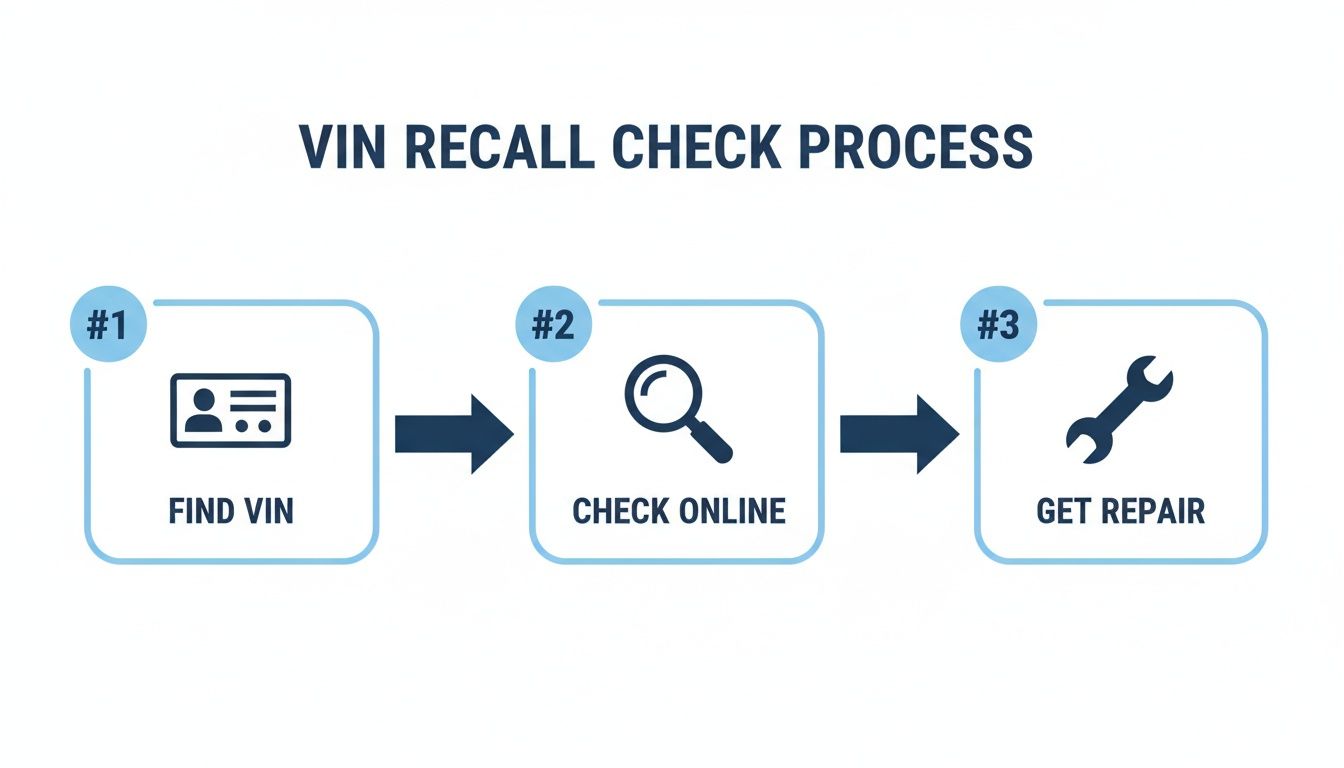
This simple three-step flow—find your VIN, check online, and get the repair—is a core part of responsible vehicle ownership and staying safe on the road.
Formally Report the Incident
Once you’re safe and have been checked out by a doctor, it’s time to create an official paper trail. This means formally reporting both the accident and the suspected defect.
- File a Police Report: Always get a police report. It provides a neutral, third-party account of what happened.
- Notify the Manufacturer: You need to contact General Motors and tell them about the accident and the specific part you believe failed on your 2013 Equinox. Keep a detailed log of every call—who you spoke to, the date, and what was discussed.
- File a Complaint with NHTSA: You can submit a vehicle safety complaint directly to the National Highway Traffic Safety Administration (NHTSA). This adds your experience to a national database, helping federal regulators spot dangerous trends that might trigger a wider investigation or recall.
Taking these steps methodically will give you the documentation and evidence needed to protect your rights. Each action builds a solid foundation, putting you in the best position to hold a manufacturer accountable for the harm caused by their defective product.
Understanding Your Legal Rights in Florida
If a defect in your 2013 Chevrolet Equinox has turned your life upside down, knowing your legal rights is the first, most crucial step. Florida’s laws are designed to protect people from dangerous products, but going up against a major auto manufacturer is no small feat. It’s about more than just filing a claim; it’s about holding a corporation accountable for the harm they’ve caused.
Let’s break down the key legal ideas you’ll encounter. Think of this as your roadmap for the journey ahead.
The Clock Is Ticking: The Statute of Limitations
In Florida, you don’t have forever to act. There’s a strict legal deadline known as the statute of limitations. For most product liability and personal injury claims, you typically have just two years from the date you knew—or reasonably should have known—about your injury to file a lawsuit.
Miss that window, and the courthouse doors will likely be closed to you for good, regardless of how strong your case is. This is why it’s so critical to move quickly after an accident. To get a deeper dive into these deadlines, check out our guide on the statute of limitations for a car accident in Florida.
How Florida Handles Shared Fault
Another concept you absolutely need to understand is Florida’s “modified comparative negligence” rule. What happens if you’re found to be a little bit at fault, too? This rule provides the answer. In plain English, your compensation can be reduced by your percentage of fault.
For instance, imagine a jury decides you were 10% at fault for the crash and awards you $100,000. Your final award would be cut by that 10%, so you’d receive $90,000. Here’s the critical part: if a jury finds you are more than 50% responsible, Florida law says you get nothing. Zero.
You can bet the manufacturer’s defense team will try to use this to their advantage by shifting as much blame as possible onto you. A detailed, independent investigation is the only way to counter this strategy.
Types of Damages You Can Recover
When you’ve been hurt by a defective vehicle, the law allows you to demand compensation—or “damages”—for everything you’ve lost. The goal is to make you as whole as possible, at least financially. These damages fall into two main buckets:
- Economic Damages: These are the straightforward, out-of-pocket costs. We’re talking about every dollar you’ve spent on medical bills (past and future), wages you’ve lost from missing work, and the cost to repair or replace your vehicle and other property.
- Non-Economic Damages: These are just as real, but they don’t come with a price tag. This is compensation for the human toll of the accident: your physical pain and suffering, emotional trauma, any permanent scarring or disability, and the loss of your ability to enjoy life the way you used to.
Proving the full scope of these damages isn’t easy. It takes meticulous records, expert testimony, and a clear understanding of how to value your suffering. Knowing these core legal principles will empower you to make the right decisions for you and your family.
How a Florida Auto Defect Lawyer Can Help
Trying to deal with the fallout from a crash caused by a faulty part in your 2013 Chevrolet Equinox can be overwhelming. The idea of taking on a giant like General Motors and their army of lawyers is enough to make anyone feel helpless. This is where having a skilled Florida auto defect lawyer in your corner can change everything.
Their job is so much more than just filing some papers. A good legal team will immediately kick off their own investigation into what happened. This goes way beyond the police report—we’re talking about bringing in accident reconstruction specialists and automotive engineers to figure out exactly what failed and prove that it was the root cause of your injuries.
Building a Powerful Case on Your Behalf
An attorney who has been down this road before knows precisely what kind of evidence is needed to build a rock-solid product liability case. They know how to connect the dots and show that one of the 2013 Chevrolet Equinox recalls, or perhaps another hidden defect, led directly to your accident. This often means digging deep into the SUV’s design blueprints, manufacturing history, and any internal records of similar problems.
Your legal team shoulders the entire burden of the complex legal fight, freeing you up to focus on what matters most: getting better. This includes:
- Securing the Evidence: Making sure your vehicle is impounded and preserved exactly as it was after the crash, before the manufacturer can get their hands on it.
- Handling All Communications: They become the buffer between you and the automaker’s legal team and their aggressive insurance adjusters.
- Calculating Your True Losses: They meticulously add up every single loss you’ve suffered, from mounting medical bills and lost paychecks to the cost of future care and the very real impact of pain and suffering.
The biggest advantage is that it levels the playing field. Automakers have nearly unlimited resources to downplay their responsibility. A qualified attorney has the experience and financial backing to push back against their tactics and fight for the full compensation you are owed.
No Upfront Cost, No Financial Risk
Worries about legal bills should never be a barrier to getting justice. Reputable auto defect lawyers in Florida operate on a contingency fee basis. What does that mean for you? You pay absolutely nothing out of your own pocket.
Your lawyer only gets paid if they win your case and recover money for you. This model removes all the financial risk from your shoulders, giving you access to high-quality legal help when you need it most. It also shows that your attorney is confident in your case and fully invested in seeing it through to a just conclusion.
If you were hurt in an accident involving a recalled 2013 Chevrolet Equinox, you don’t have to go through this alone. Contact Martin Hernandez, P.A. for a free, no-obligation consultation to understand your options by visiting the Injury Lawyers of Tampa website.