
If you own a 2013 Ford Edge, you need to know about some serious safety recalls. We’re not talking about minor glitches here; the issues involve dangerous defects like fuel leaks that can ignite engine fires and critical drivetrain failures that cause a total loss of power while you’re driving.
These aren’t just hypotheticals. For anyone navigating busy Florida highways like I-4 or I-75, these manufacturing flaws create an immediate and significant risk.
Understanding the Key Dangers of the 2013 Ford Edge Recall
Driving a 2013 Ford Edge means you have to be aware of safety issues that could turn a simple trip to the store into a life-threatening situation. Imagine merging onto a busy Tampa expressway only to have your SUV lose all power, or stalling without any warning in the middle of rush hour traffic.
These scenarios are real possibilities for owners of the affected vehicles. The recalls for this model year focus on problems that hit the core functions of the SUV, from the fuel system to the parts that actually make the wheels turn. Knowing what these risks are is the first step in keeping yourself and your family safe.
This diagram highlights the main threats you need to be aware of.
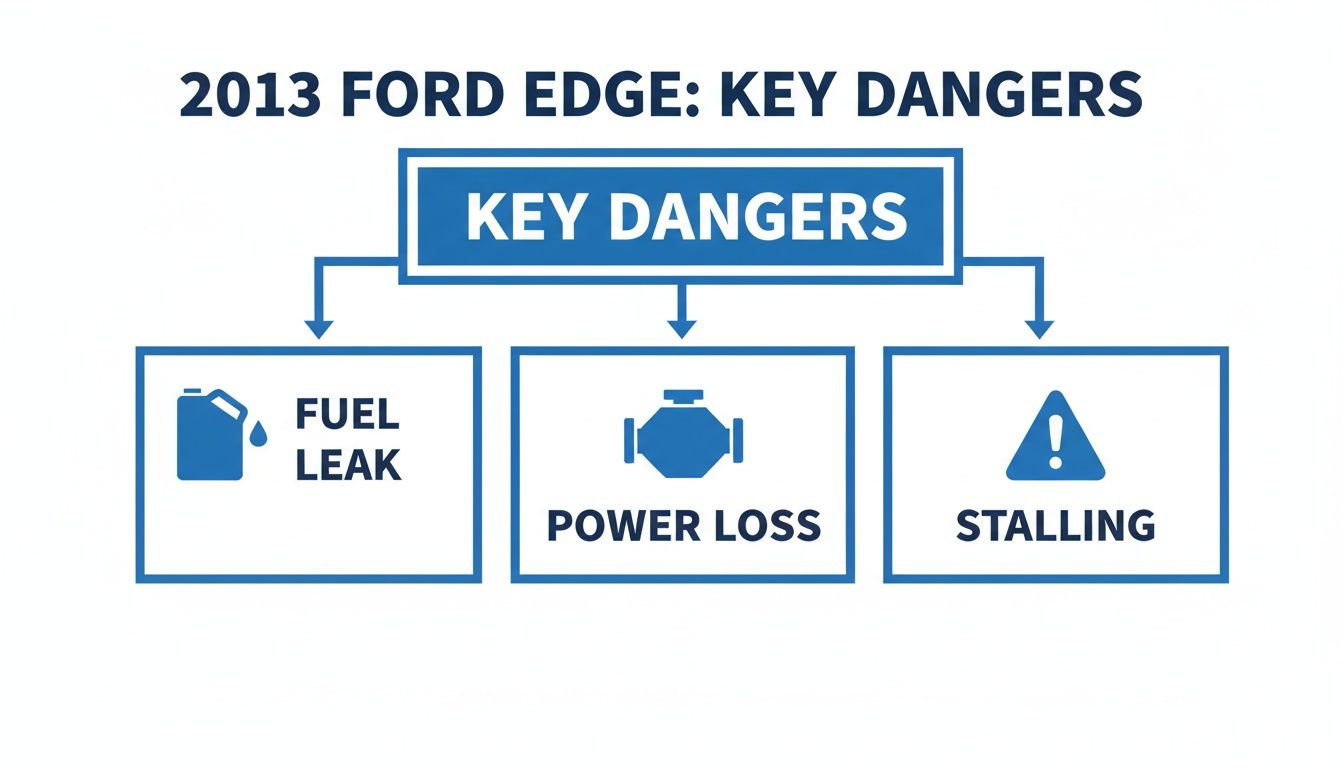
As you can see, the biggest dangers are fuel leaks, sudden power loss, and engine stalling—all of which can have catastrophic consequences.
The Risk of Sudden Mechanical Failure
One of the most alarming defects is with the vehicle’s halfshaft. This is the part that takes power from your transmission and delivers it to the wheels. If it fails, it’s like the chain snapping on your bicycle while you’re pedaling hard—all forward momentum is gone in an instant.
We’re not just talking about the engine sputtering. It’s a complete, immediate loss of acceleration that leaves you coasting. This issue, and others like it, make it absolutely critical for every 2013 Edge owner to check their recall status. While this model has its own unique problems, other Ford vehicles have faced major recalls, too. You can read more about a similar situation in our guide on the 2012 Ford Focus recall.
Why These Defects Are So Hazardous
The danger isn’t just one single part failing. A fuel leak, for example, is a ticking time bomb, especially with the high engine temperatures common in the Florida heat. A bad wiring harness can cause the engine to shut down out of nowhere, leaving you stranded and vulnerable on the road.
A recall is a formal notice from the manufacturer or the National Highway Traffic Safety Administration (NHTSA) that a vehicle has a safety-related defect. It’s their way of saying the car doesn’t meet minimum safety standards and that they have to provide a free fix for owners.
These aren’t just isolated reports; they’re documented patterns of failure that triggered official safety campaigns. Each recall is designed to fix a specific problem that could otherwise lead to a crash, an injury, or worse. The main issues boil down to:
- Fuel Leaks: A component in the fuel line can crack, leaking gasoline vapor or raw fuel right next to a hot engine—a perfect recipe for a fire.
- Sudden Power Loss: A key drivetrain part can literally pop out of place without warning, causing the vehicle to lose all ability to accelerate.
- Unpredictable Stalling: Bad wiring can send confusing signals to the engine’s computer, making it hesitate or completely shut down while you’re on the move.
The Fuel Line Fire Hazard
Of all the problems linked to the 2013 Ford Edge, the risk of an engine fire is easily the most terrifying. This isn’t just some theoretical worst-case scenario; it’s a real danger caused by a specific manufacturing flaw that can turn an ordinary drive into a life-threatening emergency.
Picture this: you’re cruising down the highway, and suddenly, the sharp, unmistakable smell of gasoline fills the cabin. It’s a gut-wrenching moment and a clear signal that something is dangerously wrong under the hood. For many owners, that smell was the first warning of a critical fuel leak, a problem that puts the vehicle at an immediate risk of fire.

This particular defect is the reason for one of the most serious recalls affecting this popular SUV.
The Defect Explained: A Cracked Fuel Line
So, what exactly is going wrong? The problem is a small but critical part called the fuel line pulse damper, found in models with the 2.0L EcoBoost engine. You can think of this damper as a sort of shock absorber for your fuel system, keeping the gasoline flowing smoothly to the engine.
Unfortunately, a manufacturing mistake meant the metal housing on this part could develop tiny cracks over time.
Once cracked, highly flammable fuel and vapors can seep out directly into the engine bay—a hot, confined space full of potential ignition sources. It only takes one spark from an electrical component or contact with a searing-hot surface like the exhaust manifold to start a fire.
This is a huge safety issue, and it led to a major 2013 Ford Edge recall for vehicles with the 2.0L engine built between September 2, 2010, and April 25, 2013. This recall, officially known as 13S13, was launched on February 25, 2014.
What’s especially concerning is that this action actually superseded a previous recall. That means some vehicles that were supposedly already fixed were still at risk and needed to be brought in again.
Florida’s Heat: An Added Risk Factor
While a fuel leak is dangerous anywhere, Florida’s climate can pour gasoline on the fire, literally. The relentless heat and humidity can speed up the breakdown of rubber and plastic parts in any engine compartment.
When a fuel system is already weakened by a factory defect, the extra stress from high temperatures makes gasoline even more volatile. This turns a small leak into a much bigger hazard, which is why it’s so critical for Florida owners to get this checked out immediately.
The dangers of a faulty fuel system can’t be overstated. Good maintenance is your best defense, and that includes keeping a clean fuel system to avoid other problems down the road.
Ford is obligated to perform the recall repair at no cost to you. The fix involves replacing the entire fuel line with a stronger, redesigned part. Given how serious the fire risk is, this is not something you want to put off. In the meantime, brushing up on a few tips for preventing car fires is always a smart move.
Sudden Power Loss From a Disconnected Halfshaft
Imagine you’re merging onto I-4 during rush hour, and your SUV suddenly loses all power. The engine is still running, but pressing the gas does nothing. You’re now coasting, a sitting duck in fast-moving traffic. This terrifying scenario is a reality for some 2013 Ford Edge owners due to a serious mechanical flaw.
The problem stems from a tiny part with a big job: the halfshaft retention circlip. The halfshaft is essentially the axle that delivers power from your transmission to the wheels. That little circlip is supposed to act like a lock, holding the halfshaft firmly in place.

When the circlip fails or wasn’t installed correctly at the factory, the halfshaft can simply pop out of the transmission. There’s no warning—just an abrupt loss of power to the wheels. This defect is the focus of the 2013 Ford Edge recall 14S10.
Understanding the Risks and Affected Models
The danger doesn’t stop with losing power on the highway. A disconnected halfshaft creates a second, hidden risk when you park. The “Park” gear might not actually hold the vehicle, allowing it to roll away if it’s on even a slight incline and the parking brake isn’t set. This kind of serious defect isn’t isolated to Ford; other SUVs from that period have faced similar unexpected mechanical failures. For instance, you can read our guide on the 2012 GMC Acadia problems to see how widespread these issues can be.
This recall specifically targets 2012-2014 Ford Edge models built between September 2, 2010, and November 30, 2013.
The National Highway Traffic Safety Administration (NHTSA) flagged this issue because an unexpected loss of power dramatically increases the chance of a crash. Ford’s official remedy is to have dealers inspect the halfshafts on both sides and replace any components that aren’t properly seated or show wear.
Worryingly, NHTSA data shows that only about 75% of recalled vehicles ever get fixed. That means roughly 1 in 4 of these potentially dangerous Ford Edges could still be driving on Florida roads without the necessary repair.
Ford’s fix, which is performed at no cost to the owner, involves:
- A detailed inspection of the left and right halfshafts to check their seating.
- Replacing any halfshaft that has come loose or is damaged.
- Installing new, properly seated circlips to secure the connection.
Given how serious this defect is, it’s absolutely critical for anyone owning an Edge from these model years to get this inspection done immediately.
Engine Stalling Caused by Faulty Wiring
It’s not just the big mechanical parts that can fail; sometimes, the smallest electrical glitch can create the biggest danger. That’s exactly what happened with another major 2013 Ford Edge recall, this time involving the vehicle’s own nervous system: the wiring harness. This issue could cause the engine to sputter, hesitate, or even shut off completely without warning, turning the SUV into a serious hazard on the road.
Imagine trying to merge onto a busy highway, and just as you press the accelerator, your engine dies. That’s the frightening reality this defect created.
The problem comes down to a tiny, poorly made connection in a wire. Your car’s wiring harness is constantly sending messages between the engine and its brain, the powertrain control module (PCM). A bad connection, or a “splice,” is like static on the line—it garbles the message, and the PCM gets confused about what the engine is doing. This miscommunication can cause the PCM to make the wrong call, leading to a sudden stall that leaves you stranded and vulnerable.
How a Small Splice Creates a Major Danger
The heart of the issue is an improperly crimped splice in the wiring harness. When that connection isn’t solid, it sends scrambled signals to the PCM. The result? The engine can lose power or shut down completely while you’re driving, which skyrockets the risk of getting rear-ended or causing a much more severe accident.
What makes this defect so terrifying is its unpredictability. You could drive for weeks without a single problem, and then one day, the engine cuts out at the worst possible moment—like when you’re making a left turn across traffic.
This specific problem prompted Ford to issue recall 14S17-S1 back in January 2016. It covered 2012-2013 Ford Edge models with the 2.0L engine, specifically those built between September 2010 and April 2013. The faulty splices were sending bad data to the powertrain control module, creating engine hesitation or mid-drive stalls—a perfect recipe for a crash on any busy road. You can learn more about the dangers of faulty vehicle wiring from AutoSafety.org.
Ford’s fix for this 2013 Ford Edge recall requires a hands-on inspection and repair by a dealer. Here’s what their technicians are instructed to do:
- Find the specific wiring harness known to have the faulty splices.
- Test the connections to see if they are sending clean, correct signals.
- Repair the bad splice or replace the affected section of wiring to ensure the PCM gets a reliable signal.
Since this issue directly impacts your control over the vehicle, it’s absolutely critical to make sure this free repair has been done on your Edge. Your safety depends on it.
How to Check If Your Ford Edge Has an Open Recall

It’s one thing to hear about a 2013 Ford Edge recall; it’s another to know if the SUV sitting in your driveway is actually affected. Fortunately, you don’t have to guess. Finding out is simple, quick, and something every owner should do right away.
The key to it all is your car’s Vehicle Identification Number, or VIN. Think of it as your car’s fingerprint—a unique 17-character code that tells its entire story, including any outstanding safety issues.
You can easily find your VIN in a few spots. The most common place is on a small plate on the driver’s side of the dashboard, right where it meets the windshield. It’s also printed on a sticker inside the driver’s side doorjamb and listed on your car’s registration and insurance cards.
Using the NHTSA Recall Tool
With your VIN in hand, the most trustworthy place to check for recalls is the National Highway Traffic Safety Administration (NHTSA) website. It’s a government-run database, so you know the information is up-to-date and accurate.
Here’s the simple, step-by-step process:
- Go to the NHTSA Recall Website: Head over to the official lookup tool at NHTSA.gov/recalls.
- Enter Your VIN: Just type your 17-character VIN into the search box and hit the button.
- See Your Results: The site will immediately tell you if there are any open recalls on your vehicle. If you’re in the clear, you’ll see a message for “0 Unrepaired Recalls.”
If a recall does pop up for your 2013 Ford Edge, the website will break down the safety risk and explain the free fix the manufacturer is required to provide. This gives you all the information you need to take action.
What to Do If a Recall Is Found
If the NHTSA tool confirms an open recall on your Edge, the next step is to call your local Ford dealership. Let the service department know your vehicle has an outstanding recall and schedule a time to bring it in for the free repair.
Remember, federal law requires the automaker to fix the problem at no cost to you. This isn’t just a Ford policy; the process is the same for other manufacturers, too. For instance, owners would follow similar steps when checking for 2012 Chevrolet Equinox recalls. Don’t put it off—getting the repair done is a critical safety measure.
Your Legal Rights After an Accident in Florida
If a known defect in your 2013 Ford Edge caused an accident here in Florida, you’re suddenly dealing with a very complex legal situation. It’s a common misconception that a recall notice gets the manufacturer off the hook. That’s just not the case, especially if you were injured before you could get the repair done.
These situations fall under a specific area of law known as product liability. At its core, this legal principle says that companies have a duty to make sure the products they sell are reasonably safe for people to use. When a defect they know about—like a cracked halfshaft or a leaky fuel line—leads directly to a crash, they’ve likely failed in that duty.
Understanding Manufacturer Negligence
Even when a recall is active, Ford could still be held legally responsible for your damages. The heart of any potential case is proving their negligence. Essentially, you’d need to show that their failure to use proper care when designing or building the Edge was the direct cause of your injuries. It’s all about drawing a clear, undeniable line from the recalled part to the accident itself.
A critical part of any claim is knowing how to prove negligence and pin responsibility on a massive corporation. This isn’t simple. It takes a deep-dive investigation, often calling on accident reconstruction specialists and automotive engineers who can forensically analyze the part that failed.
In a product liability case, it’s not about proving you were a perfect driver. The focus is on the vehicle’s defect and whether it was a substantial factor in causing the accident and your resulting harm.
If you can establish that the company was negligent, you have the right to seek compensation for everything you’ve lost. This is about more than just a car; it’s about getting your life put back together after a traumatic event. You can dig deeper by reading our complete guide on auto safety recalls.
Types of Compensation You Can Pursue
Under Florida law, victims of these accidents can recover money for both their financial and personal losses. Let’s be clear: taking on a global automaker is a massive fight that demands serious resources and very specific legal expertise. That’s why having an experienced local Tampa personal injury lawyer by your side is so critical.
The compensation you could be entitled to may cover:
- Medical Expenses: Every penny related to your care, from the initial ambulance ride and ER visit to ongoing physical therapy and future medical needs.
- Lost Wages: Reimbursement for the paychecks you missed while recovering. If your injuries prevent you from returning to your old job, this can also include your lost future earning capacity.
- Pain and Suffering: This compensates you for the physical pain, emotional trauma, and overall loss of quality of life resulting from the crash.
- Property Damage: The full cost to either repair your 2013 Ford Edge or replace it if it was totaled, plus any other personal property destroyed in the accident.
Frequently Asked Questions
When you hear about a 2013 Ford Edge recall, it’s natural to have a few questions. Let’s walk through some of the most common concerns we hear from owners.
Do I Have to Pay for Recall Repairs on My 2013 Ford Edge?
Absolutely not. Under federal law, the manufacturer is required to cover the full cost of any safety recall repair. That means no charge for parts, no charge for labor.
If you take your Edge to a Ford dealership for a recall fix and they try to hand you a bill, you should refuse to pay. Your next step should be to contact Ford’s corporate customer service line directly and report the incident. It’s also a good idea to file a complaint with the National Highway Traffic Safety Administration (NHTSA) to hold that dealership accountable.
Is My Used 2013 Ford Edge Covered by the Recall?
Yes, it is. Safety recalls are tied to the vehicle itself, specifically its Vehicle Identification Number (VIN), not to who owns it. It doesn’t matter if you’re the first owner or the fifth—if your VIN is part of an active recall, you have the right to the same free repair as everyone else.
This is why it’s so important to run a quick check using the NHTSA’s online lookup tool before buying any used vehicle. It gives you immediate peace of mind.
What if an Accident Was Caused by a Recall Defect?
If you suspect a recalled part is what caused your accident, your first and most important priority is getting medical help for anyone who needs it. After that, it’s all about preserving evidence.
Try to take clear photos of the accident scene, the position of the vehicles, and the specific damage to your car. It’s also wise to hold off on giving any recorded statements to an insurance adjuster until you’ve had a chance to speak with an attorney.
In Florida, you may have a solid product liability claim against the manufacturer. A personal injury attorney who has experience with these kinds of cases can dig into the details of the crash, work to prove the link between the defect and your injuries, and make sure your rights are protected.
If a faulty component in your 2013 Ford Edge caused an accident, you shouldn’t have to carry the burden alone. The legal team at Martin Hernandez, P.A. focuses on helping injury victims in Tampa hold large manufacturers accountable.
Reach out to us for a free, no-obligation consultation to explore your legal options at https://injurylawyersoftampa.com.