
If you own a 2013 Ford Focus, you need to know that this model year has seen some serious safety recalls. These aren’t just minor annoyances; they involve critical parts like door latches and the engine itself. Both Ford and the National Highway Traffic Safety Administration (NHTSA) have flagged these problems, which can lead to incredibly dangerous situations, like doors flying open on the highway or the engine cutting out in traffic.
Key Safety Issues for 2013 Ford Focus Owners
For anyone driving a 2013 Focus, getting a handle on these recalls is about more than just upkeep—it’s about keeping yourself and your passengers safe. This particular model year has a history of defects that can put you in harm’s way. The sheer scope of the 2013 Ford Focus recalls suggests some real underlying issues with how these cars were built, compromising their basic safety.
Think about it for a second. You’re cruising down the interstate, and suddenly a door swings open. Or you’re navigating a busy intersection, and your engine just dies without warning. These aren’t far-fetched scenarios; they’re the real-world consequences of the documented failures in these vehicles. That’s why it’s absolutely critical for every single owner to check if their car is affected.
Major Areas of Concern
When you look at the recall history, a few key problem areas keep popping up again and again. They fall into three main buckets:
- Faulty Door Latches: This is a big one. A component inside the latch can break, making it impossible to close a door properly. Worse, it can cause a door that seems secure to suddenly unlatch while the car is moving.
- Engine and Fuel System Flaws: We’ve seen a range of issues here, from deformed fuel tanks to bad wiring harnesses. The end result is often the same: a sudden loss of engine power, which is a massive hazard no matter your speed.
- Defective Wiring: Shoddy electrical components can interrupt the signals that your car’s computer needs to run the engine and other safety systems. When those signals get scrambled, things can fail right when you need them most.
This concept map gives you a good visual of how these different problems connect and create a web of risk for drivers.
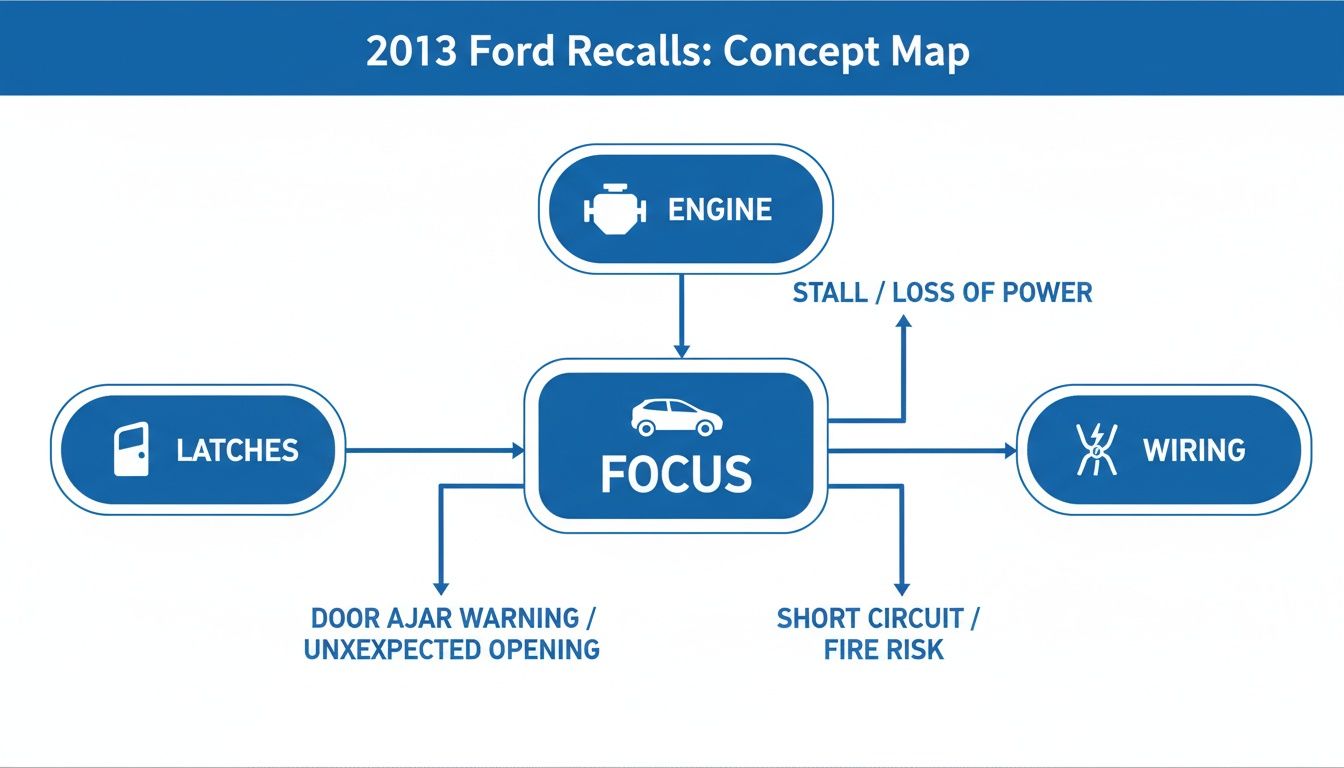
As you can see, the failures in the latches, engine, and wiring aren’t isolated incidents—they form a pattern of serious safety risks. To get a better sense of how recalls work in general, you can learn more about the broader landscape of vehicle defects in our guide on auto safety recalls. We’ll dive into the specifics of each of these Focus recalls next.
The Dangerous Defect of Failing Door Latches
Of all the issues plaguing the 2013 Ford Focus, one of the most widespread and genuinely frightening recalls involves the door latches. Picture this: you’re driving down the highway, hit an unexpected bump, and suddenly a door swings wide open. It sounds like a scene from a movie, but for hundreds of thousands of Ford owners, it was a terrifyingly real possibility.
The problem wasn’t the whole door, but one tiny part deep inside the latch mechanism. A component called the pawl spring tab had a nasty habit of breaking. When that little piece fractures, the whole latch is compromised. That means your door might not close securely in the first place, or far worse, it could fly open while you’re driving.
This defect became so common that Ford had to launch a massive recall, which you can find under NHTSA Campaign Number 20V177000. This wasn’t a one-off event; it was an expansion of earlier recalls, eventually sweeping up over 2.1 million vehicles, including the 2013 Focus. The sheer number of cars involved speaks volumes about how serious and common this failure was.
Warning Signs of a Failing Latch
A bad door latch doesn’t always fail catastrophically right away. Usually, there are warning signs that something is wrong. Catching them early could prevent a dangerous situation on the road.
Be on high alert if you notice any of these red flags:
- Trouble Closing the Door: Do you have to slam a door two or three times just to get it to catch? That’s a classic sign.
- “Door Ajar” Light Stays On: If that little light on your dash won’t go off, even when you’re certain every door is shut tight, the car’s sensor isn’t detecting a secure latch.
- Doors Rebound Open: You close the door, it seems to latch, but then it pops back to the first ‘click’ or a partially unlatched position.
- Rattling From the Door: Any unusual clicking or rattling noises coming from inside the door while you’re driving could mean the latch assembly is loose or has broken parts.
This isn’t just some minor annoyance. It’s a complete failure of a core safety system. A door you can’t trust to stay shut creates a serious risk of someone being ejected from the car in a crash or even just a sharp turn.
If you’re curious about the mechanics of how these latches work, this DIY Car Door Latch Replacement Guide offers a great look inside the door panel. Of course, working door latches are just one piece of the puzzle. For a more complete picture, check out our guide on what safety features you should look for when buying a car.
Engine Stalling Risks From Fuel System and Wiring Flaws
A door flying open is a terrifying thought, but an engine that suddenly dies in the middle of traffic is just as dangerous. A significant number of 2013 Ford Focus recalls zero in on serious flaws in the fuel system and engine wiring, creating situations where drivers could lose all power without a moment’s notice. These aren’t minor mechanical glitches; they’re defects that can turn an ordinary drive into a life-threatening event.
Imagine you’re cruising down a busy Tampa highway in your 2013 Focus. The engine suddenly cuts out, leaving you powerless and stranded in moving traffic. This nightmare scenario became a reality for hundreds of thousands of owners due to a massive fuel system recall.
In 2019, Ford announced one of its largest recalls, covering a staggering 1,282,956 vehicles in the U.S. from the 2012-2018 Focus lineup. The root cause was a defective fuel tank that could crack or deform, leading to stalling, rough idling, and a fuel gauge that jumped all over the place. You can read more about this widespread recall on Car and Driver.
This problem was often linked to another faulty component—the canister purge valve—which delivered a one-two punch of trouble for owners.
The Fuel Tank Deformation Problem
This fuel system defect is a classic case of how one small, poorly designed part can set off a chain reaction of dangerous failures. The issue starts with the canister purge valve (CPV), a component responsible for managing fuel vapors. When this valve gets stuck in the open position, it creates a powerful vacuum inside the fuel tank.
Think about what happens when you suck the air out of a plastic water bottle—it collapses and crumples under the pressure. That’s exactly what was happening to the fuel tanks in these Ford Focus models. This deformation led to several serious symptoms:
- Sudden Engine Stalling: A warped tank can mess with the fuel flow to the engine, causing it to shut down abruptly, sometimes even at highway speeds.
- Inaccurate Fuel Gauge: As the tank deforms, it can damage or move the fuel level sensor, making the gauge completely unreliable. You might think you have half a tank left when you’re actually running on fumes.
- Check Engine Light: A malfunctioning CPV will almost certainly trigger the check engine light, warning you that something is wrong under the hood.
A stalling vehicle is incredibly dangerous because you instantly lose power steering and braking assistance, making it extremely difficult to control the car and pull over safely. These symptoms echo some of the issues found in other model years. You can learn more about similar problems in our article on the 2012 Ford Focus recall.
Faulty Engine Wiring in ST Models
On top of the widespread fuel system recall, a separate and equally dangerous defect plagued the high-performance 2013 Focus ST models. This time, the problem was electrical, traced back to poorly made splices in the engine’s wiring harness.
Think of it like a bad phone connection during an important call. These faulty splices would interrupt the vital signals traveling between the engine’s sensors and its main computer, the Powertrain Control Module (PCM). Crucial information was getting lost in the static.
When the PCM lost contact with key sensors, the engine could stumble, hesitate, or stall out completely with no warning. For someone driving a performance car like the ST, a sudden loss of power while accelerating or taking a corner could easily cause them to lose control.
Other Critical Recalls Beyond Doors and Stalls
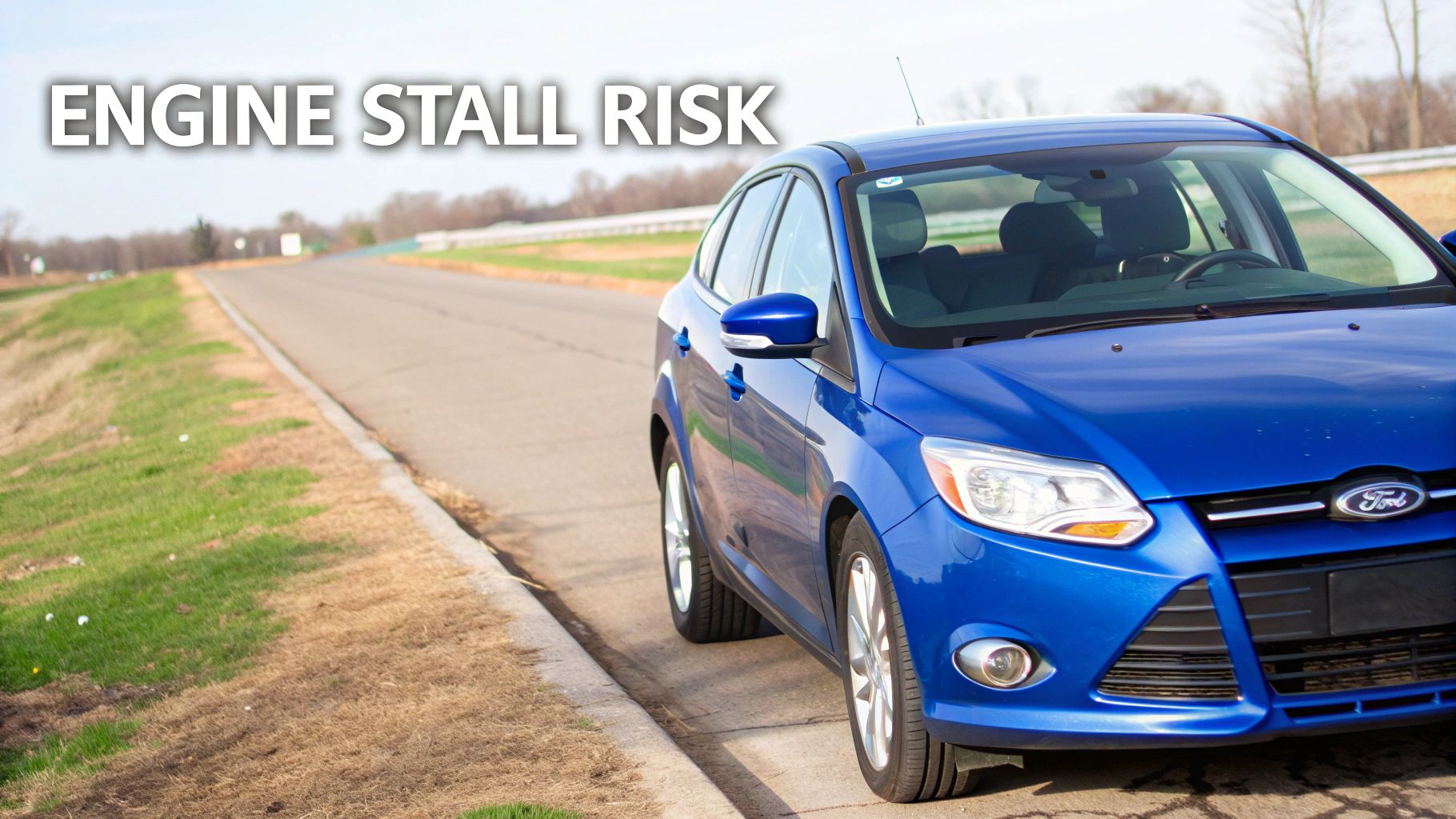
While the door latch and engine stall problems got most of the media attention, they weren’t the only serious issues plaguing the 2013 Ford Focus. Dig a little deeper, and you’ll find a pattern of safety failures in other critical systems, each one creating its own unique danger for drivers.
One of the most terrifying defects involved the side-curtain airbag inflators. In a crash, you count on those airbags to protect you. But a flaw in these inflators meant they could rupture when deploying, blasting metal fragments through the car like shrapnel.
Suddenly, the very device meant to save your life becomes a weapon. This chilling possibility highlights why it’s so important to check every single recall notice, not just the ones that make the evening news.
Transmission and Wiring Nightmares
The powertrain was another major source of headaches. A massive recall targeted the Transmission Control Module (TCM)—the computer that tells the automatic transmission when to shift gears. When the TCM failed, drivers experienced erratic shifting, a total loss of power, or found themselves unable to even get the car out of park.
Just imagine pulling onto a highway and having your transmission give out, leaving you dead in the water. That loss of control is a recurring theme across many 2013 Ford Focus recalls.
Another serious problem hit the 2013 Ford Focus ST hatchback models. A flaw in the engine wiring could cut power or stall the car without warning. This led to a recall covering around 160,000 vehicles, including some Ford Escapes. The culprit was a faulty wiring harness that messed with the signals sent to the engine’s computer. A momentary stall on a busy Florida bridge could easily turn catastrophic. You can find more details on how these wiring problems prompted a major Ford recall.
The sheer variety of these defects—from airbags and transmissions to specific engine wiring—paints a troubling picture. It shows that the safety issues with the 2013 Ford Focus were not isolated to a single component but were present across multiple vehicle systems.
Each of these recalls underscores just how critical it is for owners to be proactive. You can’t just wait for a warning light to pop up, because by then, it could be too late. The problems in the Focus weren’t unique, either; similar safety concerns affected other Fords from that era. For comparison, take a look at our guide to the 2013 Ford Edge recall.
How to Check if Your Ford Focus Has an Open Recall
Figuring out if your specific vehicle is caught up in the numerous 2013 Ford Focus recalls is something every owner should do, and thankfully, it’s a pretty painless process. It all boils down to one critical piece of information: your car’s Vehicle Identification Number (VIN).
Think of the VIN as your car’s unique fingerprint. This 17-character code holds all the key details about when and where your car was built, which is exactly what’s needed to flag it for a recall.
Finding Your Vehicle Identification Number
You won’t have to tear your car apart to find the VIN. Ford puts it in a few easy-to-spot places.
- On the Car Itself: The easiest place to look is through the windshield on the driver’s side. You’ll see a small metal plate on the dashboard with the number stamped on it. Another sure-fire spot is the sticker inside the driver’s side doorjamb.
- On Your Documents: Your VIN is also printed on all your important paperwork, like your vehicle’s title, registration card, and even your auto insurance policy.
Once you have that number jotted down, you’re ready to run a free, instant recall check.
Using Official Online Tools for a Recall Search
With your VIN in hand, you have two primary, completely reliable resources at your fingertips. Both the federal government and Ford itself offer official lookup tools that take just a few seconds to use.
- NHTSA Recall Website: Head over to the National Highway Traffic Safety Administration’s recall page and pop in your 17-digit VIN. This government-run database is comprehensive and will show you any open recall from any manufacturer, not just Ford. It’s the gold standard for recall info.
- Ford’s Official Recall Site: You can also check directly with the source by visiting Ford’s owner website. Entering your VIN there will pull up recall information specific to Ford’s campaigns and sometimes provides extra details straight from the manufacturer.
After you enter your VIN, the system will instantly tell you if there are any “unrepaired” recalls. A result of “0 unrepaired recalls” means you’re in the clear. If a recall does pop up, your next move is simple: call your local Ford dealership right away to schedule the free repair.
Staying on top of recalls is a crucial part of responsible car ownership. You can learn more by checking out our guide to auto reviews and consumer reports.
Understanding Your Legal Options After an Accident in Florida
It’s one thing to deal with the hassle of a recall. It’s another thing entirely if one of the 2013 Ford Focus recalls led to a crash that hurt you or someone you love. The shock, the medical worries, and the sudden pile of bills can feel completely overwhelming. But here in Florida, you have the right to hold a car manufacturer accountable for selling a dangerous vehicle.
This is a specific area of law called product liability. The core idea is simple: the companies that design, make, and sell products are responsible for making sure they’re reasonably safe. If a known problem, like a door that flies open or an engine that quits in traffic, causes an accident, the manufacturer can be held liable for the damage.
Proving a Defect Caused Your Crash
This is where things get tricky. To have a valid claim, you can’t just point to the recall notice. You have to prove a direct link—that the specific recalled part failed in your car and directly caused the crash and your injuries.
Building that case starts the moment the accident is over. What you do next is absolutely critical.
- Preserve the Vehicle: This is your most important piece of evidence. Don’t let the insurance company junk it or send it to a body shop right away. An expert needs to examine the car to pinpoint the failure.
- Document Everything: Get photos of the crash scene, the damage to your car, and any visible injuries. Start a folder for every medical bill, receipt, and doctor’s note.
- Get Medical Care Immediately: Don’t wait. Having a medical record created right after the accident is essential for connecting your injuries to the crash itself.
As you sort through the chaos after a crash, it’s crucial to know the legal obligations after a car accident in Florida. Following these steps doesn’t just keep you on the right side of the law; it protects your ability to pursue a claim later on.
The Role of a Florida Personal Injury Attorney
Let’s be honest: taking on a giant automaker by yourself is a battle you can’t win. They have teams of lawyers on their side. A Florida personal injury attorney who has experience with product liability cases is the advocate you need in your corner.
An experienced lawyer manages all the heavy lifting. They’ll bring in accident reconstruction experts to prove the defect was the cause and work with medical and financial specialists to calculate the true cost of your injuries. Their goal is to fight for the compensation you deserve for medical bills, lost income, and the pain and suffering this ordeal has caused, giving you the resources you need to focus on recovery.
Frequently Asked Questions About 2013 Ford Focus Recalls
Trying to make sense of the 2013 Ford Focus recalls can be confusing, and it’s natural to have a lot of questions. Below, we’ve answered some of the most common concerns owners have when dealing with repairs and figuring out their next steps.
What Should I Do If a Dealer Cannot Fix My Recalled Focus Yet?
This is a frustratingly common scenario. If a dealership tells you they can’t complete the recall work because parts aren’t available, the first thing you should do is document everything.
Get the name of the person you spoke with, the date of your conversation, and ask them for an estimated timeframe for when the parts will arrive. If the recall involves a serious safety problem, press the issue—ask if Ford is providing a loaner car until yours can be fixed.
Most importantly, if the defect makes your Focus unsafe to drive, don’t risk it. Park the car. If an accident happens because of that known defect before the repair is done, you may still have a strong legal claim.
Can I Take Legal Action If My Car Has the Defect But Is Not on the Recall List?
Yes, you often can. A recall notice is an automaker’s way of acknowledging a widespread problem, but the list of included vehicles isn’t always complete.
If your Focus suffers from the exact same issue described in a recall—like a door flying open or the engine stalling out of nowhere—and it causes an accident, you could have a solid product liability case, even if your specific VIN wasn’t flagged.
A recall is essentially an admission that a defect exists. A skilled Florida attorney can investigate whether the failure in your vehicle matches that known flaw, helping to build your case regardless of its official recall status.
Do I Have to Pay for Recall Repairs on My 2013 Ford Focus?
No, you absolutely should not pay a dime. Federal law is crystal clear on this: automakers are required to fix safety recall issues completely free of charge to the owner. This includes both the parts and the labor involved.
If a dealership ever tries to bill you for work related to a safety recall, refuse to pay. You should immediately report the dealership to Ford’s corporate customer service and file a complaint with the National Highway Traffic Safety Administration (NHTSA).
If you or a loved one were injured in an accident caused by a defect in a 2013 Ford Focus, you have legal rights. The team at Martin Hernandez, P.A. focuses on helping Florida accident victims hold manufacturers accountable for their negligence. Contact us for a free, no-obligation consultation to discuss your options at https://injurylawyersoftampa.com.