
When you hear the term “5-point restraint,” you’re looking at a safety harness designed to lock a person in at five key points, a design that drastically cuts down on injury risk in a crash. You’ll mostly see this system in child car seats and professional race cars, and for good reason—it offers superior protection by spreading the intense force of an impact across the strongest parts of the body.
How Does a 5-Point Restraint System Work?
Think of it as a protective web. During the chaos of a car accident, this harness is built to hold you tight and secure. It’s a significant upgrade from the standard 3-point seatbelt in most passenger cars, creating a much more comprehensive safety net.
The name gives away its design. The system uses five distinct straps that all click into a single buckle, anchoring the person firmly into their seat.
The five points of contact are:
- Two Shoulder Straps: One over each shoulder, pressing the upper body securely against the seat.
- Two Lap Straps: These cross over the hips, holding the lower body down and back.
- One Crotch Strap: This single strap comes up between the legs to keep the person from sliding down and under the lap belt—an action terrifyingly known as “submarining.”
This design is no accident. By fastening the body at the shoulders and hips, which are some of the strongest parts of our skeletal structure, the 5-point restraint directs the brutal energy of a crash away from vulnerable areas like the abdomen and neck. This is critical for preventing severe internal damage, spinal injuries, or being thrown from the vehicle.
The Best Protection for the Most Vulnerable
A normal 3-point seatbelt does a good job for most adults, but it falls short for people with smaller, still-developing bodies or for anyone facing the extreme G-forces of racing. In these high-stakes situations, the 5-point restraint is the undisputed gold standard.
For parents here in Florida, figuring out which car seat should my child be in is one of the most important safety decisions you’ll make.
The system’s real magic lies in its ability to minimize movement. For infants and toddlers, whose bodies are incredibly fragile, this level of security isn’t just a feature; it’s an absolute necessity. Of course, as kids grow, their needs change. It’s also helpful to understand what is a booster seat and its safety rules for when your child eventually outgrows their 5-point harness.
How a 5-Point Harness Provides Superior Protection in a Crash
When a car crashes, physics takes over in a brutal and unforgiving way. The real difference between a standard 3-point seatbelt and a 5-point harness comes down to how each one controls your body’s violent forward momentum. While a 3-point belt does a good job for most adults by holding the hips and one shoulder, it still allows for a surprising amount of dangerous movement.
In stark contrast, a 5-point harness creates a “ride-down” effect. This simply means it locks the occupant so securely to the vehicle’s frame that they slow down at almost the same rate as the car itself. This connection is crucial because it dramatically lessens the violent jolt on your internal organs and skeleton.
Preventing Dangerous Twisting and Sliding
One of the biggest safety leaps is how the harness stops torso rotation. During a side-impact or angled frontal crash, a 3-point belt can let your upper body twist violently around that single shoulder strap, leading to devastating spinal, neck, and internal injuries. The dual shoulder straps of a 5-point system keep the torso flush against the seat, completely preventing this kind of dangerous twisting.
Another life-threatening risk, especially for children, is “submarining.” This is when a person slides forward and down under the lap belt in a head-on collision. The crotch strap on a 5-point harness makes submarining practically impossible, anchoring the pelvis firmly in place.
By securing the body at the shoulders, hips, and between the legs, a 5-point harness spreads the massive forces of a crash across the strongest parts of the body. This shields the vulnerable abdomen and spine from absorbing a concentrated, catastrophic impact.
This diagram shows how all the straps come together to create a web of protection.
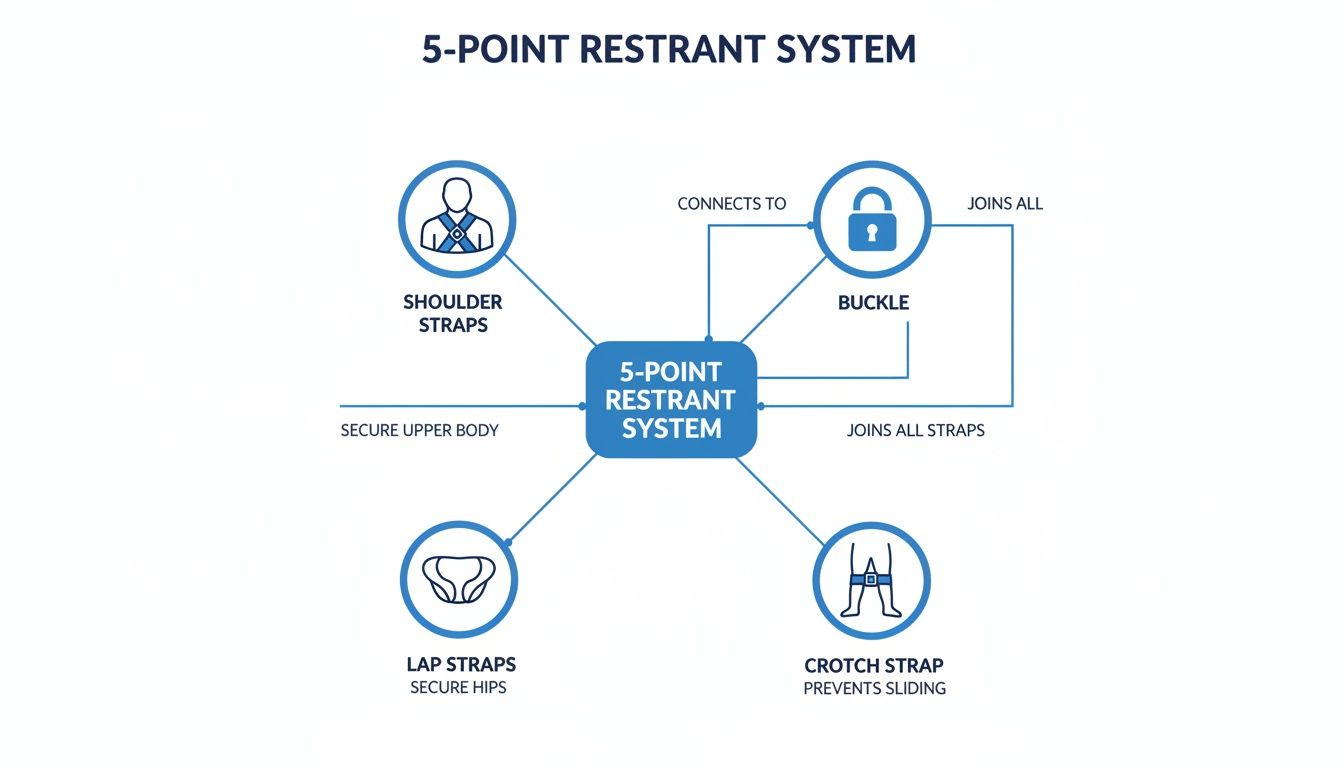
You can see how the central buckle acts as the heart of the system, locking the shoulder, lap, and crotch straps into one cohesive unit.
Safety Feature Comparison 3-Point vs 5-Point Restraint
To truly grasp the difference, it helps to see the features side-by-side.
3-Point Seatbelt (Standard in Cars)
- Force Distribution: Concentrates forces on the collarbone, chest, and pelvis.
- Torso Rotation: Allows significant upper body twisting, risking spine and internal injuries.
- “Submarining” Risk: High risk of sliding under the lap belt, especially for smaller occupants.
- Ejection Prevention: Good, but ejection is still possible in severe rollovers or side impacts.
- Body Containment: Allows for more head and limb movement, increasing the risk of secondary impact.
5-Point Restraint (Child Seats/Racing)
- Force Distribution: Spreads forces across the shoulders, hips, and crotch—the body’s strongest points.
- Torso Rotation: Prevents torso rotation, keeping the occupant square against the seat.
- “Submarining” Risk: Virtually eliminates submarining with an integrated crotch strap.
- Ejection Prevention: Offers the highest level of protection against ejection in all crash types.
- Body Containment: Keeps the entire body securely contained within the seat’s protective shell.
As you can see, while a 3-point belt is a proven lifesaver, the 5-point system offers a fundamentally higher level of security by controlling the body in ways a standard seatbelt simply can’t.
Real-World Scenarios in Florida
Picture a sudden, high-speed collision on Tampa’s I-4. With a 3-point belt, a passenger could be thrown forward and sideways, their head easily hitting the window or dashboard. A child buckled into a proper 5-point harness, however, would remain held firmly in their seat as the crash forces are absorbed by the harness and the safety seat’s structure.
Now, think about a rollover crash on a slick, rain-soaked Florida highway. The single greatest danger here is being ejected from the vehicle—an event that is almost always fatal. The 5-point harness is engineered specifically to stop this from happening, holding the occupant securely inside the car’s protective frame no matter how it tumbles.
Knowing these differences is a key part of road safety. You can find more details in our guide on what safety features you should look for in buying a car. This unmatched level of containment is exactly why these systems are mandatory for child car seats and in every professional race car.
Where You’ll Find 5-Point Restraints in Florida
A 5-point restraint might sound like something you’d only see in a fighter jet, but its two most common uses are part of everyday life for many Florida families and racing fans. The system is the absolute gold standard when maximum protection is the top priority, which is why you see them in child car seats and performance race cars.
In both of these very different worlds, the mission is identical: to hold a person securely against crash forces that would overwhelm a regular seatbelt.
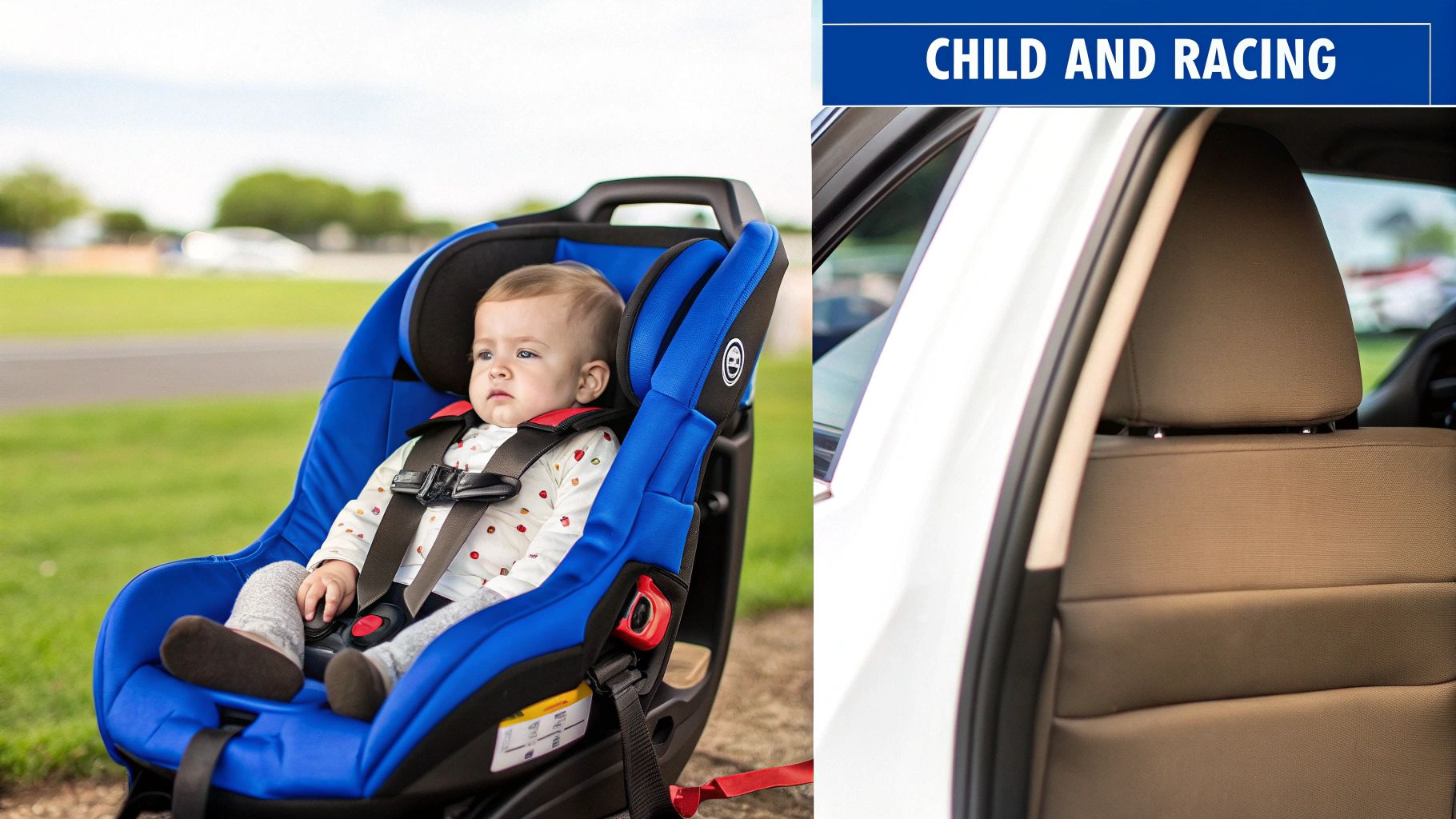
For millions of parents across Florida, buckling a 5-point restraint is a daily routine. There’s a good reason state law requires specific restraints for kids—a child’s body is incredibly vulnerable in a crash. This type of harness is specifically designed to protect small children whose skeletons aren’t yet strong enough to handle the concentrated force of a standard 3-point seatbelt.
Keeping Florida’s Smallest Passengers Safe
Under Florida law, children must ride in a federally approved child restraint until they’re big enough for a booster seat. For babies and toddlers, that means a car seat with a 5-point harness. But just having the right seat isn’t enough; using it correctly is what truly saves lives.
Getting the installation and harnessing right is everything. Two simple checks can tell you if your child is secure:
- The Pinch Test: Once your child is buckled in, try to pinch a horizontal fold of the strap at their collarbone. If you can grab any extra webbing, the harness is too loose. Tighten it until the straps are snug against their body.
- Chest Clip at Armpit Level: The chest clip is a positioning device. It needs to be right at your child’s armpit level. If it’s too low, the shoulder straps can slide off during a crash. Too high, and it becomes a throat hazard.
When used the right way, a 5-point harness in a car seat dramatically cuts the risk of ejection and spreads the force of a crash across the strongest parts of a child’s body—their chest and hips—to protect their fragile organs and developing spine.
High-Speed Protection on the Racetrack
Step away from the family minivan and onto the racetrack, and you’ll find the 5-point restraint is non-negotiable safety gear. At tracks all over Florida, from local drag strips to professional circuits like Sebring, drivers depend on these harnesses. They’re essential for staying locked in place against the extreme G-forces of hard acceleration, braking, and cornering at incredible speeds.
In a racing environment, a standard seatbelt would be completely useless and incredibly dangerous. The 5-point harness essentially makes the driver part of the car, giving them the stability needed to maintain control under intense physical stress. This secure connection is crucial for performance and, more importantly, for walking away from the high-impact wrecks that are always a risk in motorsports.
When a Safety Device Fails or Is Used Incorrectly
A safety system is only as good as its installation and its condition. This is especially true for a 5-point restraint. When it’s used incorrectly or malfunctions in a crash, it can become a source of real danger, and for children, the consequences of a simple mistake can be devastating.
The hard truth is that a staggering number of child car seats are not installed or used the right way. Even the most careful parents can make small mistakes that completely undermine how the harness works, turning a shield into a risk.
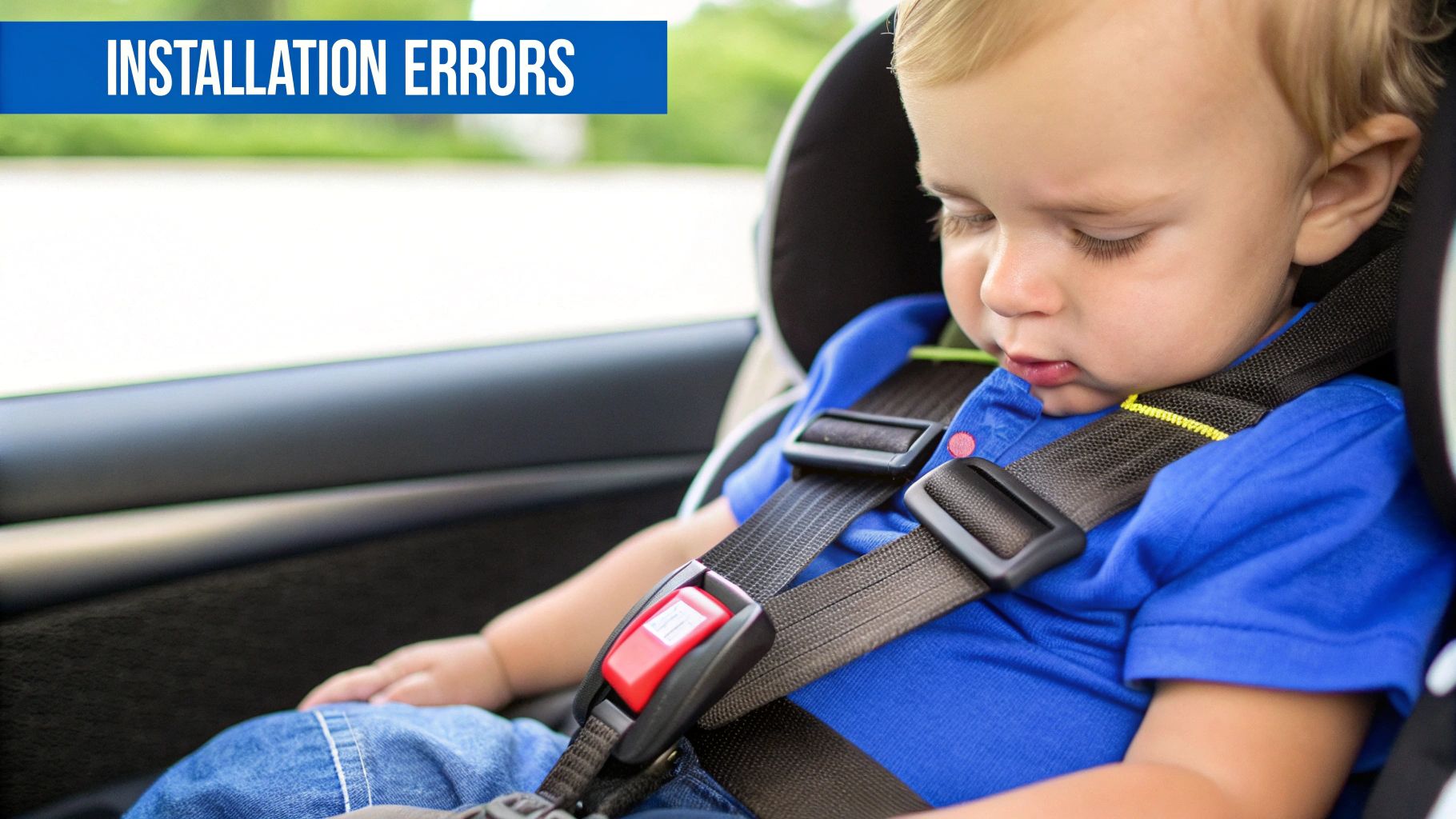
Common But Dangerous Installation Errors
It’s often the little mistakes—the ones that go unnoticed in the daily rush—that lead to catastrophic failure in an accident. These errors can cause severe injuries that the restraint was specifically designed to prevent.
Here are some of the most frequent and dangerous mistakes we see:
- Loose Harness Straps: If you can pinch a horizontal fold of webbing at your child’s collarbone, the straps are too loose. This slack, often caused by puffy winter coats, can be enough for a child to be thrown from their seat in a collision.
- Improper Recline Angle: The recline angle is crucial, especially for infants. If it’s too upright, their head can flop forward and block their airway. If it’s too reclined, it won’t absorb impact forces correctly.
- Using an Expired or Damaged Seat: Many people don’t realize car seats have expiration dates. The plastic breaks down over time and becomes brittle. A seat that has been through even a minor crash might have hidden damage and should always be replaced.
When a 5-point restraint is compromised by misuse, a child is left vulnerable to the most severe types of harm in a crash. The body can be thrown violently against the car’s interior, leading to traumatic brain injuries, neck fractures, and permanent spinal cord damage.
When the Product Itself Is the Problem
But what if you did everything right? Sometimes, the problem isn’t user error; it’s the product itself. A defect in the 5-point restraint system can cause it to fail at the worst possible moment.
We’ve seen cases involving buckles that pop open under force, straps made from cheap materials that tear, or anchors that simply break away. When this happens, the manufacturer could be held liable for the injuries that result.
Proving a product defect isn’t simple—it often requires expert analysis and a deep dive into the evidence. You can learn more about how these cases work by reading our guide on auto safety recalls. Figuring out whether an injury was caused by misuse or a defective product is one of the most important steps in any Florida personal injury claim.
The Hidden Risks of Post-Accident Medical Restraints
You’ve survived a car crash, but the ordeal isn’t always over when you reach the hospital. Shockingly, another danger can arise right where you expect to be safest. While a 5 point restraint is a lifesaver in a car, a similar device used in a medical setting can cause serious, unintended harm, especially when a patient is confused and disoriented after an accident.
Think about it: after a major collision, a victim might be dealing with a traumatic brain injury, shock, or severe emotional distress. In this state of confusion, medical staff may use physical restraints to stop a patient from accidentally hurting themselves—like pulling out an IV or falling out of bed. The intention is to protect, but this action carries significant risks of its own.
When Protection Becomes a Danger
Using medical restraints on a patient isn’t a decision to be taken lightly; it’s governed by a strict standard of care. If they’re put on incorrectly, left on for too long, or used when they aren’t truly necessary, they can cause new injuries or make the ones from the crash even worse. This is a crucial point, as it can transform a straightforward personal injury case into one involving medical negligence.
The statistics are eye-opening. A major study revealed that about 6% of adult hospital patients are placed in physical restraints. The results were startling: restrained patients were far more likely to suffer falls (22.5% vs. just 2.7%) and had a much higher mortality rate (13.3% vs. 5.1%) compared to patients who were not restrained. If you want to dig deeper, you can read the full research about these hospital restraint findings to see the data for yourself.
Improperly used medical restraints can lead to severe complications, including pressure sores, nerve damage, restricted blood flow, and increased psychological trauma. For a crash victim already in a fragile state, these additional injuries can be devastating.
When a doctor or hospital’s actions fail to meet the accepted standard of care and cause a patient harm, it can become the grounds for a completely separate legal claim.
Identifying Medical Negligence
Figuring out the difference between a necessary medical step and outright negligence takes a close look at the facts. To determine if the hospital or its staff breached the standard of care, we have to ask some tough questions.
- Was the restraint medically necessary? There must be clear, documented proof that the patient was an immediate danger to themselves or others.
- Were less restrictive alternatives tried first? Things like de-escalation techniques or simply having a staff member stay with the patient should always be the first resort.
- Was the patient monitored correctly? A patient in restraints needs constant, careful observation to check for proper circulation, skin breakdown, and changes in their vital signs.
- Was the restraint removed promptly? Restraints are only supposed to be a temporary measure, used for the shortest possible time.
If you believe you or a family member was harmed by the negligent use of a 5 point restraint in a hospital after a crash, the proof is in the medical records. Our guide on the critical role of medical documentation in Tampa personal injury cases breaks down exactly how these documents become the cornerstone of your claim. This is essential information for anyone harmed by the very professionals they trusted to help them heal.
How Restraint Evidence Can Strengthen Your Injury Claim
When a car accident happens here in Florida, the performance of a 5-point restraint isn’t just a safety detail—it’s a critical piece of evidence. For a personal injury claim, the story that harness or car seat tells can completely change the outcome. It can shift the focus from simple driver error to a much more complex case involving a defective product or another driver’s extreme negligence.
Think of the restraint system as the “black box” of the crash. Our investigative process starts right there, with a detailed forensic analysis of the physical car seat or harness. We bring in experts to examine the webbing for tell-tale signs of tearing, check the buckle for any hint of mechanical failure, and inspect the anchor points for stress fractures. These are the clues that often point straight to a manufacturing defect.
Building a Case with Physical Evidence
This tangible, physical evidence becomes the cornerstone of your legal strategy. It lets us piece together a clear, undeniable narrative of what happened in those critical moments of impact.
- Proving a Defective Restraint: If our analysis shows the 5-point restraint failed even though you used it correctly, we can build a powerful product liability claim against the manufacturer. This moves the blame from a driver to the corporation that put a faulty safety device on the market.
- Demonstrating Extreme Negligence: Sometimes, the other driver’s actions are just that reckless. Even a perfectly working restraint can’t prevent all injuries in a high-force collision. We use the evidence of proper restraint use to underscore the sheer violence of the impact, proving the other party’s gross negligence was the true cause of the harm.
- Fighting Comparative Negligence Claims: It’s a common tactic. The other side’s attorneys will often try to argue that a parent’s incorrect use of a car seat contributed to their child’s injuries. This is a concept called comparative negligence. A professional forensic review can prove the seat was installed and used exactly as it should have been, shutting down that defense and protecting your right to full compensation.
The condition of a car seat or harness after a crash is not just crash damage; it is evidence. Every scuff mark, tear, or bent buckle helps our experts reconstruct the accident and establish legal fault.
By combining this hands-on analysis with the official police reports, vehicle damage assessments, and any witness statements, we build a comprehensive picture of the collision. To learn more about what to keep, you can read our guide on what evidence you should preserve after a car accident in Tampa. This meticulous, detail-oriented approach is absolutely essential for proving liability and securing the maximum recovery you deserve.
Protecting Your Rights After a Florida Car Accident
When a car crash in Florida involves a 5-point restraint, the steps you take in the immediate aftermath can make or break your ability to recover what you’ve lost. Whether we’re talking about a child’s car seat or a special medical harness, knowing how to protect your rights is the key to a successful injury claim.
Of course, your absolute first priority is getting immediate medical help for everyone involved. Nothing is more important.
Once the dust settles and medical needs are handled, your focus has to shift to evidence. The physical restraint system—that car seat or harness—is now one of the most critical pieces of evidence you have. Whatever you do, don’t throw it out, even if it looks completely destroyed.
Your Post-Accident Evidence Checklist
Think of yourself as a detective at a crime scene. Every detail you preserve helps build a clear, undeniable picture of what happened. This groundwork is what your legal team will use to build a powerful case for the compensation your family needs.
- Secure the Restraint: Treat the car seat, harness, and any broken pieces like gold. Put them aside in a safe, dry place where they won’t be tampered with. This is your Exhibit A.
- Photograph Everything: Before anything is moved, take tons of pictures. Get wide shots of the scene, close-ups of the vehicle damage, and most importantly, detailed photos showing how the restraint was installed and how it looks post-crash.
- Gather All Documents: Start a file and put everything in it: the official police report, all medical bills and records, and even the original receipt and instruction manual for the car seat if you can find them.
Beyond the specific evidence related to the restraint, knowing the general first steps after any collision is vital. This comprehensive guide on what to do after a motor vehicle accident is a great resource for covering all your bases, from reporting the crash to dealing with the immediate chaos.
Trying to manage the fallout from a serious accident is incredibly stressful, especially when a child has been hurt. You shouldn’t have to battle insurance companies and navigate the legal system on your own.
If you or someone you love was injured in an accident, the experienced team at Martin Hernandez, P.A. is ready to stand with you. Contact us today for a free, no-obligation consultation. We’ll listen to your story and explain how we can fight for the justice and financial stability your family deserves. Visit us at https://injurylawyersoftampa.com.