
Of all the places for your car’s AC to give out, stuck in Florida traffic has to be the worst. One minute you’re fine, the next you’re getting blasted with hot, humid air. It’s more than an inconvenience; it’s an absolute nightmare.
When your car needs AC repair, the culprit is usually one of a few usual suspects. It’s rarely some bizarre, complicated failure, but more often a refrigerant leak or a simple electrical problem.
Why Is My Car AC Blowing Hot Air in This Florida Heat?
It helps to think of your car’s air conditioning as a heat-transfer specialist. Its whole job is to grab the blistering heat from inside your car’s cabin and literally dump it outside. When that process breaks down, especially during a Tampa summer, your car quickly becomes a sauna on wheels.
The number one reason we see for a failed AC is low refrigerant. But here’s the thing: refrigerant isn’t like gas; it doesn’t just get “used up.” If you’re low, you have a leak somewhere in the system. Simply topping it off without fixing the leak is a temporary fix that will have you right back in the shop sooner rather than later.
Common Culprits Behind a Failed AC
While a refrigerant leak is a frequent offender, a few other key components can stop the cold air from flowing. Knowing what they are can help you make sense of what your mechanic tells you.
- A Worn-Out Compressor: The compressor is the heart of the whole AC system. It’s what pressurizes the refrigerant and gets it moving. If the heart stops, the whole system goes down with it.
- Electrical Issues: Sometimes the problem is as simple as a $2 fuse. Other times, it could be a bad relay or damaged wiring that’s keeping the AC clutch from engaging the compressor.
- Blocked Condenser: The condenser looks like a small radiator and usually sits right at the front of your car. If it gets clogged with leaves, road grime, or plastic bags, it can’t release heat effectively, crippling the system’s performance.
A broken car AC isn’t just about comfort—it’s a safety concern. Here in Florida, the AC system powers your defroster. Without it, you can’t clear a foggy windshield in our humid or rainy weather, which seriously impacts your visibility.
The good news is that for a qualified technician, figuring out the root cause is all in a day’s work. The list of potential problems might seem intimidating, but a professional auto AC repair shop has the right tools for the job. They can use dye and UV lights to find tiny leaks, test electrical circuits, and check compressor function to give you a solid diagnosis. That way, you get a real, lasting solution, not just a quick blast of cold air that fades in a week.
How Your Car’s Air Conditioning System Really Works
Ever popped the hood and wondered how that blast of cold air actually happens? It’s not magic, but it is a pretty clever bit of engineering. Think of your car’s AC system as a dedicated heat-moving service. Its only job is to grab the heat from inside your car and dump it outside.
To understand what a technician is looking for during an auto AC repair, it helps to know the key players in this cycle. The whole thing is a sealed, closed-loop system that relies on a special substance called refrigerant. This refrigerant is constantly changing from a liquid to a gas and back again, all to keep you cool.
The Four Key Players in Your AC System
This heat-transfer dance involves four main components. They all have to work together perfectly. If just one of them stumbles, the whole system grinds to a halt, leaving you stuck in the heat.
- The Compressor: This is the heart of the system. It’s driven by your car’s engine and its job is to squeeze the gaseous refrigerant. This pressure-cooker action gets the refrigerant hot and ready to release all the heat it’s carrying.
- The Condenser: You’ll find this part at the very front of your car, usually right in front of the radiator. It looks like a small radiator itself, and it acts like one. As the hot, pressurized refrigerant flows through it, the air rushing past (from driving or a fan) pulls the heat away. This causes the refrigerant to cool down and condense back into a liquid.
- The Expansion Valve (or Orifice Tube): Think of this as the system’s pressure-release nozzle. It takes the high-pressure liquid refrigerant from the condenser and forces it through a tiny opening. This sudden drop in pressure causes the refrigerant to rapidly expand and vaporize into an intensely cold, low-pressure mist.
- The Evaporator: This is the magic box hidden deep inside your dashboard. The frigid refrigerant mist flows through it, making it ice-cold. Your blower motor then pushes cabin air across the evaporator’s fins. The evaporator absorbs the heat right out of that air, which is then sent through your vents as that refreshing cold blast you’re looking for.
This infographic breaks down the process: a healthy AC takes your hot cabin air, runs it through this cycle, and sends back cool air. A problem anywhere in the chain interrupts this flow.
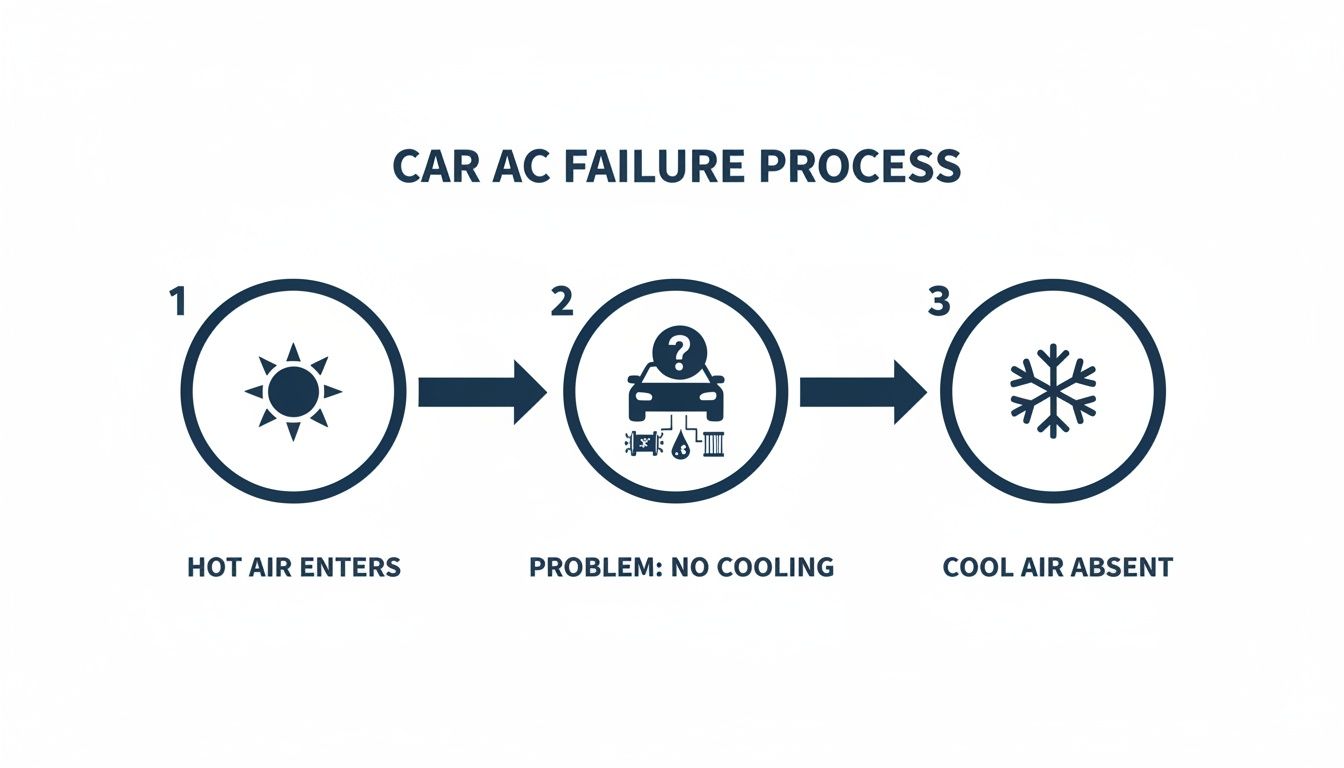
As you can see, a failure means the system can’t remove heat anymore. The result? You get nothing but hot air blowing from your vents.
The car’s AC is a high-pressure, sealed environment. It’s not just a simpler version of your home’s air conditioner; it’s a completely different beast built to withstand engine vibrations, extreme temperatures, and constant movement.
It’s crucial to know that automotive AC work and residential HVAC repair are two entirely different fields. While they both cool air, HVAC repair deals with stationary buildings. Auto AC repair, on the other hand, is a highly specialized trade that requires unique tools and knowledge to handle the demands of a vehicle. For a deeper dive, you can read more about the HVAC industry and its separate statistics. This is why you always need a certified automotive technician, not a home AC expert, to work on your car.
Diagnosing Common Auto AC Problems Yourself
You don’t need a master mechanic’s tool chest to start figuring out what’s wrong with your car’s AC. In fact, you can play detective right in your own driveway. By learning to spot the clues your vehicle is giving you, you’ll be in a much better position when you talk to an auto AC repair technician.
Think of it as learning to translate your car’s language. Those strange noises, odd smells, and weak breezes are all symptoms trying to point you to the root of the problem. When you understand these signs, you can better judge how urgent a repair is and avoid being surprised by a diagnosis.
Interpreting the Telltale Signs
Your own senses are your best first-line diagnostic tools. What you’re seeing, hearing, and smelling can often lead you straight to the failing part. Here’s a quick rundown of what common symptoms might mean.
- Weak Airflow: If the air blowing out is still cold but just doesn’t have any force behind it, the issue might not be the AC refrigerant system at all. This often points to a worn-out blower motor, a seriously clogged cabin air filter, or even leaves and debris physically blocking the air vents.
- A Loud Squealing Noise: Hear a high-pitched squeal that pops up when you turn on the AC and vanishes when you turn it off? That’s a classic sign of a failing serpentine belt. This belt is what turns the compressor, and when it gets old and starts to slip, it makes that awful screeching sound.
- Constant Clicking: A rapid-fire clicking coming from under the hood while the AC is running can be a big clue. It often means the compressor clutch is struggling to engage, which could be caused by low refrigerant pressure or an electrical problem.
A Safe At-Home Diagnostic Checklist
Before you book a visit to the shop, running through a few quick and safe checks can arm you with some really valuable information. This little inspection doesn’t require any special tools and only takes a couple of minutes.
First, start your car and crank the AC to the highest fan speed and the coldest temperature setting.
- Listen for the Click: The moment you turn on the AC, you should hear a definite “click” from the engine bay. That’s the compressor clutch engaging and getting to work. If you don’t hear anything, the compressor isn’t turning on, which points to an electrical fault or extremely low refrigerant levels.
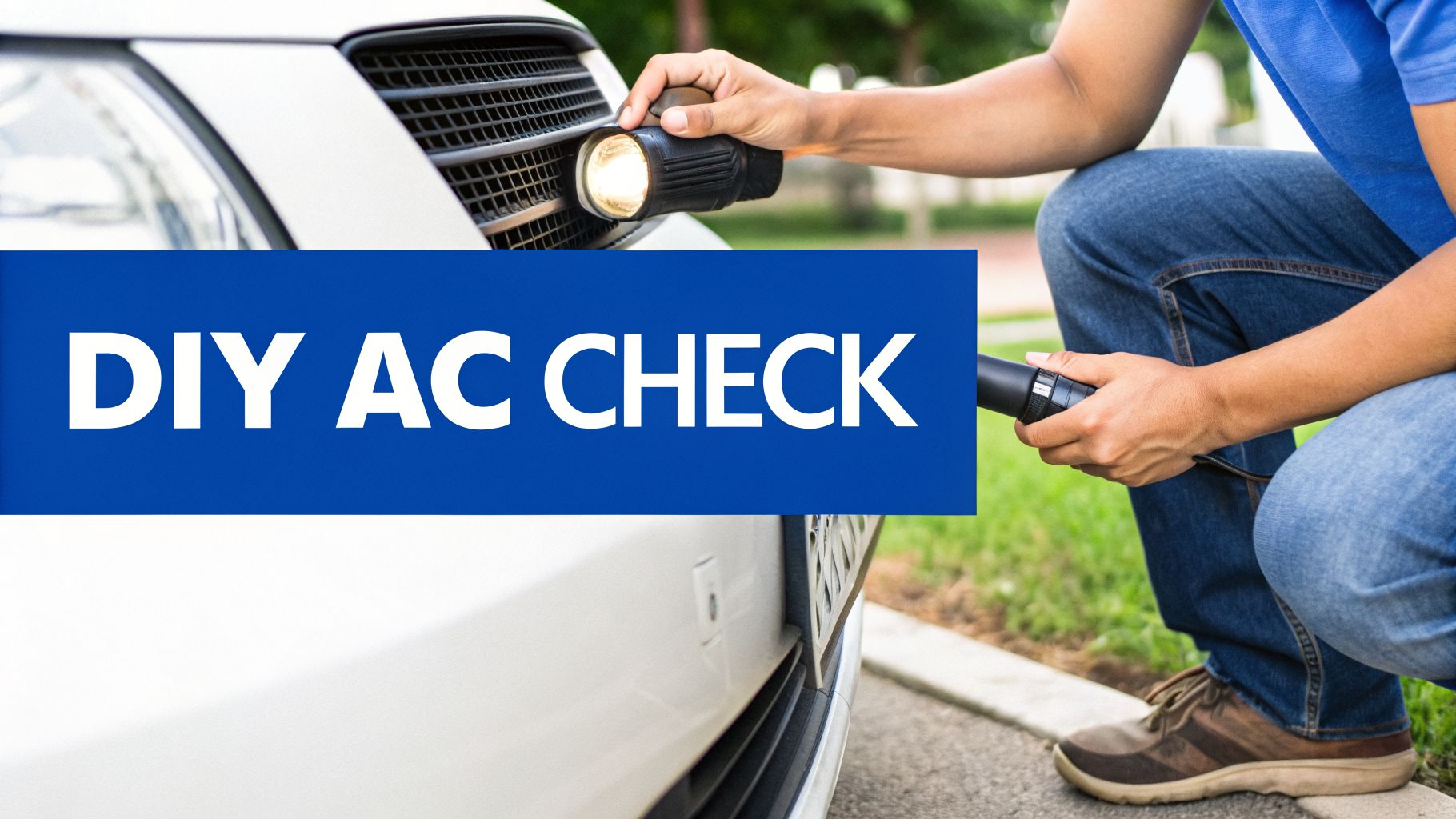
- Visually Inspect the Condenser: Pop the hood and look at the very front of the car, right in front of the radiator. That’s the condenser. Grab a flashlight and check for any obvious blockages like leaves, road grime, or even plastic bags that could be trapping heat and preventing it from working.
- Check for Leaks Under the Car: Seeing a small puddle of plain water under your car is totally normal—it’s just condensation dripping from the evaporator. But if you spot a thin, oily, or brightly colored fluid, that could be a refrigerant leak. That needs professional attention right away.
A basic understanding of your vehicle’s health is always a smart move. Just like knowing the signs of a failing AC can save you a headache, being aware of a car’s overall safety ratings helps you make better choices down the road. For more on that, take a look at these helpful auto reviews and consumer reports to stay informed.
These cooling principles aren’t just for cars. The same logic applies to other vehicles, and there are great resources for things like solving motorhome air conditioner problems. By following this simple checklist, you’ll be able to give your mechanic specific, useful details that can lead to a quicker and more accurate AC repair auto service.
What Does Auto AC Repair Cost in Florida?
When your car’s AC dies in the middle of a Florida summer, the first question on your mind isn’t how it broke—it’s “How much is this going to set me back?” The honest answer is: it depends. The final bill for an AC repair auto service is a lot like a mechanic’s work order for any other job; it all comes down to the parts, the time, and your specific vehicle.
The biggest variables are your car’s make and model, which part actually failed, and the going labor rate in your area. A simple refrigerant top-off is on the low end of the scale, but if a major component has given up the ghost, the price can climb quickly.
Common Repair Costs in Florida
Let’s get down to brass tacks. For a basic “find and fix” job, like sealing a small leak and recharging the system with refrigerant, you’re typically looking at somewhere between $150 and $300. This is often the first thing a shop will do to diagnose the problem properly.
If the diagnosis points to a failed part, however, the costs look a little different.
- AC Compressor Replacement: The compressor is the heart of the system, and replacing it is the most expensive AC repair. For most cars, you can expect to pay between $800 and $1,500 for the part and the labor involved.
- Condenser Replacement: Because it sits right at the front of your car, the condenser is vulnerable to road debris and damage. Swapping it out usually runs between $400 and $800.
- Evaporator Replacement: This is where labor costs really add up. The evaporator is buried deep inside the dashboard, so getting to it is a huge job. The bill can range from $700 to $1,300, with most of that cost covering the hours it takes to tear down and reassemble the dash.
It’s easy to see cost estimates online and get confused, so it’s important to know that auto AC repair has nothing in common with residential air conditioning. They’re completely separate industries with different parts, pricing, and skill sets. A quick look at some HVACR industry statistics shows just how different that market really is.
Just like you budget for oil changes and new tires, it’s smart to have these potential costs in the back of your mind. We cover this idea in our guide to the average price for new tires, too. Being armed with this knowledge helps you understand a mechanic’s estimate, ask the right questions, and feel confident you’re not getting taken for a ride.
How to Choose a Trustworthy AC Repair Shop in Tampa

Let’s be honest: finding a reliable mechanic in Tampa for an AC repair auto job can feel like a shot in the dark. With shops on every corner, how do you know who to trust with your car? It comes down to vetting a few key things that all great shops have in common.
Start with their reputation. Go online and dig into recent customer reviews. Don’t just glance at the star rating; read what people are actually saying about their experience with communication, pricing fairness, and whether the repair actually fixed the problem.
Key Credentials and Getting an Estimate
When you’re dealing with something as specialized as your car’s AC, you can’t afford to take chances. This isn’t a job for a generalist; you need technicians who are certified to handle refrigerants and complex electrical systems.
- Look for ASE Certification: The blue seal from the Automotive Service Excellence (ASE) is the industry’s gold standard. Think of it as a diploma on the wall—it proves the mechanic has passed rigorous tests and knows their stuff.
- Insist on Section 609 Certification: This one isn’t optional. It’s a federal requirement for any technician servicing vehicle air conditioners. If a shop can’t show you this, walk away.
- Demand a Written Estimate: Never, ever agree to work without a detailed, written estimate. It needs to clearly break down the cost of parts, labor rates, and any fees for diagnostics. This is your single best protection against surprise bills.
Choosing a technician is a matter of trust as much as it is expertise. The best shops are completely transparent about their qualifications and how they calculate their prices. If they hesitate to show you credentials or give you a clear estimate, that’s a huge red flag.
Knowing how to find good help isn’t just for AC work. Life happens, and you might find yourself needing other specialists. For instance, if you get locked out of your car, knowing where to find reliable automotive locksmith services is just as crucial as having a go-to mechanic.
Finally, always ask about the warranty. A reputable shop will stand behind its craftsmanship with a guarantee on both the parts and the labor. As you can see in our auto and home insurance reviews, taking steps to protect your investments is always the smart play.
AC Damage After a Car Accident and Your Legal Rights
When you’re in a car accident, your first thought is usually about the visible damage—the crumpled fender, the cracked headlight. But the force of a collision doesn’t just stop at the body panels. It sends a shockwave through the entire vehicle, and that can spell trouble for systems you can’t immediately see, like your air conditioning.
It’s a story we hear all the time. The accident was minor, and everything seemed fine at first. Then, a few days later, you flip on the AC to fight that thick Florida humidity, and all you get is warm air. The impact, even from a small fender-bender, is often enough to crack the condenser (which sits right up front) or knock a refrigerant line loose. This is when you need a professional to diagnose the problem with an AC repair auto inspection.
Why Your AC Is Part of Your Claim
Here in Tampa, working AC isn’t just about comfort; it’s a necessity. It’s what makes your daily commute bearable during a sweltering summer and, just as importantly, it’s what keeps your windshield clear when our sudden downpours fog everything up. Your defroster relies on the AC system to work effectively.
Because of this, any cost to repair your car’s air conditioning is a real, legitimate part of your property damage or personal injury claim.
People often underestimate how a collision’s force travels. We assume if the hit was in the rear, the front of the car is fine. But the jolt alone can easily damage fragile AC compressors and lines. Those repair costs are a valid part of your total losses from the accident.
When you’re dealing with an insurance claim, it’s easy to get sidetracked by irrelevant numbers. For instance, adjusters might refer to data from the home HVAC market, but that has nothing to do with your car. You can see how different that industry is by looking at the HVAC service market here. An automotive AC system is a specific, complex component of your vehicle, and its repair costs stand on their own.
An experienced attorney knows to account for every single loss, not just the obvious ones. This includes hidden mechanical damage and the loss in your car’s resale value after it’s been in a wreck. To learn more about this, check out our guide on what a diminished value claim is. Having a professional on your side ensures nothing gets overlooked.
Common Questions We Hear About Car AC Repair
When your car’s AC is on the fritz in the middle of a Florida summer, you need answers fast. Over the years, we’ve heard just about every question in the book. Here are some of the most common ones we get from Tampa drivers.
How Often Should I Get My Car’s AC Checked?
Here in Florida, your AC works overtime. That’s why we recommend a professional inspection every one to two years. This isn’t about waiting for something to break; it’s about being proactive.
A quick check-up lets a technician confirm your refrigerant levels are correct, scan for tiny, hidden leaks, and make sure every component is spinning and switching like it should. Think of it as a cheap insurance policy against a massive, system-wide failure down the road.
Are Those DIY AC Recharge Cans a Good Idea?
We see the appeal of those DIY recharge kits—they seem like a quick, inexpensive fix. But honestly, they can cause more harm than good. A can of refrigerant can’t tell you why your system is low in the first place. If you have a leak, you’re just dumping expensive, environmentally-damaging refrigerant into the air for a fix that won’t last.
Worse yet, it’s incredibly easy to overcharge the system with one of those cans. Too much pressure can completely destroy your compressor, turning a small problem into a $1,000+ repair. A professional has the right equipment to find the real issue and charge the system with precision, which will always save you money in the long run.
What’s that musty, “old gym sock” smell coming from my vents?
That unpleasant odor is almost always caused by mold and bacteria growing on your evaporator core. It’s tucked away deep in your dashboard where it’s dark and damp—the perfect breeding ground. While it’s usually not a health hazard, it can definitely make allergy season feel a whole lot worse. Shops offer a specific service to clean and disinfect the evaporator, which completely gets rid of the smell and makes your cabin air fresh again.
Why Did My AC Quit After a Small Fender-Bender?
Even a seemingly minor tap from another car can wreak havoc on your AC system. The condenser, which looks like a thin radiator, sits right at the front of your vehicle, making it extremely vulnerable to cracks or punctures from even a low-speed impact. A sudden jolt can also easily snap a refrigerant line or damage the delicate clutch on the compressor.
It’s absolutely essential to have a mechanic inspect the AC system after any accident, no matter how small. The cost of this repair is a legitimate part of your vehicle’s damage claim. Insurance companies sometimes balk at covering it, so it’s important to be prepared. If you’re getting pushback, knowing how to fight an insurance denial is key.
If you’ve been injured in an accident and are facing unexpected repair costs and insurance hassles, you don’t have to handle it alone. Contact the dedicated legal team at Martin Hernandez, P.A. for a free consultation about your case. https://injurylawyersoftampa.com