
When a serious car crash happens, the scene can look like pure chaos. Twisted metal, shattered glass, and conflicting stories often make it impossible to know who was really at fault. This is where an accident reconstruction expert comes in.
Think of them as a forensic detective for vehicle collisions. They use science and engineering to cut through the confusion and piece together a clear, factual story of what happened. In a complex Florida accident case, their objective analysis is often the key to proving liability.
Understanding the Role of an Accident Reconstruction Expert Witness
After a devastating car, truck, or motorcycle accident, you’re often left with more questions than answers. An accident reconstruction expert witness is the person who finds those answers. Their job is to go far beyond what witnesses think they saw—which can be notoriously unreliable—and apply the hard principles of physics to the actual evidence.
They aren’t guessing; they’re calculating. By meticulously analyzing every piece of physical evidence, they can determine the critical factors that insurance companies and opposing lawyers will almost certainly dispute. Their work is absolutely vital in high-stakes cases, especially those involving catastrophic injuries or a wrongful death here in Florida.
Translating Chaos into Clarity
A major collision leaves behind a confusing jumble of debris, vehicle damage, and skid marks. The expert’s job is to systematically interpret this chaos and build a verifiable, moment-by-moment timeline of the crash. Their analysis answers the questions that decide the case.
This process involves several key investigations:
- Determining Vehicle Speeds: They can look at the length of skid marks, the severity of crush damage on the vehicles, and where they finally came to rest to accurately estimate how fast everyone was going.
- Identifying Pre-Impact Actions: Did a driver slam on the brakes? Swerve at the last second? Or did they fail to take any evasive action at all? The evidence often tells the story.
- Pinpointing the Point of Impact: Finding the exact spot on the road where the collision happened is crucial for proving who crossed the centerline, ran a red light, or failed to yield.
- Assessing Driver Visibility: An expert will also consider sightlines, weather, and the time of day to figure out what a driver reasonably could—and should—have seen.
By applying scientific principles, an accident reconstructionist provides an unbiased, fact-based opinion that can withstand intense scrutiny from insurance companies and opposing attorneys. Their testimony transforms complex technical data into a clear and compelling narrative for a judge or jury.
Their findings become the foundation for proving fault. An experienced Tampa personal injury attorney will use the expert’s detailed report to build a rock-solid argument showing the other driver was negligent. Understanding the role of evidence in proving negligence in personal injury cases in Tampa, Florida is critical, and an expert’s testimony is often the most powerful piece of that puzzle. This scientific backing is what gives a claim the objective proof it needs to secure fair compensation for victims.
Decoding The Crash Scene: How Experts Rebuild The Truth
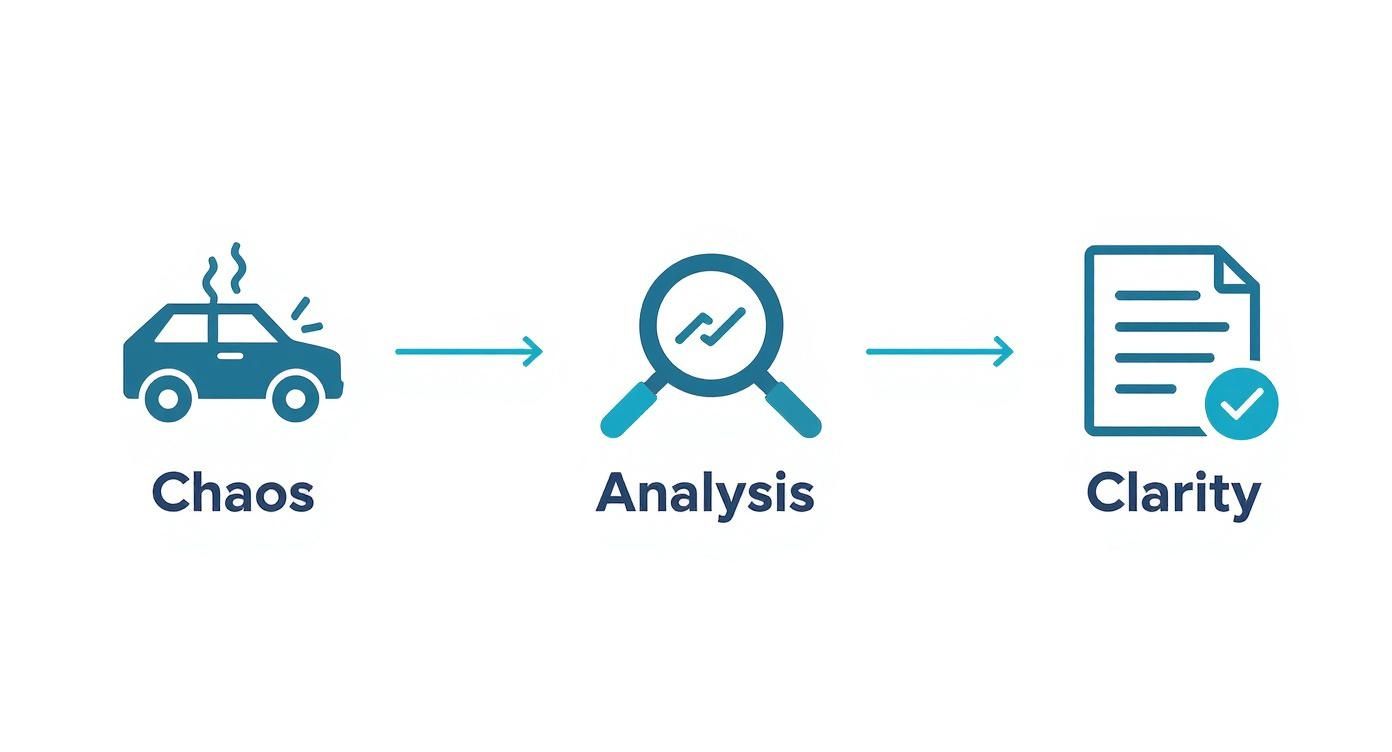
When an accident reconstruction expert arrives at a crash scene, they see more than just twisted metal and broken glass. They see a puzzle waiting to be solved. While witness memories can be fuzzy and conflicting, the physical evidence left behind tells a clear, unbiased story. The expert’s job is to methodically piece together that story, using science to turn chaos into clarity.
This process is a journey from confusion to a concrete conclusion, where the raw, scattered evidence is systematically analyzed to build a factual, defensible reconstruction of what really happened.
Core Methods Of An Accident Reconstruction Expert
An expert’s analysis isn’t guesswork; it’s a multi-faceted investigation grounded in established scientific techniques. Each method provides a different layer of evidence, which, when combined, creates a comprehensive picture of the collision. The primary investigative methods these experts use and the kind of evidence they uncover include:
- Scene Analysis: This focuses on the roadway and surrounding environment. Experts gather evidence like tire marks (skids, scuffs, yaw marks), debris fields, roadway gouges, and the final resting positions of vehicles.
- Vehicle Damage Analysis: This method examines the vehicles involved in the collision. Evidence gathered includes crush profiles, depth of impact, direction of force, component failures (e.g., tire blowouts), and paint transfers.
- Physics & Simulation: Experts apply scientific principles to make calculations for speed, momentum, and delta-V (change in velocity). They also create computer-generated models of the crash sequence.
- EDR Data Retrieval: This involves accessing the vehicle’s “black box.” The data retrieved can show pre-crash speed, brake and throttle application, steering angle, seatbelt usage, and the time of airbag deployment.
By cross-referencing the data from these different areas, an expert can validate their findings and build a reconstruction that stands up to intense scrutiny in court.
Reading The Clues On The Ground
The expert’s work often starts with a meticulous examination of the crash site itself. The asphalt, shoulders, and surrounding area hold a surprising amount of information that can answer critical questions about the moments leading up to the crash.
They are trained to spot and interpret clues that most people would overlook:
- Tire Marks: Skid marks, yaw marks, and scuffs are like a vehicle’s footprints. They reveal braking patterns, vehicle speed, and the direction of travel just before, during, and after impact. A long, straight skid mark, for instance, is a dead giveaway of a driver slamming on the brakes.
- Debris Fields: The location of shattered glass, plastic fragments, and even fluid spills helps pinpoint the exact area of impact. The way this debris is scattered can also offer insights into the collision’s force and angle.
- Roadway Gouges: Scrapes and gouges in the pavement show where metal parts of a vehicle dug into the ground. These marks often identify the precise point of impact or where a vehicle rolled over.
What started as a basic part of police work has evolved into a highly specialized forensic field. This evolution was driven by a 1985 National Highway Traffic Safety Administration (NHTSA) push to standardize training, which eventually led to the creation of the Accreditation Commission for Traffic Accident Reconstruction (ACTAR) in 1991.
Letting The Vehicle Damage Tell Its Story
Just as crucial as the scene is the damage to the vehicles themselves. The twisted metal isn’t just random destruction; it tells a story of energy and force that a trained expert can read like a book. They look far beyond simple dents.
An expert examines the “crush profile” of a vehicle—the specific pattern and depth of the damage—to calculate the energy transferred during the collision. This calculation is a key component in determining vehicle speeds with a high degree of accuracy.
This analysis helps differentiate between the first impact and any subsequent hits. It can even reveal if a critical part, like a tire or a steering component, failed before the crash, potentially pointing to a completely different cause of the accident.
The Unbiased Witness: The Event Data Recorder
Perhaps the most powerful tool in a modern reconstructionist’s kit is the Event Data Recorder (EDR), often called the “black box.” Found in most modern cars and virtually all commercial trucks, this small device records critical data in the few seconds right before and during a crash.
The EDR provides an objective, digital log of exactly what the vehicle was doing. An expert can download this data to find out:
- Vehicle speed
- Whether the brakes were applied
- The position of the throttle
- The angle of the steering wheel
- If seatbelts were in use
This digital evidence is pure fact—it’s incredibly difficult to argue with. When a driver swears they were braking, but the EDR shows the accelerator was floored, it can completely reshape a case.
When combined with the physical evidence and computer simulations, this data allows an expert to create a precise, evidence-backed model of exactly how a collision unfolded.
What Makes an Expert Witness Credible in Court?
In a Florida courtroom, you can’t just call anyone an “expert.” When an accident reconstruction expert takes the stand, their opinion carries a lot of weight—but only if they have the credibility to back it up. Their whole job is to give a judge and jury an objective, scientific opinion they can trust. That trust is built on a solid foundation of qualifications, experience, and the proven ability to defend their findings under pressure.
Simply put, credibility is an expert witness’s currency. Without it, their testimony is just another opinion. With it, their analysis can be the key to proving negligence and winning a fair outcome for an injured victim. This isn’t something that happens overnight; it’s earned through years of dedicated work in highly technical fields.
The Educational and Training Foundation
The path to becoming a believable expert starts with a strong academic background. Most top-tier reconstructionists have degrees in fields that are all about the laws of physics and mathematics—the very cornerstones of their work.
This foundation usually includes:
- Engineering Degrees: Many experts come from mechanical or civil engineering backgrounds. This gives them a deep understanding of how vehicles move, how materials handle stress, and how structures hold up in a crash.
- Physics and Mathematics: A degree in physics provides the nuts-and-bolts knowledge of motion, force, and energy. These are the exact principles they use to calculate speeds and impact forces.
- Law Enforcement Experience: While it’s not a formal degree, many of the best experts got their start in law enforcement, where they received specialized training investigating collisions right at the scene.
Of course, that initial education is just the starting point. The field is always changing with new technology and better analytical methods. That’s why ongoing, specialized training in things like collision dynamics, biomechanics, and forensic mapping is crucial for an expert to stay on top of their game.
ACTAR: The Gold Standard of Certification
While education is critical, the single most respected credential in this field is certification from the Accreditation Commission for Traffic Accident Reconstruction (ACTAR). This certification is widely seen as the industry’s gold standard. It proves an expert has met incredibly high standards for both knowledge and competence.
To get ACTAR-certified, a person has to pass a grueling, comprehensive exam. It tests everything from their theoretical knowledge to their practical ability to apply reconstruction principles. It’s a clear sign to the court that this expert isn’t just a knowledgeable person—they’ve been vetted by an independent, accredited body.
When an attorney from a firm like Martin Hernandez, P.A. brings in an accident reconstruction expert witness, ACTAR certification is almost always a must-have. It immediately sets a high bar for credibility and helps ensure their testimony will be allowed under Florida’s strict evidence rules.
Trial-Tested and Battle-Hardened
Beyond the degrees and certifications, maybe the most important qualification of all is a proven track record in the courtroom. An expert’s theories and conclusions mean nothing if they fall apart under the pressure of a sharp cross-examination from the other side’s attorney.
A truly credible expert is someone who has:
- Testified in countless depositions and trials, showing they can stay comfortable and clear-headed under pressure.
- Successfully defended their methodology against challenges from other experts trying to poke holes in it.
- Mastered the art of explaining complex scientific ideas in simple, straightforward terms that a jury can actually understand.
This courtroom experience is where an expert really proves their worth. It shows they can do more than just “run the numbers”—they can communicate their findings effectively and persuasively. Their ability to stay calm, professional, and clear while being challenged speaks volumes about their confidence and the quality of their work. A great expert makes complicated evidence easy to grasp, which is vital when you’re trying to show what really happened in a crash. For more information on what to do after a collision, see our guide explaining what evidence you should preserve after a car accident in Tampa, FL.
How Expert Testimony Can Make or Break a Florida Accident Case
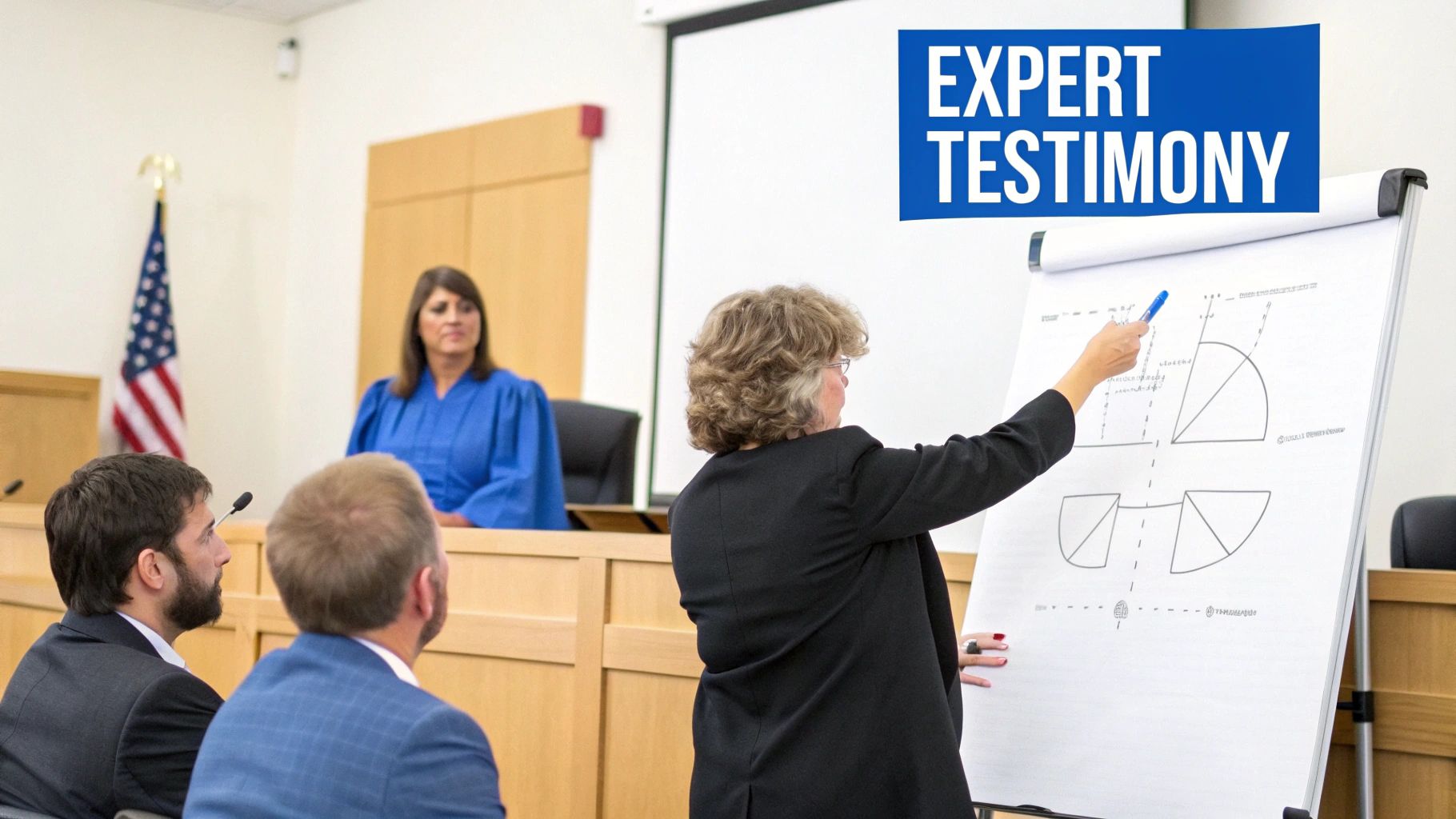
When a serious accident case lands in the legal system, it’s not just a simple matter of what happened on the road. It quickly turns into a battle of competing stories. This is where an accident reconstruction expert witness steps in. Their testimony cuts straight through the conflicting accounts and insurance company spin, anchoring the entire case in objective, scientific fact.
This isn’t just another piece of evidence. It’s a powerful tool that transforms complex physics and digital data into a clear, understandable story of how negligence caused real harm. For a judge, a jury, or even a stubborn insurance adjuster, that kind of clarity can be the one thing that truly proves who was at fault and secures the compensation an injured person deserves.
Proving Fault in Complex Scenarios
In Florida, figuring out who is at fault isn’t always straightforward. Think about the chaos of a multi-car pile-up or a devastating crash with a commercial truck—these situations are rarely simple and almost always involve multiple factors and drivers pointing fingers at each other. An expert’s analysis is absolutely essential here to pinpoint the specific actions that set off the tragic chain of events.
Just consider these all-too-common Florida scenarios where an expert’s work becomes critical:
- Multi-Car Pile-Ups on I-4: A sudden downpour triggers a massive pile-up during rush hour. Who’s to blame? An expert can analyze the final resting positions of every vehicle, pull EDR data to see who hit their brakes when, and prove that one driver’s excessive speed for the wet conditions was the first domino to fall.
- Commercial Truck Accidents on I-75: A semi-truck jackknifes, causing a fatal collision. The trucking company’s defense team might try to blame the road or the weather. A reconstructionist, however, can pull the truck’s “black box” data and show the driver was actually speeding or slammed on the brakes too hard, proving the crash was a result of driver error, not some unavoidable act of nature.
- Wrongful Death Motorcycle Cases: A motorcyclist is tragically killed at an intersection, and the other driver swears the rider was flying down the road. An expert can use the crush damage on the vehicles and the scuff marks on the pavement to precisely calculate the motorcycle’s actual speed, proving the car driver simply failed to yield the right-of-way.
Weaving the Facts into a Powerful Story of Negligence
A great expert witness does more than just list off facts and figures. They take all that raw data and weave it into a coherent story that explains exactly why the accident happened. Their findings give a personal injury attorney the hard evidence needed to prove negligence beyond a shadow of a doubt.
The real power of an expert is their ability to draw a direct line from a specific action to a specific, devastating outcome. They don’t just tell a jury a driver was speeding; they show them precisely how that extra speed directly caused the catastrophic injuries their client is now forced to live with.
This connection is everything. For example, an expert might testify that just a 10 mph increase in speed led to a 40% greater impact force, which explains why the victim’s injuries were so severe. They can demonstrate how a distracted driver looking at their phone for only two seconds traveled over 170 feet—more than half a football field—completely blind to the road ahead. This kind of tangible evidence turns a vague claim of carelessness into an undeniable reality.
The financial stakes are immense, and expert testimony often sways litigation outcomes by millions. Forensic engineering firms have used expert testimony to completely change the direction of a case, leading to massive settlements. In some instances, their scientific analysis has helped parties avoid staggering judgments as high as $94 million.
Influencing Insurance Negotiations Before a Trial Ever Begins
The impact of an expert’s report is often felt long before anyone sets foot in a courtroom. Insurance companies are masters at downplaying their driver’s fault to reduce what they have to pay. But a detailed, scientific report from a credible reconstructionist completely changes that conversation.
When an insurance adjuster is presented with an airtight reconstruction that scientifically proves their client is liable, they are suddenly far more motivated to offer a fair settlement. They know that trying to poke holes in the laws of physics in front of a jury is a losing strategy. The expert’s report becomes the leverage needed to demand full and fair compensation, often without the need for a long, draining court battle.
Choosing the Right Expert for Your Accident Case
Selecting an accident reconstruction expert is one of the most critical strategic moves your personal injury attorney will make. This isn’t just about finding someone with an engineering degree. It’s about finding a seasoned professional whose analysis, credibility, and communication can hold up under the intense scrutiny of a legal battle. A good law firm doesn’t just pull a name from a list; they carefully vet every candidate to find the perfect match for the specific facts of your case.
This selection process is foundational to building a strong claim. The right expert doesn’t just offer a scientific opinion—they bring the clarity and authority needed to prove exactly how the other party was negligent. The person chosen can directly impact how powerfully your story is told to an insurance adjuster or, if necessary, a jury.
Key Criteria for Vetting an Expert
A top-tier attorney sizes up potential experts from several angles. They’re looking for a very specific mix of technical know-how, real-world experience, and courtroom presence. The goal is to find someone who isn’t just brilliant on paper but can also be an effective and compelling teacher in a high-pressure setting.
Here’s what that evaluation looks like:
- Specific Case Experience: Has the expert handled this exact type of accident before? An expert who lives and breathes commercial trucking collisions will know the nuances of federal regulations inside and out, something an expert focused on passenger cars might miss.
- A Strong Courtroom Track Record: The expert must be able to defend their findings while being hammered by the opposing counsel’s questions. A history of successful testimony is proof they can stay professional, clear, and unshaken under fire.
- Communication Skills: This is huge. Can they explain complex physics in a way that anyone can understand? An expert who confuses a jury with jargon is useless, no matter how correct their science is.
The goal is to find an expert whose testimony is not only scientifically sound but also accessible and persuasive. They must be able to translate dense data into a clear narrative of cause and effect that leaves no room for doubt.
This level of diligence is why it’s so important to work with a law firm that already has a network of proven, top-tier experts they can call on immediately.
Essential Questions Attorneys Ask
To find the right person, your attorney will conduct a thorough interview that goes far beyond their resume. They need to dig into the expert’s methodology, past cases, and any potential biases. The answers tell us whether their opinions are truly objective and, most importantly, defensible.
Accident reconstructionists have been deeply involved in legal cases for decades, providing testimony that can make or break an outcome. To give you an idea, one prominent Florida-based expert, Ralph Aronberg, P.E., has reconstructed over 1,500 accidents and testified in more than 150 jury trials since 1983. That sheer volume shows you just how crucial these specialists are and the level of experience seasoned attorneys look for. You can find more insights on the role of accident reconstruction professionals on JurisPro.com.
When we’re vetting an expert, we’re looking for honest, direct answers to tough questions. We need to be absolutely certain they are the right person for the job. Key questions fall into several important areas:
- Objectivity and Bias: We might ask, “Have you testified for both plaintiffs and defendants in the past?” An expert who has worked on both sides is seen as more objective and less like a “hired gun” for one side.
- Communication Ability: A crucial test is to ask, “Walk me through your process as if I were a juror with no technical background.” This tests their ability to translate complex jargon into a simple, compelling story.
- Credibility and Reliability: It’s important to know, “Has your testimony ever been challenged or excluded by a court under the Daubert Standard?” A “yes” here is a major red flag, questioning the scientific validity of their methods.
- Relevant Experience: We need to confirm they have hands-on experience with the specifics of your case, not just general knowledge, by asking, “How many motorcycle-versus-SUV cases have you personally reconstructed?”
- Professional Standing: We’ll inquire, “Are you actively involved in any professional reconstruction organizations like ACTAR?” Active membership and certification show a commitment to ongoing education and industry standards.
This rigorous vetting process is fundamental to building a powerful case. Your attorney’s ability to select and collaborate with the right expert witness is a reflection of their experience and commitment to securing the best possible outcome for you.
Why You Need an Experienced Tampa Attorney on Your Side
When you’re trying to prove who was at fault after a serious crash in the Tampa Bay area, the police report is just the starting point. Winning your case often comes down to hard, scientific evidence, and that’s exactly what an accident reconstruction expert provides.
But here’s a critical detail many people don’t realize: you can’t just hire one of these experts on your own for a lawsuit. They must be brought in by your attorney. This is one of the biggest reasons why having the right law firm in your corner is non-negotiable.
Putting Top-Tier Experts to Work for You
At Martin Hernandez, P.A., we’ve spent years building relationships with some of the most respected and credible accident reconstruction experts in Florida. We know precisely who to call for your specific situation, whether it’s a devastating collision with a commercial truck, a complex motorcycle accident, or a multi-car pile-up.
Our team doesn’t just hire an expert; we strategically integrate their findings to build an airtight, scientifically-backed case. We use their powerful analysis to shut down the arguments insurance companies love to use to deny or lowball your claim.
When an insurance adjuster is confronted with an undeniable, physics-based breakdown of what really happened, their usual tactics fall apart. It puts you in a much stronger position to get the full compensation you deserve. When selecting a firm, their professional network and reputation matter immensely. The concepts behind good Lawyer Reputation Management highlight why choosing a firm with a strong ethical standing is so important.
The right legal team does more than just present evidence; they translate complex scientific analysis into a clear, persuasive narrative that proves negligence and demonstrates the true impact the accident has had on your life.
If you’ve been seriously injured, you don’t just need a lawyer—you need a powerful advocate with the resources to go the distance. Our experienced Tampa car accident lawyers are ready to put our expertise and our network of premier experts to work for you. Contact us for a free consultation to see how we can make a crucial difference in your case.
Answering Your Questions About Accident Reconstruction
When you’re dealing with the fallout from a serious crash, the last thing you need is more confusion. It’s completely normal to have questions about how these complex investigations work. Let’s clear up some of the most common ones.
How Much Does an Accident Reconstruction Expert Cost?
This is a big question for many people, but the answer is simple: you don’t pay for it out of your own pocket. Your law firm advances all expert witness fees as a necessary expense to build your case.
These costs are then covered by the final settlement or court award. This arrangement allows you to get the powerful testimony you need without any upfront financial stress, ensuring we can build the strongest case possible from day one.
How Long Does a Reconstruction Take?
A proper, thorough reconstruction doesn’t happen overnight. You can generally expect the process to take anywhere from several weeks to a few months, depending entirely on the crash itself.
What determines the timeline? Things like the amount of evidence that needs to be gathered and processed, the complexity of digging into “black box” data, and how detailed the computer simulations need to be. A careful, methodical analysis takes time, but it’s that very diligence that makes it hold up in court.
In a Florida courtroom, an expert’s credibility hinges on the strength of their process. Rushing an investigation is the fastest way to give the other side an opening to tear the case apart. That’s why a deliberate, meticulous approach isn’t just a good idea—it’s essential.
Can the Other Side Challenge an Expert’s Opinion?
They absolutely can, and they will. Florida courts use a strict legal test known as the Daubert Standard. This standard basically makes the judge a “gatekeeper” who has to ensure any expert testimony is not only relevant but also based on reliable, scientifically sound principles.
This is precisely why we only work with highly qualified experts who have a proven history of their work standing up to intense questioning. Their methods have to be bulletproof enough to withstand the toughest cross-examination from the opposing lawyers.
Do I Need an Expert for a Minor Accident?
In most cases, no. An accident reconstructionist is a powerful resource we bring in for serious and complex collisions where the stakes are high. Their deep-dive analysis is really only necessary when we’re dealing with:
- Catastrophic or life-changing injuries
- A wrongful death
- Major disagreements over who was at fault
- Crashes involving big rigs or other commercial vehicles
For a straightforward fender-bender where fault is clear, this level of scientific investigation usually isn’t needed.
If you or someone you love was seriously hurt in an accident and the other side is trying to shift the blame, you need a legal team with the experience to build a rock-solid case. At Martin Hernandez, P.A., we work with a network of the best accident reconstruction experts in the field to uncover the truth.
Let us put that expertise to work for you. Contact us today for a free consultation to find out how we can help you get the justice and financial recovery you deserve.