
When you hear the sirens getting closer after a car accident, the main feeling is relief. Help is on the way. But that sense of security can vanish weeks later when you get a bill for that ambulance ride—a bill that can be shockingly high. So, who actually pays for it? The answer isn’t as straightforward as you’d think, and assuming you’re covered is a mistake many people make.
The Shocking Cost of Ambulance Rides in Florida
In the confusion right after a crash, your only thought is getting the medical attention you need. No one is thinking about the price tag on that ambulance trip. But they should be. That single ride can easily run over $1,500 for ground transport, and if you need an air ambulance, the cost can soar into the tens of thousands.
A lot of Floridians are stunned to find out their insurance doesn’t just automatically pay the full amount. The truth is, getting that bill covered is like navigating a maze. It involves piecing together different insurance policies, dealing with coverage limits, and fighting an insurer’s own definition of what counts as an emergency. It’s a complicated process that often leaves accident victims holding a massive, unexpected bill.
Navigating the Insurance Maze
Think of your insurance coverage as a stack of different shields, each with its own rules and weak points. After a car accident in Florida, several different policies might get involved, but none of them come with a blank check to cover your ambulance transport.
- Personal Injury Protection (PIP): As a Florida driver, this is your first line of defense. Your own auto insurance policy is required to pay 80% of your initial medical bills, but only up to your policy limit—which is usually $10,000. An ambulance ride can eat up a huge chunk of that, leaving you with very little for the rest of your medical care.
- Health Insurance: Once your PIP benefits are used up, your health insurance is supposed to kick in as the secondary payer. This is where things get tricky. You’ll likely run into high deductibles, copayments, and the all-too-common problem of the ambulance company being “out-of-network” with your plan.
- Government Programs: If you’re covered by Medicare or Medicaid, they have their own strict rules for what they’ll pay for. Their decision often comes down to whether the transport was “medically necessary” in their eyes.
An insurer’s definition of “medical necessity” is the real battleground. If they look at your case and decide the situation wasn’t a true life-or-death emergency, they have grounds to deny the claim entirely. That leaves you on the hook for every penny.
This tangled web of insurance policies is precisely why you can’t just assume an ambulance trip is paid for. As we explain in our guide to Florida car insurance costs, even drivers who pay for what they think is “full coverage” can be left with huge out-of-pocket bills for emergency transport. Knowing this from the get-go is the first step in protecting yourself financially after an accident.
When that shockingly high ambulance bill shows up in your mail, the first question is always, “Who is supposed to pay for this?” It can feel like trying to untangle a hopelessly knotted rope. In Florida, there’s a specific pecking order for payment, and it doesn’t start where most people think. It’s more like a payment waterfall, with coverage flowing from one source to the next, and at every drop, you risk getting soaked financially.
First Up: Your Auto Insurance, Not Your Health Insurance
After a car crash, the first insurance company on the hook is your own. Florida is a no-fault state, which means every driver is required to carry Personal Injury Protection (PIP) coverage. This is your first line of defense. PIP is designed to be the primary payer for your medical bills, which includes that ambulance ride. It covers 80% of these initial expenses up to your policy limit—usually $10,000—no matter who caused the accident.
The problem? A single ambulance transport, especially if advanced life support is needed, can eat up a huge chunk of that $10,000. That leaves very little to cover the actual hospital visit, follow-up appointments with doctors, or any other necessary treatments.
If you want a closer look at everything this crucial coverage is supposed to handle, our guide on what PIP covers in Florida breaks it all down.
Florida Insurance Coverage for Ambulance Rides
After a car accident in Florida, different insurance policies apply in a specific order. Here’s how each type of insurance typically responds to an ambulance bill:
- Auto Insurance (PIP): This is the primary payer. It covers 80% of your ambulance bill, but only up to your policy limit, which is usually $10,000. The major limitation is that once this limit is reached, your PIP coverage is exhausted, and it may not cover the entire cost of the bill.
- Health Insurance: This acts as the secondary payer. It’s supposed to cover the remaining 20% of the bill that PIP doesn’t, or step in after your PIP benefits are completely used up. However, you will likely still be responsible for your plan’s deductibles, copays, and coinsurance. A huge problem is that the ambulance company may be considered out-of-network, leading to much higher costs for you.
- Medicare/Medicaid: These government programs are payers of last resort. They will only cover ambulance transport if it is deemed “medically necessary” by their strict standards. Coverage is frequently denied if they determine that a less expensive method of transport, like a car, would have been safe.
The handoffs between these payers are rarely smooth, creating gaps where you can be left responsible for the bill.
When PIP Runs Out
So, what happens when the ambulance bill burns through your PIP benefits? This is where your health insurance is supposed to take over as the secondary payer. Unfortunately, “supposed to” is the key phrase here.
This is almost never a seamless transition. Your health plan will likely require you to meet your annual deductible first. After that, you’re still on the hook for any copayments or coinsurance your plan requires. It’s a setup that guarantees you’ll still be paying something out of your own pocket.
This infographic paints a pretty clear, and stressful, picture of the journey many people face.
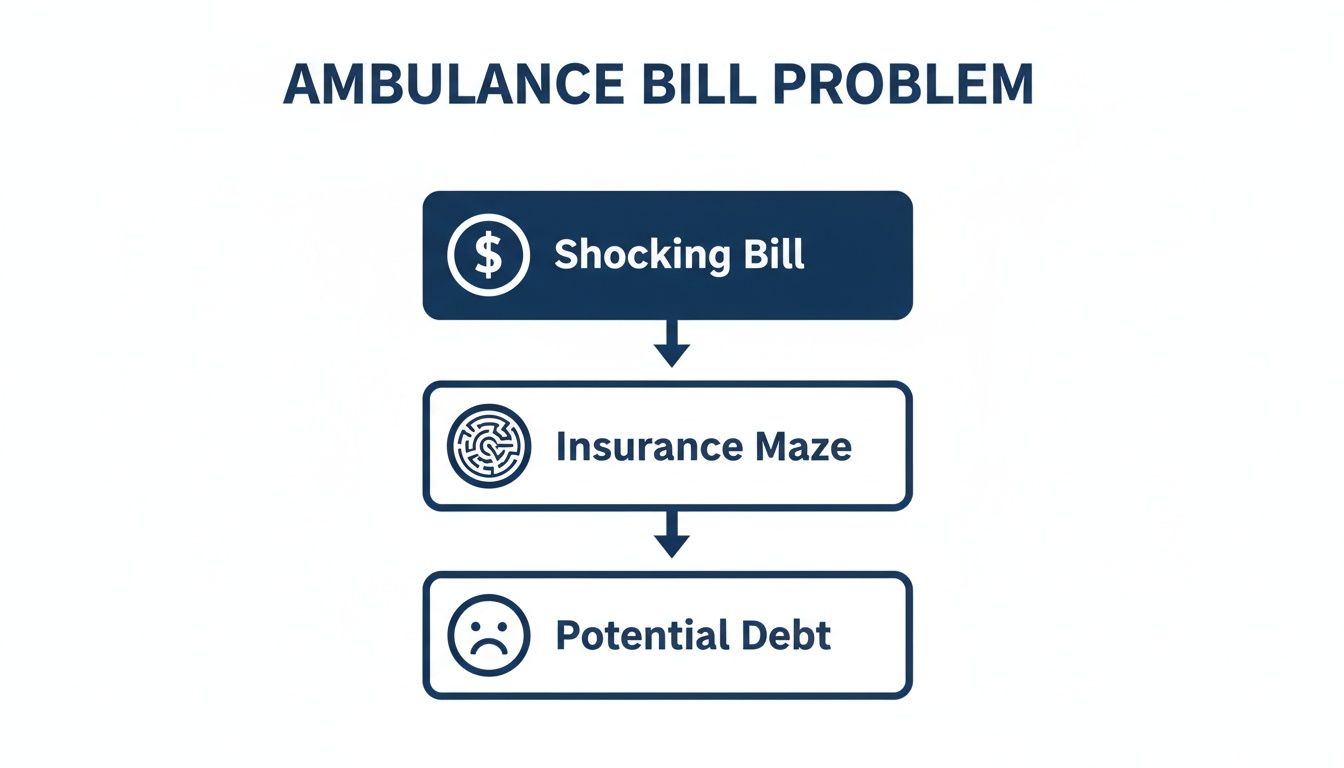
As you can see, that initial bill often triggers a confusing battle with insurance providers, where coverage gaps can quickly turn into significant personal debt.
The Catch with Medicare and Medicaid
For anyone covered by a government health plan, the rules get even stricter. Medicare and Medicaid don’t just automatically approve ambulance bills.
The entire claim often hinges on one critical concept: “medical necessity.” Both programs will scrutinize the details of your transport. They want to know if an ambulance was truly the only safe way to get you to the hospital. If they decide you could have safely taken a car, they can deny the claim entirely, leaving you with the full, enormous bill.
Eventually, you’ll get a document from your insurer called an Explanation of Benefits (EOB). Learning how to read this is essential. It tells you what they paid, what they denied, and why. This entire payment hierarchy is loaded with traps that can leave even people with good insurance facing bills they can’t afford.
Ground vs Air Ambulance Coverage Differences

When you’re seriously hurt in an accident, the choice between a ground ambulance and an air ambulance isn’t just about how you get to the hospital. The financial difference is staggering, and it’s a detail that can leave unsuspecting victims in financial ruin.
While a ride in a traditional ambulance is already shockingly expensive, a trip in a medical helicopter is in a completely different stratosphere.
An air ambulance is usually called in for the most severe cases—think major trauma from a wreck on I-4 or a remote crash where every second is critical. This speed is a lifesaver, but it comes with a price tag that can be just as shocking as the accident itself. We’ve seen bills easily top $50,000 for a single flight.
The Nightmare of Out-of-Network Air Transport
One of the biggest financial traps we see with air ambulances is the “out-of-network” problem. In a life-or-death emergency, you don’t get a say in which helicopter company shows up. The trouble is, many of these air ambulance services don’t have contracts with major health insurance carriers.
This leads to a disastrous billing practice known as balance billing. Your insurance pays what it deems a “reasonable” amount, which is almost always a tiny fraction of the total charge. The air ambulance company then turns around and bills you directly for the massive remainder.
Let’s say the air ambulance bill is $55,000. Your insurer might pay just $8,000 of that. The air ambulance company then “balances” the bill by sending you a demand for the remaining $47,000. It’s a devastating blow for families already coping with serious injuries.
This isn’t just a local issue; it’s a nationwide problem. The global ambulance services market is projected to skyrocket from $62.35 billion in 2025 to over $117 billion by 2034. As you can see in this full analysis of the ambulance services market, with that growth comes a higher likelihood of these billing disputes.
The Role of PIP and MedPay
In Florida, your Personal Injury Protection (PIP) insurance is your first line of defense. But its $10,000 limit can be completely wiped out by a single ground ambulance ride, leaving nothing for a helicopter flight.
- PIP: This required no-fault coverage is supposed to help, but its low limit means it’s often exhausted almost immediately.
- Health Insurance: This is your secondary payer, but as we’ve seen, it leaves you dangerously exposed to balance billing from out-of-network air transport companies.
This is exactly why having the right kind of auto insurance is so important. As we detail in our article on what MedPay insurance covers, this optional coverage can be a financial lifesaver, helping to cover the gaps left by PIP and your health plan’s high deductibles. Understanding these massive cost differences is the first step in protecting yourself after a serious Florida accident.
Why Advanced vs Basic Life Support Matters to Your Claim
When that ambulance bill arrives, you might notice it’s not just one simple fee for a ride to the hospital. The final cost is heavily influenced by the level of care you received during the trip. This is where understanding the difference between Advanced Life Support (ALS) and Basic Life Support (BLS) becomes absolutely critical for your insurance claim.
Think of it like booking a flight. You can fly economy, or you can fly first class. Both get you to the same airport, but the experience—and the price tag—are worlds apart. It’s the same with an ambulance. Your insurance company is going to want to know if that “first-class” medical treatment was genuinely needed.
What’s the Difference Between ALS and BLS?
The real distinction lies in what the emergency crew did for you on the way to the hospital. This is exactly what insurance adjusters dig into when they decide whether to pay up or push back on a claim.
- Basic Life Support (BLS): This is all about safe and stable transport. The vehicle is staffed by certified EMTs who can monitor your vital signs, administer oxygen, and perform CPR. BLS is appropriate for patients who are in stable condition but still require medical supervision.
- Advanced Life Support (ALS): This is a much higher and more intensive level of care. It’s provided by highly trained paramedics who can perform life-saving procedures right there in the ambulance. We’re talking about things like starting IV lines, managing complex airways with intubation, or administering emergency cardiac medications. This level of care is reserved for critical situations, like the severe trauma often seen after a major car wreck.
Because ALS requires more skilled professionals, specialized training, and expensive equipment, the bill is significantly higher. That price gap is often where insurance disputes begin.
Why Your Insurer Cares So Much
Insurance companies operate on one guiding principle: medical necessity. Was the service you received absolutely necessary for your condition?
If an adjuster reviews your chart and decides that BLS would have been good enough, they have the power to downgrade the claim or deny the more expensive ALS charge entirely. When that happens, you’re left holding the bag for a very large bill.
The global ambulance industry is exploding, with forecasts showing a jump from $33.3 billion in 2020 to $50.9 billion by 2026. But here’s the catch: coverage battles are more common than ever. Advanced Life Support (ALS) makes up 65% of all emergency Medicare transports in the U.S., but private insurers are notorious for denying these claims without rock-solid proof of medical necessity. You can read more about these market insights on ambulance services and their financial impact.
A denial can turn an emergency into a financial disaster. It’s not enough to ask are ambulance rides covered by insurance; you need to know how they’re covered based on the specific care you were given.
Why Did My Insurance Company Deny the Ambulance Bill?

Getting a letter stamped with “Claim Denied” feels like a punch to the gut. You’ve just been through a traumatic accident, and now you’re facing a huge bill for a service you thought was obviously covered. After a car crash, you’d assume your insurance would pay for the ambulance, right? Unfortunately, insurance companies have a playbook of reasons they use to refuse payment, turning your recovery into a stressful, unexpected fight.
The most common excuse we see is a dispute over “medical necessity.” Think about it: an adjuster sitting at a desk, maybe hundreds of miles away, decides your emergency wasn’t really an emergency. They’ll second-guess the paramedics who were on the scene, arguing that you could have just called a friend or a taxi to get to the hospital. It’s a frustrating tactic designed to protect their bottom line, not your health.
Another major headache is the out-of-network provider trap. In an emergency, you don’t get to choose which ambulance service shows up. Many private ambulance companies don’t have contracts with the major health insurance carriers, a detail you won’t learn until the bill lands in your mailbox. Your insurer might pay a tiny fraction of the charge—whatever they deem “reasonable”—leaving you on the hook for the rest.
Common Denial Pitfalls
Beyond those two big issues, a whole host of other frustrating problems can get your claim rejected. These may seem like small details, but they give an insurer the perfect excuse to deny payment, hoping you’ll just give up and pay the bill yourself.
Here are some of the most frequent reasons for an ambulance claim denial:
- Simple Clerical and Billing Errors: You would be shocked at how often a misspelled name, an incorrect date, or the wrong billing code can cause an automatic denial. These mistakes can come from the ambulance company’s billing department or the insurance processor.
- Hidden Policy Exclusions: Your insurance policy is a dense, confusing document full of fine print. Buried in that text might be specific exclusions that limit coverage for ambulance transport unless very strict conditions are met.
- Payment Priority Disputes: After a car accident in Florida, there’s a specific pecking order for payment. Your PIP coverage is supposed to pay first, before your health insurance. If the ambulance company bills your health plan before your PIP benefits are used up, the claim gets denied, creating a tangled mess for you to sort out.
A denial letter is not the final word. It’s the start of a negotiation. Having an experienced advocate in your corner can make all the difference, as many of these issues can be successfully appealed.
Often, these denials happen because ambulance companies themselves make costly billing mistakes, which complicates your claim without you even realizing it. An experienced attorney knows how to spot these errors and hold the right parties accountable.
If you’ve received a denial, it’s critical to understand the strategies at play. You can learn more in our detailed guide on why insurance companies deny claims.
How a Lawyer Can Fight Your Ambulance Bill
When you’re trying to heal from an accident, the last thing you need is a mountain of paperwork and a denied ambulance claim. It’s incredibly frustrating to get a bill for thousands of dollars after an insurance company decides your emergency transport wasn’t “medically necessary.”
But here’s something the insurance companies don’t want you to know: their initial denial is rarely the final word. This is where an experienced personal injury attorney steps in. We deal with insurance adjusters every day and know exactly how to counter their tactics for denying or underpaying legitimate claims.
Appealing Denials and Challenging Rulings
When your ambulance claim is rejected, we launch a formal appeal. This isn’t just about sending the same bill back and hoping for a different result. It’s a methodical process of building a case that proves the ambulance was absolutely essential.
Here’s a look at what that process involves:
- Digging for Proof: We gather all the critical documents—police reports, paramedic run sheets, ER intake forms, and other medical records—to build an undeniable timeline of the emergency.
- Fighting the Denial: Armed with evidence, we formally dispute the insurer’s denial. We show them precisely why the situation required immediate ambulance transport and wasn’t just a matter of convenience.
- Negotiating with Providers: We can also go straight to the source and negotiate with the ambulance company. This is especially effective in out-of-network situations where you’re facing a surprise “balance bill.”
An attorney’s job is to make sure the full cost of your emergency medical transport is built into your personal injury claim against the driver who caused the accident. The goal is to shift the financial responsibility off of you and onto the at-fault party.
How a Contingency Fee Agreement Works
Many people worry about how they can afford a lawyer, especially with medical bills piling up. That’s why we work on a contingency fee basis.
It’s simple: you don’t pay us a single dollar upfront. Our fee is just a percentage of the total settlement or verdict we win for you. If we don’t recover any money for you, you owe us nothing. This system levels the playing field, giving you access to the same quality of legal help that insurance companies have.
Insurance disputes over ambulance rides are surprisingly common. Even Medicare only covers 65% of emergency ambulance trips with Advanced Life Support (ALS) for its members. Private insurers are often even tougher, demanding irrefutable proof that the ride was necessary. As you can discover from these insights on the ambulance services market, this is a major reason why injury law firms are so vital for accident victims.
Letting an attorney handle the insurance fight lets you focus on what’s truly important: your recovery. If you’re wondering if it’s the right time to get help, our guide on getting a lawyer after a car accident can provide some clarity.
Common Questions We Get About Ambulance Bills
After a car wreck in Florida, the last thing you want to worry about is another bill. But that ambulance ride can be surprisingly expensive, and it often leads to a lot of confusion. Here are some of the most frequent questions we tackle for our clients.
Can an Ambulance Company Send My Bill to Collections?
Absolutely, and it happens more often than you’d think. If an ambulance bill isn’t paid, the provider can—and often will—send it to a collection agency. This is a serious problem because it can do real damage to your credit score.
If you get a denial letter from your insurance or a bill you simply can’t pay, don’t ignore it. The best thing you can do is talk to the ambulance provider and a lawyer right away. This shows you’re actively trying to resolve the issue and can often stop the account from going to collections while you sort things out.
What if I Was a Passenger in the Crash?
This is a great question. If you were hurt as a passenger in a Florida accident, the first line of defense is actually your own Personal Injury Protection (PIP) insurance, even though you weren’t driving. That’s how the system is designed.
If you don’t have car insurance, you might be covered under the PIP policy of the driver whose car you were in. Beyond that, the at-fault driver’s liability insurance is another avenue for getting those costs covered.
Do I Have to Take the Ambulance if Paramedics Are Called?
Legally, you have the right to refuse a ride to the hospital. Paramedics can’t force you to go. However, deciding to refuse transport can be a very risky gamble with both your health and your potential legal claim.
Many severe injuries, like internal bleeding or even a traumatic brain injury, don’t have obvious symptoms right after a crash. What feels like simple soreness could be something much more serious. On top of that, insurance companies often use a refusal of transport to argue your injuries weren’t that bad, which can put your entire personal injury claim at risk.
Staring at a huge ambulance bill after a crash is incredibly stressful, but you shouldn’t have to face it by yourself. The experienced team at Martin Hernandez, P.A. understands exactly how to push back against insurance denials and negotiate with medical providers. We work to protect you from unfair debt.
If you’re wrestling with a bill from an accident, get in touch with us today for a free, no-obligation consultation at https://injurylawyersoftampa.com.