
So, you’re wondering if the Hyundai Elantra is a reliable car. The short answer? Absolutely. Modern Elantras deliver the kind of dependable performance that puts them right in the ring with the heavyweights of the compact car world. While some older models definitely had their share of problems, Hyundai has worked hard to build a solid reputation for durable, long-lasting vehicles.
The Bottom Line On Hyundai Elantra Reliability
Figuring out a car’s reliability is a bit like forecasting the weather—you look at historical data, expert analysis, and past patterns to get the clearest possible picture. For the Hyundai Elantra, the long-range forecast looks pretty good. It’s successfully shaken off its old reputation as just a “budget” option and is now seen as a well-engineered car that offers real value.
This isn’t just a gut feeling; the data backs it up. You’ll see major automotive reviewers talking about the Elantra in the same breath as its toughest rivals. In many cases, its performance is so close that your decision might simply boil down to personal preference on styling or features, not a major gap in dependability.
What The Experts Say
The organizations that live and breathe vehicle data paint a clear picture. The Hyundai Elantra has earned its stripes, with Consumer Reports predicting that the 2026 model will have “about average” reliability when stacked against other new cars. That puts it on a level playing field with perennial favorites like the Honda Civic and Toyota Corolla.
In a class this competitive, a rating of “average” is actually a huge compliment. It tells you that the Elantra is a trustworthy daily driver that shouldn’t give you a constant headache with unexpected repairs.
Then you have Hyundai’s trump card: its industry-leading 10-year/100,000-mile powertrain warranty. This shows just how much confidence the manufacturer has in its own product.
Think of that warranty as a financial safety net. It covers the most expensive parts—the engine and transmission—for far longer than most competitors, giving you serious peace of mind.
Of course, no car is invincible. How you treat it matters. To really maximize its lifespan and keep it running smoothly, staying on top of essential vehicle maintenance is non-negotiable. Consistent upkeep is the real secret to getting a long, trouble-free life out of any vehicle.
Decoding The Elantra’s Reliability Ratings
Gut feelings about a car are one thing, but the hard data tells the real story of its dependability. When we ask, “are Hyundai Elantras reliable?” the numbers from major automotive authorities provide the clearest answer. These figures let you move past opinions and see exactly how the Elantra holds up under a microscope.
Think of reliability ratings as a vehicle’s report card, graded by independent experts. Organizations like J.D. Power and Consumer Reports spend all year collecting data from thousands of actual owners. Their scores reflect real-world experiences, not just what a manufacturer claims, which is why it’s so important to understand what they mean. You can learn more about how to interpret these ratings in our guide to auto reviews and consumer reports.
What The Ratings Really Mean
One of the most common metrics you’ll see comes from J.D. Power, which uses a “Problems Per 100” (PP100) score. A lower score is better, as it indicates fewer issues reported by owners. It’s a direct measure of quality and dependability right from the people who drive the car every day.
Consumer Reports takes a different approach. They combine owner feedback with their own tough track testing to create a predicted reliability score. This gives you a forward-looking perspective on how a new car is expected to hold up over time. When both sources point in the same direction, it’s a pretty strong indicator of a car’s true nature.
For example, a car with a low PP100 score and a high predicted reliability rating is like a student who consistently gets good grades and has glowing teacher recommendations—it’s a safe bet for long-term success.
How The Elantra Measures Up
So, where does the Elantra actually land? The data from major raters confirms it’s a solid contender. For instance, The Car Guide awarded the 2026 model a 7/10 reliability score and an overall 79% rating. Consumer Reports echoes this, giving the 2026 model an “about average” predicted reliability based on recent model years.
Even more telling, recent Elantras score well in J.D. Power’s studies. The 2025 model’s dependability was rated at 162 PP100, which handily beats the segment average of 176 PP100. That 8% advantage translates to fewer problems for every 100 vehicles sold.
These numbers aren’t just abstract figures; they translate directly into a better ownership experience. This means:
- Fewer unexpected trips to the mechanic for frustrating repairs.
- Lower long-term maintenance and ownership costs.
- Greater peace of mind on your daily commute.
Ultimately, the collective data shows that the modern Hyundai Elantra has earned its reputation as a reliable compact car that holds its own against the toughest competition in its class.
Common Problems And Which Model Years To Watch
Let’s be honest: no car is perfect, and the Hyundai Elantra has had its share of growing pains. While the latest models are generally solid performers, certain past generations were known for some specific, well-documented headaches. Knowing what to look for can be the difference between a great buy and a money pit.
The biggest red flags usually pop up around the engine and transmission, especially in older models. We’re not talking about small annoyances here, but major mechanical failures that can lead to some eye-watering repair bills. The trick is knowing which model years are most likely to give you trouble.
Key Problem Areas By Model Year
The Elantra has been a compelling package for years, but some models have definitely racked up more complaints than others. The fifth generation, particularly from 2011 to 2013, is probably the most notorious for engine troubles. Owners frequently reported everything from a persistent ticking noise to catastrophic engine seizure, making this era a real sore spot for the brand.
Transmission woes have also cropped up from time to time. Take the 2017 Elantra, for example. Some drivers complained about its dual-clutch transmission feeling hesitant or shifting roughly. While it wasn’t as widespread as the earlier engine fiasco, it’s definitely something you’d want to feel out during a test drive.
This timeline gives a good visual of how the Elantra has cleaned up its act in recent years.
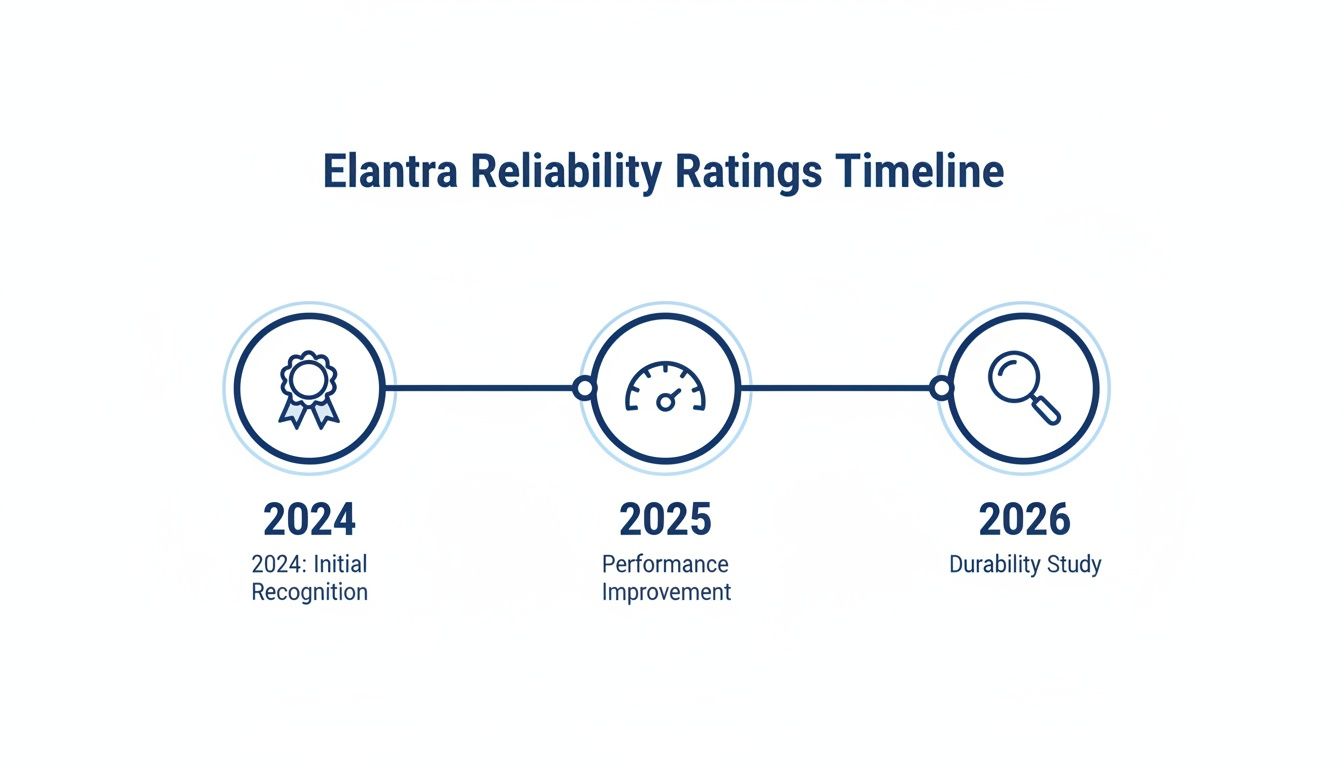
You can see a clear trend here—newer models are gaining serious ground in performance and durability.
Model Years To Approach With Caution
Looking at owner complaints and repair data, a few model years stand out as ones you should approach with extra caution. If you see one of these on a used car lot, it’s time to put on your detective hat.
- 2011-2013 Elantras: These are the poster children for the infamous “Theta II” engine problems. That ticking sound you might hear isn’t just a quirk; for many, it was the first sign of complete engine failure.
- 2017 Elantra: This model year saw a number of complaints about transmission hesitation and a few electronic glitches. It’s a year where a thorough inspection is crucial.
It’s important to separate isolated incidents from a clear pattern of defects. While any used car can have issues, like the common problems found in the 2012 GMC Acadia, the 2011-2013 Elantras have the most consistent and serious track record of complaints.
When you’re shopping for a used Elantra—especially one from these problem years—getting a pre-purchase inspection from a mechanic you trust isn’t just a good idea, it’s essential. A pro can often spot the early warning signs of engine or transmission trouble that you might miss.
By sticking with newer models, especially from 2018 onward, you can dramatically lower your chances of running into these known issues. Hyundai really stepped up its game in later generations, and the improved reliability scores prove it. A little homework goes a long way in making sure the Elantra you choose is a dependable one.
How Hyundai’s Warranty Shapes The Ownership Experience
A car’s reliability isn’t just about its track record; it’s also about how much faith the manufacturer has in its own product. This is where Hyundai really steps up and puts its money where its mouth is. Their warranty isn’t just a selling point—it’s a core piece of the Elantra’s value and a huge confidence boost for buyers.
Think of it as a safety net for the most expensive and frustrating repairs. For many people, this coverage is the deciding factor, turning the question “are Hyundai Elantras reliable?” into a much less stressful one. It provides a serious financial buffer that’s hard to ignore, especially if you’re watching your budget.
A Closer Look At The Coverage
Hyundai’s warranty is legendary in the industry, often touted as “America’s Best Warranty.” It’s structured to protect owners from major mechanical headaches long after many other warranties have run their course.
The two pillars of this coverage for the first owner are:
- 10-Year/100,000-Mile Powertrain Limited Warranty: This is the big one. It covers the expensive stuff—the engine, transmission, and all the parts that make the car go—for a full decade or 100,000 miles.
- 5-Year/60,000-Mile New Vehicle Limited Warranty: This is your classic “bumper-to-bumper” warranty. It handles nearly everything else, from electrical components to the infotainment system.
This two-pronged approach provides an incredible amount of security. It means the most catastrophic potential repair bills are simply not your problem for years to come, which significantly lowers the real-world cost of owning the car. The peace of mind that comes with that is a huge benefit, especially for drivers who rely on their vehicle every single day.
The warranty is Hyundai’s promise, plain and simple. They are betting on the Elantra’s durability and backing that bet with one of the most solid guarantees you can find.
What This Means For Florida Owners
For anyone driving in Florida, this coverage is especially practical. Our mix of stop-and-go traffic and long, hot highway miles puts a ton of stress on a car’s engine and transmission. Knowing those critical systems are protected offers a real shield against sudden, unexpected repair costs.
Hyundai puts its full weight behind the Elantra, offering that 10-year or 100,000-mile powertrain coverage, a 5-year/60,000-mile limited warranty, and even three years of complimentary scheduled maintenance (up to 36,000 miles). It’s a package that makes the Elantra a serious contender, a fact often highlighted by reviewers like Car and Driver.
One last thing to keep in mind: even with a stellar warranty, a car’s value can take a hit after an accident. It’s smart to know your rights. We have a guide where you can learn more about diminished value claims and what you can do. At the end of the day, Hyundai’s warranty is a powerful asset that makes owning an Elantra a much more predictable and secure investment.
Understanding Elantra Safety Ratings And Recalls
When we talk about a car’s reliability, we’re not just talking about whether it will start every morning. True reliability is also about how well it protects you and your family if the worst happens. Navigating Florida’s hectic roads, from the I-4 crawl to the constant traffic on US-19, means you need a car built for safety. This is where we need to take a close look at the Hyundai Elantra’s performance.
Two major safety organizations put cars through the wringer to see how they stand up in a crash: the National Highway Traffic Safety Administration (NHTSA) and the Insurance Institute for Highway Safety (IIHS). Their ratings give us an unbiased, real-world picture of a car’s structural strength and its ability to keep passengers safe.
Interpreting Crash Test Results
The good news is, the Hyundai Elantra has a strong track record here. For years, it has consistently pulled in high marks from both organizations. Many recent models have even earned the coveted IIHS TOP SAFETY PICK award.
That’s not just a sticker for the window; it’s a big deal. It means the car scored high in a whole series of tough crash tests—front, side, roof strength, you name it. For a Florida driver, this means the Elantra is engineered to absorb and channel crash energy away from the people inside, giving you crucial peace of mind on every drive.
Recalls And Their Impact
Let’s be clear: no car company is perfect, and recalls happen to everyone, including Hyundai. A recall is issued when a potential safety defect is discovered in a specific batch of vehicles. While the word “recall” can sound scary, what really counts is how the manufacturer handles it.
The Elantra has seen its share of recalls over the years, for everything from minor electrical glitches to more significant engine issues. When Hyundai issues a recall, they notify owners and fix the problem for free at a dealership. It’s actually a sign that the safety oversight system is working. Just as you might study past 2013 Ford Focus recalls to understand its history, it’s smart for any potential Elantra buyer to run a VIN check for any open recalls before signing the papers.
A car with a recall history isn’t automatically a lemon. The critical step is making sure all the recall work has been completed by a certified dealer. That’s how you know it’s back to meeting its original safety standards.
If you own an Elantra, keeping its safety features in top shape is key. Newer models come loaded with Advanced Driver-Assistance Systems (ADAS) that use a network of cameras and sensors. It’s important to understand that things like a simple windshield replacement require a professional ADAS calibration after windshield replacement to ensure those safety systems work correctly.
At the end of the day, the Elantra’s solid safety ratings, combined with Hyundai’s process for handling recalls, help solidify its reputation as a dependable and secure car for today’s driver.
When A Vehicle Defect Becomes A Florida Legal Matter
Sometimes, the question of whether a Hyundai Elantra is reliable moves out of the mechanic’s garage and into the courtroom, especially after a serious accident in Florida. A car crash isn’t always as simple as one driver making a mistake. The situation gets a lot more complicated when a vehicle’s own failure plays a role in causing the wreck.
Think about it: what if the brakes suddenly fail on the interstate? Or an airbag that was supposed to protect you never deploys? When a critical engine part seizes up at 65 mph and you lose all control, the car’s reliability isn’t just a number anymore—it becomes the central piece of evidence in a legal claim.
Navigating The Legal Aftermath
In Florida, figuring out who is at fault after a crash like this requires a much deeper dive than a standard police report. Investigators need to scrutinize the vehicle’s entire history, from maintenance logs and recall notices to the manufacturer’s own internal data on known defects. A skilled legal team works to determine if the manufacturer was negligent in how they designed, built, or even repaired the vehicle.
This is precisely where having an experienced personal injury attorney is so important. They know how to ask the tough questions:
- Did an unaddressed engine recall on the Elantra directly contribute to the accident?
- Was a faulty sensor the real reason a collision avoidance system didn’t work?
- Did a known defect in the steering mechanism cause the driver to lose control?
When a car’s failure leads to injury, it’s not just an accident; it’s a potential case of product liability. The focus shifts from the drivers to the corporation that put the vehicle on the road, and proving that link is essential for victims to receive fair compensation.
An attorney’s job is to meticulously build that case, often working with automotive experts to prove the defect was a direct cause of the injuries. For victims here in Tampa, this process is crucial for recovering the costs of medical bills, lost income, and pain and suffering.
To better understand how these vehicle safety issues are handled, you can find more information in our guide to auto safety recalls.
Quick Answers to Your Elantra Reliability Questions
Let’s cut to the chase. When you’re researching a car, you want straightforward answers to the most important questions. Here’s what people most often ask about the Hyundai Elantra’s dependability.
Which Hyundai Elantra Years Are The Most Reliable?
If you’re looking for the most dependable Elantras, your best bet is the newest generation, covering the 2021-present model years. Hyundai has really dialed in the engineering on these, ironing out many of the kinks from older versions. The previous generation (2017-2020) is also a solid choice, earning high marks for its overall performance and reliability.
On the flip side, you’ll want to be extra careful with the 2011-2013 models. These specific years had a higher-than-average number of complaints about engine and transmission issues. If you’re looking at one of these, a thorough pre-purchase inspection by a trusted mechanic isn’t just a good idea—it’s essential.
How Does Elantra Reliability Compare To A Corolla Or Civic?
The Elantra goes head-to-head with the heavyweights of the compact sedan world: the Toyota Corolla and Honda Civic. For decades, those two have been the benchmark for reliability, and that reputation is well-earned.
But here’s the thing—the modern Elantra has closed the gap significantly. It now pulls down reliability scores that are right on par with its main rivals. Where the Elantra really shines, though, is its warranty. That 10-year/100,000-mile powertrain warranty is a massive confidence booster that its competitors just don’t offer, giving it a real advantage in long-term peace of mind.
Are Hyundai Elantra Repairs Expensive?
Not at all. The cost to maintain and repair a Hyundai Elantra is typically average, or even a little below average, for a car in its class. Parts are easy to find and reasonably priced, and you won’t need a specialist mechanic to work on it.
The real game-changer here is Hyundai’s warranty. It acts as a financial backstop, protecting you from the most catastrophic (and expensive) engine or transmission repairs. This dramatically lowers the risk of getting hit with a huge, unexpected bill.
When you combine fair repair costs with that industry-leading warranty, the Elantra makes a very strong case for itself as an economically smart and reliable vehicle.
If a vehicle defect or failure leads to an accident and injuries, you need a legal team that understands how to hold manufacturers accountable. The attorneys at Martin Hernandez, P.A. are dedicated to helping victims in Tampa fight for the compensation they deserve. Contact us for a free consultation to discuss your case at https://injurylawyersoftampa.com.