
So, you’re wondering if a Smart car is reliable. The short answer? It really comes down to the job you’re hiring it for. If you need a nimble little vehicle for navigating Tampa’s city traffic and tight parking spots, a Smart car can absolutely be a trusty sidekick. But if you’re planning on racking up serious miles on the highway, it’s probably not the right tool for the job.
Deconstructing Smart Car Reliability
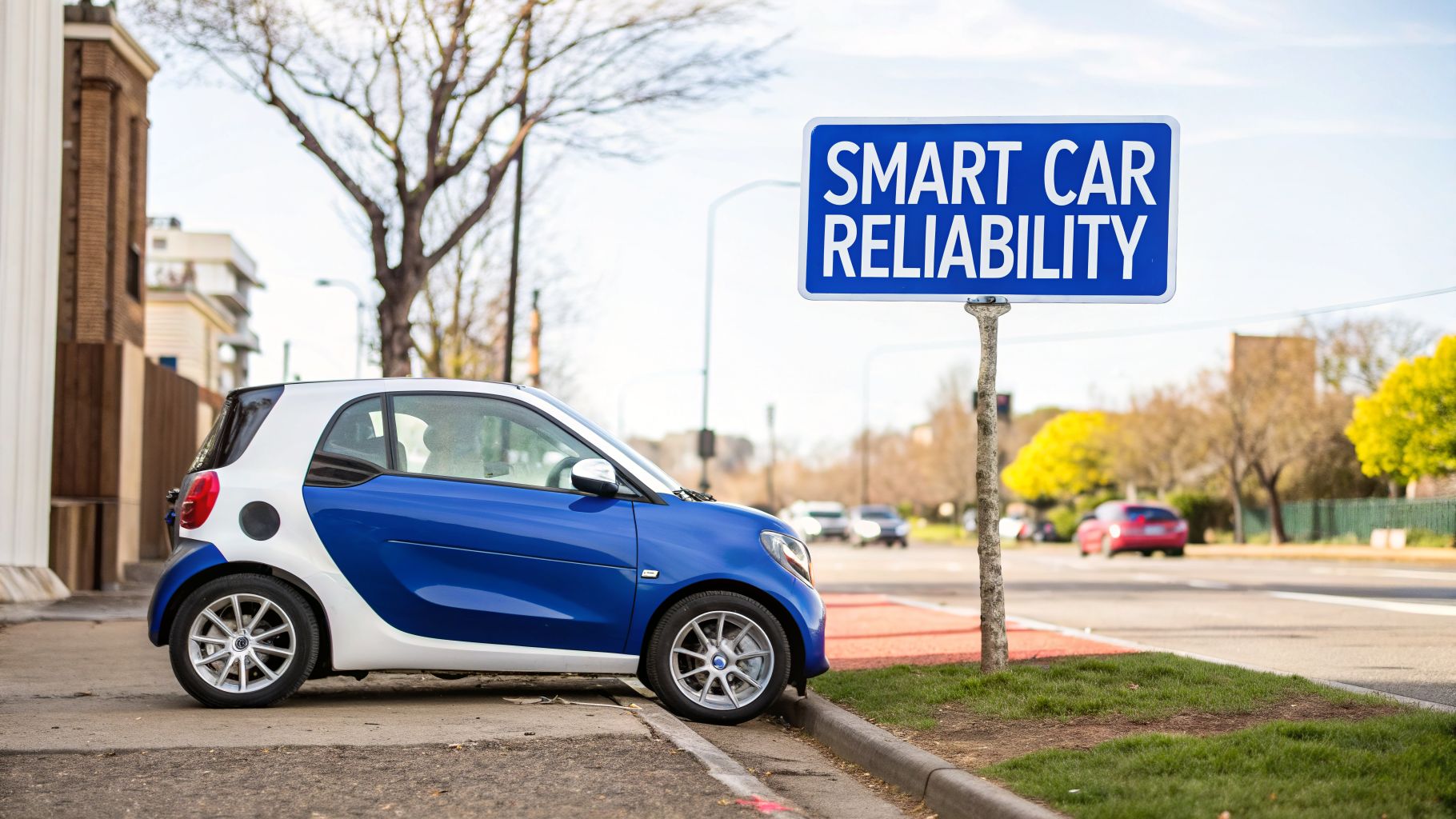
Before we get into repair stats and owner experiences, it’s important to clear something up. The term “smart car” gets thrown around a lot these days, and it can mean two very different things.
- The Smart Brand: This refers to the actual car brand, famous for its tiny two-seater, the Smart Fortwo. It’s the one you see squeezing into impossible parking spaces.
- Modern “Smart” Cars: This is a catch-all term for any new vehicle loaded with advanced tech—think AI, driver-assist systems, and constant connectivity. We’re talking about Teslas, Rivians, and the latest connected models from nearly every major automaker.
For this guide, we are focusing squarely on the Smart car brand. We’ll break down what reliability really looks like for these unique microcars, especially for those of us driving in Florida.
Lifespan and Long-Term Durability
One of the first questions on any potential owner’s mind is longevity. Just how many miles can you expect to get out of a Smart car? The data shows a vehicle built for a specific purpose: urban life.
An in-depth analysis of over 300 million vehicles found that the Smart Fortwo convertible has an average lifespan of just 79,640 miles. What’s really telling is that the study found a 0% chance of one reaching 200,000 miles, which underscores its limitations for high-mileage drivers. Even with that, it still scored a respectable 7.9 out of 10 reliability rating for its intended city-dwelling role.
It helps to think of it this way: a Smart car is like a specialized tool. It’s the pair of track spikes you’d use for a short, fast sprint—perfect for zipping around town. A Honda or Toyota, on the other hand, is like a durable pair of running shoes built for the long-haul endurance of a marathon.
Evolving Brand and Future Models
The Smart brand itself has been going through some big changes. It started as a project under Mercedes-Benz but has since become a joint venture with Geely, a major Chinese automotive company. This new partnership is pushing the brand toward all-electric models that are larger and more like conventional cars than the classic Fortwo.
For example, the launch of the new Smart 5 model shows the brand is now aiming to compete directly with popular EVs, stepping away from its original microcar identity. This evolution will almost certainly impact future reliability ratings and what it’s like to own one. As you continue reading about repair costs and common issues, keep this brand shift in mind. You can also see how other vehicles stack up by checking out our guide on other vehicle auto reviews and consumer reports.
Understanding the Real-World Cost: Reliability Ratings and Repairs
When you’re car shopping, it’s easy to see a reliability score and just gloss over it. It’s just another number, right? But these ratings are the closest thing you’ll get to a crystal ball for your future budget.
Think of a reliability rating as a car’s financial report card. It’s not just a simple pass or fail grade; it gives you a surprisingly clear forecast of how often you’ll be making unplanned trips to the mechanic—and how much you should expect to spend when you get there. A strong score means fewer surprise bills and more worry-free miles.
Turning the Scores into Dollars and Cents
So, where does the Smart car land on this report card? The results are actually pretty encouraging. According to RepairPal’s in-depth analysis, the Smart brand does quite well, ranking 10th out of 32 car manufacturers.
They gave the brand a solid 4.0 out of 5.0 reliability score. This “Excellent” rating isn’t just a number; it’s based on some impressive real-world data:
- The average annual repair cost is just $751.
- Owners make an average of only 0.3 unscheduled shop visits per year.
- Just 8% of those repairs are considered “severe,” which is well below the 12% average across all car models.
You can dig into the specifics yourself right on the RepairPal reliability report. What this really means is that the average owner might only face an unexpected repair issue once every three years or so. That’s a track record many other car owners would envy.
It helps to think of your car’s maintenance budget like your own health. That $751 annual cost is your budget for routine check-ups and the occasional minor cold. The low severity rate means you’re far less likely to face a sudden, expensive “major surgery,” like a complete engine or transmission replacement.
What Does That $751 Annual Cost Actually Pay For?
That $751 figure isn’t for one big, scary breakdown. It’s an average spread across the small, predictable jobs that every car needs to stay in good shape. Typically, this covers things like:
- Routine Upkeep: Think oil changes, new filters, and checking the brake pads. These are the standard tasks that keep any car running well.
- Minor Electrical Fixes: Every now and then, a sensor, window switch, or light might act up. These are usually quick and relatively cheap to fix.
- Wear-and-Tear Parts: Components like belts, hoses, and spark plugs don’t last forever. Replacing them is a normal part of vehicle ownership.
Of course, this is just an average. Some years you’ll spend less, and another year might bring a more costly repair. But the key takeaway from the data is that catastrophic, budget-destroying failures are rare for Smart car owners.
As with any specialized vehicle, staying on top of maintenance is key. For example, if you’re cross-shopping compacts, it’s interesting to see how they stack up. We did a similar breakdown exploring whether Hyundai Elantras are reliable that offers a useful comparison.
At the end of the day, the numbers show that while a Smart car isn’t built for cross-country road trips, its day-to-day running costs are predictable and manageable. For city drivers who value low-maintenance ownership, it’s a financially sound choice.
Common Problems Smart Car Owners Face
While Smart cars get decent marks for avoiding the kind of catastrophic engine failures that send a car to the junkyard, they are far from perfect. Every car has its quirks, and the Smart car is no exception. Think of it this way: the car’s basic structure is solid, but you need to be aware of the specific gremlins that tend to pop up.
Knowing what to look for is half the battle. For potential buyers, this list is your pre-purchase inspection cheat sheet. For current owners, it’s about catching small issues before they snowball into bank-breaking repairs. This is what truly answers the question, “are Smart cars reliable?” in the real world.
Transmission and Clutch Issues
Talk to any longtime Smart car owner, and you’ll almost certainly hear complaints about the transmission. This is, without a doubt, the car’s most talked-about frustration, especially in the older gasoline models. The issue stems from its unique “automated manual transmission”—it’s not a smooth, conventional automatic. Instead, it’s a manual gearbox operated by a computer, and the results can be… unrefined.
The most common symptom is jerky or delayed shifting. You’ll feel the car hesitate or lurch as it moves between gears, which can make navigating stop-and-go Tampa traffic a real chore. This is usually the first sign of a failing clutch actuator, a repair that can set you back anywhere from $300 to over $1,000.
A worn clutch actuator is a known weak point. Owners report needing to replace this part as early as 40,000-60,000 miles. Ignoring the warning signs of rough shifting can lead to premature wear on the entire clutch assembly, turning a moderate repair into a much costlier one.
On a related note, the clutch itself can wear out prematurely. Because the shifting is automated, you can’t “baby” it the way you might with a true manual. This leads to faster wear and tear, and a full clutch replacement is a big job, typically costing between $1,500 and $2,500.
Electrical Gremlins and Sensor Failures
Like most modern cars, Smart cars are packed with electronics, and sometimes those circuits get crossed. These electrical bugs aren’t always wallet-busters on their own, but they can be maddening to diagnose and live with day-to-day.
Here are a few of the usual suspects:
- Faulty SAM Unit: The Signal Acquisition and Actuation Module is the car’s electronic nerve center. When it goes on the fritz, all sorts of bizarre things can happen—from the lights misbehaving to the car refusing to start. Swapping out a SAM unit is a pricey fix, often in the $800 to $1,500 range.
- Sensor Malfunctions: Crankshaft sensors, O2 sensors, and wheel speed sensors are all common failure points. While the sensors themselves aren’t terribly expensive, the labor to pinpoint the bad one and replace it adds up. Expect a bill of around $200 to $400 for a typical sensor job.
- Key Fob Problems: It’s not uncommon for owners to find their key fob has forgotten the car, leaving them stranded. Getting a key reprogrammed or replaced at a dealership can cost $150 to $350.
This pattern of cascading issues isn’t unique to Smart. Once one system starts acting up, others often follow. You can see a similar trend in other vehicles, like the common issues found in the 2010 Subaru Forester in our detailed guide.
Other Mechanical Concerns
Beyond the big-ticket items, there are a few other mechanical weak spots to keep an eye on. These aren’t necessarily design flaws, but rather the realities of a car built with such compact and unique engineering.
The water pump on certain models has a reputation for giving out earlier than you’d expect. Oil leaks are another frequent sight, often seeping from the oil pan gasket or turbo lines. While no car is immune to leaks, these are specific things to look for on a Smart car. Catching them early can mean the difference between a simple gasket swap and a much more serious engine problem down the road.
How Safe Is a Smart Car in a Collision?
Let’s be honest: when you see a Smart car, the first thing you probably think is, “How could that tiny thing possibly be safe in a crash?” It’s a completely fair question. It looks like a David vs. Goliath situation on the road, but the answer isn’t what you’d expect. It all comes down to some brilliant engineering.
The entire safety philosophy of the Smart Fortwo is built around its Tridion Safety Cell. This isn’t just a marketing buzzword—it’s a high-strength steel cage that acts like a rigid, protective shell for the driver and passenger.
A great way to think about the Tridion cell is like the shell of a nut. It’s designed to be incredibly tough and resist being crushed, protecting the important stuff inside. During a collision, this steel cage is engineered to distribute the force of the impact around the cabin, rather than letting it collapse inward.
This is a fundamentally different approach than most cars take. Instead of relying on large front and rear “crumple zones” to absorb energy, the Smart car’s design prioritizes the sheer strength of its core structure to keep the passenger area intact.
This visual shows how the Smart car’s safety systems are designed to work together to protect you during an accident.
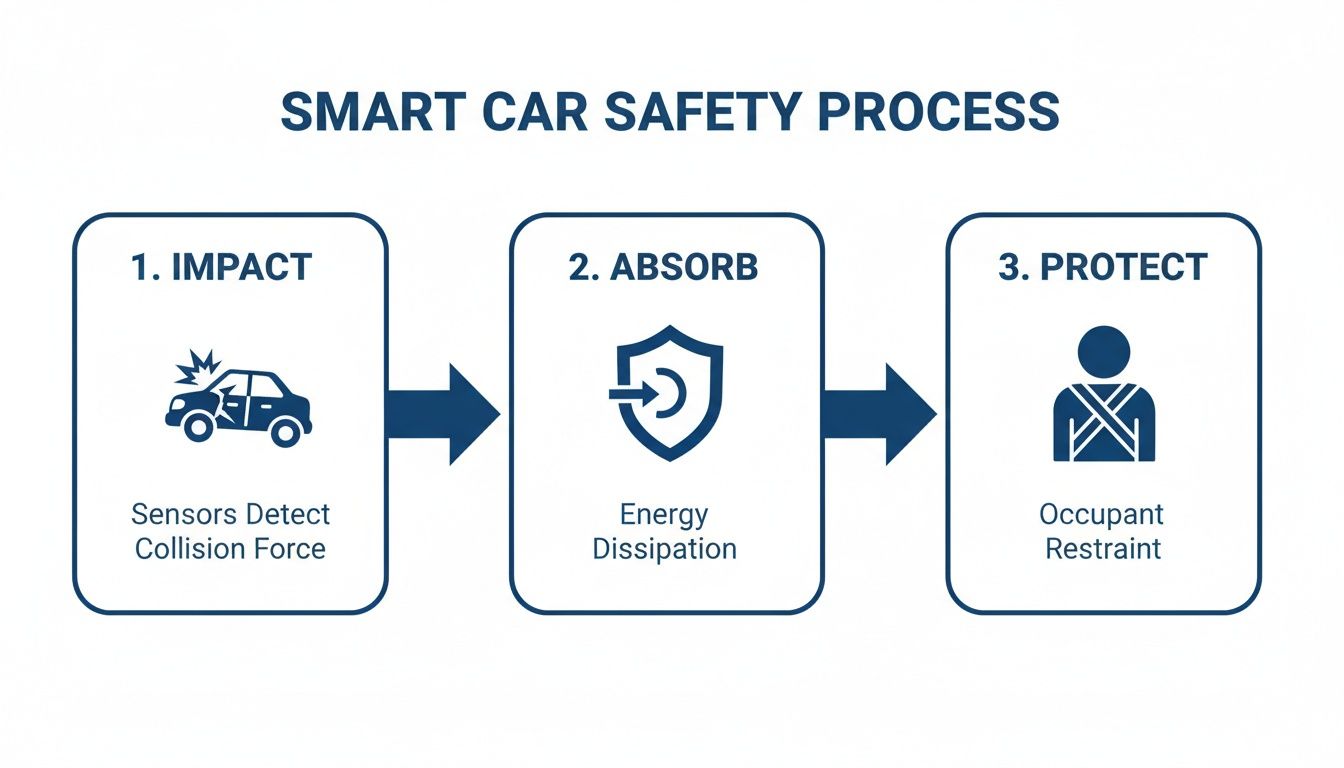
The process breaks down how the car first detects an impact, then uses its structure to absorb the energy, and finally protects the occupants from harm.
Crash Test Ratings and Real-World Physics
So, that’s the theory. But how does this little car hold up when it’s actually smashed into a barrier by the professionals? The Insurance Institute for Highway Safety (IIHS) put the Smart Fortwo through its paces, and the results are surprisingly good for a vehicle of its stature.
The Smart car earned the top rating of “Good” in several critical tests:
- Moderate overlap front test: Simulates a head-on crash with a vehicle of a similar weight.
- Side impact test: Mimics getting T-boned by a small SUV.
- Roof strength test: Measures how well the car protects occupants in a rollover.
These results prove that the Tridion cell really works as intended. But here’s the reality check: you can’t cheat the laws of physics. When the IIHS tested the Smart car against much larger vehicles, the results were more sobering. The massive difference in weight means the people inside the smaller car will always be subjected to greater forces.
Even though the safety cell held its shape, the IIHS noted the forces transferred to the crash test dummies were significant. That’s the unavoidable truth of driving a microcar—it’s engineered to be as safe as possible for its size, but it can’t magically erase the physics of a collision with a full-size truck or SUV.
Standard Safety Features
Beyond its tough-as-nails frame, the Smart car also came packed with safety features that were quite advanced for its class. These systems all work together to help you avoid a crash in the first place, or to minimize injuries if one becomes unavoidable.
Most models came standard with:
- Eight standard airbags: This includes knee airbags, something you don’t always find as standard equipment, even in bigger cars.
- Electronic Stability Program (ESP): A critical feature for a car with a very short wheelbase, ESP helps prevent skids and keep the driver in control.
- Anti-lock Braking System (ABS): This stops the wheels from locking up during a hard brake, so you can still steer to avoid an obstacle.
It’s clear the designers put a lot of thought into safety. For any car owner, staying on top of potential safety issues is just smart practice. You can learn more about auto safety recalls in our comprehensive guide to see what you should be watching for with any vehicle you own.
At the end of the day, the Smart car is much safer than its small size would lead you to believe. Its impressive IIHS scores show that its unique design is effective at protecting its occupants. Still, anyone behind the wheel needs to be mindful of the inherent risks of driving a very small car, especially on highways filled with much larger vehicles.
What to Do After a Smart Car Accident in Tampa
Getting into an accident is always a shock, but when you’re in a Smart car, the experience can feel even more intense. Here in the Tampa area, these compact vehicles are fantastic for navigating city streets, but their small size can become a real point of contention after a crash.
Insurance adjusters and even other drivers might make unfair assumptions based on the car’s size alone. That’s why it’s absolutely critical to know exactly what to do to protect yourself, both physically and legally.
Immediate Steps to Take at the Scene
After the initial impact, your first thought should be safety. Once you’ve made sure everyone is out of immediate danger, you need to shift into evidence-gathering mode. In Florida, you’re legally required to report any crash involving injury, death, or at least $500 in apparent property damage.
Here are the first things you need to do:
- Get to a Safe Spot: If you can, move your Smart car off the road and onto the shoulder. Flip on your hazard lights immediately.
- Call 911: Always report the accident. This gets police and, if needed, paramedics on their way. An official police report created in Hillsborough County is a vital piece of evidence for any future claim.
- Exchange Key Information: Swap details with the other driver—get their name, address, phone number, driver’s license, and insurance policy information. Stick to the facts. Don’t apologize or get into an argument about who was at fault.
- Document Everything: This is huge. Use your phone to take as many pictures and videos as you can. Get shots of the damage to both cars from every angle, any skid marks on the pavement, nearby traffic signs, and the weather conditions. Don’t forget to photograph any visible injuries.
Knowing the right steps after a car accident can make all the difference in how the next few weeks and months play out.
Understanding Florida’s No-Fault System
Now for the part that trips a lot of people up: Florida is a “no-fault” state. This doesn’t mean no one is to blame. It simply means you have to go through your own insurance first for your initial medical expenses and lost income, no matter who caused the wreck.
This is handled by your Personal Injury Protection (PIP) coverage.
Your PIP policy will cover up to $10,000 in benefits. But there’s a catch: you absolutely must get medical attention within 14 days of the crash. If you miss that two-week window, you could lose your right to those benefits completely.
That $10,000 can get eaten up surprisingly fast, especially if your injuries are serious. Once your PIP is exhausted, you can then pursue the at-fault driver’s insurance for the rest of your costs.
When to Contact a Personal Injury Attorney
You should think about calling a lawyer much earlier than you might expect, particularly after a wreck in a Smart car. An insurance adjuster might see the small vehicle and try to argue your injuries can’t possibly be that bad, or that the car itself is to blame. It’s a common tactic used to undervalue your claim.
Reach out to a Tampa personal injury attorney if any of these situations apply to you:
- You were injured in any way. What feels like minor soreness can easily turn into a chronic, long-term problem. An attorney makes sure your medical care is properly documented from the start.
- The other driver was clearly at fault. If they were texting, speeding, or blew through a red light, you have the right to seek compensation for damages beyond your medical bills, like pain and suffering.
- The insurance company is giving you the runaround. If they are delaying, denying, or lowballing your claim, you need an advocate to fight back.
- Your medical bills are going to exceed your $10,000 PIP limit. A lawyer will begin the process of holding the at-fault driver’s insurance accountable for the rest.
The legal side of a car accident is complicated and can be overwhelming. To get a better feel for the road ahead, take a look at our complete guide on what to do after a car accident in Florida. Having an attorney on your side levels the playing field and lets you focus on what really matters: getting better.
Smart Car Reliability: Answering Your Lingering Questions
We’ve dug into repair costs, common mechanical headaches, and even what to do after a crash. But you probably still have a few practical questions rattling around. Let’s tackle the most common “what if” scenarios people have when considering a Smart car. Think of this as the final gut-check before you make a decision.
We’ll clear up some of the real-world concerns that come up time and again, especially for drivers here in Florida.
Is a Used Smart Car a Good Buy in Florida?
It absolutely can be, but you have to be a much savvier shopper than if you were buying, say, a used Camry. The secret is knowing exactly what to look for. Since these cars often tap out under 80,000 miles, you should only be considering low-mileage examples that come with a stack of service records.
You need to be almost obsessive about the maintenance history for the transmission and clutch. These are the car’s known Achilles’ heels, and solid proof of proper care is a deal-breaker. If a seller can show you receipts for a new clutch actuator or has records of consistent transmission service, that’s a massive green flag.
Don’t forget, Florida’s relentless, year-round heat is tough on any car. For a Smart car, that means the air conditioning system, battery, and various electronic sensors are under constant stress. A pre-purchase inspection from a mechanic who actually knows these quirky cars isn’t just a good idea—it’s your best defense against buying a lemon.
For someone who sticks to city streets in places like Tampa, St. Pete, or Miami, a well-cared-for, low-mileage Smart Fortwo is still one of the most economical and easy-to-park cars out there. It’s a fantastic choice for its very specific job, as long as you do your homework first.
How Does Smart Car Reliability Stack Up Against Toyota or Honda?
Putting a Smart car’s reliability next to a Toyota or a Honda is like comparing a specialized tool to a multi-tool. Both are useful, but they were built for completely different jobs and have different strengths.
Brands like Toyota and Honda built their reputations on marathon-like longevity and all-around toughness. Their cars are engineered to blow past the 200,000-mile mark with little more than routine oil changes and basic upkeep. They’re designed to be dependable workhorses for everything from the daily grind to cross-country road trips.
A Smart Fortwo’s reliability is measured differently. As the data from RepairPal suggests, its reliability shines in having fewer unexpected trips to the shop and less-severe problems when they do pop up. It’s not about lasting forever; it’s about being less likely to ambush you with a random, eye-watering repair bill during its lifespan.
Here’s another way to look at it:
- A Honda Civic is like a solid pair of all-purpose hiking boots. They’re built to last, they’re comfortable, and you can trust them on almost any terrain.
- A Smart Fortwo is more like a pair of sprinter’s track spikes. They are unbeatable for short, fast bursts in a controlled environment (the city), but you’d never choose them for a long-distance trek.
So, while a Toyota will almost certainly last longer, a well-maintained Smart might give you fewer surprise headaches during its shorter time on the road.
Can a Smart Car Really Handle Florida Highway Driving?
Sure, a Smart Fortwo is legally allowed on any highway in Florida, including I-4, I-75, and I-95. But just because you can do something doesn’t always mean you should.
The Smart car’s entire design makes it feel like a fish out of water at highway speeds. Its tiny wheelbase and light frame make it incredibly vulnerable to strong crosswinds and the powerful air displacement—the “bow wave”—from passing semi-trucks. It can be a white-knuckle experience, forcing you to constantly correct the steering just to stay in your lane.
On top of that, the small engine has to scream to maintain 70 mph, especially on an incline. This creates a ton of cabin noise and puts a huge amount of sustained stress on the engine and transmission. Driving it like this regularly goes against everything that makes the car reliable for its intended purpose.
While it can handle a quick jump on the interstate to get from downtown Tampa to the suburbs, it is not a comfortable or confidence-inspiring car for daily, long-haul highway commutes. You’ll preserve your Smart car’s reliability—and your own sanity—by keeping it in the city and suburban environments it was born to rule.
Are Modern Cars with ‘Smart’ Tech More Reliable?
This is a really important distinction to make. There’s a world of difference between the Smart brand car and a modern “smart” car packed with AI-driven navigation, advanced driver-assist systems (ADAS), and giant touchscreens. The answer to which is more “reliable” really boils down to how you define the word.
The mechanical bits—the engine, transmission, and chassis—of a new car from a brand like Tesla or Hyundai can be incredibly solid. An electric motor, for instance, has dramatically fewer moving parts than a gasoline engine, which means fewer things can physically break.
However, the mind-boggling complexity of the software and electronics in these “smart” cars opens up a whole new can of worms. Owners of new, tech-heavy vehicles often complain about problems that a Smart Fortwo owner couldn’t even imagine:
- Software Glitches: Infotainment screens that freeze up, go black, or decide to reboot in the middle of a drive.
- Sensor Malfunctions: Parking sensors that shriek for no reason or phantom collision warnings that slam on the brakes.
- Connectivity Headaches: The car’s app won’t connect, the keyless entry is on the fritz, or a software update fails and bricks the system.
These aren’t usually as expensive as a blown transmission, but they can be maddeningly frustrating and make the car feel unreliable on a day-to-day basis. A new “smart” car might have a bulletproof powertrain but feel like it’s constantly broken because of software bugs. The Smart Fortwo, in contrast, is a much simpler, more analog machine with far fewer digital gremlins to worry about.
Figuring out what to do after a car accident is confusing, especially when you’re hurt and facing down insurance companies. At Martin Hernandez, P.A., we have extensive experience fighting for people in Tampa who have been injured because of someone else’s carelessness. If you’ve been hurt in any kind of auto accident, you don’t have to go through it alone. We prepare every case for trial from the very beginning and are dedicated to getting you the full compensation you are owed. Contact us for a free, no-obligation consultation to understand your rights by visiting us at https://injurylawyersoftampa.com.