
Finding the right auto insurance for seniors in Florida isn’t about just getting a standard plan; it’s about making your policy work for your retirement lifestyle. It means using your years of driving experience to your advantage to get better rates and making sure your coverage truly protects your financial future. When you understand Florida’s specific rules and the discounts available, you can often lower your premiums by a surprising amount.
Securing Affordable Auto Insurance in Retirement
Let’s be honest, car insurance can feel like a maze, especially when you’re moving into retirement. The great news? This new chapter in your life often comes with changes that can lead directly to big savings. For many Florida seniors, retirement means no more rush-hour commutes and more flexibility, which almost always means fewer miles on the odometer.
This change in driving habits is your golden ticket. Insurance companies see lower annual mileage as lower risk, and that can translate directly into lower premiums. Your decades of experience on the road are also a huge plus, as many insurers offer great discounts for a long, safe driving record. The trick is knowing how to make all these factors count.
Three Keys to Better Senior Car Insurance
Getting a better, more affordable policy really comes down to understanding three key things. Each one is crucial for building a plan that fits your life without breaking your budget. It’s a common question we hear from drivers, and you might find yourself wondering, am I paying too much for Florida auto insurance? This guide is designed to help you figure that out.
Here are the key areas we’ll dig into:
- Understanding Florida’s Rules: The Sunshine State has its own set of insurance laws. Getting a handle on the basics, like Personal Injury Protection (PIP), is the foundation of a solid policy.
- Unlocking Senior-Focused Discounts: Beyond the usual safe driver rewards, there are specific discounts for mature drivers, low mileage, and bundling policies that can really add up.
- Tailoring Coverage to Your Lifestyle: Your insurance needs have likely changed. We’ll look at how adjusting your coverage limits or removing extras you no longer need (especially on a paid-off car) can fine-tune your policy.
By focusing on these three areas, you can stop feeling unsure about your auto insurance and start feeling confident you have a plan that protects you, your vehicle, and your peace of mind.
Decoding Florida’s Essential Insurance Coverages
Trying to make sense of an auto insurance policy can feel like you’re learning a whole new language. But here’s the truth: understanding your policy is the most powerful tool you have to protect yourself.
Think of your insurance not as one single thing, but as a bundle of different shields. Each shield is designed to guard you against a specific financial hit after a crash. In Florida, the law says you have to carry a couple of these shields, but the smartest drivers know the optional ones are often just as crucial.
Let’s pull back the curtain on the key pieces of a solid auto insurance for seniors policy. When you know what each part does, you can build a strong defense for your savings and assets, ensuring you’re actually covered when you need it most.
The Foundation: Personal Injury Protection
First up is Personal Injury Protection, or what everyone in Florida just calls PIP. This is your first line of defense. Every driver in the state is required to have it, and it’s designed to cover your own medical expenses right after an accident, no matter who was at fault.
This is the cornerstone of Florida’s “no-fault” system. The whole point is to get you medical care quickly without having to wait weeks or months for insurance companies to argue about who caused the wreck.
PIP covers 80% of your initial medical bills and 60% of your lost wages, all up to a $10,000 limit. That immediate access to funds is what gets the bills paid for emergency room visits, follow-up doctor’s appointments, and other initial care. To get a deeper dive, you can learn more about what Personal Injury Protection insurance is and see why it’s the bedrock of your coverage.
Covering Damage to Other People’s Property
The second piece of legally required coverage is Property Damage Liability (PDL). While PIP takes care of your injuries, PDL pays for the mess you make to someone else’s property if you cause an accident. We’re not just talking about their car—this could be a mailbox, a fence, or even the side of a building.
The state minimum for PDL is only $10,000. Frankly, that’s nowhere near enough. Think about it: a brand-new car can easily cost $30,000 or more. If you’re at fault in a pile-up, that $10,000 limit will disappear in a flash, and you’ll be on the hook for the rest.
Why the “Optional” Coverages Are Not Really Optional
Relying on just the state-mandated PIP and PDL leaves you dangerously exposed. This is where the so-called “optional” coverages come in, and for any senior looking to protect their retirement, they are absolutely essential.
Bodily Injury Liability is, without a doubt, one of the most important coverages you can buy. If you cause a crash that injures someone else, this is what pays for their medical bills, lost income, and pain and suffering. More importantly, it protects you from a life-altering lawsuit.
Let’s play this out. Imagine you cause an accident and the other driver’s medical bills hit $80,000. Without Bodily Injury Liability, you’re getting sued personally for that entire amount. Your home, your savings, everything you’ve worked for could be at risk. This coverage is the firewall that stands between a bad day on the road and your financial future.
Another critical piece of the puzzle is Uninsured/Underinsured Motorist (UM/UIM) coverage. This is your personal safety net.
- Uninsured Motorist (UM): Kicks in to protect you when you’re hit by a driver with no insurance at all.
- Underinsured Motorist (UIM): Steps up when the at-fault driver has insurance, but their policy limits are too low to cover all of your medical bills.
Think of UM/UIM as a backup plan that you buy for yourself. It covers your medical costs, lost wages, and suffering when the person who hurt you can’t pay. With so many uninsured drivers on Florida’s roads, skipping this coverage is a gamble you don’t want to take.
By putting these pieces together—the required PIP and PDL, plus the vital layers of Bodily Injury and Uninsured Motorist coverage—you can build a policy that does what it’s supposed to do: truly protect you.
Finding Every Senior Discount You Deserve

After decades behind the wheel, you’ve earned more than just experience—you’ve earned the right to more affordable auto insurance. Insurance companies reward responsibility, and as a senior driver, you’re sitting on a goldmine of potential savings. It’s time to dig deeper than the standard offers and find the discounts specifically available to you here in Florida.
Many seniors just assume their rates are set in stone, but that couldn’t be further from the truth. By knowing what to ask for and advocating for yourself, you can often knock a surprising amount off your annual premium. You just have to be your own best advocate.
Turn Your Experience into Savings
One of the easiest wins is completing a state-approved mature driver safety course. Don’t worry, this isn’t about re-learning how to parallel park. These courses are designed to be a quick refresher on modern defensive driving techniques and new traffic laws.
In Florida, finishing one of these courses legally requires your insurer to give you a discount that can last for up to three years. It’s a small investment of time for a guaranteed return, and it shows your insurance company you’re serious about safety.
Another huge area for savings comes from lifestyle changes, especially after retirement. Your driving habits have probably changed quite a bit.
- Low-Mileage Discounts: No more daily commute? If you’re driving less, you should be paying less. Many insurers offer a nice break for those who drive under a certain threshold, often around 7,500 to 10,000 miles per year.
- Usage-Based Insurance (UBI): This is a more modern approach that rewards you for how you drive, not just how much. A small device in your car or a smartphone app tracks things like smooth braking and acceleration. Good habits can translate directly into great discounts.
These “pay-as-you-drive” programs are a great fit for cautious senior drivers who want their rates to reflect their actual behavior on the road. It’s a trend that rewards real-world safety, and you can see how it’s changing the industry in the latest findings on U.S. auto insurance trends from J.D. Power.
Your Discount Checklist
Finding the best auto insurance for seniors means being proactive. Don’t sit back and wait for an agent to offer up savings—you need to ask for them directly. Think of this checklist as your script.
Remember, insurance companies can offer all sorts of discounts, but they aren’t legally required to. It’s on you to ask about them and make sure you’re getting every single one you qualify for.
Before you sign on the dotted line, run through these specific questions:
- Do you offer a discount for taking a mature driver safety course? What are the exact requirements?
- What are your annual mileage limits for a low-mileage discount, and how do I prove I meet them?
- Can I save money by bundling my auto policy with my home or renter’s insurance?
- Is there a loyalty discount for customers who have been with you for a long time?
- Do you give discounts for members of certain organizations, like AARP?
- How much can I save with my car’s safety features, like anti-lock brakes, airbags, or an anti-theft system?
Having the answers to these questions puts you in the driver’s seat. It gives you the power to truly compare apples to apples when you’re doing an auto insurance rates comparison and find the absolute best deal.
How Your Health and Age Affect Your Premiums
Let’s be honest—it’s not always comfortable to discuss how getting older might affect things like driving. But when it comes to car insurance, understanding this connection is the key to keeping your rates fair and affordable. Insurance is all about risk, and as we age, certain natural changes can be seen by insurers as potential risks.
This isn’t personal. It’s just how their numbers game works. The great news is that by understanding why they see it this way, you can flip the script. You can highlight your decades of driving experience and prove you’re a safer bet than the statistics might suggest.
An Honest Look at Age-Related Risk
From an insurance company’s viewpoint, older drivers are a mixed bag. On one hand, they know you’re probably more cautious, less likely to speed, and far less prone to texting and driving than younger generations. That’s a huge plus.
But on the other hand, their actuaries are paid to look at broad statistics that point to potential age-related changes. They aren’t looking at you specifically, but at trends across millions of drivers.
These are the main factors on their radar:
- Changes in Vision: Things like cataracts or glaucoma can make it harder to see at night or catch something in your peripheral vision.
- Slower Reaction Time: It’s natural for reflexes to slow down a bit over the years, which can affect how quickly you react to a sudden stop or a swerving car.
- Cognitive Shifts: Minor changes in memory or how we process complex situations can sometimes come into play during stressful driving moments.
These elements create a complicated picture for insurers. While many seniors have stellar driving records, the data shows that when accidents do happen, they can sometimes be more severe. According to S&P Global, drivers aged 65 and older represent a huge portion of insured vehicles. Their data reveals a unique pattern: while accident frequency is often moderate, the severity of injury claims can be higher. You can learn more about these insurance risk characteristics from S&P Global.
Proving You’re Still a Great Driver
Just because an actuary has a spreadsheet doesn’t mean your fate is sealed. You have plenty of power to push back against age-based assumptions and prove you’re a low-risk driver.
The best defense is a good offense. Taking charge of your health and sharpening your driving skills gives your insurer concrete evidence that you’re a safe, responsible driver—exactly the kind of client they want.
Key Takeaway: Your personal driving record and a proactive attitude will almost always outweigh general age statistics. An insurer would much rather have a senior with a clean record who just took a safety course than a younger driver with a history of tickets.
Here are a few practical steps you can take:
- Get Regular Health Check-Ups: This is non-negotiable. Consistent eye exams and physicals are your best friend. A note from your doctor confirming you’re fit to drive is an incredibly powerful piece of paper to have.
- Take a Mature Driver Safety Course: We’ve mentioned this before, but it’s worth repeating. It’s not just about the discount; it’s about sending a clear message to your insurer that you are actively invested in safety.
- Acknowledge and Adapt to Changes: This shows incredible responsibility. If you notice driving at night is getting tougher, don’t force it. Sticking to daylight hours or familiar roads isn’t a sign of weakness—it’s a sign of a smart, safe driver.
When you take these actions, you’re building a strong case for yourself. You’re showing your insurance company that you’re an individual, not a statistic. This proactive approach can have a real impact on the average cost for car insurance you’re offered. If you’re looking at how health affects other types of coverage, you can also explore the best travel medical insurance for seniors to see similar principles at play.
Your Step-By-Step Guide After a Car Accident
No matter how many years you’ve been driving, a car accident is always jarring. The sudden shock and confusion can make it tough to think clearly. Knowing exactly what to do in the moments, hours, and days that follow is the key to protecting your health and your finances.
Let’s walk through the process, step by step, so you can handle the situation with confidence.
Your first thought should always be safety. Before you do anything else, check on yourself and your passengers. If anyone seems hurt, or if the cars are too damaged to move, call 911 right away.
If everyone is okay and the cars are drivable, try to move them to the side of the road, out of traffic. The last thing you want is to cause another collision. Flip on your hazard lights so other drivers can see you clearly.
What to Do at the Scene
Once you’re safely out of harm’s way, your role shifts to that of a careful fact-gatherer. The details you collect right here will become the bedrock of your insurance claim. It’s absolutely vital to stick to the facts and avoid getting into an emotional discussion about who was at fault.
Here’s a simple checklist to run through:
- Exchange Information Calmly: Get the other driver’s full name, address, phone number, and their insurance company details—don’t forget the policy number. Jot down the make, model, and license plate of their vehicle, and be ready to provide them with your information.
- Never Admit Fault: This is a big one. Even a simple, well-meaning “I’m sorry” can be twisted into an admission of guilt later. Let the police and the insurance companies figure out the details of what happened.
- Document Everything with Your Phone: Your smartphone is an incredible tool in this situation. Take wide shots of the entire scene, get close-ups of the damage to both cars from different angles, and snap photos of any skid marks, traffic signals, or road signs.
Think of yourself as a detective. Timestamped photos create a crystal-clear, objective record of the scene. This evidence is incredibly valuable for your insurance adjuster and helps shut down potential disputes before they even start.
Of course, the best way to handle an accident is to avoid one in the first place. Proactive safety is a three-part effort: staying on top of your health, getting regular vision check-ups, and keeping your driving skills sharp.
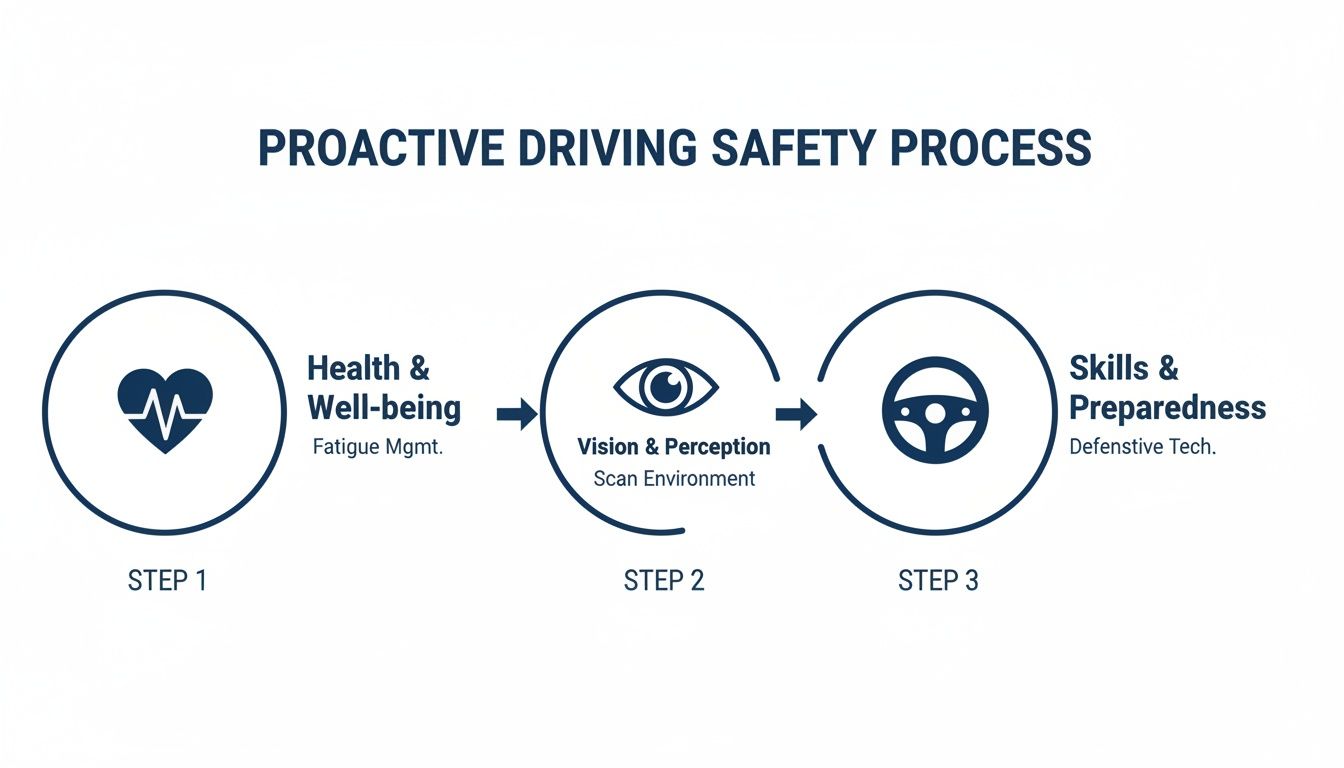
As the image shows, these three pillars—health, vision, and skills—are the foundation of safe driving for seniors.
Initiating Your Florida Insurance Claim
Once you’ve left the scene, it’s time to get the official process started. Here in Florida, your very first call should be to your own insurance company to open a Personal Injury Protection (PIP) claim. This is true no matter who was at fault—it’s how our “no-fault” system works.
Your PIP coverage is there to get your initial medical bills paid quickly, but you have to act fast.
You have a strict 14-day deadline to seek medical treatment after the accident. If you wait any longer, your insurance company can deny your PIP benefits entirely, leaving you to foot the bill.
Even if you feel perfectly fine, please get checked out by a doctor. The adrenaline rush from a crash is powerful and can easily hide injuries like whiplash or internal bruising that might not surface for hours or even days. A prompt medical visit creates an official record linking your condition to the crash.
Next Steps in the Days Following
With your health and initial report handled, there are a few more things to do. You’ll also need to report the accident to the other driver’s insurance company. When you do, give them only the basic, objective facts you gathered at the scene.
You can expect a call from their insurance adjuster. Just remember, that adjuster’s job is to save their company money. Stick to the facts, don’t guess or speculate about what happened, and never agree to give a recorded statement without first knowing your rights. For a deeper dive, our firm has a full guide on what to do after a car accident in Florida.
Finally, you’ll need to deal with vehicle repairs. It’s helpful to get a few estimates. When you do, understanding the choice between aftermarket parts vs. OEM (Original Equipment Manufacturer) can make a big difference. Your policy might specify which type of parts must be used for repairs, so knowing the pros and cons of each will help you navigate that conversation.
Common Questions We Hear About Senior Auto Insurance
As life changes, so do your insurance needs. It’s only natural to have questions about how things like retirement, health, and age might affect your policy. Let’s tackle some of the most common concerns we hear from Florida seniors to help you get clear, straightforward answers.
“Will My Premium Automatically Go Up When I Turn 70?”
This is a big one, and thankfully, it’s mostly a myth. Your insurance rates don’t automatically jump just because you hit a milestone birthday. The truth is much more nuanced.
While age is one of many factors in the pricing equation, it’s rarely the most important one. Your driving record, the car you drive, and how many miles you put on it each year usually carry far more weight. In fact, many seniors in Florida see their rates level off or even drop in retirement, especially if they’re driving less and keeping their record clean.
The bottom line is this: a long history of safe driving is your single most valuable asset. If you’re proactive and take a mature driver safety course, you can often completely cancel out any potential age-related rate adjustments your insurer might be thinking about.
“Should I Lower My Liability Limits to Save a Few Bucks?”
I know it’s tempting to look for quick ways to lower your monthly premium, but slashing your liability limits is one of the riskiest moves you can make. Your Bodily Injury liability coverage is the critical shield that protects your personal assets if you’re at fault in a crash that hurts someone else.
Without enough Bodily Injury coverage, everything you’ve worked a lifetime for—your home, your retirement savings, your nest egg—is on the line. If you cause a serious accident, you could be sued personally for the other driver’s medical bills, lost wages, and pain and suffering. Those costs can easily soar into the hundreds of thousands of dollars.
Instead of gutting this vital protection, look for smarter ways to save:
- Raise your deductible: Opting for a higher deductible on your collision or comprehensive coverage can bring your premium down.
- Hunt for every discount: As we’ve covered, discounts for low mileage, bundling policies, and safe driver courses really do add up.
- Re-evaluate your other coverages: Adjusting different parts of your policy might be a much safer path to savings.
“Do I Have to Tell My Insurer About a New Medical Condition?”
In Florida, the law is very specific. You’re only legally required to notify your insurance company about a medical condition if it results in a formal change to your driving status from the Florida Department of Highway Safety and Motor Vehicles (DHSMV). This would include things like a license restriction (like “no night driving”) or a full suspension.
However, the golden rule is that you must always be medically fit to drive safely. If you develop a condition that could potentially impair your driving, it is absolutely critical to follow your doctor’s professional advice. Getting behind the wheel against a doctor’s orders is not only dangerous, but it could also jeopardize your insurance coverage if you get into an accident.
“Is Full Coverage Worth It on an Older, Paid-Off Car?”
This is a great, practical question, and the answer comes down to simple math and your personal finances. “Full coverage” is just a shorthand term for having both collision (pays to fix your car after a crash) and comprehensive (covers theft, hail, etc.) policies.
A good rule of thumb is to think about dropping collision and comprehensive if the annual cost for that coverage is more than 10% of your car’s current cash value.
For example, let’s say your car is worth $4,000. If the full coverage part of your policy costs $500 per year, that’s 12.5% of the car’s value. In that scenario, it might make more sense to drop the coverage and put that $500 in savings for future repairs or a down payment on another car.
On the other hand, if having to replace that car out-of-pocket would be a major financial hardship, then keeping the coverage might be worth every penny for the peace of mind it buys. It’s a personal call based on your own risk tolerance and financial stability.
Navigating the aftermath of a car accident and dealing with insurance companies can be overwhelming. If you’ve been injured and aren’t sure of your rights or what to do next, the experienced team at Martin Hernandez, P.A. is here to help. We are dedicated to making sure our clients in Tampa and across Florida receive the full and fair compensation they deserve. Contact us today for a free, no-obligation consultation to discuss your case by visiting our website.