
If you want to do a proper auto insurance rate comparison, you first need to know what the insurance companies are looking at. The price you’re quoted isn’t just pulled out of a hat; it’s built on specific details about you, your car, and even your neighborhood. Getting a handle on these factors is the first step before you even start shopping around.
Key Factors Driving Florida Auto Insurance Rates

Before you can compare quotes apples-to-apples, you have to understand the rulebook insurers play by. They’re in the business of calculating risk, and every piece of information they collect helps them figure out how likely you are to file a claim.
Think of it this way: your final premium is their best guess at that risk. Understanding the ingredients they use to cook up that number will show you where you might have room to save.
Your Personal Profile
A huge piece of the puzzle is you. Insurers use demographic data to paint a picture of risk, meaning things like your age, where you park your car at night, and even your credit history all play a role in the final price.
- Driving Record and History: This one’s the heavyweight. A clean record—no at-fault accidents, no tickets, no DUIs—is your golden ticket to lower rates. Any recent blemishes tell an insurer you’re a higher risk, and your premium will reflect that.
- Geographic Location: Your ZIP code has a surprisingly big impact in Florida. Insurers track local claim data for everything from theft and vandalism to the frequency of collisions. Parking your car in a busy Tampa neighborhood will almost always cost more than in a quiet, rural town.
- Age and Driving Experience: Statistics don’t lie: younger, newer drivers get into more accidents. That means sky-high premiums until they get more experience under their belt. Rates usually start to drop in your late 20s but can creep back up for senior drivers.
- Credit History: Yes, in Florida, your credit matters. Insurers use what’s called a credit-based insurance score to help set rates. The thinking is that financial responsibility often goes hand-in-hand with responsible driving, so a better score can lead to a lower premium.
Your Vehicle and Its Use
It’s not just about who you are, but what you drive. A souped-up sports car and a reliable family minivan are two completely different animals from an insurance perspective, and they’re priced that way.
Your premium is a direct reflection of risk. Every factor, from the anti-theft devices on your car to the number of miles you drive annually, helps an insurer calculate the probability and potential cost of a future claim.
At the end of the day, the insurer is worried about how much it will cost to fix or replace your car if something happens. That’s why they look closely at:
- Vehicle Type: The make, model, and year are critical. Luxury cars, high-performance models, and brand-new vehicles simply cost more to repair or replace, so they cost more to insure.
- Safety and Anti-Theft Features: This can work in your favor. Cars with modern safety tech like automatic emergency braking or good anti-theft systems are less risky, and many insurers offer small discounts for them.
- Annual Mileage: The math is simple: the more you’re on the road, the higher the chance of an accident. Being honest about how many miles you drive each year is crucial for getting a quote that won’t change later.
Your Chosen Coverage and Limits
This is where you have the most direct control. While Florida has minimum insurance requirements, the specific coverage types and dollar limits you choose will have a massive impact on your final bill.
It’s no secret that Florida is one of the most expensive states for car insurance. Back in 2022, the national average expenditure for auto insurance was $1,127. In Florida? It was the highest in the nation at $1,625.
That huge difference is exactly why paying attention to your coverage is so important. If you want to dig deeper into why our state’s rates are so high, you can learn more in our guide on why car insurance is so expensive in Florida.
Getting Accurate Apples-to-Apples Insurance Quotes

Shopping for car insurance isn’t just about finding the lowest price. It’s about finding the best value. To do that, you have to make sure you’re comparing the exact same product from one company to the next. Without that baseline, you’re just looking at a jumble of random numbers, not the true cost of protection.
It’s easy to be tempted by a cheap quote. But that low number often hides dangerously low liability limits or a sky-high deductible that could become a financial disaster if you ever have to file a claim. To avoid that trap, every single quote you get needs to be built on the same foundation. It’s the only way to make a smart, informed choice.
Creating Your Comparison Framework
Consistency is everything. Before you even think about getting a quote, you need to decide precisely what coverage you want. This will be your template, your non-negotiable standard for every insurer you approach.
Don’t be vague. Simply asking for “full coverage” means nothing, as it can be interpreted differently by every company. You need to nail down the specific dollar amounts for each type of protection.
Here’s the information you must standardize for every single quote:
- Liability Limits: Decide on the exact amounts for Bodily Injury Liability (both per person and per accident) and Property Damage Liability.
- Uninsured/Underinsured Motorist (UM/UIM) Coverage: Choose the limits you want for this crucial coverage and stick to them.
- Collision and Comprehensive Deductibles: Pick an out-of-pocket amount you’re comfortable with (e.g., $500 or $1,000) and use that same number for every quote.
- Personal Injury Protection (PIP): Florida law requires $10,000 in PIP, but make sure this is consistent and ask about options for higher limits or different deductibles.
- Optional Add-Ons: Do you need extras like rental car reimbursement or roadside assistance? Decide ahead of time whether to include or exclude them from all quotes.
Gathering Your Personal and Vehicle Data
With your coverage framework set, it’s time to pull together the information every insurer will ask for. Having this ready to go will make the quoting process much smoother. Be precise, because even minor details can have a real impact on your rates.
You’ll need the following for every driver and vehicle on the policy:
- Full name, date of birth, and driver’s license number for each driver.
- The Vehicle Identification Number (VIN) for each car.
- An honest estimate of the annual mileage for each vehicle.
- The primary address where the cars are parked overnight.
A true apples-to-apples comparison requires discipline. By standardizing every variable—from liability limits to rental reimbursement—you force insurers to compete on price for the exact same level of protection, revealing the true value of each offer.
Choosing Your Quoting Method
Once you’re organized, you can start the hunt for quotes. There are a few ways to go about it, and each has its pros and cons. The best method for you really depends on how much time you have and whether you want some expert guidance along the way. You can learn more about what goes into these numbers by exploring the average cost for car insurance and the factors that drive it.
- Direct Online Portals: Going straight to an insurer’s website is quick, and you’re in total control. The downside is that you’ll have to type in the same information over and over again on multiple sites.
- Independent Insurance Agents: A good agent can save you a ton of time by shopping multiple carriers on your behalf. They also provide professional advice, though they may not work with every single insurance company in your area.
How to Analyze Quotes Beyond the Premium Price
It’s the most common trap people fall into when comparing auto insurance: grabbing the quote with the lowest monthly payment. It feels like a smart move for your wallet, but that cheap policy can hide some serious risks that might cost you a fortune down the road. A low price is often a red flag for sky-high deductibles, bare-bones coverage, or even an insurance company known for leaving its customers high and dry.
Real value isn’t just about the monthly bill. It’s about finding that sweet spot between an affordable premium and rock-solid protection. To do that, you have to learn to look past the price tag and really dig into what each quote is offering.
The Critical Link Between Premiums and Deductibles
Your premium and your deductible are like two ends of a seesaw. If you want a lower monthly premium, you’ll have to accept a higher deductible—that’s the cash you have to pay out of your own pocket before your insurance company pays a dime. It’s a simple fact: a $1,000 deductible will almost always get you a lower premium than a $500 one.
This is exactly where drivers get into trouble. They jump at the lowest possible premium, getting stuck with a $1,500 or $2,000 deductible, and never stop to think if they could actually write that check after a wreck.
A low premium is only a good deal if you can comfortably cover the deductible tomorrow without breaking a sweat. If you can’t, those “savings” are just an illusion that will evaporate the moment you actually need to file a claim.
Before you sign anything, ask yourself one simple question: “If I got into an accident today, could I pay the deductible without panicking?” If the answer is no, you need to look for a policy with a lower deductible, even if it costs a bit more each month. Taking the time to understand things like comprehensive car insurance coverage helps you see how all these pieces fit together to truly protect you.
Vet the Insurer’s Reputation and Financial Health
A great price from a shaky company isn’t a great price at all. The whole reason you have insurance is to have a financially sound partner ready to step up when things go wrong. If an insurer has a reputation for denying legitimate claims or is on wobbly financial footing, your “affordable” policy could be worthless when you need it most.
Here’s how you can do a little detective work on an insurance company before you commit:
- Check Financial Strength Ratings: Independent agencies like AM Best grade the financial stability of insurance companies. You want to see carriers with an “A-“ rating or better. This shows they have a strong ability to pay their claims.
- Read Customer Service and Claims Satisfaction Reviews: Don’t just believe the company’s commercials. Dig into third-party reviews and consumer reports to see what real customers say about the claims process. Are they known for being fair and responsive, or is there a pattern of frustrating delays and disputes?
This kind of research is a non-negotiable part of comparing insurance rates. It ensures the company you pick has both the money and the right attitude to make good on its promises.
Uncovering Hidden Gaps in Coverage
Finally, you have to read the fine print. Two quotes might look the same at first glance—same liability limits, same deductibles—but one could have sneaky exclusions that weaken your protection. For instance, some standard policies won’t cover custom wheels or a high-end stereo system without a special add-on.
Thinking about your overall protection is key. Even if you’re just renting a car for a weekend, understanding various insurance options for rented vehicles can give you a broader perspective on how coverage works and where potential gaps might be.
Getting this right is more important than ever as costs continue to climb. Auto insurance rates have shot up way faster than general inflation over the past few decades. The U.S. Bureau of Labor Statistics reported that by 2021, the cost of car insurance was a staggering 217.52% higher than it was in 1990. More recently, Experian noted the national average annual cost hit $2,320 by 2025. This shows just how much these expenses have outpaced the overall cost of living. A careful analysis makes sure your hard-earned money buys you real security, not just a piece of paper.
Comparing Insurance for Different Florida Driver Scenarios
To really understand how to compare auto insurance rates, you have to see how it plays out in the real world. Let’s walk through three common driver profiles here in Florida. Each one has different needs, from a first-time driver just trying to get affordable coverage to a family balancing comprehensive protection with a tight budget.
These examples show why your personal situation is the most important factor in your search. It’s about moving past generic advice to find what truly works for you.
Scenario 1: The Young Driver in Tampa
Meet Alex, a 22-year-old college student in Tampa. He has a clean driving record and a reliable used Honda Civic, but as a first-time policyholder, he’s seeing some painfully high premium quotes. His goal is simple: find a policy that meets Florida’s legal minimums without breaking the bank.
For someone in Alex’s shoes, the comparison process should zero in on a few key areas:
- Smart Liability Coverage: While Florida only mandates PIP and PDL, adding Bodily Injury Liability is a wise move. A modest limit, like $25,000/$50,000, can provide a huge layer of financial protection for a relatively small increase in cost.
- Higher Deductibles: Choosing a $1,000 or even $1,500 deductible for collision and comprehensive coverage will make a real dent in the monthly premium. If Alex can keep that amount in savings for a potential claim, it’s a smart trade-off.
- Hunting for Discounts: Alex needs to be proactive. He should ask every single insurer about discounts for good grades, completing a defensive driving course, or bundling with a renters insurance policy.
Alex’s best bet is to get quotes from insurers known for being competitive with younger drivers. Right now, the focus isn’t on fancy add-ons; it’s about building a solid, affordable foundation.
Scenario 2: The Suburban Family with a Teen Driver
Now let’s head over to a suburb of Orlando and meet the Garcia family. They have two vehicles—a minivan and an SUV—and just added their 17-year-old son to their policy. Their top priority is protecting their family’s assets from the huge liability risk a new teen driver represents, all while trying to manage the sticker shock of the new premium.
Their auto insurance comparison needs to be laser-focused on protection:
- High Liability Limits: This is the one area they can’t afford to skimp on. The Garcias should be looking at Bodily Injury Liability limits of at least $100,000/$300,000, along with strong Uninsured/Underinsured Motorist coverage. This is what will protect their savings and home if a serious accident happens.
- Bundling for Savings: Their single biggest money-saver will almost certainly come from bundling their two cars and their homeowners insurance with the same company.
- Tech-Savvy Discounts: Enrolling their son in a usage-based insurance program (telematics) that tracks his driving habits could lead to big discounts down the road. It’s a great way to reward safe driving.
For the Garcias, the cheapest policy is absolutely the wrong choice. Their comparison must weigh the premium cost against the critical need for high-octane liability protection, making those multi-policy discounts a deciding factor.
This infographic gives a great visual breakdown of the key things to balance when you’re looking at different quotes.
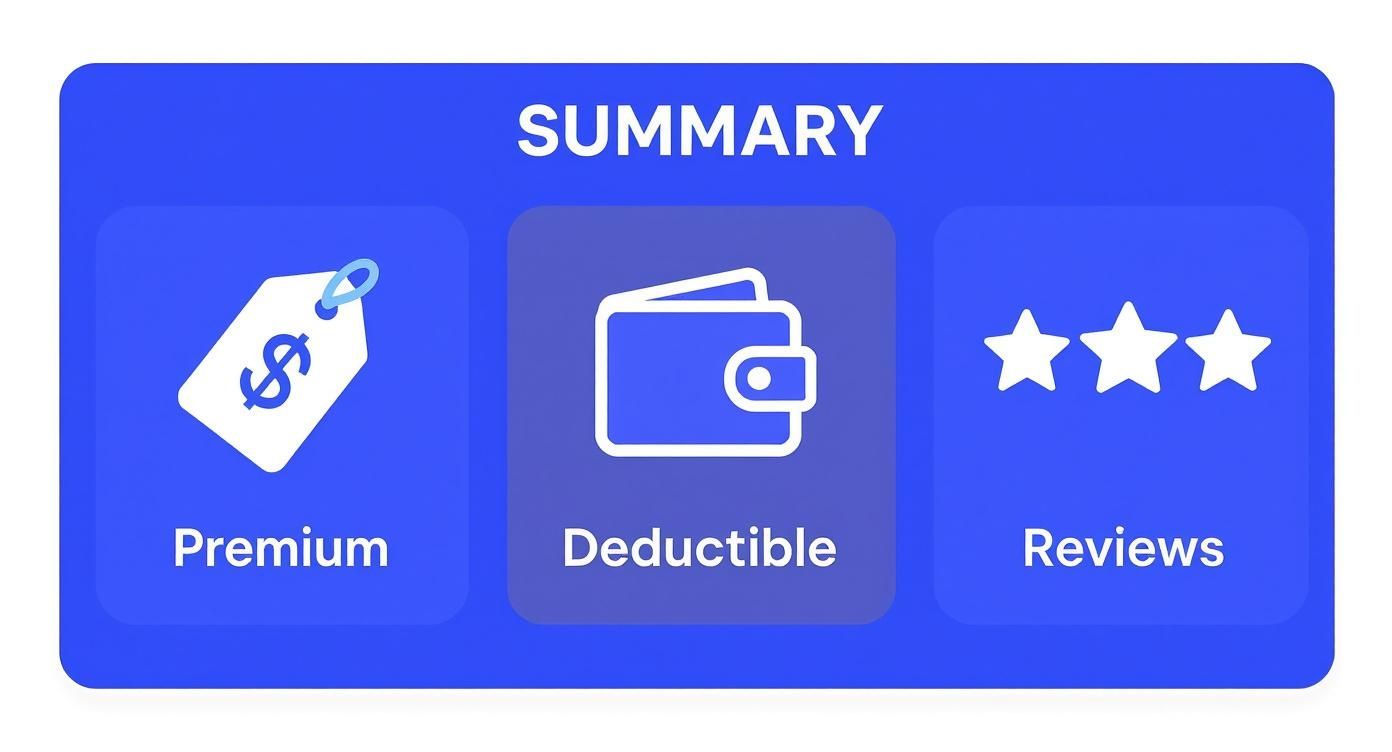
As you can see, a true comparison isn’t just about the price. It’s a three-way balance between your premium, your out-of-pocket deductible, and the insurer’s reputation for taking care of its customers.
Scenario 3: The Senior Driver on a Fixed Income
Finally, let’s consider Carol, a 70-year-old retiree in St. Petersburg. She’s living on a fixed income and drives her paid-off Toyota Camry fairly little, but she still wants solid protection without overpaying. Her mission is to find an affordable premium that lets her sleep at night.
Carol’s comparison should concentrate on fine-tuning her coverage:
- Right-Sizing Physical Damage Coverage: Since her car is older and paid off, she could consider dropping collision coverage if the premium savings are more than the car is actually worth. Keeping comprehensive, however, is often a good idea in Florida to cover theft, storm damage, or vandalism.
- Low-Mileage Discounts: Carol needs to specifically ask every insurer about discounts for driving less. Her limited mileage makes her a lower risk, and she should be rewarded for it.
- Mature Driver Programs: Many companies offer discounts for drivers over a certain age, especially if they complete an approved defensive driving course designed for seniors.
For seniors on a budget, the key is surgical precision. It’s not about cutting coverage across the board, but about strategically reducing protection that no longer matches the vehicle’s value while retaining robust liability and medical coverage.
This targeted approach helps Carol avoid paying to over-insure her car while making sure she’s still fully protected from liability claims. The reality is that insurance costs are climbing everywhere—the worldwide auto insurance market was valued at USD 911.64 billion in 2024 and is projected to reach USD 1.69 trillion by 2033. If you want to dig deeper, you can discover more insights about why insurance premiums have gone up so much to better understand these powerful market forces.
Navigating Insurer Tactics After an Accident

The real test of your insurance policy isn’t when you pay the bill. It’s when you actually need to use it. After a car accident, you’d hope that your insurer—or the other driver’s—would step up and do the right thing. Unfortunately, that’s often not the reality.
Insurance companies are for-profit businesses, and their main objective is to minimize payouts. This business model can lead them to use specific tactics designed to delay, undervalue, or outright deny valid claims. Knowing what you might be up against is crucial for protecting your rights and getting the compensation you’re entitled to.
Common Tactics to Watch For
Once you file a claim, you’ll start dealing with a claims adjuster. Their job isn’t to be your friend; it’s to settle your claim for as little money as possible. Here are a few common strategies they use to do just that.
- Claim Delays: One of the oldest tricks in the book is simply dragging their feet. The insurer might take forever to investigate, inspect your car, or even return your calls. They hope the mounting frustration and financial pressure will push you into accepting a quick, low settlement just to be done with it.
- Lowball Settlement Offers: The first offer is almost never the best offer. Adjusters are trained to start low, sometimes shockingly so. They’re banking on the fact that you might not know the true value of your claim, which includes future medical bills, lost wages, and pain and suffering.
- Disputes Over Fault: Even when an accident seems completely straightforward, don’t be surprised if the insurer tries to pin some of the blame on you. In Florida, this is a big deal. The state’s comparative negligence rules mean that if you’re found even 10% at fault, your potential settlement is reduced by that amount.
Protecting Your Claim from the Start
What you do in the minutes and hours after a crash can make or break your claim. Solid documentation and careful communication are your best defense against an adjuster’s tactics.
Right at the scene, gather as much evidence as you possibly can. Take photos and videos of everything—the damage to all vehicles, the wider accident scene, skid marks, and any visible injuries. Make sure you get the names and phone numbers of everyone involved, especially any independent witnesses.
The strength of your claim is built on the quality of your documentation. Every photo, every medical record, and every note you take creates a factual foundation that is difficult for an insurer to dispute.
When you speak with any claims adjuster—yours or the other driver’s—be polite but cautious. Stick to the facts. Avoid saying anything that could be twisted into an admission of fault, like “I’m so sorry” or “I should have seen them.” These simple phrases can be used against you later.
Handling Disputes and Unfair Offers
If you get a settlement offer that feels insultingly low or if your claim is being unfairly delayed, you don’t have to just accept it. You have every right to challenge the adjuster’s valuation and provide your own evidence—like repair estimates and medical bills—to support a higher amount.
This becomes especially tricky with Uninsured/Underinsured Motorist (UM/UIM) claims. In these situations, you’re filing a claim with your own insurance company to cover what the at-fault driver couldn’t. It’s a jarring experience, but your insurer will often switch roles and become your adversary, working to pay out as little as possible. Knowing how to handle these conversations is critical, which is why our firm created a detailed guide on how to negotiate with insurance companies to help you navigate this process.
At the end of the day, a cheap premium is worthless if your insurer abandons you when you need them most. Understanding your rights as a Florida policyholder and preparing for these potential roadblocks will give you the confidence to fight for the fair settlement you deserve.
When to Call a Car Accident Attorney
After a crash, the natural first step is dealing with the insurance companies. If it was a simple fender-bender with no one hurt, that’s often all you need to do. But when things get more serious, handling a complex claim by yourself can be a huge mistake.
You need to know when a simple insurance claim turns into a real legal fight. Insurers have armies of adjusters and lawyers working to protect their profits, not you. Bringing in your own legal expert is often the only way to level the playing field and protect yourself.
Red Flags That Mean You Need Legal Help
There are a few clear signs that it’s time to stop talking to the insurance adjuster and start talking to an attorney. If you’re in one of these situations, getting legal advice isn’t an overreaction—it’s a smart move to safeguard your financial well-being.
These situations are usually too complicated for the average person to handle. They involve everything from proving long-term medical needs to fighting back when an insurer unfairly denies your claim.
Here are the specific times when getting a lawyer is non-negotiable:
- You or a passenger were seriously injured. We’re talking broken bones, head injuries, or anything that needs surgery or ongoing medical care. An attorney knows how to calculate the true cost of your claim, including future medical bills and lost wages.
- The other driver’s insurance is blaming you. If they’re trying to shift fault onto you, even partially, it’s time to lawyer up. An attorney will dig for evidence, talk to witnesses, and can even bring in accident reconstruction experts to prove what really happened.
- The settlement offer is insultingly low. The first offer is almost always a lowball. A good lawyer knows what your case is actually worth and won’t let the insurer bully you into taking less. They’ll negotiate for a settlement that covers all of your losses.
- Your claim was flat-out denied. A wrongful denial is a massive red flag. An attorney can fight the denial and, if the insurer still won’t pay what’s fair, file a lawsuit to hold them accountable.
What a Personal Injury Attorney Actually Does
A good attorney does far more than just negotiate. They take over the entire legal headache so you can focus on getting better. They will handle every phone call and email with the insurance companies, collect the evidence needed to build your case, and prove exactly who was at fault and what your injuries have cost you.
An experienced car accident attorney has seen all the tricks insurers use to pay out as little as possible. They know how to counter these tactics with solid evidence and a deep knowledge of Florida law, making sure you don’t get pressured into a bad deal.
Their job is to fight for full compensation for your medical expenses, lost income, and the pain and suffering you’ve been forced to endure. In the end, an attorney makes sure your voice is heard and your rights are defended. It’s critical to know how to choose a car accident lawyer with the right experience for your situation. Knowing when to get professional help is just as important as knowing how to compare insurance rates in the first place.
Common Questions About Comparing Insurance Rates
Shopping for car insurance can feel overwhelming, and it’s natural to have questions. Getting clear answers is the first step toward making a smart, confident choice. Here are some of the most common things Florida drivers ask about.
How Often Should I Compare Car Insurance Rates?
It’s a good habit to shop around for new quotes at least once a year. Think of it as an annual financial check-up.
You should also get fresh quotes whenever a major life event happens. This could be anything from moving to a new neighborhood, buying a different car, or even adding a teenage driver to your policy. Insurance rates are always changing, so the company that gave you the best deal last year might not be your best bet today.
Will Getting Multiple Quotes Affect My Credit Score?
Not at all. This is a common myth that holds people back from shopping around. When you get an insurance quote, the company runs a “soft inquiry” on your credit.
Unlike the “hard inquiries” from a loan or credit card application, these soft pulls don’t show up to lenders and have zero impact on your credit score. Feel free to get as many quotes as you need to find the right fit.
It’s a complete misconception that comparing insurance rates will lower your credit score. Insurers use soft credit pulls for quoting, which are harmless. This empowers you to shop freely and find the best possible deal without worrying.
What Are the Most Important Coverages for Florida Drivers?
In Florida, a few coverages are absolutely critical to get right. Don’t skimp on these:
- Bodily Injury (BI) Liability: While you don’t technically need it to register your car, going without it is a huge financial risk. If you injure someone in an accident, this is what protects your savings and assets.
- Uninsured/Underinsured Motorist (UM/UIM): This is your safety net. With so many uninsured drivers in Florida, this coverage steps in to pay for your injuries if you’re hit by someone who has little or no insurance. It’s a lifesaver.
- Personal Injury Protection (PIP): This one isn’t optional. Florida law requires every driver to carry $10,000 in PIP. It covers your own initial medical bills after an accident, no matter who was at fault.
Are There Hidden Fees in an Auto Insurance Policy?
They aren’t usually “hidden,” but there are definitely extra charges to look out for. Some insurers add installment fees if you pay monthly instead of in one lump sum. Others might charge a policy fee just to set up or renew your coverage.
You might also see optional add-ons for specific situations. For example, some people wonder about specialized policies like car key replacement insurance. The key is to always ask for a detailed breakdown of your quote so you know exactly where every dollar is going.
If you’ve been in an accident and are struggling with an unfair insurance company, you don’t have to fight them alone. The experienced team at Martin Hernandez, P.A. is here to protect your rights and pursue the full compensation you deserve. Contact us today for a free consultation at https://injurylawyersoftampa.com.