
A car accident in Tampa can turn your world upside down in an instant. Beyond the immediate shock and potential injuries, you are thrust into a complex and often confusing process with insurance companies. The steps you take in the minutes, days, and weeks that follow are critical. They can determine whether you receive fair compensation for your medical bills, lost wages, and suffering, or if you are left with mounting debt and unresolved claims.
This guide provides 10 essential auto insurance tips specifically for Florida residents, particularly those in the Tampa and Hillsborough County area. We will move beyond generic advice to offer actionable strategies for protecting your rights. The goal is to provide a clear roadmap for dealing with the aftermath of a crash, from the moment it happens until your claim is resolved. To effectively navigate this journey, gaining insight into the mechanics of understanding claims processing can be invaluable.
You will learn how to properly document an accident scene, interact with insurance adjusters, and understand the nuances of Florida-specific coverages like Personal Injury Protection (PIP) and Uninsured/Underinsured Motorist (UM/UIM) coverage. Each tip is designed to be a practical, easy-to-follow step that empowers you to take control of the situation. These insights are tailored to help you navigate your auto insurance claim with confidence and secure the best possible outcome for your situation.
1. Understand Your Insurance Policy Coverage Limits
Your auto insurance policy isn’t a single blanket of protection; it’s a collection of different coverages, each with its own maximum payout amount, or “limit.” These limits are the absolute most your insurer will pay for a specific type of claim. Misunderstanding them is one of the costliest mistakes you can make, especially in Florida where minimum coverage requirements are deceptively low.
The core of your policy is outlined on the “declarations page.” This document lists your chosen coverages, such as Bodily Injury Liability (BI), Property Damage Liability (PD), and Uninsured/Underinsured Motorist (UM/UIM) coverage, along with the dollar limits for each. Florida law requires drivers to carry a minimum of $10,000 in Personal Injury Protection (PIP) and $10,000 in Property Damage Liability (PD). Bodily Injury Liability (BI) is often required, particularly for drivers with a history of certain traffic offenses.
Why Minimums Aren’t Enough in Tampa
Relying on state minimums can expose you to significant financial risk. A common Tampa traffic scenario illustrates this perfectly: if you have a $10,000 property damage limit and cause an accident involving a newer SUV and a sedan, the repair costs could easily exceed $30,000. Your insurance would pay the first $10,000, leaving you personally responsible for the remaining $20,000. Similarly, if you seriously injure someone and only have minimum Bodily Injury coverage, it is grossly inadequate for hospital bills, lost wages, and other damages.
Key Insight: Your policy limits dictate the maximum financial shield you have. If damages exceed these limits, your personal assets, from your savings to your home, could be at risk to cover the difference.
Actionable Steps for Reviewing Your Coverage
To protect yourself, it is crucial to proactively manage your policy. This is one of the most vital auto insurance tips for any Florida driver.
- Review Your Declarations Page Annually: Make it a yearly financial check-up. Look at your BI, PD, and UM/UIM limits.
- Assess Your Assets: A good rule of thumb is to carry liability limits that meet or exceed your net worth. This protects what you’ve worked hard to build.
- Consider Higher Limits: Opting for higher limits, such as 100/300/100 ($100k per person, $300k per accident, $100k property damage), offers far greater protection for a relatively small increase in your premium.
- Consult an Attorney After a Crash: If you’re injured by another driver, never accept a settlement offer without understanding both their policy limits and your own, especially your UM/UIM coverage.
Understanding what liability insurance covers is the first step toward securing adequate protection. For a deeper dive, you can learn more about liability insurance coverage specifics in Florida.
2. Document Everything at the Accident Scene
The moments immediately following a car accident are chaotic, but what you do right then can become the most critical evidence for your insurance claim. Thorough documentation at the scene creates an objective, unchangeable record of events. This evidence is what insurance adjusters and legal teams use to determine fault, assess the extent of damages, and validate your injuries. Without it, you are left relying on memory, which can fade or be disputed.
In the high-stakes environment of a Florida insurance claim, failing to gather strong evidence from the outset can weaken your position, leading to unfair denials or lowball settlement offers. Insurance companies scrutinize every detail, and having clear, contemporaneous proof is one of the most powerful auto insurance tips you can follow to protect your rights.

How Scene Evidence Wins Tampa Injury Cases
Strong documentation can make or break a case. For instance, a Tampa motorcyclist was hit by a driver who ran a red light but later denied fault. The motorcyclist’s photos from the scene clearly showed the position of both vehicles, skid marks, and the functioning traffic signals from multiple angles. This irrefutable evidence dismantled the at-fault driver’s story and was instrumental in securing a full settlement for the victim’s injuries and damages.
Key Insight: The evidence you collect in the first 30 minutes after an accident is often more valuable than anything gathered weeks later. Your smartphone is your most powerful tool for capturing photos, videos, and notes that establish liability.
Actionable Steps for Documenting an Accident
If you are physically able, taking these steps can significantly strengthen your claim. This is a crucial auto insurance tip for anyone driving on Tampa’s busy roads.
- Take Wide and Close-Up Photos: Capture the entire scene, including all vehicles, their license plates, property damage, skid marks, and road conditions.
- Exchange Information: Get the names, phone numbers, addresses, driver’s license numbers, and insurance details for all drivers involved. Also, gather contact information from any witnesses.
- Record the Details: Note the exact date, time, and location of the crash. Describe the weather, visibility, and any relevant road hazards.
- Obtain the Police Report: Ask the responding officer for the police report number before you leave the scene. This official report is a vital piece of evidence.
- Avoid Admitting Fault: Do not apologize or admit fault to anyone. Stick to the objective facts when speaking with others and law enforcement.
Properly documenting an accident scene establishes a foundation of facts that is difficult for insurance companies to dispute. To learn more about what to do after a crash, you can find a helpful post-accident checklist here.
3. File a Police Report and Obtain the Report Number
After any car crash, the moments are often chaotic and confusing. However, one of the most critical steps is to create an official record of the event. In Florida, the law mandates that drivers report any accident involving injury, death, or apparent property damage of $500 or more to law enforcement. This official documentation, the police report, becomes a cornerstone of your subsequent insurance claim.
The police report serves as an impartial, third-party account of the incident. It includes the officer’s observations about the scene, vehicle positions, witness statements, and often a preliminary determination of fault. For insurance adjusters reviewing your claim, this report is one of the first and most influential pieces of evidence they will consider when assessing liability.
How a Police Report Strengthens Your Claim in Tampa
A detailed police report can be the deciding factor in a disputed claim. For instance, consider a Tampa rideshare accident where liability is unclear. If the responding officer’s report documents their observation of the other driver using a cell phone at the time of the crash, it provides powerful evidence of distracted driving. In another case, a truck accident victim was able to establish clear liability after the Florida Highway Patrol report cited the commercial driver for violating federal hours-of-service regulations.
Key Insight: The police report is not just a formality; it is foundational evidence. It provides an objective narrative that can corroborate your version of events and prevent the other party from changing their story later.
Actionable Steps for Documenting Your Accident
Ensuring you have this crucial document is a vital auto insurance tip that protects your rights from the very beginning. The process of obtaining it requires immediate and diligent action.
- Call 911 Immediately: Even for seemingly minor accidents, call the police. This ensures an officer is dispatched to create a report. In Tampa, this could be the Tampa Police Department, Hillsborough County Sheriff’s Office, or the Florida Highway Patrol depending on the location.
- Gather Officer Information: Before the officer leaves the scene, ask for their name, badge number, and the agency they work for.
- Request the Report Number: Most importantly, ask the officer for the specific police report number or incident number for your accident. This is the key to tracking and retrieving the official document.
- Follow Up Promptly: Police reports are not always available instantly. Start checking for the report within 24 to 48 hours through the appropriate agency’s online portal or records department.
Having the police report is the first step in building a strong case. If you have questions about the details in your report or how they impact your claim, it’s wise to review it with an experienced attorney.
4. Seek Medical Evaluation Promptly and Keep Detailed Records
After a car accident, your immediate health and long-term financial recovery are directly linked to seeking a prompt medical evaluation. Many serious injuries, like whiplash or internal bleeding, may not present symptoms for hours or even days. Delaying treatment not only endangers your health but also gives insurance companies a powerful reason to deny or devalue your claim.
In Florida, the connection between the crash and your injuries must be clearly established with medical evidence. Insurance adjusters will scrutinize any gap between the accident date and your first doctor’s visit. They often argue that a delay means your injuries were either pre-existing or caused by something other than the collision. Comprehensive medical records serve as the undeniable proof needed to validate your injury claim.
Why Immediate Medical Care Maximizes Claim Value
Failing to document your injuries is one of the most detrimental mistakes you can make. A Tampa driver who felt only minor neck soreness after a rear-end collision waited a week to see a doctor. The insurer argued the injury was unrelated, but had he sought immediate care and followed up with an orthopedic specialist, the resulting vertebral fracture diagnosis would have been directly tied to the crash, leading to a much higher settlement. Proper documentation validates the need for treatment, from physical therapy to surgery, and substantiates claims for pain and suffering.
Key Insight: Your medical records are the primary evidence in an injury claim. Without prompt and continuous documentation, it becomes your word against the insurance company’s, and they will use any delay to protect their bottom line.
Actionable Steps for Documenting Your Injuries
Properly managing your medical care is one of the most critical auto insurance tips for protecting your rights after a crash in Florida.
- Seek Care Immediately: Go to an emergency room or urgent care center right after the accident, even if you feel fine.
- Adhere to Florida’s PIP Law: You must receive initial medical services within 14 days of the accident to be eligible for Personal Injury Protection (PIP) benefits. To understand this critical deadline, you can learn more about Florida’s PIP 14-day rule.
- Keep a Pain Journal: Document your daily pain levels, physical limitations, and how the injuries affect your life.
- Follow All Medical Advice: Attend all follow-up appointments, physical therapy sessions, and specialist consultations. Gaps in treatment can be used against you.
- Photograph Visible Injuries: Take photos of bruises, cuts, and swelling over time to create a visual record of your recovery process.
5. Do Not Admit Fault or Make Recorded Statements to Insurance Companies
In the chaotic moments after a car crash, your words carry immense weight. Statements made at the scene or later to an insurance adjuster can be twisted and used against you, potentially jeopardizing your ability to recover fair compensation for your injuries and damages. This is especially true in Florida, a comparative negligence state where any admission of fault, no matter how small, can reduce your financial recovery.
Insurance adjusters, particularly those from the at-fault driver’s company, are trained professionals whose primary goal is to minimize their company’s payout. They often request a recorded statement early on, hoping to catch you in a moment of confusion or pain. Anything you say, from a simple “I’m sorry” to “I didn’t see the other car,” can be interpreted as an admission of guilt, even if you were not at fault.
The Cost of an Unguarded Statement
The financial consequences of a misplaced word can be devastating. Consider a Tampa driver whose casual remark, “I didn’t see the motorcycle,” was used to argue he was inattentive, leading to a complete denial of his claim. Similarly, a rideshare passenger who mentioned in a recorded statement that she was “distracted by her phone” just before the crash saw her settlement offer reduced by 40%, as the insurer argued she was not paying attention to her own safety.
Key Insight: You are not legally obligated to provide a recorded statement to the other driver’s insurance company. These statements are tools used by insurers to find inconsistencies and assign blame to you, thereby reducing or denying your claim.
Actionable Steps for Protecting Your Claim
Controlling your communication is one of the most critical auto insurance tips you can follow after an accident. Protect your rights by being deliberate and cautious in every conversation.
- Limit On-Scene Conversation: At the accident scene, only exchange essential information: names, contact details, insurance policy numbers, and driver’s license numbers. Do not discuss how the accident happened or speculate on fault.
- Avoid Phrases of Apology: Never say “I’m sorry” or any other phrase that could imply you accept blame for the incident.
- Politely Decline Recorded Statements: When the other party’s adjuster calls, state clearly: “I will not be providing a recorded statement at this time. Please direct all future correspondence to my attorney.”
- Consult Counsel First: Before giving any detailed statement, even to your own insurance company, it is wise to speak with a personal injury attorney. They can advise you on how to provide necessary information without compromising your claim.
Understanding how to interact with insurance adjusters is fundamental to protecting your case. For more guidance on this crucial step, you can learn more about what to do when an insurance adjuster calls.
6. Report the Accident to Your Insurance Company Within Required Timeframes
After a car crash, your priority is safety, but a close second is preserving your rights. A critical step is to report the accident to your own insurance company promptly. Florida law and the fine print in your policy document create a contractual obligation for you to provide “prompt notice” of any incident that could lead to a claim. Failing to do so can have severe consequences, including the outright denial of your claim.
This requirement exists even if the accident was clearly not your fault. Notifying your insurer triggers important processes under your own policy, such as accessing your Personal Injury Protection (PIP) benefits for medical bills or activating your Uninsured/Underinsured Motorist (UM/UIM) coverage if the at-fault driver is uninsured or has insufficient limits. The clock starts ticking the moment the accident occurs.
Why Delays Can Be Disastrous in Tampa
Insurance companies can use delayed reporting as a reason to deny coverage, arguing that the delay prejudiced their ability to investigate the claim properly. For instance, a Hillsborough County driver who waited five days to report a fender-bender found their claim denied under their policy’s “prompt notice” provision. The insurer claimed the delay prevented them from examining the vehicle or speaking to witnesses in a timely manner.
Conversely, a Tampa driver who was rear-ended immediately called their insurer’s 24/7 hotline from the scene. This quick action preserved their full rights under the policy. Even though they later had to dispute the adjuster’s fault determination, their initial compliance prevented the insurance company from using a technicality to deny the claim.
Key Insight: Timely reporting is not an admission of fault; it is a contractual duty you have to your own insurance company. Fulfilling this obligation is essential to protect your access to the benefits you pay for, such as PIP and UM/UIM coverage.
Actionable Steps for Reporting Your Accident
Following a structured process for reporting is one of the most vital auto insurance tips to protect your interests. It ensures you meet your obligations without making statements that could harm your case.
- Report Promptly: Aim to notify your insurer within 24 hours of the accident, if possible. Use their 24/7 claims hotline or contact your agent directly.
- Stick to the Facts: When you make the initial report, provide only basic information: your name, policy number, and the date, time, and location of the accident. Do not speculate on fault, discuss your injuries in detail, or give a recorded statement.
- Create a Paper Trail: Follow up your phone call with a written notice via email. This creates a documented record of when you reported the incident.
- Document Everything: Note the date and time of your call, the claim number you are given, and the name of the representative you spoke with.
- Seek Legal Counsel First: Before providing detailed statements, signing medical authorizations, or accepting any offers, consult with an experienced attorney. They can manage all further communications with the insurer to protect your rights.
7. Understand Uninsured and Underinsured Motorist (UM/UIM) Coverage
While your liability coverage protects others when you are at fault, Uninsured/Underinsured Motorist (UM/UIM) coverage is designed to protect you. This coverage steps in when the driver who hits you either has no insurance (uninsured) or not enough insurance to cover the full extent of your injuries and damages (underinsured). In Florida, where a high percentage of drivers are on the road without adequate coverage, UM/UIM is not a luxury; it’s a necessity.
This coverage is separate from your liability limits and acts as a vital safety net. For instance, if you are hit by a driver with only the state minimum Bodily Injury coverage of $10,000, but your medical bills and lost wages total $60,000, their policy falls drastically short. Your own UIM coverage would then kick in to cover that $50,000 gap, up to your policy limits.
How UM/UIM Protects You in Tampa
Consider a common Tampa scenario: a rideshare passenger is seriously injured when their vehicle is struck by an uninsured driver. The at-fault driver has no means to pay. The passenger’s own $50,000 in UM coverage becomes their primary source of financial recovery for medical bills, pain, and suffering that PIP benefits did not cover. Without it, they would be left with overwhelming debt.
Key Insight: UM/UIM coverage is your personal insurance against irresponsible drivers. It ensures you have a path to financial recovery even when the at-fault party is uninsured or their policy is insufficient to cover your losses.
Actionable Steps for Managing Your UM/UIM Coverage
Properly managing this part of your policy is one of the most critical auto insurance tips for securing your financial well-being after a crash.
- Purchase Adequate Limits: A good starting point is to carry UM/UIM limits that are equal to your own Bodily Injury liability limits.
- Ask About “Stacking”: Florida law allows you to “stack” UM coverage. This means if you have two vehicles on your policy, each with $50,000 in UM, you can combine them for a total of $100,000 in available coverage. Always confirm with your insurer if your policy is stacked.
- Report the Accident Immediately: If you are hit by an uninsured or underinsured driver, notify your own insurance company right away to start the UM/UIM claim process.
- Never Settle Too Soon: Do not accept a settlement from the at-fault driver’s insurance company until you have consulted with an attorney to understand how it impacts your ability to make a UIM claim.
Understanding how this protection works is crucial before you ever need it. For a comprehensive overview, you can learn more about uninsured motorist coverage in Florida.
8. Monitor Your Credit and Pursue Insurance Disputes Aggressively
An insurance claim is not always a straightforward process. Insurers may deny valid claims, misinterpret policy language, or use delay tactics to minimize their payout. When this happens, the battle isn’t just about the claim; it’s about protecting your financial health from the fallout, including damage to your credit score from unpaid medical bills.
In Florida, you have the right to challenge an insurer’s decision. This can range from a simple appeal to a formal bad faith claim if the company acts unreasonably. A bad faith claim holds the insurer accountable for not honoring their contractual obligations, such as failing to investigate a claim properly or unreasonably denying coverage. Ignoring a dispute can leave you with thousands in medical debt that wrongfully ends up in collections.
Why Aggressive Pursuit Matters in Hillsborough County
Consider a Tampa accident victim whose insurer denies their PIP claim without a thorough investigation, stating the injuries weren’t related to the crash. As the dispute drags on, medical providers send the bills to collections, damaging the victim’s credit. By pursuing a bad faith claim, the victim could not only recover the original benefits but also additional damages for the harm caused by the insurer’s actions, including attorney fees. This proactive approach is essential for financial survival after a crash.
Key Insight: A denied claim is not the final word. Florida law provides powerful tools for policyholders to fight back against unfair insurance practices, but you must act decisively to protect your rights and your credit.
Actionable Steps for Handling Insurance Disputes
Effectively managing a claim dispute requires organization and assertiveness. These auto insurance tips are crucial when an insurer is not cooperating.
- Document Everything: Keep a detailed file of all correspondence, including letters, emails, and notes from phone calls with the adjuster.
- Demand Written Denials: Never accept a verbal denial. Require the insurer to provide a specific, written explanation referencing the exact policy language they are using to deny your claim.
- File Official Complaints: If the insurer is unresponsive, file a complaint with the Florida Department of Financial Services. This often prompts a faster, more formal response.
- Monitor Your Credit: Regularly check your credit reports for medical accounts sent to collections. Dispute any inaccuracies immediately.
- Consult an Attorney: If your claim is denied, delayed unreasonably, or you suspect bad faith, contact an experienced attorney immediately. They can assess the insurer’s conduct and escalate the matter legally.
Navigating a complex insurance dispute is challenging. Learn more about how a lawyer can help you handle insurance claim problems and protect your financial future.
9. Consult an Attorney Before Accepting Settlement Offers
An insurance adjuster’s primary goal is to close your claim quickly and for the lowest possible amount. The initial settlement offer they present is often just a starting point, calculated to cover immediate expenses while ignoring the long-term consequences of a serious injury. Accepting this first offer without a professional review is one of the most significant financial mistakes an accident victim can make.
Once you sign a settlement release, you forfeit your right to seek any future compensation for that accident, even if your injuries worsen or new medical needs arise. In Florida, injury claims frequently involve damages that are not immediately apparent, such as the need for future surgeries, chronic pain management, permanent disability, and non-economic damages like pain and suffering.
Why Quick Settlements Are a Trap in Florida
Insurance companies know that injured victims are under financial and emotional stress. They use this to their advantage by offering a seemingly fair amount of money upfront. Consider a common Tampa scenario: an accident victim with a herniated disc accepts a $15,000 settlement to cover their ER visit and initial physical therapy. Six months later, doctors determine they need a spinal fusion surgery costing over $80,000. Because they signed the release, they cannot reopen the claim and are now personally responsible for these catastrophic costs.
Key Insight: An insurance settlement release is a final, legally binding contract. Signing it permanently closes your claim, making it impossible to seek additional funds for future medical care, lost income, or unforeseen complications related to your injuries.
Actionable Steps Before You Settle
Engaging legal counsel is a critical auto insurance tip that protects your long-term financial and physical well-being. An attorney ensures your claim is valued correctly before you sign away your rights.
- Never Sign Anything Under Pressure: Do not sign any documents, especially a release, without having an attorney review them first.
- Document All Your Losses: Keep meticulous records of medical bills, lost wages, out-of-pocket expenses, and a journal detailing your pain and its impact on your daily life.
- Wait for Medical Certainty: Do not settle until you have reached Maximum Medical Improvement (MMI) or your doctor can provide a clear prognosis for future treatment needs and costs.
- Request a Breakdown: Ask the adjuster for a written calculation explaining how they arrived at their offer. This often reveals they have overlooked or undervalued key damages.
Understanding the full scope of your claim is essential. You can learn more about getting a lawyer after a car accident in Tampa to see how professional guidance can maximize your recovery.
10. Preserve Evidence and Avoid Actions That Undermine Your Claim
After a car accident, your actions and words become part of the official record. Insurance companies and their attorneys actively investigate claims to find any information that contradicts your account of the accident or the severity of your injuries. What you post online, say to others, or even delete from your phone can be used to challenge your credibility and reduce your settlement.
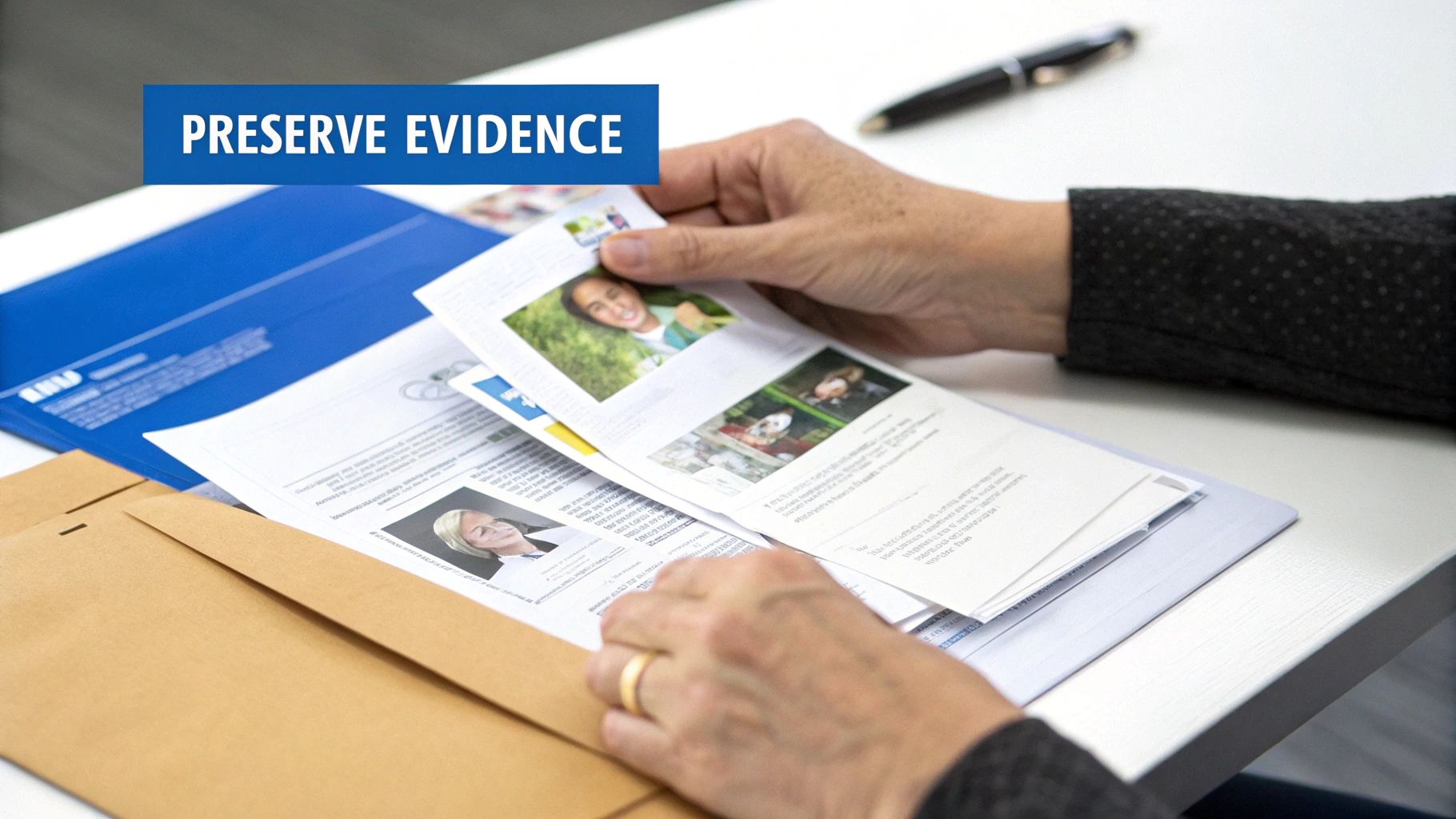
This scrutiny means that preserving all original evidence while simultaneously avoiding activities that could be misconstrued is paramount. Seemingly innocent actions can have significant consequences. For example, a Tampa accident victim’s claim was substantially reduced after investigators found social media photos of them hiking just weeks after they claimed severe mobility restrictions from the crash.
Why Your Post-Accident Behavior Matters
Insurance adjusters are trained to look for inconsistencies. A casual text message to a friend minimizing your injuries can directly contradict your formal claim. Likewise, deleting photos or messages after an accident can be viewed as “spoliation of evidence,” a serious issue that can damage your case and lead to legal penalties. Every piece of evidence, from medical receipts to vehicle repair estimates, helps build a cohesive and verifiable narrative of your damages.
Key Insight: The insurance company is not on your side. They will use your own words, photos, and actions against you. Assume everything you do and say after an accident could be reviewed by the opposing side.
Actionable Steps for Protecting Your Claim
Adopting a cautious and organized approach to evidence is one of the most critical auto insurance tips for protecting your right to fair compensation.
- Go Silent on Social Media: Do not post anything about your accident, injuries, or recovery. Avoid posting photos or videos of yourself engaged in physical activities that could contradict your injury claims.
- Preserve All Communications: Do not delete text messages, emails, or voicemails related to the accident, your injuries, or vehicle repairs. These are valuable records.
- Organize Your Documents: Keep a dedicated folder for all accident-related paperwork, including medical bills, doctor’s notes, pharmacy receipts, and correspondence with insurers.
- Be Mindful of Repair Details: When getting your car repaired, the type of parts used can impact your claim. For a detailed breakdown, see this helpful guide on the differences between aftermarket and OEM parts.
- Inform Your Attorney Immediately: If you receive any requests for information or are threatened with legal action, contact your lawyer before responding.
Taking Control: When to Seek Professional Legal Guidance
Navigating the aftermath of a car accident in Tampa can feel like trying to solve a complex puzzle while simultaneously recovering from a serious injury. The auto insurance tips provided in this guide are your essential building blocks, designed to empower you with the knowledge needed to protect your rights from the very first moment. By understanding your own Florida-specific policy, meticulously documenting evidence at the scene, and seeking prompt medical care, you lay a crucial foundation for a successful claim.
These strategies are not just abstract concepts; they are tangible actions that can dramatically influence the outcome of your insurance settlement. Recalling the importance of Florida’s 14-day rule for seeking medical attention to qualify for PIP benefits, or the critical distinction of never admitting fault to an adjuster, can be the difference between a fair recovery and a denied claim. Each step, from obtaining the police report to preserving evidence like damaged personal items, strengthens your position against insurance carriers whose primary goal is to minimize their financial exposure.
From Knowledge to Action: Mastering Your Claim
Mastering these concepts transforms you from a passive victim into an active participant in your own recovery. The true value of these auto insurance tips lies in their application. When you understand the strategic importance of your Uninsured/Underinsured Motorist (UM/UIM) coverage, you are better prepared to fight for compensation when the at-fault driver is inadequately insured, a common scenario on Florida roads. When you know to avoid giving a recorded statement, you prevent your own words from being twisted and used against you later.
However, knowledge alone may not be enough when faced with a powerful insurance corporation. These companies have vast resources, including teams of experienced adjusters and attorneys, all working to protect their bottom line. This is the critical juncture where understanding your limitations and recognizing the need for professional reinforcement becomes your most powerful move.
Key Insight: The most crucial tip is knowing when to stop handling the claim yourself. If you encounter resistance, lowball offers, or confusing legal jargon, it is a clear signal that the playing field is no longer level.
Leveling the Playing Field with Legal Expertise
The moment an insurance adjuster disputes the severity of your injuries, questions the necessity of your medical treatment, or presents a settlement offer that barely covers your initial medical bills, it is time to seek professional legal guidance. An experienced Tampa personal injury attorney serves as your advocate and strategist, taking the burden of complex negotiations off your shoulders so you can focus on healing.
An attorney’s role extends far beyond simply sending letters. They will:
- Conduct a thorough investigation to gather all necessary evidence, including accident reconstruction reports and witness testimony.
- Accurately calculate your total damages, which includes not only current medical bills but also future treatment costs, lost wages, diminished earning capacity, and compensation for pain and suffering.
- Handle all communications with the insurance companies, shielding you from aggressive adjuster tactics.
- Ensure all Florida-specific deadlines, like the statute of limitations for filing a lawsuit, are meticulously met.
Ultimately, navigating a serious injury claim is not a journey you should undertake alone. The insights in this article provide the map, but a skilled attorney acts as your expert guide, ensuring you reach the destination you deserve: a full and fair financial recovery. Taking decisive action to secure legal representation is the final, and often most important, step in taking control of your future.
If you are facing a difficult insurance dispute after an accident in the Tampa Bay area, you don’t have to fight alone. The team at Martin Hernandez, P.A. specializes in helping accident victims navigate complex claims and secure the compensation they deserve. Contact them today for a free, no-obligation consultation to understand your legal options.