
When you’re piecing together what happened after a Florida car accident, you look for clues everywhere. The crash scene tells part of the story, but some of the most powerful evidence might be buried in a database. Data from an independent source like Consumer Reports can give you an unbiased look at a vehicle’s history, and that history can become a critical piece of your personal injury claim.
Why Your Car’s “Report Card” Matters After a Crash
After an accident, the focus naturally falls on the drivers involved. But what if the car itself was a contributing factor? This is where objective, third-party data from an organization like Consumer Reports becomes so important. It’s not just a magazine on a newsstand; it’s a massive archive of real-world vehicle performance data that can uncover patterns of defects and safety issues.
Think about it like this: a single accident often feels like a random, unlucky event. But what happens when CR data reveals that hundreds, or even thousands, of other drivers have reported the exact same brake failure or steering problem in that specific make and model? Suddenly, it doesn’t look so random anymore. It starts to look like a predictable failure.
For anyone involved in a car wreck in Florida, grasping this concept can be a game-changer. The information compiled by Consumer Reports can help show that a vehicle had known problems that may have played a direct role in the crash.
From Buyer’s Guide to Legal Evidence
This guide is designed to help you look past the immediate aftermath of your accident. We’ll dig into how independent data can bolster your case by proving a vehicle had a track record of poor performance or well-documented mechanical flaws. This kind of information is especially compelling in claims that involve:
- Sudden mechanical failures: Think brake system malfunctions, steering that locks up, or a car that accelerates on its own.
- Safety system defects: Situations where airbags didn’t deploy as they should have or driver-assistance features malfunctioned.
- Recurring electrical problems: Glitches that could cause a driver to lose control of the vehicle.
This “report card” on your car provides the historical context that can fortify your claim, suggesting that a pre-existing defect might have been a silent partner in what happened on the road.
How Consumer Reports Grades a Vehicle
To really get why Consumer Reports auto reviews carry so much weight, especially after a car accident, you need to peek behind the curtain at their process. They don’t just give cars a quick once-over. Each vehicle goes through a demanding, multi-stage evaluation designed to uncover its true performance and potential flaws—the stuff you’d never see in a slick TV commercial.
What makes their system so credible is its independence. Consumer Reports buys every single car they test, anonymously, right from a dealership, just like you would. This means no cherry-picked models from the manufacturer and no special treatment. The car they test is the same one that ends up in your driveway.
The Auto Test Center Proving Grounds
The heart of their operation is the massive 327-acre Auto Test Center in Connecticut. This place is far more than a simple racetrack. It’s a purpose-built facility with everything from a long straightaway and a challenging handling course to specialized surfaces for braking tests and a rock hill for testing SUVs.
Here, every vehicle is put through a grueling gauntlet of more than 50 individual tests.
Think of the facility as a standardized exam for cars. Every vehicle, from a tiny hatchback to a massive truck, faces the exact same set of challenges. This allows for direct, apples-to-apples comparisons on everything from braking distance and acceleration to how a car behaves in an emergency.
One of their most telling evaluations is the emergency lane-change maneuver, sometimes called the “moose test.” It simulates a driver swerving violently to avoid a sudden obstacle. A car that loses control or feels unstable during this test might have hidden design flaws in its suspension or stability control system—precisely the kind of defect that could contribute to a real-world crash.
This diagram shows how a Consumer Reports review can draw a line between a vehicle’s known issues and your accident claim.

As you can see, documented flaws in a CR report can provide powerful evidence, strengthening the foundation of your legal claim after an accident.
Beyond the Road Test
The intense track testing is just one piece of the puzzle. A car’s performance on a closed course reveals a lot, but it doesn’t tell the whole story of what it’s like to own one. That’s why Consumer Reports layers in three other crucial sources of data to build a complete, 360-degree view.
This comprehensive method is what gives their ratings such authority. They combine their hands-on testing with:
- Reliability Surveys: CR gathers data from its members—hundreds of thousands of them—about the problems they’ve had with their cars over years of ownership. This gives an unparalleled look at a vehicle’s real-world dependability, far beyond what a short-term test can show.
- Owner Satisfaction: They ask members a very straightforward but powerful question: “Would you buy this car again if you had to do it all over?” The answer cuts right to the heart of what it’s like to live with a vehicle, warts and all.
- Safety Analysis: Finally, they analyze official crash-test results from government and insurance industry sources (like the IIHS and NHTSA). They also award points for vehicles that include proven, life-saving safety features. The way different agencies evaluate these systems is also critical, which we cover in our guide to auto insurance ratings and how Consumer Reports views them.
By weaving together these four distinct pillars—road tests, reliability, owner satisfaction, and safety—Consumer Reports produces a final score that is both incredibly detailed and trustworthy. It’s this painstaking, multi-faceted process that makes their findings so influential and, in a legal setting, so compelling.
How CR’s Reliability and Owner Satisfaction Ratings Tell the Real Story
The road test is just the first chapter in a car’s story. How a vehicle actually holds up over years of daily driving—through stop-and-go traffic, family road trips, and countless commutes—is where its true character is revealed. This is precisely why Consumer Reports’ reliability and owner satisfaction scores are so insightful, especially when you’re trying to understand what went wrong in an accident.
These scores aren’t based on an expert’s opinion after a week-long test drive. They’re built from the collective, real-world experiences of hundreds of thousands of people who live with these cars every single day.

Think about it this way: a single faulty brake caliper might look like a random, unpredictable mechanical failure to an insurance adjuster. But what if Consumer Reports data shows a clear, undeniable pattern of brake problems reported by thousands of other owners of the very same model?
Suddenly, the narrative shifts. Your accident is no longer a one-off fluke; it’s a foreseeable outcome of a known, documented defect. This data forges a powerful link between your personal experience and a much larger problem, giving your claim significant credibility.
The Power of Data in Numbers
Consumer Reports can spot these trends because of the sheer volume of data they work with. Their modern auto reviews from Consumer Reports don’t just rely on track tests; they integrate massive amounts of owner-survey data to generate reliability scores that can completely reframe the conversation around accident and defect cases.
For its 2025 Annual Auto Surveys, CR collected detailed problem and satisfaction data on about 380,000 vehicles, covering model years from 2000 to 2025. With a typical model having 200–300 survey responses per year, the insights become statistically solid. This is how they pinpoint recurring patterns in everything from engine and transmission failures to brake system problems and glitches in in-car electronics. You can get a deeper look into their methodology from Consumer Reports’ reliability FAQ.
This huge sample size lets them track issues across 20 different trouble spots with incredible accuracy. These aren’t just minor annoyances; they include critical systems like:
- Major Engine Components: Problems with cylinders, pistons, and other internal parts.
- Transmission Systems: Failures in both automatic and manual gearboxes.
- Brake Systems: Widespread issues with calipers, rotors, anti-lock systems (ABS), and master cylinders.
- Steering and Suspension: Defects in tie rods, ball joints, and shock absorbers.
- In-Car Electronics: Frustrating glitches with infotainment screens, climate controls, or keyless entry systems.
A documented trend in any of these areas—especially for safety-critical systems like brakes or steering—can be a game-changer when building a personal injury case in Florida.
Owner Satisfaction: The Real-World Verdict
Beyond just tracking what breaks, Consumer Reports also measures owner satisfaction. They get straight to the point, asking members a simple but incredibly revealing question: “Considering all factors (price, performance, reliability, comfort, enjoyment, etc.), would you get this car if you had it to do all over again?”
This isn’t just about whether a car is reliable. It’s about whether it actually delivers on its promises in the real world. A low satisfaction score can hint at problems that don’t show up in a repair log, like a distracting infotainment system, poor visibility that creates dangerous blind spots, or uncomfortable seats that lead to driver fatigue.
For instance, if a car model consistently gets terrible marks for its driving experience or comfort, it could point to design flaws that contribute to driver distraction. While maybe not as direct as a brake failure, this kind of information helps paint a much fuller picture of a vehicle’s shortcomings and how they could have factored into an accident.
Building a Decades-Long Case History
A single bad review is easy to write off as a fluke. Maybe the driver had a bad day, or that one car was just a lemon. But what happens when that single review is echoed by thousands, year after year, for the same model? It’s no longer an outlier; it’s a pattern.
This is the real power behind auto reviews from Consumer Reports. Their credibility isn’t just about one-off road tests. It’s built on a massive, decades-long library of data that tracks how vehicles hold up in the real world over their entire lifespan.
This historical perspective is a game-changer in an accident claim. It allows you to frame the incident not as a random, unfortunate event, but as the predictable result of a known flaw—one the manufacturer arguably should have known about for years.
Think of it like building a case in court. One witness can be shaky. But a long line of witnesses, all telling the same consistent story, creates a powerful, undeniable narrative. Consumer Reports’ historical data is that line of witnesses, establishing a clear track record for a specific model’s problems.
From Humble Beginnings to Massive Databases
The sheer scale of this data is what gives it so much weight. Consumer Reports has been at this for a long time. Back in the early 1950s, they started surveying car owners about reliability and satisfaction, something that now influences millions of car buyers.
Their first reliability chart in 1952 was based on feedback from about 50,000 subscribers—a respectable number for the time. Fast forward to 2011, and their auto-reliability database had exploded to include data on over 1.3 million vehicles, covering more than 300 different models. Today, their annual surveys continue to gather reliability data on hundreds of thousands of cars, trucks, and SUVs. You can learn more about their reliability history on ConsumerReports.org.
This journey from a modest survey to a massive data-gathering engine makes their historical records incredibly potent, especially when your accident involves an older vehicle.
This long-term tracking can demonstrate that a manufacturer knew—or should have known—about a recurring defect long before your specific accident occurred. It transforms a simple incident into part of a documented history of risk.
Let’s say your 2015 SUV suffered a sudden, catastrophic transmission failure that caused a crash. A deep dive into CR’s archives might reveal a noticeable spike in transmission complaints for that exact model, starting as early as 2012. Suddenly, you have a documented timeline proving this wasn’t just your car’s problem.
This kind of documented history is pure gold when building a legal case. Getting a handle on all the steps in a personal injury lawsuit will show you exactly how this kind of evidence can be woven into a winning legal strategy.
Why Historical Data Strengthens Your Claim
When you’re filing a personal injury claim involving a potential vehicle defect, this historical data does some heavy lifting for you.
Here’s how it helps:
- It Establishes Foreseeability: This is a big one. The data helps prove that a specific type of failure wasn’t a freak accident but a known, predictable problem.
- It Demonstrates Negligence: A pattern of complaints over several years can strongly suggest the manufacturer knew about a safety issue but failed to act, putting people like you at risk.
- It Counters the Automaker’s Defenses: Car companies love to blame failures on poor maintenance or driver error. It’s a lot harder for them to make that argument stick when there’s a documented pattern of thousands of identical failures across the country.
This decades-long case history gives you the context and the proof you need to hold a manufacturer accountable when their product fails to keep you safe.
How Vehicle Flaws Lead to Real-World Accidents
It’s one thing to read about a car’s reliability score in a magazine, but it’s another thing entirely to live through the terrifying reality of a sudden vehicle failure. The key is connecting the dots between those statistics in auto reviews from Consumer Reports and what actually happened to you on the road. When you can show a pattern, it completely changes the story of an accident.
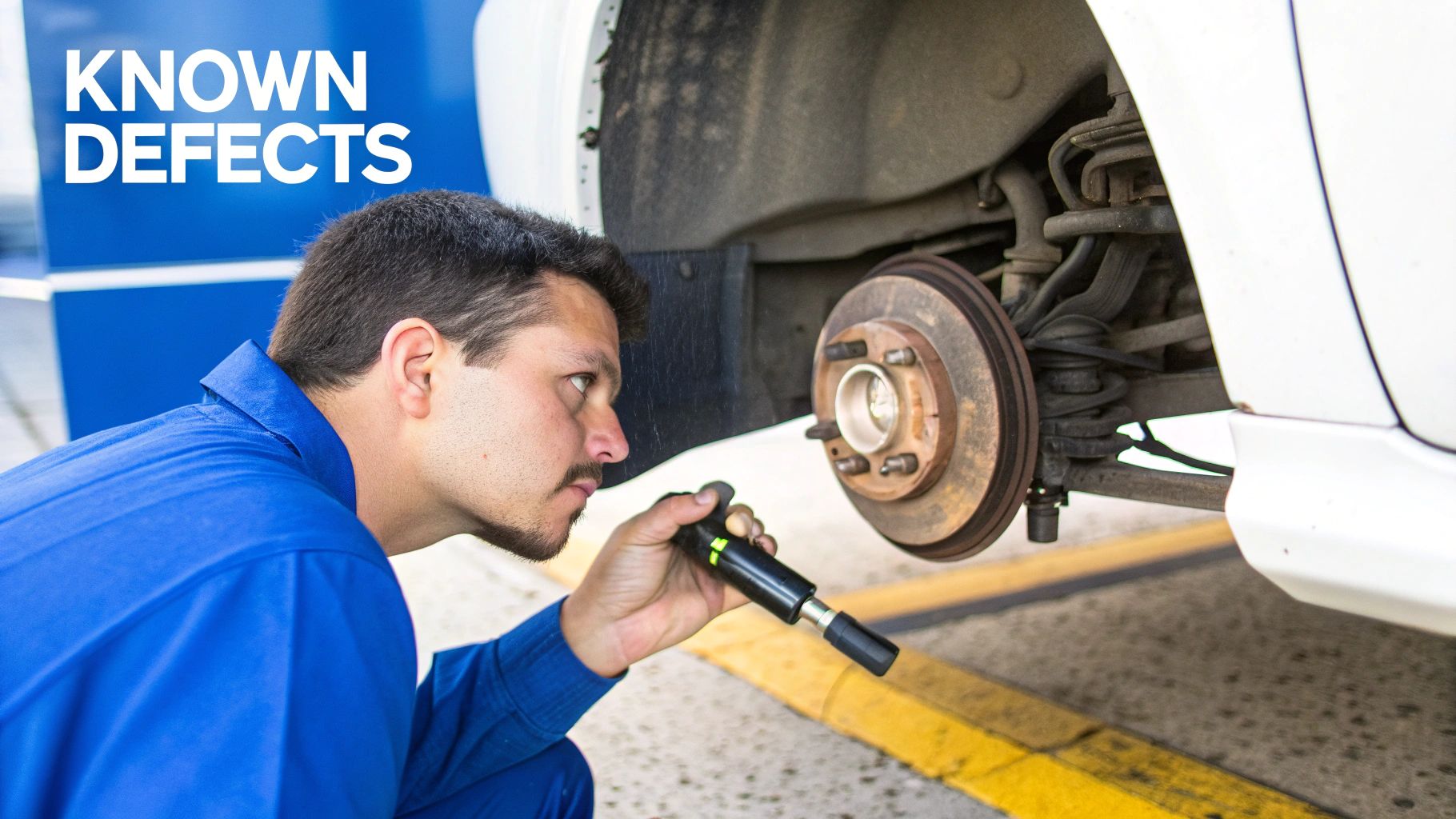
Think about it this way: say your crash was caused by a driver-assist feature that suddenly malfunctioned. If you discover that Consumer Reports has been flagging a trend of electronic glitches in your exact model, that’s powerful. It suggests what happened to you wasn’t just a random, one-off event—it was the predictable result of a known problem.
Finding the Pattern in Powertrain Problems
Recent data reveals some stark differences between vehicle types, which can be incredibly relevant after a crash. For instance, Consumer Reports’ auto reviews have started to spotlight the growing pains of new technology. Their latest annual reliability survey, which pulled data from over 330,000 vehicles, found that EVs and plug-in hybrids often have more issues than their simpler counterparts, especially with their electronics and new powertrain components. Meanwhile, traditional hybrids continue to be reliability champions. You can dig into these reliability findings on ConsumerReports.org.
This kind of information is crucial if your accident involved a sudden loss of power or some other bizarre vehicle behavior. The data helps build a case that the automaker knew about potential issues with its new tech, shifting the focus from driver error to a potential defect. Documented recall patterns are also a goldmine of evidence; you can see this in action with issues like the 2012 Chevrolet Equinox recalls.
Using Data to Back Up Your Story
The goal is to find specific, documented trends in the CR data that perfectly mirror what you experienced. You want to draw a clear line from a known flaw to the moment of your crash.
Here are a few concrete examples of how this works:
- Brake System Failures: Did your brakes feel spongy or fail to engage? Check CR for widespread owner complaints about premature pad wear, warped rotors, or master cylinder failures in your model.
- Steering and Suspension Issues: If your car suddenly veered or became impossible to control, data showing a high rate of problems with tie rods, ball joints, or electronic power steering can back up your claim.
- Unintended Acceleration: Though it’s less common, some vehicle models have a history of electronic throttle glitches. CR data can reveal if other owners have reported the same terrifying experience.
When your personal account lines up with these broader, documented trends, you’re no longer just one person with a story. You’re demonstrating that your accident was part of a larger, foreseeable pattern of failure.
Using Consumer Reports Data in Your Florida Accident Claim
After a car wreck, everything can feel overwhelming. But having the right information can make a huge difference in building a strong case. This is where auto reviews consumer reports data comes in. It’s a practical tool that can turn abstract safety scores and reliability numbers into solid evidence for your Florida accident claim.
Think of it this way: CR data isn’t a silver bullet that wins your case on its own. Instead, it provides powerful context. It helps show that a specific mechanical failure wasn’t just a random, one-off event but part of a documented, widespread problem. This can shift the conversation from simple driver error to a predictable issue the manufacturer knew about—or should have known about.
Research Your Vehicle Model Effectively
The first move is to dig into the Consumer Reports archives for your car’s exact make, model, and year. Don’t just glance at the overall score. You need to zero in on the detailed reliability section where they break down real-world issues reported by actual owners.
Look for recurring complaints related to the systems that keep a car safe on the road. Specifically, keep an eye out for patterns involving:
- Brake System Problems: Are there multiple reports of brakes wearing out too fast, pedals feeling spongy, or total brake failure?
- Steering and Suspension Issues: Watch for complaints about the car pulling to one side, steering feeling loose or unresponsive, or drivers suddenly losing control.
- Engine and Transmission Failures: Look for data on engines that stall unexpectedly, unintended acceleration, or transmissions that fail without warning.
- Electrical and Tech Glitches: Note any problems with advanced driver-assist systems or other electronics that could distract a driver or fail at a critical moment.
For anyone trying to pull meaningful insights from accident reports, repair invoices, and CR reviews, learning about effective document analysis is a great place to start.
Document and Organize Your Findings
Once you’ve found a pattern that sounds familiar, it’s time to document everything. I mean everything. Take clear screenshots of the reliability charts, the specific ratings, and especially the quotes from other owners whose experiences match yours. Then, organize all of this evidence so it tells a clear story.
This documentation connects the dots. It builds a bridge between your personal story of what happened in the accident and a much larger, statistically significant history of that vehicle’s problems. It shows an insurance adjuster or a jury that what happened to you wasn’t just a fluke.
A Florida personal injury attorney can take this organized data and use it to add serious weight to your claim. It offers objective, third-party proof that supports an argument for product liability or manufacturer negligence. This kind of evidence is incredibly useful when negotiating with insurance companies, who often take a claim more seriously when faced with proof of a known defect. If you’re just getting started, it helps to understand how to file a personal injury claim in Florida.
Answering Your Questions About Auto Reviews and Accident Claims
When you’re trying to make sense of things after a car accident, questions pop up left and right. One of the biggest is often, “What now?” Understanding how data from sources like auto reviews consumer reports can play a role in your Florida personal injury case gives you a clearer path forward.
Can This Data Actually Prove Who Was at Fault?
That’s a common question, but the short answer is no, not directly. Consumer Reports data isn’t about proving a specific driver was careless in the moment of a crash.
Instead, its real power lies in supporting claims that a vehicle defect was a contributing factor. The reports focus on a car’s documented performance, safety ratings, and known issues over time, which can be crucial if a mechanical failure or design flaw is suspected.
Is This Information Only for Brand-New Cars?
Not at all. This data is just as valuable—sometimes even more so—for accidents involving used or older vehicles.
Consumer Reports tracks reliability and owner-reported problems across many model years. This long-term view is fantastic for uncovering persistent design flaws or manufacturing defects that might be relevant to your situation. For a different angle on vehicle evaluation, especially with newer tech, some people also look at guides on the UK’s best electric car reviews.
Remember, every piece of evidence matters, but time is also a factor. It’s important to understand the statute of limitations for a car accident in Florida to ensure you act within the required timeframe.
While Consumer Reports is a subscription service, don’t let that stop you. Many public libraries offer free digital access to their entire database, making it an excellent and accessible resource for gathering evidence.
If you suspect a vehicle defect played a part in your accident, the experienced team at Martin Hernandez, P.A. is ready to help you build a powerful claim. Contact us today for a free consultation to explore your legal options. Learn more at https://injurylawyersoftampa.com.