
You’ve probably heard the term “auto safety recall” on the news, but what does it really mean when it affects your car?
Simply put, a recall happens when a vehicle or a piece of its equipment has a serious safety-related defect or doesn’t meet federal safety standards. This isn’t just about a rattling noise or a cosmetic flaw. We’re talking about parts—from airbags to brakes to fuel pumps—that could create a real danger for you and your passengers.
What An Auto Safety Recall Means For You
Think about it: the airbag that’s supposed to save your life could suddenly become a threat. That’s the reality behind a recall. It’s more than a postcard in the mail; it’s a critical warning that something in your car could fail, potentially causing a crash or making an injury much worse.
A single bad part, like a faulty ignition switch or a flawed seatbelt latch, might be installed in millions of cars across the country. Suddenly, a widespread safety crisis emerges, leading to serious accidents on Florida’s busy highways, from the daily grind on I-4 in Tampa to the fast-paced traffic of I-95. The first step in keeping yourself safe is understanding what these recalls are all about.
The Two Paths To A Recall
A recall doesn’t just happen out of the blue. It’s the end result of a process designed to get unsafe vehicles fixed or off the road. Most of the time, a recall gets started in one of two ways:
- The Manufacturer Finds It First: This is the most common scenario. A car company, through its own testing or by noticing a pattern in warranty claims, discovers a problem. They do the right thing and voluntarily report the defect to the National Highway Traffic Safety Administration (NHTSA), kicking off the recall themselves.
- The Government Steps In: Sometimes, the automaker is slow to act. The NHTSA might open its own investigation after seeing a spike in consumer complaints or analyzing crash data. If the agency finds a genuine safety defect, it can legally force the manufacturer to issue a recall.
When a recall is issued, it’s an official admission that a vehicle or one of its parts poses an unreasonable risk. The manufacturer is then legally on the hook to provide a fix—a repair, a replacement, or even a refund—completely free of charge to you, the owner.
The massive financial cost of these recalls is typically covered by the manufacturer’s product liability insurance, which is a key part of how the industry handles the fallout from dangerous products.
All of this underscores just how important it is for every car owner to stay informed. Of course, picking a vehicle with the latest safety gear is a smart move, and you can learn more about what safety features you should look for in our article. But remember, even the most advanced features can fail if they’re part of a recall, which makes checking for them yourself an absolute must.
From Defect Discovery to Your Mailbox: The Recall Process Explained
An auto safety recall doesn’t just happen overnight. It’s the end result of a long, often complicated process that begins the moment a dangerous defect is first spotted. Understanding how a problem goes from a strange noise in one car to an official notice in your mailbox is crucial—it shows you just how many chances there are for the system to work, and sometimes, where it can fail.
The first whispers of a problem usually come from people like you. When a driver runs into a scary or unexpected issue with their car, they can file a complaint directly with the National Highway Traffic Safety Administration (NHTSA). At the same time, car manufacturers are supposed to be watching their own warranty claims and running quality control tests, which can also uncover these hidden dangers.
The Investigation Stage
When enough complaints about the same problem start piling up, it gets the attention of the NHTSA’s Office of Defects Investigation (ODI). This is where things get serious. The ODI can launch a formal investigation to dig into the data, study crash reports, and lean on the manufacturer to figure out if there’s a genuine safety defect.
So, what makes a defect “safety-related”? It’s any flaw that creates an unreasonable risk of a crash, injury, or death. Think about the critical systems that keep you safe on the road:
- Steering components that suddenly fail, leading to a complete loss of control.
- Fuel system parts that leak, posing a serious fire risk.
- Airbags that don’t deploy in a crash—or worse, deploy when they shouldn’t.
- Braking systems that give out without warning.
This flowchart breaks down the two main ways a defect triggers an official recall.
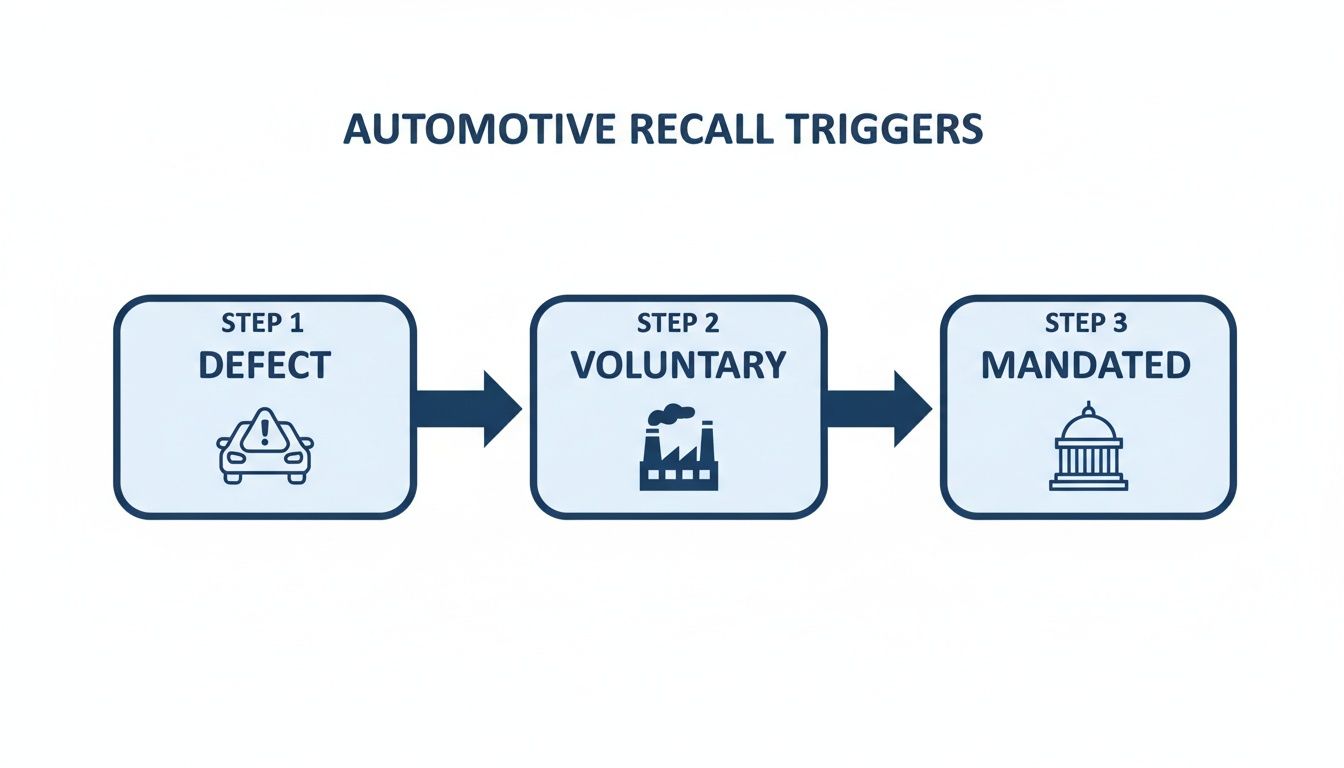
As you can see, a recall can start in one of two ways: either the automaker initiates it voluntarily, or the government steps in and mandates it. Either way, it all starts with a confirmed defect.
The Official Recall and Your Notice
Once an investigation confirms a dangerous flaw, the manufacturer is required to issue a recall. Many automakers do this voluntarily to get ahead of the problem. But if they drag their feet, the NHTSA has the legal power to force them to act.
From there, the law is clear: the automaker must notify every registered owner of an affected vehicle by first-class mail.
That letter in your mailbox is your official call to action. It’s required to clearly explain the defect, the safety risk it poses, and any warning signs you should look out for. Most importantly, it will spell out the free remedy the manufacturer is obligated to provide.
The “remedy” is just the official term for the fix. This is always done at zero cost to you. It might involve repairing a faulty part, replacing an entire component, or, in very rare situations, refunding you for the vehicle. A dealer cannot legally charge you for the parts or labor needed to complete a safety recall repair.
This entire system is built to protect drivers. But when there are delays or breakdowns anywhere in this process, the consequences can be devastating, leading to preventable crashes and serious injuries on Florida’s roads.
How To Check Your Vehicle For Open Recalls: A Practical Guide

You can’t afford to wait for a letter in the mail to find out your car has a dangerous defect. While manufacturers are legally required to send recall notices, these official letters can easily get lost, be mistaken for junk mail, or never arrive at all if you’ve recently moved.
That’s why every car owner should proactively check for auto safety recalls. It’s a simple, fast, and free step that puts you in control of your safety. The single best way to do this is by using the National Highway Traffic Safety Administration’s (NHTSA) official VIN Lookup tool. This federal database cuts through the noise and gives you a definitive answer on your vehicle’s recall status in seconds.
To get started, you’ll need your car’s Vehicle Identification Number (VIN). Think of the VIN as your car’s unique fingerprint—it’s a 17-character code that tells you everything about its specific make, model, and manufacturing history.
Where to Find Your VIN
Finding your VIN is easy once you know where to look. It’s always in a few standard spots:
- On the dashboard: Glance through the windshield on the driver’s side. You’ll see a small plate with the VIN stamped on it right where the dashboard meets the glass.
- On the driver’s side door jamb: Open the driver’s door and look at the frame. There’s a sticker there (usually black and white) with tire pressure information and other data, including your VIN.
- On your paperwork: Your VIN is also printed on key documents like your vehicle registration card and your auto insurance policy.
Once you have that 17-character number, you’re ready to check. It’s a small step that can make all the difference.
A Step-By-Step Guide To Using The NHTSA Tool
Running an auto safety recalls check on the NHTSA’s website takes just a minute. The process is straightforward and designed for anyone to use.
- Go to the NHTSA Website: Open your browser and navigate to the official recall page: NHTSA.gov/recalls. This is the government’s direct source for all safety recall data.
- Enter Your VIN: You’ll see a large search box on the page. Carefully type in your 17-character VIN and hit the “Check” button.
- See Your Results: The system instantly cross-references your VIN against the entire recall database and shows you the results.
The screenshot below shows you exactly where to enter your VIN on the NHTSA’s site.
This page will give you a clear, immediate answer, so there’s no more guessing about your car’s safety status.
Understanding Your Recall Results
The results page will give you one of two clear answers. If you see a message saying, “0 Unrepaired Recalls,” you can breathe a sigh of relief. This means your specific vehicle has no outstanding safety issues that need to be addressed.
If there is an active recall, the page will lay out all the details. You’ll see the official recall campaign number, a summary explaining the safety risk, and instructions on the free fix offered by the manufacturer. This is your cue to call a local dealership and schedule the repair at no cost to you. For a deeper dive into what to look for, some professional guides offer a comprehensive vehicle recall check rundown.
The sheer volume of recalls is astonishing. Between 2010 and 2024, an average of over 41 million vehicles were recalled in the U.S. each year. With major manufacturers like Ford and Chrysler recalling millions of cars in early 2025 alone, it’s clear this problem isn’t going away.
Taking just a few minutes to check your VIN is a powerful preventative measure. It ensures you are not unknowingly driving a vehicle with a known defect that could compromise your safety on the road.
Beyond the official NHTSA tool, it’s always smart to stay informed by reading professional reviews and safety reports. For more on this, check out our guide on using auto reviews and consumer reports. Making this a regular habit helps you stay ahead of potential issues before they become real problems.
When Safety Devices Fail: The Takata Airbag Crisis
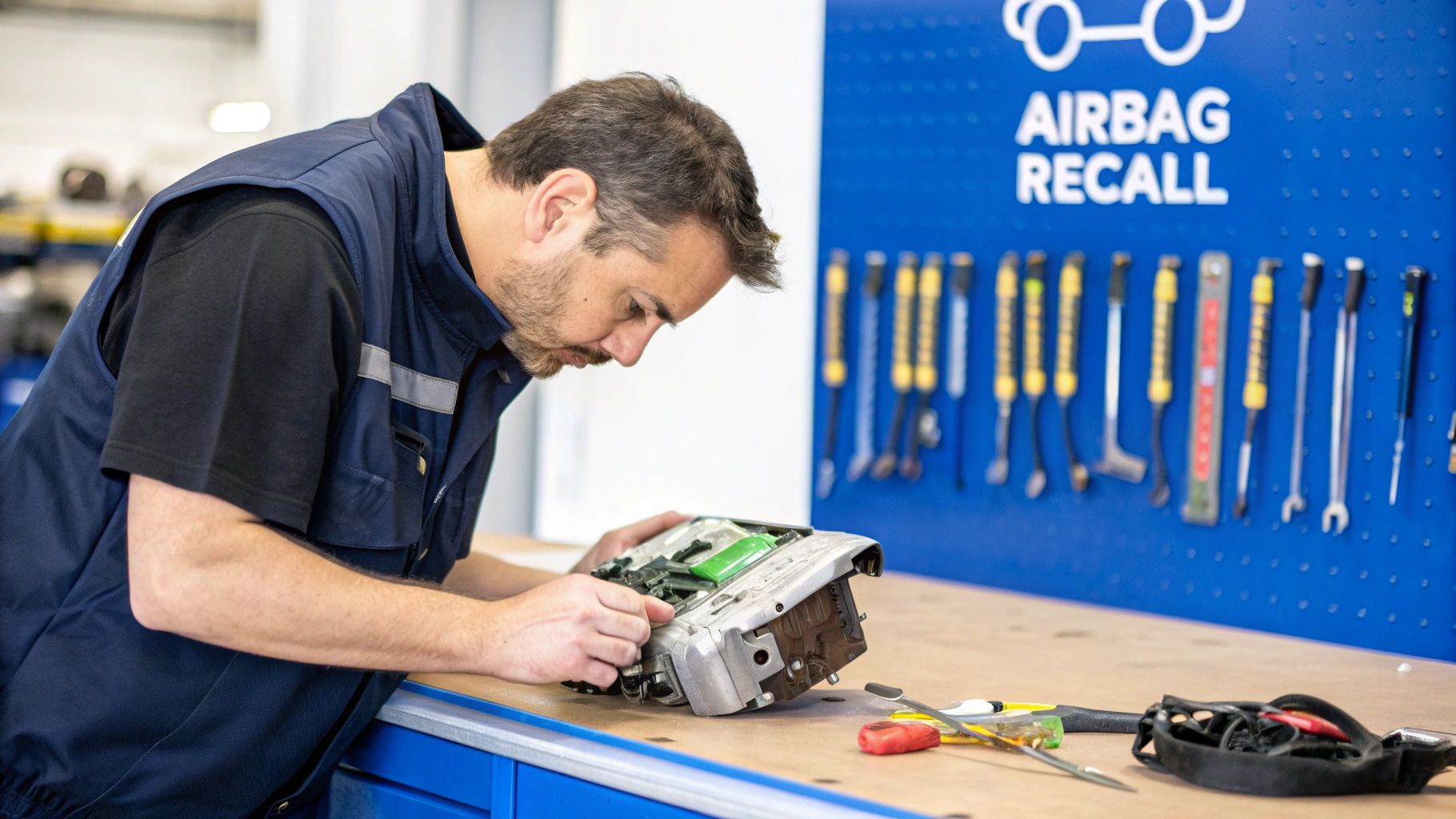
The term “auto safety recall” can sound abstract, like just another notice you find in the mail. But what happens when the very part designed to save your life becomes a deadly weapon? The Takata airbag crisis is a devastating, real-world lesson that turned a distant risk into a tragic reality for hundreds of families.
This wasn’t some minor glitch. We’re talking about a fundamental design flaw with fatal consequences. The core of the problem was the chemical propellant used to inflate the airbags: ammonium nitrate. While it creates the rapid expansion needed for deployment, this chemical is notoriously unstable, especially when exposed to heat and humidity over a long period.
For drivers in Florida, this created a perfect storm. The relentless heat and moisture we see in the Tampa Bay area accelerated the breakdown of the ammonium nitrate. With each passing year, the compound grew more volatile, effectively turning the airbag’s metal housing into a ticking time bomb.
The Science Behind The Danger
When an airbag deploys, it’s essentially a controlled explosion. The propellant ignites, instantly filling a nylon bag with gas to cushion you from impact. But the degraded ammonium nitrate in Takata’s inflators burned far too quickly and with too much force—well beyond what the device was ever designed to handle.
This extreme over-pressurization caused the metal inflator canister to rupture violently. Instead of just inflating the airbag, the device exploded like a grenade, blasting metal fragments directly into the car’s cabin at incredible speeds. The one thing meant to be a life-saving cushion became a lethal projectile.
The results have been horrific. Drivers and passengers have suffered severe, life-altering injuries, including:
- Deep lacerations to the face, neck, and chest
- Permanent blindness from shrapnel striking the eyes
- Traumatic brain injuries
- Severed arteries leading to death
Tragically, these injuries often happened during minor, low-speed collisions—the kind of fender-benders you should walk away from without a scratch. Instead, people faced grave injury or death because a safety device failed in the most violent way imaginable.
A Recall Of Unprecedented Scale
The sheer scale of the Takata recall is staggering, making it the largest and most complex auto safety recall in history. Imagine driving down a Tampa highway with your family when a minor bump causes your airbag to explode, hurling metal shards at your face. Beginning in 2013, defects in Takata’s inflators triggered recalls of over 67 million vehicles worldwide. The exploding inflators have claimed at least 26 lives globally and are tied to over 400 injuries, many happening in otherwise routine accidents. You can read more about the history of this and other massive recalls on carbuzz.com.
The crisis touched nearly every major car brand, from Honda and Toyota to Ford and BMW, spanning more than a decade of model years. The overwhelming number of affected vehicles crippled the supply chain for replacement parts. This left millions of drivers stuck with a known, lethal defect in their cars for months or even years while they waited for a fix.
The Takata airbag disaster is the ultimate cautionary tale. It shows in brutal detail how a corporation’s decision to use a cheaper, less stable chemical led directly to widespread human suffering. It’s a powerful reminder that an unaddressed recall is never just a “suggestion”—it’s a critical warning about a real and present danger.
This crisis also underscores the immense legal and financial fallout for manufacturers who put dangerous products on the road. When these defective parts cause harm, victims have the right to seek justice. The injuries caused by faulty airbags can be particularly severe, and understanding your rights is the first step toward recovery. To learn more, you might be interested in our guide on seeking compensation for airbag injuries.
Your Legal Rights After A Recall-Related Accident In Florida
The aftermath of a car accident in Florida is always chaotic and disorienting. But when the crash stems from a defective part that was under an auto safety recall, the entire situation changes. It’s no longer just a traffic accident; it’s a potential product liability claim against a massive corporation.
Many people assume that if a recalled part fails and hurts them, it’s just bad luck. That couldn’t be more wrong. In Florida, car manufacturers have a legal and moral responsibility to build vehicles that are reasonably safe. An open safety recall is a powerful piece of evidence that they fell short of that duty.
This means you have rights. An injury caused by a known defect isn’t something you just have to live with. You have the ability to hold the manufacturer accountable for the damage their unsafe product has done to you and your family.
Building A Product Liability Case In Florida
To have a real shot at a successful claim, your case needs to prove three key things. Think of these as the legs of a stool—without all three, the case can’t stand up.
- Duty of Care: Every automaker has a basic legal duty to sell products that are safe for the public to use. It’s the baseline expectation.
- Breach of Duty: A safety recall is practically an admission that the manufacturer breached this duty. It shows they knew, or at least should have known, that a part was dangerously defective.
- Causation: This is the critical link. We have to prove that the specific recalled defect is what directly caused or was a major factor in your accident and injuries.
Let’s say your car’s brakes were recalled because they could fail without warning. If they suddenly gave out while you were on I-275 and you rear-ended someone, there’s a very clear line connecting the dots. The manufacturer’s failure to fix the defect led directly to your injuries.
A recall notice transforms your accident from a simple traffic incident into a potential legal battle against a manufacturer. It establishes that the company was aware of a dangerous defect yet failed to prevent it from harming you.
Proving these elements is how you build a solid foundation to recover the compensation you deserve for your medical bills, lost income, and the pain you’ve had to endure.
The Importance Of Evidence And Florida’s Deadlines
After any crash, but especially one involving a potential recall, preserving evidence is everything. Your vehicle is the single most important piece of evidence. It holds the failed part that our automotive experts and engineers need to inspect to build your case.
It’s also crucial to hold onto any recall notices you received in the mail. These letters are direct proof that the manufacturer knew about the problem. Without this kind of physical evidence, putting together a strong claim is much tougher. Understanding the rules around this is vital, which is why you should learn more about what spoliation of evidence means in a Florida injury case.
You also need to know that Florida law gives you a strict deadline for filing this kind of lawsuit. It’s called the statute of limitations. For most product liability cases, you have a very specific window of time from the date you were injured to file a claim. If you wait too long, you can be permanently blocked from seeking any compensation, no matter how strong your case is.
This is exactly why you have to act fast. Getting in touch with a knowledgeable personal injury attorney right away ensures that crucial evidence is protected and all your legal deadlines are met, safeguarding your right to pursue justice.
How an Attorney Can Help With Your Recall Injury Claim

When a recalled part causes an injury, you aren’t just dealing with the aftermath of an accident—you’re suddenly up against a massive corporation and its team of seasoned lawyers. Trying to take them on by yourself is a tough, often impossible, fight. A skilled personal injury attorney steps in to become your advocate, leveling the playing field and fighting for the compensation you deserve.
At Martin Hernandez, P.A., we know that an auto safety recall case is a different beast entirely from a standard car crash claim. These are complex product liability cases, and they demand a very specific, aggressive strategy right from the start. Our entire focus is on proving that the manufacturer’s negligence is the direct cause of your injuries and losses.
Going toe-to-toe with a multi-billion-dollar automaker isn’t just about knowing the law. It takes serious resources and a network of specialists who can dismantle the other side’s arguments. That’s why we immediately assemble a team of top-tier experts to build an ironclad case for you.
Assembling the Evidence for Your Claim
To win these cases, you have to prove that the recalled defect directly caused or worsened your injuries. This requires more than just pointing fingers; it takes hard data and expert analysis. Our legal team collaborates closely with highly qualified professionals to uncover the facts and clearly establish liability.
Our expert team typically includes:
- Accident Reconstruction Experts: These specialists can meticulously recreate the entire crash sequence, showing precisely how the recalled part failed and what role it played in the accident.
- Automotive Engineers: They are the ones who can take apart the defective component, explain its design flaws in plain English, and testify on how it failed to meet established safety standards.
- Private Investigators: They dig for the evidence that manufacturers don’t want found, from tracking down key witnesses to unearthing internal company documents.
This expert-driven approach is absolutely critical. It’s what allows us to draw a straight line from the manufacturer’s defective product to your specific injuries, which is the foundation of any successful claim.
Maximizing Your Compensation
A serious injury affects every corner of your life, from your bank account to your mental health. Our job is to make sure that the full scope of your suffering is documented, calculated, and presented forcefully. We leave no stone unturned when calculating your damages to build the strongest possible case for maximum compensation.
We fight to recover every dollar you’re owed for:
- All Medical Expenses: This covers everything from the initial emergency room visit to future surgeries, physical therapy, long-term care, and medications.
- Lost Wages and Diminished Earning Capacity: If your injuries have kept you out of work or have permanently impacted your ability to earn a living, we fight for that lost income.
- Pain and Suffering: This compensates you for the very real physical pain, emotional distress, and loss of enjoyment of life that follows a traumatic injury.
We prepare every single case as if it’s headed for trial. This sends a powerful message to the manufacturer’s lawyers and their insurance companies: we will not be intimidated into accepting a lowball settlement offer.
Our deep roots in the Tampa court system give us a home-field advantage. We know the courts, the judges, and the playbook corporate legal teams use, which puts us in a prime position to counter their tactics.
Best of all, you never have to worry about paying for our help upfront. We work on a contingency fee basis, which simply means we only get paid if we win your case and recover compensation for you. It’s a no-risk way to pursue the justice you deserve. For a deeper dive into how this works, check out our guide on hiring a personal injury lawyer.
Common Questions About Florida Auto Safety Recalls
When you find out your car has a safety recall, it’s natural to have a lot of questions. Here are some straightforward answers to the most common concerns we hear from Florida drivers, especially after they’ve been in an accident involving a recalled vehicle.
Do I Have to Pay for Recall Repairs in Florida?
Absolutely not. Federal law is ironclad on this: manufacturers are required to fix safety recall issues completely free of charge. That means you don’t pay a dime for the parts or the labor.
If any dealership in Florida attempts to charge you for a safety recall repair, don’t pay it. You should immediately contact the automaker’s corporate customer service line and file a complaint with the NHTSA.
What if the Recall Notice Showed Up After My Crash?
This happens more often than you’d think, and you could still have a very strong case. The key legal issue isn’t when you got the notice in the mail, but when the manufacturer knew—or should have known—that their product was dangerously defective.
A good attorney will dig into the company’s internal records. If we can prove the manufacturer dragged their feet and delayed issuing the recall, they can absolutely be held liable for the injuries their defective product caused, no matter when you were officially notified.
Can I Sue if I Was Injured by a Recalled Part in a Used Car?
Yes, you can. A carmaker’s responsibility to build a safe vehicle doesn’t just disappear after the first owner. That duty is attached to the car itself, for its entire lifespan on the road.
If you were hurt by a defective part that was part of an auto safety recall, it doesn’t matter that you bought the car used. The manufacturer is still on the hook for putting a dangerous product out there for public use.
If a defective or recalled auto part caused an accident that injured you or a family member here in the Tampa Bay area, you don’t have to take on a massive corporation by yourself. The legal team at Martin Hernandez, P.A. has the experience to fight for the compensation you deserve. Reach out to us today for a free, no-pressure consultation to go over your case at https://injurylawyersoftampa.com.