
Before you can even begin to make sense of auto warranty reviews, you have to know what’s actually being sold. It’s a common mistake—many drivers use the terms “warranty” and “service contract” as if they’re the same thing. They’re not. In fact, they represent two very different kinds of protection, and getting this right is the first step to making a smart choice and avoiding a costly mistake.
Understanding Auto Warranties and Service Contracts
When you drive a brand-new car off the lot in Florida, it’s protected by a manufacturer’s warranty. The best way to think about this is like a builder’s guarantee on a new house. For a set amount of time—usually the first three years or 36,000 miles—the automaker is promising their product is free from defects. If something breaks down due to a flaw in manufacturing during that period, they cover the repair.
But what happens when that factory coverage runs out? That’s when you’re on the hook for every repair bill, which is precisely where an extended service contract enters the picture. While everyone calls it an “extended warranty,” it’s really more like an insurance policy you buy to cover mechanical breakdowns. You’re paying for a plan that picks up where the manufacturer’s warranty left off.
Who Is Really Behind the Plan?
Here’s a critical detail that trips up a lot of people: the dealership that sells you the service contract is almost never the company that actually backs it. The dealership is just the middleman. Your contract is typically managed by a third-party company, an administrator you’ve likely never heard of.
This is a huge deal. It means your entire experience, from getting a repair approved to actually getting paid, is with this separate administrator—not the friendly salesperson you bought the plan from. This is exactly why digging into auto warranty reviews is so vital. You’re not just checking up on the dealership; you’re investigating the reputation of the company that will either approve or deny your future claims.
Decoding Common Florida Coverage Tiers
Service contracts aren’t a one-size-fits-all product. They’re sold in different coverage levels, and the names they use can be confusing. For the most part, you’ll run into two main types in Florida:
- Powertrain Coverage: This is your most basic plan. It’s designed to cover only the most essential (and expensive) components that make the car go: the engine, transmission, and drivetrain.
- Bumper-to-Bumper Coverage: This is the most comprehensive plan you can buy and is meant to be as close to the original factory warranty as possible. It covers a huge list of mechanical and electrical parts, but—and this is important—it never truly covers everything.
A “bumper-to-bumper” plan is better described as an exclusionary policy. Instead of listing what’s covered, its contract lists what isn’t. Things like brake pads, tires, windshield wipers, and batteries are considered ‘wear and tear’ items and are almost always excluded. These exclusions are a major source of disputes.
Knowing what is and isn’t covered is also critical if your vehicle is ever subject to a recall. To better understand this process, you can learn more about how auto safety recalls work and what your rights are as a consumer. Grasping these differences will help you set realistic expectations for what any plan will, and won’t, do for you down the road.
How to Read Auto Warranty Reviews Like a Pro
Trying to find a reliable auto warranty in Florida can feel like navigating a minefield of online reviews. It’s tough to tell what’s a real customer experience and what’s just slick marketing. To make the right choice, you have to learn to read between the lines, separating the genuine stories from the noise.
Think of it this way: a truly useful review is a detailed account, not just a simple thumbs-up. It tells you a story with specifics. A fake or low-value review, on the other hand, is usually full of vague, over-the-top praise like “Best service ever!” without a single detail to back it up.
Spotting Fakes and Finding Facts
Your first job is to filter out the junk. A lot of companies will do just about anything to flood sites with positive feedback. At the same time, a single angry customer might leave out crucial details that led to their problem. You need to look for patterns that signal authenticity. So, how do you tell the difference? It comes down to paying attention to the details—or the lack thereof.
Here’s a breakdown of the common red flags of fake reviews versus the green flags that signal a genuine customer story:
Red Flags (Likely Fake or Biased):
- Over-the-top, generic praise (“Amazing company!”) with no specifics.
- The exact same enthusiastic phrases appear in multiple reviews.
- The reviewer’s profile is empty, new, or has no other activity.
- The review focuses only on the sales process, not on actual service.
- The story feels emotionally charged but lacks any verifiable facts.
Green Flags (Likely Genuine):
- Mentions the car’s make, model, and year, providing real context.
- Describes the specific mechanical failure, like a “blown head gasket” or “faulty sensor.”
- Names a real person they spoke with, like a claims adjuster or representative.
- Outlines the claims process timeline—how long approval took and what the communication was like.
- The tone feels balanced, even if negative, and includes objective details about the experience.
By keeping these points in mind, you can quickly sift through the fluff and focus on the reviews that actually tell you something meaningful about the company.
A Pro Tip From Experience: A warranty company’s real test doesn’t come when they take your money. It comes when you actually need them. The most valuable reviews you can find will always be the ones that walk you through the entire claims process, from start to finish.
This is especially true for the products most people are shopping for—vehicle service contracts. They aren’t the same as the warranty that comes with a brand-new car.
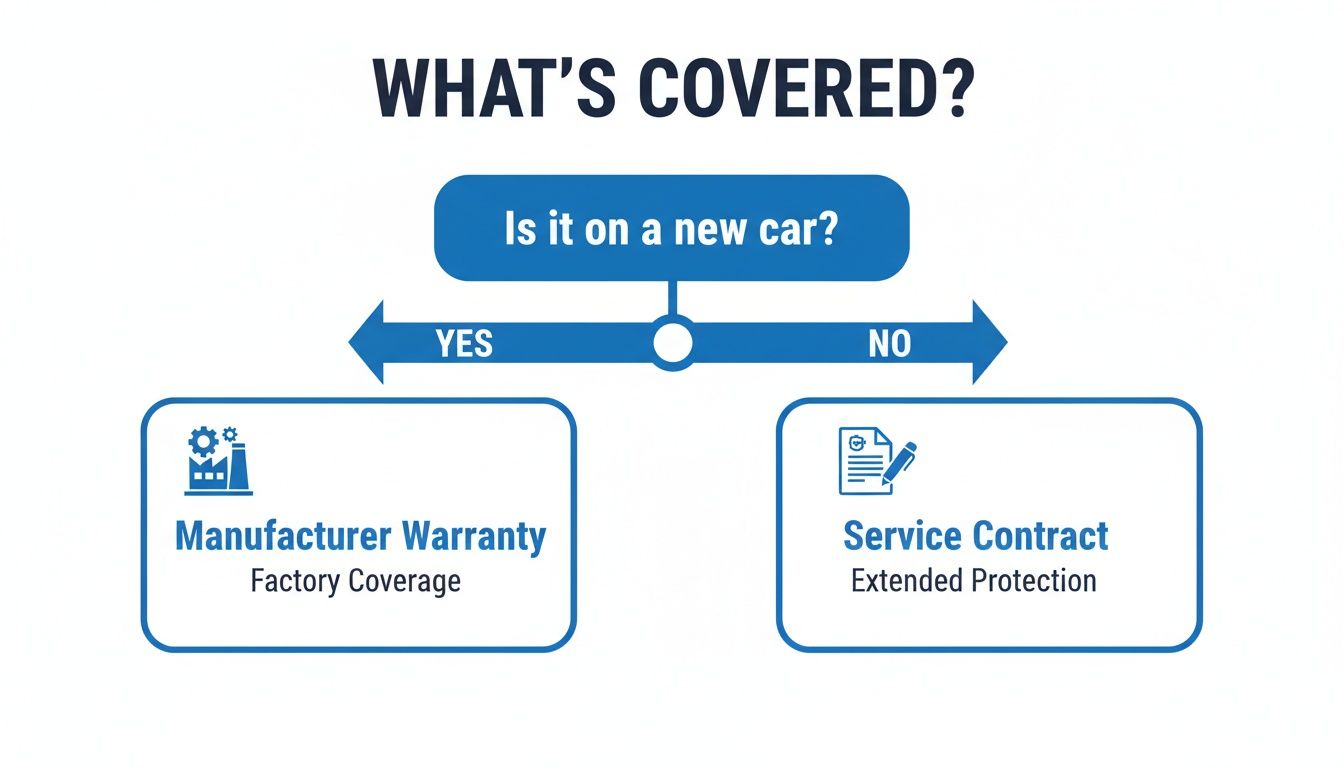
As you can see, new cars are covered by a manufacturer’s warranty straight from the factory. For almost every other vehicle, what we call a “warranty” is actually a vehicle service contract, and that’s what nearly all of these online reviews are about.
Building Your Own Review Checklist
As you dive into reviews, it helps to have a mental checklist. Running each review through these questions will help you cut through the marketing spin and get to the heart of a company’s performance.
- Does it name the car? A review that mentions a 2018 Ford F-150 is far more credible than one that just says “my truck.”
- Does it describe the problem? “The transmission started slipping” is a real story. “My car broke down” is just a vague complaint.
- Does it mention a real person? Naming a claims representative like “spoke with Sarah in claims” adds a huge layer of authenticity.
- Does it talk about the timeline? Details like “it took 3 days for approval” or “they never called me back for a week” are incredibly revealing.
Applying this critical eye turns you from a passive reader into an active investigator. It’s the same mindset you’d use when researching any other major purchase. You can see how this evaluation process works in other contexts by reading our guide for evaluating auto and home insurance reviews. Mastering this skill will give you a much clearer picture of what you can truly expect from a warranty provider.
Decoding the Fine Print in Your Florida Warranty Contract

The glossy brochure and the confident sales pitch paint a pretty picture. The reality, however, lives in the contract. If you’ve spent any time reading auto warranty reviews, you’ve probably noticed a common theme: frustration. More often than not, that frustration stems from something buried deep in the fine print—a detail that turns a covered repair into a denied claim.
Think of that contract as the official rulebook for a game. The warranty company wrote it, and they know every single rule. To have any chance of winning, you need to learn the key plays before you sign anything.
Mechanical Breakdown vs. Wear and Tear
Here’s where things get tricky, and it’s one of the biggest points of contention I see. Your contract is designed to cover a mechanical breakdown, which is a sudden and unexpected failure of a part. What it almost never covers is wear and tear—the natural, gradual decline of parts from normal driving.
For instance, if your car’s water pump gives out at 70,000 miles, that’s a clear breakdown. But what about your brake pads getting thin after 40,000 miles of stop-and-go traffic? That’s classic wear and tear, and it won’t be covered. A lot of claim denials here in Florida happen because the provider labels a failure as “wear,” even when it feels like a sudden breakdown to the car owner.
Understanding Critical Contract Clauses in Florida
Beyond that crucial distinction, there are a few other clauses that act as potential traps for Florida vehicle owners. Knowing what they are ahead of time lets you ask the right questions before you commit.
Keep an eye out for these:
- Consequential Damage Exclusions: This is a big one. It means if a covered part fails and damages other components, the policy will only pay to fix the original part. If a covered water pump breaks and your engine overheats and cracks, you’re only getting a new water pump. The massive engine repair bill? That’s on you.
- Pre-Authorization Requirements: This is non-negotiable. Almost every single contract requires you to get the company’s approval before your mechanic turns a single wrench. If the shop starts work without that authorization, the provider has the right to deny the entire claim, even if the failed part was clearly covered.
- Labor Rate Limits: Many plans put a cap on how much they’ll pay for labor. Your favorite shop might charge $150 per hour, but if your policy only covers up to $100 per hour, you have to pay that $50 difference for every hour they work on your car.
Let’s put it all together. A Tampa driver’s A/C compressor fails—a part listed as covered. The mechanic finds the failure also took out the condenser. Because of a consequential damage clause, the provider only pays for the compressor. On top of that, there’s a labor rate cap. The owner is now stuck paying for a new condenser and the labor difference, turning what they thought was a “covered” repair into a major out-of-pocket expense.
Finally, always look for the transferability and cancellation policies. A good plan should let you transfer the coverage to the next owner if you sell your car, which is a nice little boost to its resale value. You also need a clear process for canceling the policy and getting a prorated refund. Digging into resources like auto reviews from consumer reports can shed more light on these details. Knowing this stuff is how you spot risks and avoid nasty surprises later on.
Your Consumer Rights in Florida Warranty Disputes
Getting a claim denied by your warranty company feels like hitting a dead end, especially after you’ve paid your premiums faithfully. But as a Florida consumer, you’re not powerless. You have specific, powerful legal rights designed to protect you from unfair denials and deceptive practices.
The key is knowing these rights exist and how to use them. Your protection comes from two major laws—one at the federal level and one right here in Florida. Together, they give you the leverage to fight back when a warranty company doesn’t play by the rules.
Your Shield Against Unfair Practices
When you’re up against a warranty provider, think of the Magnuson-Moss Warranty Act and the Florida Deceptive and Unfair Trade Practices Act (FDUTPA) as your primary defense. They might have long names, but their goal is straightforward: to force companies to be honest and fair.
- Magnuson-Moss Warranty Act: This federal law is a game-changer. It mandates that warranties must be written in simple, easy-to-understand language. This stops companies from burying exclusions in confusing legal jargon and makes it easier for you to sue if they don’t honor their promises.
- Florida Deceptive and Unfair Trade Practices Act (FDUTPA): This is Florida’s own powerful consumer protection law, and its reach is even broader. It makes any “unfair or deceptive acts or practices” illegal in commerce, which is exactly where extended service contracts fall.
Under FDUTPA, an action is considered deceptive if it’s likely to mislead a typical consumer. It’s deemed unfair if it goes against public policy or is just plain unethical or unscrupulous. This gives you a wide net to catch all kinds of bad behavior.
Deceptive practices aren’t always obvious. It could be an ad that promised “bumper-to-bumper” coverage that turned out to be full of holes. Or it could be an adjuster deliberately misinterpreting your contract’s terms to avoid paying for a legitimate repair. When a company denies a valid claim by twisting the facts, they may be acting in bad faith. If that sounds familiar, it’s worth learning more about what constitutes a bad faith insurance claim, as many of the same principles apply here.
Taking the First Step in a Dispute
So, your claim was denied. Don’t just throw your hands up in frustration. Your first move is to create a paper trail that proves you’re formally disputing the decision. The best way to do this is by sending a certified demand letter to the warranty administrator.
This letter isn’t the time for anger; it’s the time for facts. Clearly state your name, policy number, and vehicle details. Lay out the specifics of the denied claim and, most importantly, explain precisely why you believe the denial violates your contract.
Sending it via certified mail with a return receipt is crucial—it gives you undeniable proof that they received your formal complaint. You’d be surprised how often this step alone is enough to make a company take a second look at your claim.
While laws vary by location, the core principles of fairness are universal. Taking a look at general guidance on warranty claims, like information related to the Consumer Rights Act 2015, can offer more perspective on what’s considered fair dealing between a consumer and a company.
When to Contact a Florida Insurance Dispute Attorney

You’ve done everything by the book. You read the auto warranty reviews, picked a reputable provider, and filed a legitimate claim with all the right paperwork. But the company simply won’t pay. After sending your demand letter, you’re met with silence or another denial. It’s an incredibly frustrating position to be in, and it’s exactly when you should think about getting legal help.
Knowing when to escalate the fight is crucial. Certain behaviors from a warranty company are more than just poor customer service; they’re giant red flags that suggest you need a professional in your corner. If you find yourself in one of these scenarios, it’s probably time to stop going it alone.
Red Flags That Signal You Need a Florida Attorney
Not every denial is illegal, but some tactics are clear signs of a company acting in bad faith. If your warranty provider is pulling any of these moves, they’re likely banking on you getting tired and giving up.
Watch out for these classic delay-and-deny tactics:
- Going Silent: The company suddenly stops responding to your calls or emails. You’re left completely in the dark, with no explanation for the delay or a timeline for their decision. This is a common stalling strategy.
- Denying a Clearly Covered Repair: They reject a claim for a component that is explicitly covered in your contract. Often, the reason they give is vague, nonsensical, or contradicts the plain language of your policy.
- Blaming Pre-Existing Conditions Without Proof: This is a go-to excuse. The provider claims the issue existed before you even bought the warranty, but they offer no evidence. The burden is on them to prove it, not on you to disprove it.
- Refusing to Provide a Written Denial: They’ll only tell you “no” over the phone and flat-out refuse to put the reason for the denial in writing. This is a deliberate attempt to avoid creating a paper trail you could use against them.
When a provider uses these tactics, they are often making a calculated bet that you’ll run out of steam. They assume you won’t have the time, energy, or money to keep fighting. But in Florida, the law is designed to help you push back.
The Role of a Florida Insurance Dispute Lawyer
This is where a Florida insurance dispute attorney can completely change the game. These lawyers live and breathe state-specific laws like the Florida Deceptive and Unfair Trade Practices Act (FDUTPA). They know exactly what counts as bad faith and how to make providers answer for it.
An attorney’s primary job is to level the playing field. They know how to cut through an adjuster’s flimsy excuses and build a case that documents a pattern of bad faith conduct. Using their deep knowledge of the law, they can enforce the contract you paid for and fight for the compensation you’re owed.
Here’s something many Florida drivers don’t realize: if you have to sue your warranty company to get them to honor your policy and you win, the court can order them to pay your attorney’s fees. This provision makes it possible for you to get expert legal help without worrying about the cost.
If you’re trapped in a seemingly endless cycle of denials, it’s vital to know your rights. You can learn more about how to fight an insurance denial and see how a legal professional can make all the difference. You don’t have to take on a stubborn warranty company by yourself.
Common Questions About Florida Auto Warranties
Alright, let’s cut through the noise. After you’ve waded through auto warranty reviews and tried to make sense of dense contracts, a few key questions always seem to pop up. Think of this as your final checklist—the essential truths you need to know before you ever sign on the dotted line.
Getting these right is just as important as knowing the rules of the road in Florida. One protects you from an accident, the other protects you from a financial wreck.
Is an Extended Warranty the Same as Florida Car Insurance?
Absolutely not, and it’s a dangerous mistake to confuse the two. Your Florida auto insurance is for sudden, external events—a car crash, a tree falling on your roof, or even theft. It covers the unexpected things that happen to your car.
An extended warranty, which is really a service contract, covers your car’s internal health. It’s designed to pay for repairs when a mechanical or electrical part fails on its own. They cover completely different things and one can never replace the other.
Can I Use My Own Mechanic for Repairs in Florida?
This is a deal-breaker for many people, and the answer is a classic “it depends.” The best contracts give you the freedom to take your car to any ASE-certified repair shop in the country. That means you can stick with the local Florida mechanic you know and trust.
Be careful, though. Many other plans lock you into a specific network of “approved” repair facilities. If you go outside that network, even for a simple diagnosis, your claim will be denied flat out. You absolutely must find this detail in the fine print before committing.
Reputable plans offer you freedom of choice. A contract that forces you into a limited network is a huge red flag and can be a nightmare if you break down on a road trip or simply prefer your trusted local technician.
What Happens If the Warranty Company Goes Out of Business in Florida?
This is a legitimate fear—what if you pay for years of coverage and the company simply disappears? In Florida, any reputable extended service contract must be backed by a separate, highly-rated insurance company. This is your financial safety net.
If the administrator (the company you bought the plan from) goes under, that insurance backer is legally required to step in and pay for covered claims. Always ask for the name of the insurance carrier and verify their financial strength rating yourself. If they can’t or won’t provide it, walk away.
Does a Florida Service Contract Cover Routine Maintenance?
This is a hard no. These plans are for unexpected breakdowns, not predictable upkeep. Things like oil changes, new tires, brake pads, and filter replacements will always be on your dime.
In fact, failing to keep up with and document your car’s required maintenance can give the company a perfect excuse to deny a legitimate claim later. They’ll argue that your neglect caused the part to fail, which voids your coverage. Keep your receipts!
Knowing the ins and outs of vehicle protection agreements is crucial. For instance, a deeper dive into understanding car rental insurance policies can offer a wider perspective on how different types of coverage and their legal terms operate in Florida, which is useful context when dealing with any vehicle-related contract.
If a warranty company has used deceptive tactics or issued a bad-faith denial on your claim in Florida, don’t just accept the financial loss. The legal team at Martin Hernandez, P.A. has a long track record of holding insurance and warranty providers accountable.
Contact us for a free, no-obligation consultation to understand your consumer rights. We’ll show you how we can fight to get you the compensation you deserve. Visit us at https://injurylawyersoftampa.com to learn more.