
If you’ve been hurt in a car wreck, one of the first questions on your mind is probably, “What’s my case actually worth?” It’s a completely fair question. While it’s tempting to look for a quick answer online, the idea of an average car accident settlement in Florida is more myth than reality.
Why? Because a few massive, multi-million dollar verdicts can throw the numbers way off for everyone else.
The Myth of a Single Florida Settlement Average
Thinking about a single “average” settlement is like trying to find the average price of a vehicle in a dealership that sells both reliable family sedans and million-dollar supercars. The handful of exotic cars on the lot would skew the average so high that it becomes a useless number for someone just trying to price a normal car.
Car accident settlements in Florida are exactly the same. The few tragic, catastrophic injury cases that result in massive payouts pull the mathematical average way up, creating a figure that doesn’t help the vast majority of people. Relying on that single number will only lead to false hope and frustration.
The bottom line is this: there is no one-size-fits-all settlement amount. Every single case is unique. The value is built from the ground up based on your specific circumstances, from how badly you were hurt to the amount of insurance coverage available.
Understanding Ranges Instead of Averages
A much more realistic way to get a feel for your potential compensation is to look at settlement ranges based on the severity of the injury. It just makes sense, right? A minor whiplash claim that heals in a few months is going to fall into a completely different ballpark than a case involving a spinal cord injury that requires a lifetime of care.
Thinking in terms of ranges helps you understand how much a personal injury case is worth by tying expectations to the real-world damages you’ve actually suffered. It shifts the focus away from a misleading average and onto the real factors that give a claim its value.
How Data Reveals the Truth
Looking at real data shows just how massive these ranges can be. Reviews of Florida settlements have revealed individual recoveries spanning from just a few thousand dollars to several million. For example, common soft-tissue injuries like whiplash often settle in the $5,000–$25,000 range. On the other hand, cases where surgery is needed can easily push settlements into the $75,000–$250,000 band and beyond. These numbers make it crystal clear: a claim’s value is tied directly to the facts, not some generic statewide average.
This is the only approach that works—analyzing your case based on real-world factors to build an accurate picture of what your claim might truly be worth.
Florida’s Unique Rules That Shape Your Settlement
Before we can even start talking numbers, you have to understand the unique legal maze that is Florida car accident law. These aren’t just minor details; they are the fundamental rules of the road that dictate what you can recover and from whom. Getting a grip on these concepts is the first, and most important, step in building a strong claim.
You’ve probably heard Florida called a “no-fault” state, which tends to confuse just about everyone. It doesn’t mean that no one is to blame for a crash. What it really means is that for your initial expenses, you turn to your own insurance policy first, no matter who caused the accident. This is handled through your Personal Injury Protection (PIP) coverage.
Think of PIP as the first responder for your wallet. It’s mandatory coverage designed to get some money in your hands quickly for initial bills without getting bogged down in a long “who’s at fault” investigation.
What Is Personal Injury Protection (PIP)?
After a crash, your PIP coverage is the very first well you draw from. It’s designed to provide a quick, though partial, reimbursement for your most immediate costs.
Here’s the breakdown of what a standard policy covers:
- Medical Bills: PIP pays for 80% of your initial medical expenses that are reasonable and necessary, up to your policy limit.
- Lost Wages: If you can’t work because of your injuries, it covers 60% of your documented lost income.
- Policy Limit: In Florida, the standard, required PIP policy provides a total of $10,000 in combined medical and lost wage benefits.
Given these rules, finding affordable car insurance in Florida that still provides adequate protection is a balancing act every driver faces. That initial $10,000 is a crucial safety net, but as you can imagine, it gets eaten up incredibly fast in a serious accident.
This is where the path to a settlement splits into two very different directions, depending entirely on how badly you were hurt.
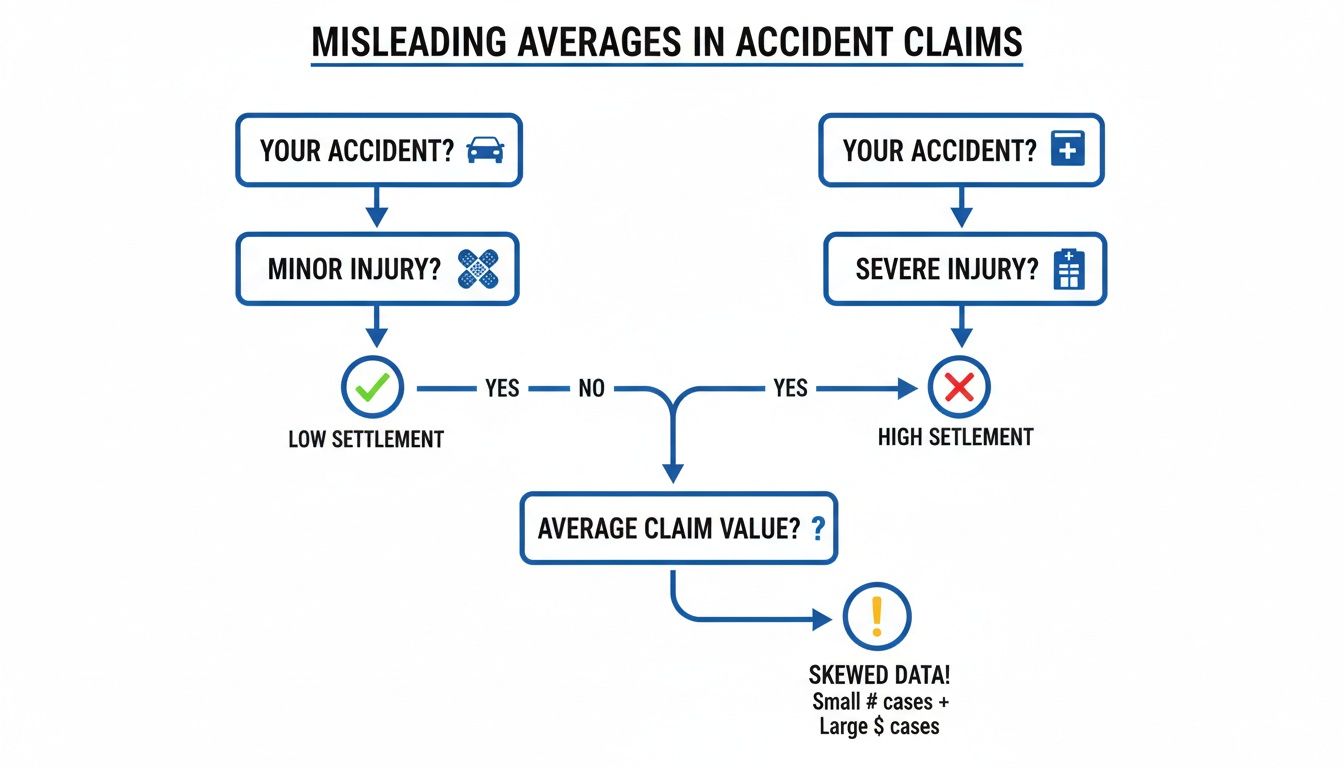
As the chart shows, only people with severe injuries get to step outside the no-fault system and pursue a full claim against the at-fault driver. This is exactly why a single “average settlement” figure is so meaningless.
Crossing the “Serious Injury Threshold”
So, what happens when your medical bills and lost wages blow past that $10,000 PIP limit? This is where Florida’s “serious injury threshold” becomes the most important factor in your case. In order to sue the at-fault driver for things like pain and suffering, you first have to prove your injury is severe enough to meet this legal standard.
This threshold is the legal gateway you must pass through to pursue full compensation beyond your PIP benefits. Without meeting it, your claim is limited to your economic losses that exceed your PIP coverage.
So, what qualifies? Generally, your injury has to involve one of the following:
- Significant and permanent loss of an important bodily function.
- Permanent injury within a reasonable degree of medical probability.
- Significant and permanent scarring or disfigurement.
- Death.
A minor sprain that heals up in a few weeks won’t cut it. But a herniated disc that requires surgery and leaves you with chronic pain? That will almost certainly qualify as a permanent injury and open the door to a much larger claim.
How Blame Can Reduce Your Settlement
There’s one last piece to this puzzle: fault. Florida uses a legal rule called “pure comparative negligence” to figure out who pays what. In plain English, this means that more than one person can be partially to blame for an accident.
Under this system, you can still get money even if you were partly at fault. The catch is that your final settlement gets reduced by your percentage of blame.
Let’s say your total damages add up to $100,000. If a jury decides you were 20% at fault for the crash—maybe you were speeding a little—your final award is slashed by that 20% ($20,000). You would walk away with $80,000.
Insurance adjusters love to use this to their advantage by trying to shift as much blame as possible onto you. Because of this, knowing the role of uninsured motorist coverage in Florida is also incredibly important for your financial protection. Ultimately, proving the other driver was primarily, if not completely, at fault is key to getting the full value of your claim.
The True Building Blocks of Your Settlement Value

Think of a fair settlement as a structure built from many different blocks. Each block represents a specific loss you’ve suffered because of the accident. To figure out what your claim is really worth, you have to find and account for every single one of those blocks. If you leave one out, the whole structure of your case gets weaker, and you could end up with far less than you deserve.
These losses fall into two major categories. Getting a handle on both is the only way to accurately estimate a potential average car accident settlement in Florida for your unique situation.
Economic Damages: The Tangible Costs
This is where we tally up every measurable financial loss—anything you can track with a receipt, a bill, or a pay stub. These are the black-and-white numbers that a calculator can add up.
Most people immediately think of the big hospital bill, but that’s just the tip of the iceberg. A complete calculation of your economic damages has to include everything.
- Current Medical Bills: This covers the obvious things, like the ambulance ride, the ER visit, any hospital stays, and surgeries. It also includes all the diagnostic tests, like MRIs and X-rays, that got you to a diagnosis.
- Future Medical Expenses: A serious injury rarely heals on a neat timeline. This block accounts for what’s coming next—physical therapy, ongoing visits with specialists, prescriptions, and even the possibility of future surgeries.
- Lost Wages: This is simply the income you lost because you couldn’t work while you were recovering. We calculate this by looking at your recent pay stubs and work history.
- Loss of Future Earning Capacity: What if the injury is permanent? If you can’t go back to your old job or have to take a lower-paying one, this calculates the income you stand to lose over the rest of your working life.
- Property Damage: This is the straightforward cost to either repair your car or, if it was totaled, replace it. It also includes any other personal property, like a laptop or phone, that was destroyed in the crash.
Calculating your future medical needs is one of the most critical parts of your claim. Settling before your doctors have a clear picture of your long-term prognosis is a massive risk. This is why reaching what is known as Maximum Medical Improvement is so vital.
You can learn more about this crucial milestone by reading our detailed guide explaining what is Maximum Medical Improvement. Understanding this concept is key to making sure you don’t accept an offer that won’t cover the medical bills that pop up years from now.
Non-Economic Damages: The Human Cost
The second category is much harder to put a number on, but it’s every bit as real and important as your medical bills. Non-economic damages are designed to compensate you for the human toll the accident has taken—the suffering and losses that don’t come with an itemized invoice.
Here’s a good way to think about it: if economic damages cover what you’ve lost from your wallet, non-economic damages cover what you’ve lost from your life.
These damages give a voice to the real-world impact of your injuries. For a passionate gardener who can no longer kneel to tend her flowers because of a permanent back injury, that loss of joy has a real, compensable value. For a young father who can no longer lift his toddler because of a severe shoulder injury, that emotional pain is a central part of his claim.
Common types of non-economic damages include:
- Pain and Suffering: This is compensation for the physical pain, discomfort, and general misery you’ve had to endure from the moment of impact through your recovery.
- Emotional Distress: This covers the mental side of things—the anxiety, depression, fear, and sleepless nights that so often follow a traumatic car crash.
- Loss of Enjoyment of Life: This accounts for your inability to participate in the hobbies, sports, and daily activities that brought you happiness before you were hurt.
- Disfigurement and Scarring: This provides compensation for permanent physical changes to your body that can cause embarrassment, shame, and psychological harm.
- Loss of Consortium: In some cases, the uninjured spouse may have a claim for the loss of companionship, support, and intimacy they’ve suffered because of their partner’s injuries.
An insurance adjuster’s first offer will almost always ignore or dramatically undervalue these human costs. They prefer to focus only on the stack of bills. A strong claim, however, tells the full story of your suffering, ensuring that every single building block of your settlement is counted.
How Injury Severity Influences Settlement Ranges
Let’s be blunt: the single biggest factor that drives the value of your car accident claim is how badly you were hurt. A minor neck sprain and a catastrophic brain injury simply aren’t in the same universe, and their settlement values will reflect that stark reality.
This is where the vague concept of an “average” settlement gets real. Instead of chasing a meaningless number, it’s far more helpful to think in terms of tiers. By looking at settlements based on the severity of the injury, you can get a much clearer, more realistic picture of what to expect.
Tier 1: Minor Injuries and Their Typical Settlement Range
This is the most common category of car accident injuries. Think of things that are painful and disruptive but, thankfully, are expected to heal completely over time.
- Common Examples: Whiplash, soft-tissue strains, minor cuts, and bruising.
- Key Settlement Factors: The medical bills are usually on the lower end, maybe an ER visit, a few follow-ups with a doctor, and a short round of physical therapy. Lost wages are often minimal. Since the injuries aren’t permanent, the compensation for pain and suffering is also more modest.
For these reasons, settlements for minor injuries are usually the lowest. While every case is unique, claims in this tier often resolve for amounts that cover the medical bills and lost pay, plus a bit extra for the hassle and pain.
Tier 2: Moderate Injuries That Increase Settlement Values
When an injury needs more serious medical care and the recovery drags on for months, the settlement value naturally starts to climb. These are the kinds of injuries that often push past Florida’s “serious injury threshold,” opening the door for pain and suffering damages.
- Common Examples: Simple bone fractures (like a broken arm), herniated discs that require treatment, or a concussion with symptoms that linger for months.
- Key Settlement Factors: Here, the economic damages are much higher. We’re talking about potential surgery costs, extended physical therapy, prescription medications, and significant time missed from work. The pain, suffering, and disruption to your life are much greater and last far longer, which means that component of the settlement grows, too.
Because the total damages are so much more extensive, the settlement for a moderate injury is significantly higher than for a minor one. This is where having a good attorney becomes crucial to make sure all your future medical needs and long-term impacts are properly documented and valued.
Tier 3: Catastrophic Injuries and the Highest Settlements
This tier represents the most devastating outcomes of a crash. Catastrophic injuries are permanent and will fundamentally change the victim’s life forever. These cases demand the highest settlement values because the damages are immense and last a lifetime.
A catastrophic injury creates a ripple effect of losses that extend across a lifetime. The settlement must account not just for past bills, but for decades of future medical care, lost earning potential, and profound human suffering.
- Common Examples: Traumatic brain injuries (TBI), spinal cord injuries leading to paralysis, severe burns, amputations, or wrongful death.
- Key Settlement Factors: The economic damages are often astronomical. They can include multiple surgeries, round-the-clock nursing care, home and vehicle modifications, and a complete loss of any future ability to earn a living. The non-economic damages for pain, suffering, and the loss of enjoyment of life are at their absolute peak.
While only a small percentage of personal injury cases ever go to trial, those involving catastrophic harm are the most likely to result in six-figure or even multi-million-dollar recoveries.
Looking at real-world data, minor soft-tissue injury settlements in Florida often fall between $5,000–$25,000. Moderate injuries like fractures can settle in the $30,000–$200,000 range. For catastrophic injuries, it’s not uncommon to see documented Florida settlements climb from $500,000 into the millions. This is exactly why an experienced attorney is non-negotiable in these situations.
For a deeper dive into how specific injuries play out, guides on back injury settlements from a car accident can offer great insight. These wildly different outcomes show why it’s so important to understand where your injury falls on this spectrum.
Why a Skilled Attorney Is Your Strongest Asset

Trying to handle a Florida car accident claim on your own is like walking into a professional boxing ring with one hand tied behind your back. The insurance adjuster you’re up against is a trained negotiator, and their main job is to protect their company’s profits by paying you as little as they possibly can.
Hiring an experienced personal injury attorney flips that script entirely. They become your advocate, your strategist, and your shield, leveling a playing field that is stacked against you from the start.
Leveling the Playing Field Immediately
From the moment you hire them, a good lawyer starts taking critical actions you just can’t do yourself. They’ll launch their own investigation to preserve evidence that can vanish quickly—things like surveillance footage or the fresh memories of a witness. They know precisely what paperwork is needed to build an undeniable case.
Crucially, they take over all communication with the insurance company. This single move shuts down the adjuster’s most common tactics.
- Lowball Offers: Insurers often throw out a fast, low settlement offer. They’re hoping you’re desperate enough to take it before you even know how serious your injuries are or what your future medical care will cost.
- Recorded Statements: The adjuster will press you for a recorded statement. This is a minefield where they use leading questions to get you to downplay your pain or even unintentionally admit partial fault.
- Delay Tactics: By dragging their feet, they try to wear you down. The hope is that financial and emotional stress will push you to accept a lower offer just to get it over with.
Having an attorney sends a clear message to the insurance company: you will not be intimidated, and you are prepared to fight for the full value of your claim.
Maximizing Your Settlement Value
A lawyer does more than just play defense; they actively work to maximize your compensation. They have connections with medical experts who can detail the full scope of your future care needs, making sure your settlement covers these long-term costs. They’ll also meticulously document every dollar of your lost wages and show how your injuries could affect your ability to earn a living down the road.
For a free consultation, understanding the benefits of getting a lawyer after a car accident is the most important first step you can take. They know how to build a case that properly values both your financial losses and the real, human cost of your injury.
An attorney’s negotiation skills and deep understanding of Florida courts give your claim immediate credibility. This pressure often leads the insurer to offer a much fairer settlement without ever seeing the inside of a courtroom. In fact, studies consistently show that accident victims with legal representation receive significantly higher settlements—often three times more or higher, even after attorney fees—than those who go it alone. It’s not about getting the average car accident settlement in Florida; it’s about getting the right settlement for you.
Common Questions After a Florida Car Accident
After a crash, your head is spinning with questions. How will I pay these bills? How long is this all going to take? It’s a confusing and stressful time, and the last thing you need is a complicated legal process. Let’s walk through some of the most common questions we hear every day and get you some straight answers.
How Long Will My Car Accident Settlement Take?
This is usually the first question people ask, and the honest answer is: it depends. Every case moves at its own pace. A simple fender-bender with minor injuries and no argument about who’s at fault might wrap up in just a few months.
But that’s not the typical scenario. If you’ve suffered serious injuries, if the other driver is fighting their responsibility, or if we have to file a lawsuit, the timeline can stretch to a year or more. The most important milestone we’re waiting for is something called Maximum Medical Improvement, or MMI. This is simply the point when your doctor says your condition has stabilized, and they have a clear picture of what your future medical needs will look like.
Settling your case before you reach MMI is a huge mistake. You only get one shot at a settlement. If you take an early offer, you can’t go back and ask for more money if your injury turns out to be worse than you thought.
A good attorney’s job is to balance the need for a timely resolution with the absolute necessity of getting you fully compensated. We push things along as fast as we can, but never at the expense of your health and financial future.
Do I Have to Go to Court?
The thought of stepping into a courtroom makes most people anxious, but you can breathe a little easier. The chances of your car accident case going all the way to a trial are incredibly slim.
Here in Florida, well over 90% of all personal injury cases settle out of court. Think about it: both sides have a powerful incentive to avoid trial. It’s expensive, time-consuming, and the outcome is never guaranteed. Insurance companies want to control their risk, and you want to get your compensation without a drawn-out court battle.
So, what’s the secret to getting a great settlement without going to court? We prepare every single case as if it’s going to trial. When the insurance company sees that we’ve built an ironclad case and are ready to face a jury, they get serious about negotiating. That’s when the fair offers start coming in.
How Is Pain and Suffering Calculated?
This is where things get tricky. You can add up medical bills and lost paychecks, but how do you put a dollar figure on the pain, anxiety, and disruption to your life? There’s no magic formula, but we use a couple of established methods to build a case for it.
- The Multiplier Method: This is a common starting point. We take the total of your “hard” costs (medical bills, lost income) and multiply it by a number between 1.5 and 5. A minor sprain might get a 1.5x multiplier, while a life-altering injury that requires surgery and leaves you with permanent limitations could warrant a 4x or 5x multiplier.
- The “Per Diem” Method: This approach assigns a daily rate for your suffering, often based on what you would have earned at your job each day. We then calculate that amount from the day of the accident until you reach MMI.
An experienced lawyer doesn’t just pick a number out of the air. We use these methods and back them up with evidence from recent jury verdicts in similar Florida cases to show the insurance company precisely what your pain and suffering is worth.
Can I Still Get a Settlement If I Was Partially at Fault?
Yes, absolutely. Florida law is on your side here. We operate under a “pure comparative negligence” rule, which is a fancy way of saying you can still recover money even if you were partly to blame for the crash.
Here’s how it works in the real world: your total settlement is just reduced by whatever percentage of fault is assigned to you.
Let’s say your case is determined to be worth $100,000, but a jury decides you were 20% at fault for the accident (maybe you were going slightly over the speed limit). Your $100,000 award would be reduced by that 20% ($20,000), and you would receive $80,000.
Insurance adjusters love to use this rule against you, often trying to pin more blame on you than you deserve to reduce their payout. That’s why having a strong advocate is so critical. We fight back against these unfair tactics to protect your right to the compensation you’re truly owed.
If you’ve been injured in an accident, you don’t have to face the insurance companies alone. The legal team at Martin Hernandez, P.A. is ready to fight for the full and fair compensation you deserve. Contact us today for a free, no-obligation consultation to discuss your case by visiting our official website.