
Let’s be blunt: if you’re a driver in Florida, you’re going to pay more for car insurance. While you might see national averages floating around $225 per month for full coverage, that number doesn’t tell the whole story for those of us in the Sunshine State. Here, you should realistically budget closer to $300-$350 per month, and there are some very specific reasons for that.
Understanding the True Cost of Full Coverage in Florida
One of the biggest misconceptions out there is that “full coverage” is a specific product you can just buy. It’s not. In reality, it’s just a common term for a bundle of different coverages that, when combined, give you much more protection than the bare-bones policy Florida legally requires.
Think of it this way: the state’s minimum insurance is like having a basic first-aid kit with a few bandages. It’s better than nothing, but it won’t help you in a serious emergency. Full coverage is like having a fully-stocked paramedic bag. It’s designed to handle a much wider range of problems, protecting not just other people but you and your vehicle, too.
The Building Blocks of Full Coverage
So, what’s actually in this “bundle”? A typical full coverage policy is built on a few key components:
- Liability Coverage: This is the non-negotiable part that pays for the injuries and property damage you cause to other people if you’re at fault in an accident.
- Collision Coverage: This is what pays to fix or replace your own car after a crash, whether you hit another vehicle or a light pole. It kicks in regardless of who was at fault.
- Comprehensive Coverage: Think of this as the “life happens” coverage. It handles damage to your car from things other than a collision, like theft, vandalism, fire, a falling tree branch, or—especially important here in Florida—hail and flood damage from a hurricane.
Because you’re buying a much more robust safety net, the average full coverage car insurance cost is naturally higher. It’s an investment in your own financial security.
Full Coverage vs. Minimum Coverage in Florida
When you compare a full coverage policy to Florida’s minimum required insurance, the differences are stark. Minimum coverage only requires Personal Injury Protection (PIP) to cover your own initial medical bills and Property Damage Liability (PDL) to cover damage you cause to others’ property.
- Your Vehicle’s Repairs: A minimum policy does not cover repairs to your own vehicle. With full coverage, your car is covered through collision insurance.
- Damage from Theft or Weather: Minimum coverage provides no protection for these events. Full coverage handles them through comprehensive insurance.
- Your Medical Bills: Both policy types include PIP for your initial medical costs.
- Cost: Full coverage has higher premiums, but it protects your investment. Minimum coverage is cheaper but leaves you financially exposed if your car is damaged.
A minimum policy leaves you completely on the hook for your own car’s repair or replacement costs. With full coverage, you’re protecting your investment.
Why the National Average Doesn’t Apply Here
It’s always good to have a benchmark, but Florida’s insurance market is its own unique beast. Nationally, the average annual cost for full coverage in 2025 is about $2,697, which works out to that $225 per month figure. For comparison, a bare-minimum policy averages only $820 a year nationwide.
Those numbers are a world away from what we see locally. But the higher upfront cost is a strategic decision. It shields you from catastrophic out-of-pocket expenses that could easily wipe out your savings and leave you without a car. Taking a moment to understand what comprehensive car insurance means is the first step toward seeing its real value.
A full coverage policy acts as a financial firewall. Without it, a single serious accident could lead to thousands of dollars in personal vehicle repair costs, leaving you without transportation and facing a significant financial burden.
Why Is Florida Car Insurance So Expensive?
If you’ve ever opened your car insurance bill and felt a jolt of sticker shock, you’re not alone. That nagging feeling that you’re paying way more than your cousin in Ohio isn’t just in your head—it’s the reality for millions of Florida drivers.
This isn’t just a string of bad luck; it’s a perfect storm of local factors that makes insuring a car here so costly. While national full coverage premiums in 2025 can vary, Florida is in a league of its own. Some estimates pin our state’s average annual cost at a staggering $4,090, while others land closer to $3,264, all thanks to our unique risk profile. You can see how these local factors affect drivers nationwide, but let’s break down exactly what’s happening here in the Sunshine State.
To get to the bottom of your high premiums, we have to look at the specific challenges that define Florida’s insurance landscape.
Our Tricky No-Fault System
At the core of Florida’s high insurance costs is our “no-fault” law. This system requires every single driver to carry Personal Injury Protection (PIP) coverage. On paper, it seems straightforward: after a minor crash, your own PIP insurance pays for your initial medical bills, no matter who caused the accident.
The original idea was to cut down on lawsuits and get injury claims paid faster. Unfortunately, it’s had the unintended consequence of inflating costs, sometimes due to fraudulent claims. Because the system provides a guaranteed source of payment, it has created an environment where medical expenses can get exaggerated, driving up what insurance companies pay out for even a simple fender-bender.
In Florida’s no-fault system, your own insurance is the first line of defense for your injuries. This structure, designed to simplify small claims, is also a major reason the average full coverage car insurance cost is higher here than in at-fault states.
The Uninsured Driver Problem
Another huge piece of the puzzle is the shocking number of uninsured drivers on our roads. Florida consistently ranks as one of the top states for people driving without insurance. When an uninsured driver causes a wreck, guess who foots the bill? The responsible drivers and their insurance companies.
This forces those of us who follow the law to buy Uninsured Motorist (UM) coverage just to protect ourselves. Insurers, knowing they’ll have to cover frequent losses from accidents caused by uninsured drivers, spread that cost across all their policyholders. Essentially, you’re paying a higher premium in part to cover the risk created by others who don’t carry insurance.
The Ever-Present Threat of Severe Weather
You can’t talk about Florida costs without talking about the weather. Our state is a magnet for severe weather, especially hurricanes, and this plays a massive role in how premiums are calculated. Just one major storm can trigger thousands of vehicle damage claims from flooding, falling trees, and flying debris.
These claims are handled under comprehensive coverage, which is a standard part of any full coverage policy.
- Widespread Damage: A hurricane doesn’t just damage one or two cars; it can wipe out vehicles across entire communities at once.
- Costly Repairs: Flood damage is especially destructive and often leads to a car being declared a total loss.
- Baked-In Risk: Insurance companies price their policies knowing this high-cost risk is a near certainty. That means higher comprehensive rates for everyone in the state, even if your town doesn’t get a direct hit.
This constant environmental pressure pushes rates up for everyone. When you combine our no-fault system, the high number of uninsured drivers, and our volatile weather, you get the expensive and challenging insurance market we all have to navigate.
Key Factors That Determine Your Personal Premium
While statewide averages give you a ballpark idea, the actual price you’ll pay for full coverage car insurance is intensely personal. Insurance companies don’t just throw a dart at a map of Florida; they run a detailed underwriting process that calculates a premium as unique as your own fingerprint. Understanding these factors is the first step to getting a handle on your costs.
Think of it like building a puzzle. Your final premium is the complete picture, and each personal detail is a piece that fits together. Some pieces, like your driving record, are massive and have a huge impact. Others, like the specific model of your car, might be smaller but still change the final image. Let’s break down the most significant pieces of this puzzle.
Your Location, Down to the Zip Code
Where you park your car at night matters—a lot. It goes way beyond just being in a “high-cost state.” Insurers get incredibly specific, setting rates based on your zip code. Someone living in a dense Tampa neighborhood with constant traffic and a higher claim frequency is almost guaranteed to pay more than a driver in a quiet, rural part of Hillsborough County.
Why the drastic difference? It all comes down to risk. Urban areas statistically have:
- More Collisions: Simply put, more cars on the road means more chances for things to go wrong.
- Higher Theft and Vandalism: Densely populated areas often see more vehicle-related crime.
- A Greater Likelihood of Lawsuits: Some zip codes have a history of more frequent insurance claims and litigation, which pushes up costs for everyone in that zone.
This is a huge reason why your premium can jump even if you only move a few miles down the road. The infographic below shows some of the major statewide issues that then get magnified at the local level.
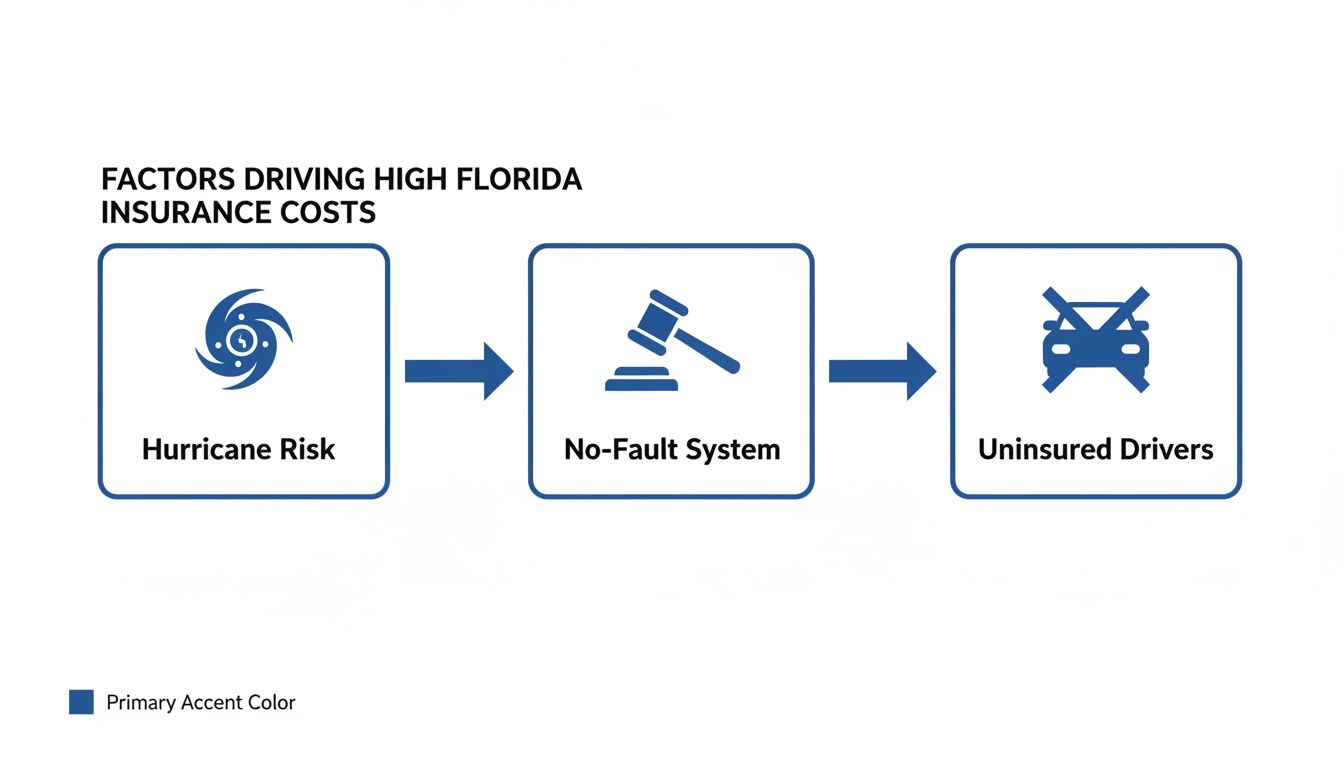
These big-picture risks set the stage, but the spotlight is really on your personal details, starting with how you handle yourself on the road.
Your Driving Record and Age
This is probably the single biggest factor you can control. To an insurer, your driving history is a crystal ball predicting how likely you are to cost them money. A clean record, free from at-fault accidents and moving violations, is your golden ticket to a lower premium.
On the flip side, even one speeding ticket can make your rates spike. A serious offense like a DUI can nearly triple your costs overnight, as it instantly flags you as a major risk. Age is also a huge piece of the puzzle. Statistical data consistently shows that younger drivers—especially those under 25—get into more accidents because they simply have less experience behind the wheel.
Your Credit History and Vehicle Choice
Here’s one that surprises a lot of people. In Florida, insurers can legally use a credit-based insurance score to help set your rates. While it has nothing to do with your ability to parallel park, industry data shows a strong link between credit history and the likelihood of filing a claim. As a result, drivers with good credit often pay significantly less for the exact same coverage than those with poor credit.
What you drive also sends a clear message. A safe, reliable sedan with great safety ratings and cheap parts will be far less expensive to insure than a brand-new, high-performance sports car. The logic is straightforward: luxury and sports cars cost a fortune to repair or replace, and they’re also bigger targets for theft. For a deeper dive into how these factors stack up, our detailed auto insurance rates comparison offers more insights.
Your Deductible and Coverage Choices
Finally, you have direct control over your premium by choosing your deductibles. Your deductible is simply the amount you agree to pay out-of-pocket on a claim before your insurance company steps in to pay the rest.
By choosing a higher deductible—say, $1,000 instead of $500—you can lower your monthly premium. But it’s a trade-off. You save money every month, but you’re also taking on more financial risk if you actually have to file a claim.
It’s absolutely critical to pick a deductible you could comfortably pay tomorrow without breaking a sweat. Finding that sweet spot between monthly savings and out-of-pocket risk is a key lever you can pull to make your premium fit your budget.
Actionable Strategies to Lower Your Full Coverage Costs
Seeing the sticker shock from the average full coverage car insurance cost in Florida can be disheartening. But the good news is, you have more control over that number than you probably realize.
While you can’t change things like our state’s hurricane risk, you absolutely can take direct steps to lower your monthly payments. It’s all about actively managing your policy instead of just accepting the bill.
Make Comparison Shopping Your Best Friend
The single most powerful move you can make is to shop around. I can’t stress this enough. Auto insurance isn’t a “one-size-fits-all” purchase, and blind loyalty to one company can cost you a fortune. Insurers are constantly tinkering with their rates, so the company that offered the best deal last year might be one of the most expensive for you today.
Your first step should always be to get quotes from at least three to five different insurance companies. This is the only way to see how differently they price the exact same coverage for you. It gives you a real-time snapshot of the market and puts the power back in your hands.
Unlock Discounts You May Be Missing
Beyond comparing carriers, you need to become your own best advocate and ask—point-blank—for discounts. Insurers have a whole menu of them, but they rarely apply them automatically. You have to ask.
Many companies offer significant savings you might already qualify for.
- Bundling Policies: Do you have a homeowners or renters policy? If it’s with a different company, you’re likely leaving money on the table. Bundling auto and property policies with one insurer can often slash your premium by 10% to 25%.
- Safe Driver Programs: If you’ve kept your driving record clean from accidents and tickets for a few years, you’re what they consider a low-risk driver. Make sure you’re getting rewarded for it with a good driver discount.
- Telematics Programs: You’ve probably seen ads for these. Many major insurers now offer programs that use a smartphone app or a small plug-in device to monitor your driving habits. If you’re a safe driver—avoiding hard braking, speeding, and late-night trips—it can translate into a much lower premium.
- Other Potential Savings: Don’t stop there. Ask about discounts for being a good student, belonging to certain alumni or professional groups, or having anti-theft devices installed in your car. For more tips on finding a great insurer, check out our guide to the best car insurance according to consumer reports.
Adjust Your Deductible Strategically
One of the fastest ways to see an immediate drop in your monthly premium is to raise your collision and comprehensive deductibles. Think of a deductible as your share of the repair bill—it’s what you pay out-of-pocket before the insurance company steps in.
When you agree to take on a little more of that initial risk, the insurer rewards you with a lower rate.
For instance, simply increasing your deductible from $500 to $1,000 can often cut your premium by 15% to 30%. Over a year, that can easily add up to hundreds of dollars in savings.
But there’s a crucial catch: never set your deductible higher than what you could comfortably pay tomorrow without creating a financial crisis. Your deductible amount should always be less than or equal to what you have saved in your emergency fund. It’s a smart financial balancing act that puts you in control.
The Real-World Impact of Your Coverage After an Accident

An insurance policy is just a piece of paper—until you actually need it. We’ve been talking a lot about the numbers behind the average full coverage car insurance cost. But now, let’s shift from what it costs to what it does. This is where your coverage choices really matter.
Let’s walk through a couple of real-world scenarios to see how different policies play out when things go wrong.
Scenario One: The Driver with Full Coverage
Picture this: you’re driving through a Tampa intersection when another driver blows a red light and T-bones your car. The damage is bad, and you’re left with a throbbing neck and an aching back.
With a solid full coverage policy, the aftermath is stressful, but it’s manageable. Your collision coverage kicks in right away to handle the repairs on your car, minus your deductible. Your Personal Injury Protection (PIP) covers your initial medical bills so you can get treatment without delay.
On top of that, your policy might include extras like roadside assistance, which can be a lifesaver for anything from a dead battery to needing specialized automotive locksmith services for a broken key. This is the whole point of full coverage—it acts as a financial shield, letting you focus on getting better instead of worrying about how to pay for a new bumper or a trip to the doctor.
Scenario Two: The Uninsured Motorist Nightmare
Now, let’s replay that same accident with one crucial difference: the driver who hit you has no insurance. It’s a scary thought, but it happens all the time here in Florida.
If you don’t have Uninsured Motorist (UM) coverage, you’re in a tough spot. Your only option is to sue the other driver personally, and if they don’t have any money or assets, you’ll likely never see a dime.
This is exactly why UM coverage is one of the smartest investments you can make. When you have it, your own insurance company essentially takes the place of the uninsured driver’s. Your UM policy will cover your medical bills, lost wages, and even your pain and suffering once your PIP benefits run out.
Uninsured Motorist coverage is your personal safety net. In a state with one of the highest rates of uninsured drivers, it’s the only reliable way to ensure you are financially protected when the person who injures you can’t pay.
Making the right choice is more critical than ever. Since February 2020, full coverage premiums in the U.S. have jumped by an average of 55%. Why? Modern cars are packed with electronics that make them 40% more expensive to fix, parts shortages are adding 20-30% to repair bills, and medical costs have gone through the roof.
Knowing When to Call an Attorney
After a crash, it’s natural to wonder, “Can I handle this myself, or do I need a lawyer?” The answer really depends on how serious and complicated the situation is. Making the right call here is crucial for protecting your rights.
- Consider handling it yourself if: The accident was a minor fender-bender with no injuries, fault is 100% clear and admitted by the other driver, and the settlement offer fully covers your straightforward property damage.
- Contact an attorney immediately if: Anyone was injured (even if it seems minor), the insurance company is disputing fault or delaying your claim, you need ongoing medical care or are missing work, the insurer makes a lowball offer, or the at-fault driver was uninsured or underinsured.
In short, if your accident involves anything more than a simple dented bumper, getting legal advice is not a luxury—it’s a necessity. An experienced attorney levels the playing field with the insurance companies and fights to make sure you get the full and fair compensation you deserve.
Common Questions About Florida Full Coverage Insurance
Trying to make sense of auto insurance can feel like a real headache. To help you sort through the noise, let’s tackle some of the most common questions Florida drivers ask about full coverage policies and what they really cost.
Is Full Coverage Legally Required in Florida?
This is probably one of the biggest points of confusion, and the short answer is no. You are not legally required to buy “full coverage” in Florida. The state’s minimum requirement to register a car is just Personal Injury Protection (PIP) and Property Damage Liability (PDL).
But here’s the catch: if you have a car loan or are leasing your vehicle, the bank or finance company will almost always require you to carry both collision and comprehensive coverage. It’s their way of protecting their asset—your car—until you’ve paid it off.
When Should I Consider Dropping Full Coverage on My Car?
This is a personal financial decision, and it really comes down to your car’s value versus what you’re paying for coverage. It’s a classic cost-benefit analysis.
A good rule of thumb many people use is the 10% rule. If the annual cost for your collision and comprehensive coverage is more than 10% of your car’s actual cash value, it might be time to drop it. For example, if your older car is only worth about $4,000 and your full coverage costs $1,500 a year, you’re paying a huge premium for a relatively small potential payout. The most an insurer will ever pay is the car’s value (minus your deductible), so you could easily end up paying more than the car is even worth.
How Does Living in Tampa Affect My Insurance Rates?
Your location matters—a lot. Living in a busy city like Tampa almost always means a higher average full coverage car insurance cost than you’d find in a quieter, rural part of the state. Insurance companies are all about risk, and they set rates based on specific zip codes.
Cities are just riskier places to drive. Insurers see:
- More traffic: Heavy daily congestion leads to more fender benders and serious collisions.
- Higher crime: Rates of vehicle theft and vandalism are typically higher in urban areas.
- More claims: Densely populated areas naturally have more insurance claims filed.
This is why moving just a few miles to a different neighborhood can sometimes cause a noticeable jump or dip in your premium.
Does My Credit Score Really Affect My Insurance Cost?
It absolutely does. In Florida, insurance companies are allowed to use a credit-based insurance score to help calculate your rates. It might not seem fair or even related to how well you drive, but their data shows a statistical link between credit history and the likelihood of filing a claim.
Because of this, drivers with good credit often get much better rates than those with poor credit. It’s just one more piece of the puzzle that insurers use to create your personal risk profile. Many drivers also wonder if liability is part of this package, and you can learn more about whether full coverage includes liability insurance in Florida in our detailed article.
If you’ve been injured in an accident and are getting the runaround from an insurance company, you don’t have to face them alone. The team at Martin Hernandez, P.A. is here to fight for your rights and make sure you get the fair compensation you deserve. Contact us today for a free, no-obligation consultation at https://injurylawyersoftampa.com.