
Shopping for new tires can feel like a guessing game, especially when it comes to the price. In 2026, you can generally expect to pay anywhere from $150 to $350 per tire for a typical passenger car. But for trucks or high-performance vehicles, that number can easily climb past $500 a pop.
The final price tag is really a moving target. It all depends on your vehicle, the tire brand you choose, and several other factors we’ll get into.
The Real Average Price for New Tires in Florida
Trying to pin down the “average price for new tires” in Florida is tricky because there isn’t just one number. The cost is a wide spectrum, shaped by everything from the sedan, truck, or SUV you drive to the quality of the tire you need. A budget tire for a small commuter car, for example, is a world away from a premium, all-terrain tire built for a heavy-duty pickup.
This price gap has gotten wider lately. Over the past few years, the cost of new tires across the U.S. has shot up. Research from ProPublica found that prices jumped an incredible 21.4% in just two years leading up to early 2023. That increase outpaced core inflation by more than 70%.
For Florida drivers, this means buying new tires is a much bigger financial hit than it used to be. This is especially important to remember after a car accident, where you need to document this cost accurately for your insurance claim.
A Snapshot of Florida Tire Costs
To get a better handle on what you might pay, it helps to break down the costs by the type of vehicle you own. Here’s a quick look at what you can expect to spend per tire in Florida, depending on whether you’re looking for a basic option or a top-of-the-line performance model.
Estimated New Tire Costs in Florida by Vehicle Type (Per Tire)
Here’s a breakdown of estimated per-tire costs for different vehicles in Florida:
- Sedan/Coupe:
- Budget: $100 – $180
- Mid-Range: $180 – $250
- Premium/Performance: $250 – $400+
- SUV/Crossover:
- Budget: $150 – $220
- Mid-Range: $220 – $300
- Premium/Performance: $300 – $500+
- Truck/Van:
- Budget: $180 – $275
- Mid-Range: $275 – $375
- Premium/Performance: $375 – $600+
As you can see, the bigger the vehicle, the bigger the bill. These estimates give you a realistic starting point so you can budget accordingly before heading to the shop.
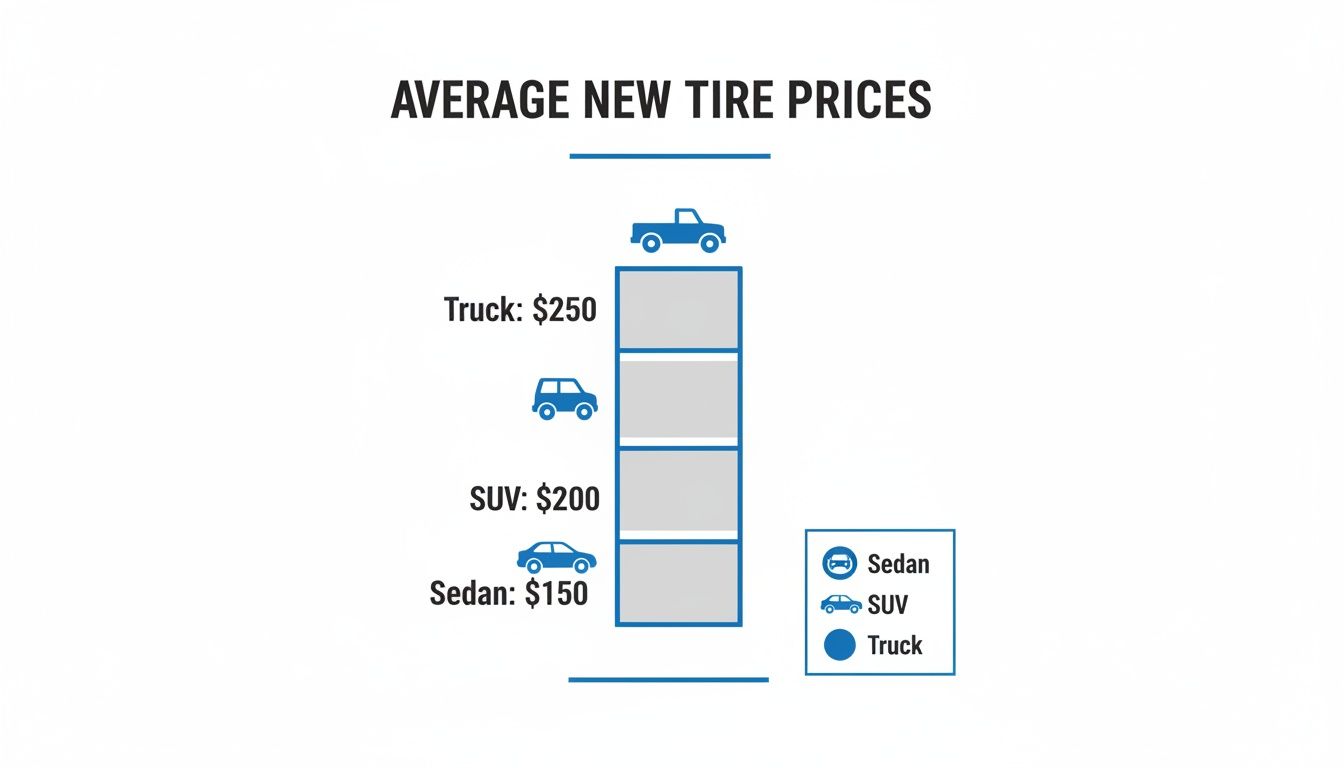
The general rule of thumb is clear: truck tires can easily cost double what you’d pay for sedan tires. This comes down to their larger size, heavier-duty materials, and more complex engineering.
For Florida accident victims, these rising costs aren’t just an annoyance—they are a crucial part of your property damage claim. If you don’t document the full, true replacement cost, you could end up paying hundreds out of your own pocket, even when the crash wasn’t your fault.
Picking the right tire is all about finding a balance between cost, performance, and most importantly, safety. If you want to dive deeper, our guide on how to understand auto tire ratings can help you make a smart choice for your car and your driving style here in Florida. Knowing what to look for is key to staying safe and getting what you pay for.
Why Some Tires Cost More Than Others
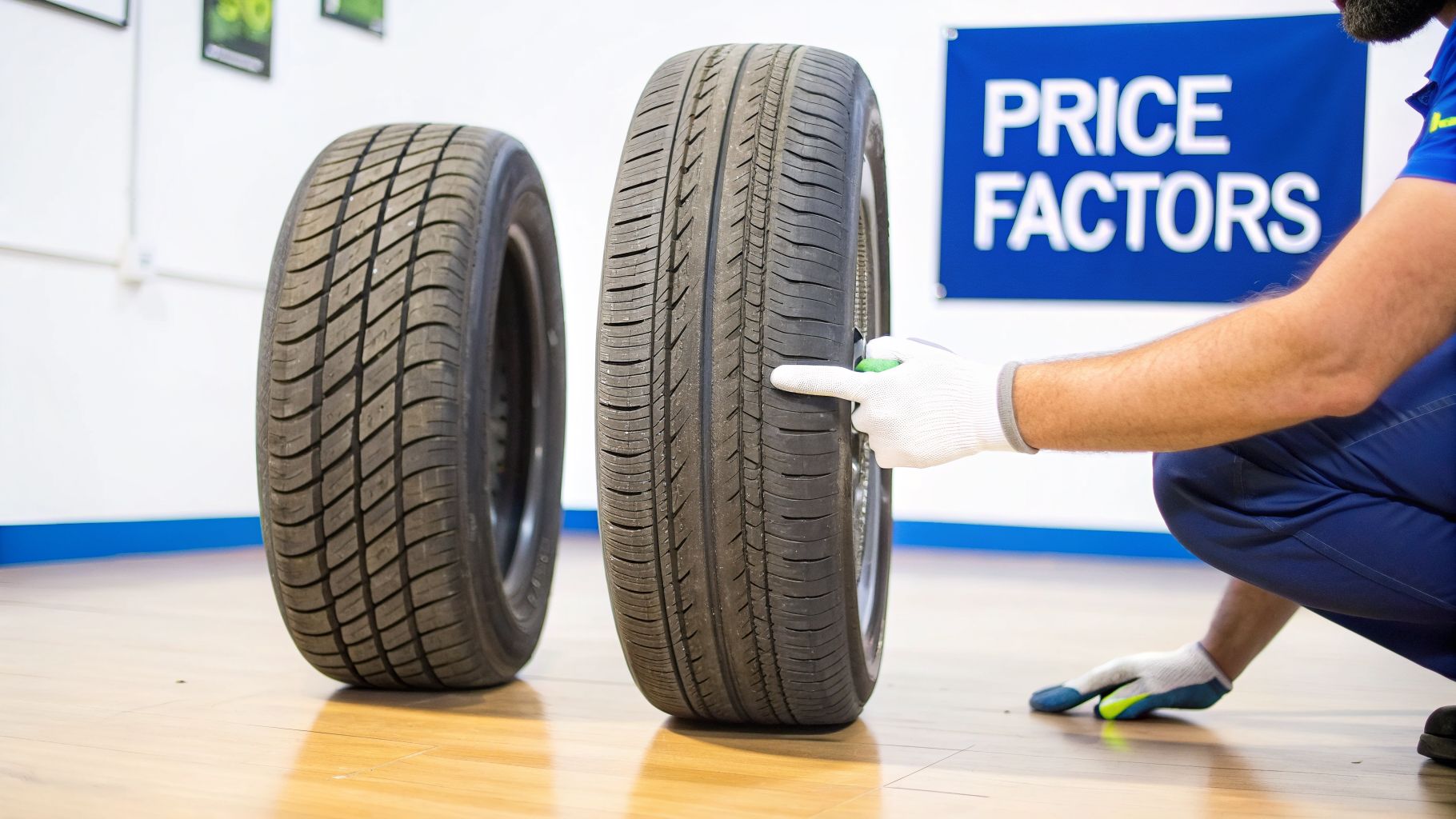
When you see the huge range in the average price for new tires, it’s easy to wonder what you’re actually paying for. Is a $350 tire really that much better than a $150 one? Often, the answer is a resounding yes, and the difference goes far beyond the brand name stamped on the side.
Think of it like buying a pair of running shoes. A basic sneaker gets the job done for a walk around the block, but a serious marathon runner invests in a shoe with specialized support, advanced cushioning, and durable materials. Tires are no different. The price tag reflects the engineering, materials, and specific job they were built to do.
The Science Behind the Rubber
First off, not all rubber is the same. A tire’s rubber compound is a complex, highly-engineered recipe of natural and synthetic polymers, silica, and carbon black. A budget-friendly tire might use a harder, less expensive compound that’s built for one thing: a long tread life.
On the other hand, a premium tire—especially one made for Florida’s sudden, torrential downpours—will feature a softer, silica-heavy compound. This special blend provides far better grip on wet roads, which can dramatically shorten your stopping distance and keep you safer in a storm. That advanced material science costs more to research and produce, which you’ll see in the final price.
Then there’s the tread design. A simple, straight-ribbed pattern is cheap and easy to manufacture. But look at a high-performance tire, and you’ll see an intricate, often asymmetrical pattern with deep channels and thousands of tiny slits, known as “sipes.”
These features aren’t just for looks; they are engineered for specific safety functions:
- Wide Circumferential Grooves: These act like canals, quickly forcing water out from under the tire to prevent hydroplaning on slick Florida highways.
- Intricate Sipe Patterns: These create thousands of tiny “biting edges” that grab the road for better traction in both wet and dry weather.
- Reinforced Shoulder Blocks: These provide stability and grip when you need it most, like during a sharp turn or an emergency swerve.
The massive amount of research and development that goes into perfecting these designs is a major reason why mid-range and premium tires cost more.
Speed Ratings and Tire Construction
Every tire has a speed rating, shown as a letter on the sidewall (like S, T, H, V, W, or Y). This letter isn’t just about the top speed the tire can handle; it’s a window into its overall construction. A tire with a higher speed rating, such as a V or W, is built to withstand significantly more heat and stress.
To do that, it needs stronger internal parts, like reinforced steel belts and nylon cap plies, which add to the manufacturing cost. A standard commuter tire with an “S” or “T” rating is perfectly safe for daily driving, but it just doesn’t have the heavy-duty build of its high-performance cousins. For drivers of cars like a Hyundai Elantra, knowing these ratings helps ensure you buy a tire that matches your vehicle’s capabilities. If you’re curious, you can explore our guide on whether Hyundai Elantras are reliable.
Think of it this way: The tire’s internal structure is like a building’s foundation. A skyscraper needs a much deeper and more complex foundation than a single-family home, and that extra engineering comes at a cost. The same principle applies to tires built for high speeds versus those for daily commutes.
Finally, global supply chains and raw material costs play a huge part. The prices of natural rubber, oil, and steel can swing wildly, and those increases are ultimately passed on to us. Recent disruptions have put a lot of pressure on manufacturers, contributing to the rising average price for new tires that drivers in Florida and across the country are facing.
Uncovering the Hidden Costs of Tire Installation
That price sticker you see on a new tire? It’s just the starting point. The average price for new tires advertised almost never includes the services needed to get them safely onto your car. These additional charges, sometimes called “hidden fees,” can really inflate your final bill and catch a lot of people off guard.
Think of it like buying a flat-pack bookcase. The price on the box is just for the wood and screws; you still have to put it together. Getting your tires professionally installed is the same idea—it’s an extra, but essential, cost. Knowing what to expect helps you budget accurately and understand exactly what a mechanic’s quote is telling you.
Decoding the Installation Service Quote
When you get a quote for a new set of tires, you’ll see several line items besides the tires themselves. They might look like optional extras, but most are absolutely critical for your safety and for getting the most life out of your new rubber. Let’s break down what these common charges are and why they’re so important.
You should expect to see most, if not all, of these services on your bill:
- Mounting: This is the hands-on work of taking the old tire off the wheel (the metal rim) and fitting the new one on. It’s a job that requires specialized equipment and is pretty labor-intensive.
- Balancing: No tire-and-wheel combo is perfectly weighted from the get-go. A technician spins the wheel at high speed on a special machine to detect tiny imbalances, then adds small weights to the rim to smooth things out. This is what prevents that annoying steering wheel vibration and stops your tires from wearing down unevenly.
- New Valve Stems: That little rubber or metal stem you use to add air to your tire wears out over time. Replacing it is cheap and prevents frustrating slow leaks later on. It’s a small part that does a big job.
- TPMS Service: Modern cars have a Tire Pressure Monitoring System (TPMS). Its sensors often need to be reset or serviced during a tire change to make sure they keep reading your tire pressure accurately.
That feeling of sticker shock when you get to the register is all too common, but it doesn’t have to be. By planning for these necessary installation costs, which typically run between $20 to $60 per tire, you can turn a surprise bill into an expected expense.
The Critical Role of Wheel Alignment
A wheel alignment is one of the most common services you’ll be offered with new tires, and it’s easy to dismiss it as a simple upsell. But here’s the thing: skipping an alignment after getting new tires is like building a beautiful new house on a crooked foundation. It completely undermines your investment.
An alignment doesn’t actually adjust your tires; it adjusts your car’s suspension. The goal is to make sure your tires hit the pavement at the perfect angle. If the alignment is off, your brand-new tires will wear down unevenly and far too quickly, potentially costing you hundreds of dollars. Even more importantly, a bad alignment can make your car pull to one side, which is a major safety hazard on Florida’s busy highways.
Finally, remember to account for local Florida taxes and tire disposal fees. Shops are legally required to dispose of old tires in an environmentally sound manner, and they pass that cost—usually $2 to $5 per tire—on to the customer. When you add it all up, these so-called “hidden” costs are simply part of the true average price for new tires.
How Tire Costs Can Strengthen Your Florida Car Accident Claim

After a car wreck in Florida, your first thoughts are probably about your health and getting medical care. But the financial fallout, especially the damage to your car, can be a heavy burden. This is where understanding the true average price for new tires becomes more than just a consumer headache—it’s a crucial piece of protecting your legal rights.
The condition of the tires on both cars can be a pivotal piece of evidence in a personal injury claim. Even more directly, the steep cost of replacing tires damaged in a crash is a significant expense that you deserve to get back. Insurance companies, however, often try to downplay these costs, which can leave you stuck paying the difference out of your own pocket.
Using Tire Condition to Prove Negligence
In any Florida car accident claim, the core of your case is proving the other driver was negligent. Sometimes, the proof is literally where the rubber meets the road. If the at-fault driver was operating their vehicle with dangerously worn-out, bald tires, that’s powerful evidence showing they disregarded basic safety.
We can use evidence of another driver’s bald tires to help establish their fault. It shows they failed to keep their vehicle in a safe condition, which is a clear violation of their duty to other drivers on Florida’s roads. Photos of their unsafe tires, expert opinions, and notes in the police report can all build a stronger argument that their negligence led to your injuries.
For Florida drivers, today’s inflated prices mean replacing four tires after an accident could easily add thousands to your out-of-pocket expenses before insurance even gets involved. This is especially true for older vehicles—which now average 12.5 years on the road—that wear through treads faster and often require more expensive replacements. In Florida, where negligence claims are common, law firms meticulously document these rising costs to maximize compensation for medical bills, lost income, and all vehicle repairs.
Documenting Tire Costs for Your Settlement
When your own tires are ruined in an accident, replacing them isn’t a minor fix—it’s a major expense. With the high average price for new tires, you have to document this cost with precision to make sure it’s fully covered in your property damage settlement. Insurance adjusters are trained to minimize what they pay out, and they will seize any opportunity to undervalue your claim.
Without complete and organized proof of your expenses, an adjuster might offer a lowball settlement based on a generic, depreciated value that doesn’t cover the real-world cost of getting your car safely back on the road.
To stop this from happening, you need to treat every receipt and record like it’s vital evidence. Solid documentation is your best defense against an insurer trying to shortchange you. For more insights on the quality of different auto brands, you might be interested in our review of Consumer Reports auto data.
Checklist for Florida Accident Victims
If your tires were damaged or destroyed in an accident, start gathering the following documentation right away to build a strong claim for compensation.
- Photographs of the Damaged Tires: Before they get replaced, take clear, well-lit photos of the damaged tires from several different angles. Make sure to capture any punctures, sidewall gashes, or tread damage from the impact.
- The Original Mechanic’s Invoice: Your final bill from the tire shop is the most important document. It needs to list the cost of each tire, mounting, balancing, alignment, taxes, and any other related fees.
- Proof of Payment: Keep your credit card statement or bank record that shows the transaction. This confirms the exact amount you paid.
- The Old Tires (If Possible): It can be a smart move to ask the shop to hold onto the old tires as evidence, especially if there’s any dispute about how bad the damage was.
To prove the cost of your new tires for an accident claim, reliable documentation is essential. If you need to track down past records, a helpful guide to getting copies of receipts for any purchase can show you how. This documentation isn’t just paperwork; it’s solid proof of your financial loss. By connecting the high price of new tires directly to your claim, an experienced attorney can fight to make sure you recover every dollar you are owed.
Smart Ways to Save Money on New Tires in Florida
Trying to figure out the true average price for new tires can feel like hitting a moving target. But once you get a handle on the costs, you can start looking for real savings. It’s not about just grabbing the most expensive premium brand or settling for the cheapest, potentially unsafe, option. With a few smart strategies, Florida drivers can find that sweet spot and lower their costs without giving up safety or quality.
Shopping for tires is all about getting the best value, not just the lowest price tag. Think about it: a tire that costs a little more but lasts an extra 20,000 miles is the better deal by far. The secret is to look past the initial sticker shock and think long-term.
Shop Smart by Comparing Prices
Here’s the golden rule of saving money on almost anything: never accept the first price you see. The tire market is incredibly competitive, and you can use that to your advantage. Always get a few quotes before you pull the trigger.
Start by checking prices at local Florida tire shops and comparing them to major online retailers. Local businesses often have great promotions and might bundle installation into their deals. On the other hand, online sellers can sometimes offer lower prices because they have less overhead, but don’t forget to add in shipping costs and the price of getting a local shop to mount and balance them for you.
A quick tip for Florida drivers: Don’t sleep on warehouse clubs like Costco or Sam’s Club. They frequently have fantastic prices on top-tier brands and their installation fee often includes mounting, balancing, and even lifetime rotations.
Time Your Purchase Strategically
Just like buying a new TV or appliance, timing your tire purchase can make a huge difference. Tire companies and shops roll out rebates and special deals around major holidays all the time. Keep an eye out for sales during these key periods:
- Spring: Right before summer road trip season kicks into high gear, you’ll see lots of “buy three, get one free” offers and big mail-in rebates.
- Fall: Shops want to clear out old inventory before winter, making this another prime time for discounts—even in sunny Florida, it’s a major sales season for the industry.
- Holiday Weekends: Memorial Day, the Fourth of July, and especially Black Friday are famous for tire sales.
Simply planning ahead to buy during one of these events could save you $50 to $150 or more on a set of four. If your current tires can safely last another month or two, waiting for a great sale is one of the easiest ways to cut your bill.
Look for Value in Mid-Range Brands
Everyone knows the big names like Michelin and Goodyear, but there’s a whole world of excellent “Tier 2” brands that offer a fantastic mix of performance and value. Companies like Cooper, Hankook, and Kumho often use technology that’s just as good as their premium rivals but at a price that’s much easier to swallow. You can learn more about how air pressure affects performance in our article exploring air vs. nitrogen in tires.
Buying a full set of four matching tires at once is also a smart financial play. It’s not just better for your car’s handling and promoting even wear; most of the best promotions and rebates require you to purchase a complete set anyway.
Prioritize Long-Term Savings with Maintenance
Honestly, the best way to save money on tires is to make your current set last as long as possible. A little bit of regular maintenance is the ultimate savings strategy because it means you won’t have to buy new ones as often.
The two most important things you can do are keeping your tires properly inflated and rotating them every 5,000 to 7,000 miles. Correct inflation cuts down on wear and tear and even boosts your gas mileage. Rotations ensure the tread wears down evenly across all four tires. Following a good tire maintenance checklist is the key to making them last. This simple upkeep turns your tire purchase from a recurring expense into a true long-term investment.
National Trends and What They Mean for Florida Drivers
While it’s essential to know what you’ll pay for tires in Florida, it’s also helpful to see the bigger picture. Understanding what’s happening across the country gives you a clearer view of why tire prices can feel so complicated and why they seem to be constantly creeping up.
Think of it this way: large-scale economic forces set a starting price for every tire dealer in the country. Things like international trade agreements, tariffs on rubber, and the volatile costs of raw materials all contribute to the final price tag you see at a local shop. When a supply chain gets tangled up on the other side of the world, you feel the ripple effect right here in Florida.
National Averages and Market Forces
Recent data from 2025 puts the national average price for a single new tire at $192. This figure, detailed in a report on the U.S. online tire market, shows that even with online competition, those broader economic pressures are keeping costs high for everyone.
This is all part of a massive U.S. tire market valued at a staggering $56.27 billion in 2025—and it’s only expected to grow. Two major trends are fueling this: Americans are simply driving more, and the average vehicle on the road is now 12.5 years old. Older cars mean more maintenance, and that often starts with replacing worn-out tires.
This national context is incredibly important for Florida accident victims. Insurance adjusters often work from national databases and might try to lowball your property damage claim. They may quote a “national average” that simply doesn’t account for the higher, real-world costs you’re facing in the Florida market.
Why Your Local Florida Invoice Matters Most
This is precisely why you can’t let an insurer dictate the value of your claim based on a generic number. Their offer might sound fair at first, but it can easily leave you paying out-of-pocket to get your car safely back on the road.
The final invoice from your local Florida tire shop is your best defense. It’s concrete proof of what you actually paid, including local labor rates, state taxes, and disposal fees. That number is the one that counts—not a convenient, lower average pulled from a national chart. Knowing how to handle these negotiations is key, and you can get a better sense of their strategies by reading our reviews of top auto and home insurance providers. To protect yourself, you have to fight for the compensation that covers your true expenses.
Frequently Asked Questions About New Tire Costs
Let’s wrap things up by tackling some of the most common questions Florida drivers ask about the average price for new tires and the buying process. These quick answers should give you more confidence and lock in what you’ve just learned.
How Can I Tell If I Need New Tires?
Knowing exactly when your tires are done is crucial for staying safe on the road. The easiest trick in the book is the “penny test.”
Just grab a penny and stick it into one of your tire’s tread grooves with Lincoln’s head facing down. If you can see the top of Abe’s head, your tread has worn down to 2/32 of an inch or less. That’s the legal limit in many states, including Florida, and it’s a clear sign you need new tires, pronto.
Your tires also have a built-in warning system: the tread wear bar. These are small, raised rubber bars hidden in the bottom of the tread grooves. As your tire wears down, these bars will eventually become flush with the tread. When you see them, your tires have hit the end of their safe life and need to be replaced immediately.
Is It Safe to Replace Only One or Two Tires?
It’s tempting to save a few bucks by just swapping out one or two tires, but this is one of those areas where you really shouldn’t cut corners. For the best safety and vehicle performance, replacing all four tires at once is always the right call. This keeps the tread depth, brand, and tire model consistent, giving you predictable handling and grip when you need it most.
If you absolutely have to replace fewer than four, you need to follow these safety guidelines:
- Replace in pairs: At a minimum, always replace two tires at a time on the same axle (both fronts or both rears).
- New tires go on the back: This might sound counterintuitive, especially for a front-wheel-drive car, but the newest tires should always be installed on the rear axle. This helps prevent your car from spinning out and gives you much better stability in wet conditions.
In an accident claim, an insurance adjuster might question why you only replaced two tires. It’s critical to document why a full set was necessary—whether due to widespread damage or to meet safety standards—to make sure you’re fully compensated.
Why Do My SUV Tires Cost So Much More Than Sedan Tires?
It’s a common moment of sticker shock for many drivers: why do tires for an SUV or truck cost so much more than for a regular sedan? The price gap isn’t just arbitrary; it all boils down to size, construction, and the sheer amount of material involved.
Simply put, SUV tires are bigger and heavier, which means they use a lot more raw materials like rubber and steel. They’re also built differently—engineered to handle heavier vehicle loads and often designed with more complex, aggressive tread patterns for all-terrain performance. All that extra engineering and robust construction adds up to a higher manufacturing cost, which gets passed on to you at the register.
After an accident, trying to get an insurance company to cover property damage like ruined tires can be a real headache. The team at Martin Hernandez, P.A. meticulously documents every single expense to ensure our clients get the full and fair compensation they deserve. If you were injured in a crash and are facing a mountain of costs, contact us for a free consultation and let us help.