
It’s the question on every injured rider’s mind: “What’s the average settlement for a motorcycle accident in Florida?” While there isn’t an official, published average, the reality is that settlements can swing wildly from tens of thousands of dollars for less severe injuries to well over $1 million for life-altering ones.
The key takeaway is that your final compensation isn’t determined by some generic average. It comes down to the unique, specific details of your crash.
Why There Is No Single Average Settlement

It’s completely understandable to want to know what a typical case is worth. You’re facing medical bills and an uncertain future, so you need a ballpark figure to decide if filing a claim even makes sense. The problem is, looking for that one “average” number can set you up with false expectations.
It’s a bit like asking for the average price of a house in Tampa. That city-wide average doesn’t tell you anything meaningful about a specific property. After all, a historic bungalow in Seminole Heights is a world apart from a waterfront mansion on Bayshore Boulevard, and their values reflect that. The exact same principle applies to personal injury claims.
The Building Blocks of a Settlement
Every motorcycle accident claim is constructed from a unique set of facts. The potential value of your case hinges entirely on the actual losses you’ve suffered, not on what another rider recovered in a completely different situation.
At its core, a settlement’s value is calculated based on two distinct categories of damages:
- Economic Damages: These are the concrete, out-of-pocket financial losses you can prove with receipts and records. Think medical bills, lost paychecks from time off work, and the cost to fix or replace your bike.
- Non-Economic Damages: This is where we account for the very real, but less tangible, human cost of the crash. It’s compensation for the physical pain you’ve endured, the emotional trauma, and the loss of enjoyment of life—like no longer being able to take that weekend ride down the coast.
Because these factors are so deeply personal, two people involved in what look like similar accidents on paper could end up with vastly different settlements.
A settlement isn’t a winning lottery ticket. It’s a calculated recovery meant to cover specific, provable harm. The entire point is to restore you, as much as money possibly can, to the position you were in before another person’s carelessness turned your life upside down.
Getting a handle on these components is the first real step toward figuring out what your own case might be worth. To learn more, check out our guide on how to determine what your Tampa auto accident case is worth, as much of the same logic applies. This helps you move past a meaningless “average” and focus on the true, specific value of your claim.
Key Factors That Determine Your Settlement Amount
It’s easy to get caught up in statistics, but the truth is, the value of your specific Florida motorcycle accident claim isn’t based on some generic average. Your case is unique.
Think of it like building a house. The final value depends on the specific materials used, the quality of the craftsmanship, and the foundation it’s built on. Similarly, your settlement is built piece by piece, with every detail of your crash scrutinized by insurance adjusters and your attorney. Understanding these individual elements is what really matters.
The Severity and Nature of Your Injuries
This is the absolute cornerstone of any personal injury claim. A crash that leaves you with some road rash and a few follow-up appointments is worlds away from one that causes a traumatic brain injury (TBI) or spinal cord damage requiring lifelong care. The settlement values will reflect that vast difference.
The calculation isn’t just about the ER bill, either. We have to look at the entire picture of how this accident has impacted your life, both today and for years to come.
- Past and Future Medical Bills: This covers everything from the ambulance ride and hospital stay to surgeries, physical therapy, medications, and any specialized medical equipment you might need.
- Long-Term Impact: Will you live with chronic pain? Do your injuries require ongoing treatment or future surgeries? For catastrophic injuries, we often develop a life care plan to project these future costs accurately.
- Emotional and Psychological Trauma: A terrifying crash leaves more than just physical scars. A settlement must also account for the non-physical harm, like anxiety, depression, or PTSD.
Simply put, the more profoundly the accident has upended your physical and emotional health, the higher the potential settlement.
Proving Fault Under Florida Law
Here in Florida, we operate under a rule called modified comparative negligence. This legal doctrine is a game-changer for your settlement, and you have to understand how it works. It means your final compensation can be reduced by your percentage of fault in causing the crash.
Let’s say a jury decides your damages are worth $100,000, but they also find you were 20% responsible for the accident—maybe you changed lanes without signaling right before you were hit. Your final recovery would be cut by 20%, leaving you with $80,000. Critically, if you are found to be 51% or more at fault, you get nothing. Zero.
This rule makes the quality of your evidence absolutely vital. A case with clear dashcam footage of the other driver blowing through a red light is much stronger than one that comes down to your word against theirs. The better your evidence, the lower your percentage of fault, and the higher your financial recovery.
Available Insurance Policy Limits
This is the harsh, practical reality that catches many riders by surprise. You can have a rock-solid case with catastrophic injuries that’s theoretically worth millions, but if the at-fault driver only carries the bare-minimum insurance policy, there’s simply no money to recover from their end.
This is exactly why your own insurance policy is often your most important financial protection. Having strong Uninsured/Underinsured Motorist (UM/UIM) coverage is the safety net that can save you. If the other driver has no insurance or not enough to cover your massive bills, you can file a claim against your own UM/UIM policy. It’s crucial to know what your policy includes, and you can learn more about what motorcycle insurance covers in Florida in our detailed guide.
At the end of the day, a settlement is capped by the total amount of money available from all insurance policies involved. A skilled attorney will dig deep to uncover every possible source of recovery to give you the best shot at being made whole again.
Calculating Economic and Non-Economic Damages
If you want to understand what your motorcycle accident settlement might really be worth, you have to look beyond the averages. The final number isn’t pulled out of thin air; it’s carefully built, piece by piece. Think of it like a contractor’s estimate—the total only makes sense once you see the line items for materials and labor.
In a personal injury claim, those line items fall into two big buckets: economic damages and non-economic damages. One covers the bills you can hold in your hand, while the other addresses the very real, but less tangible, human cost of the crash. Getting a fair settlement means accounting for both.
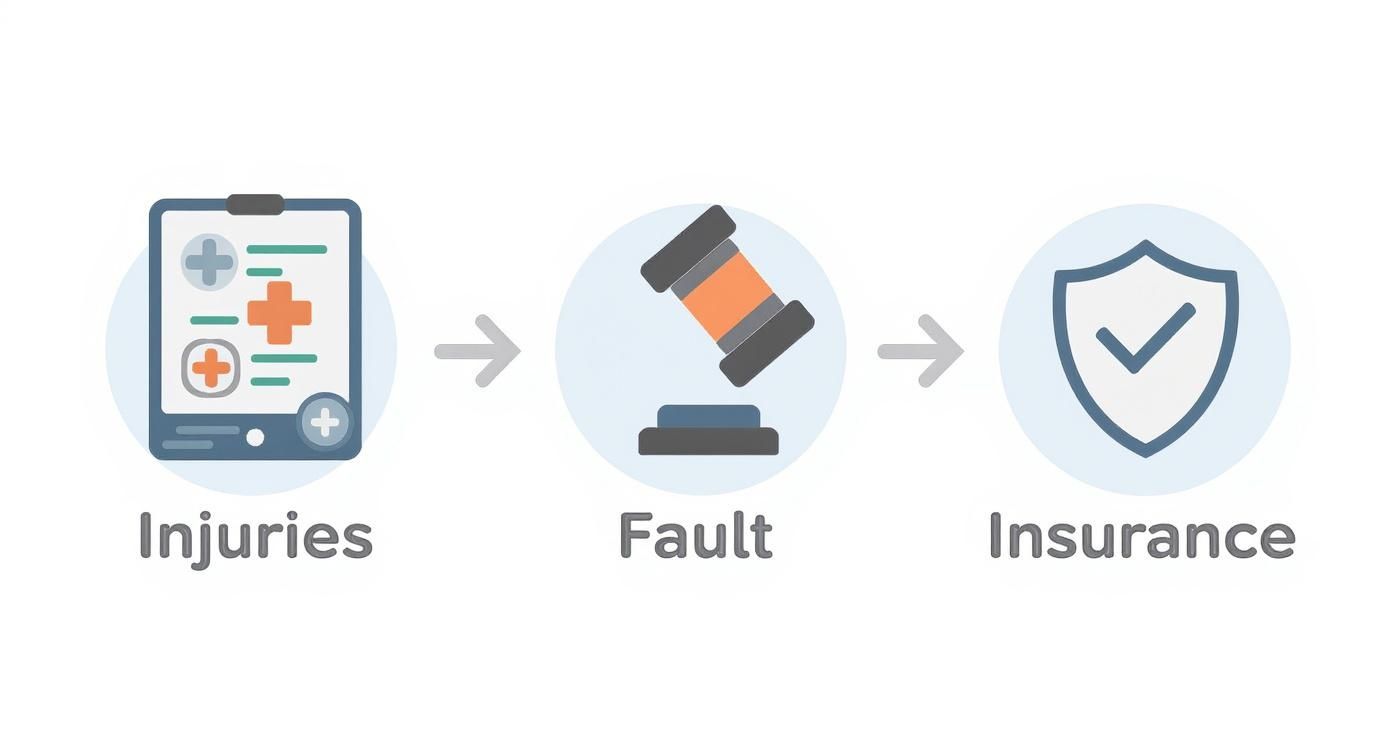
As you can see, the final settlement isn’t a simple equation. It’s the result of how your specific injuries, the facts about who was at fault, and the available insurance all interact.
Economic Damages: The Tangible Costs
Let’s start with the easy part. Economic damages are the black-and-white, provable financial losses you’ve suffered because of the accident. These are the numbers we can track with receipts, pay stubs, and medical bills.
Your attorney’s job is to meticulously gather and add up every single expense. This isn’t just about the bills piling up now; it’s also about accurately projecting the costs you’ll be facing down the road.
Here’s what typically gets included:
- All Medical Bills (Past and Future): This is everything from the ambulance ride and ER visit to surgery, physical therapy, and prescriptions. Critically, it also includes an expert’s estimate of what future care you’ll need.
- Lost Income and Earning Capacity: We calculate the paychecks you missed while you were out of work. If your injuries are serious enough to prevent you from returning to your old job or limit your future earning potential, this piece of the claim becomes much larger and more complex.
- Motorcycle Repair or Replacement: This one is straightforward—it’s the cost to fix your bike or, if it’s a total loss, its fair market value right before the crash.
- Out-of-Pocket Expenses: All the little things add up. This bucket includes costs for things like gas to get to doctor’s appointments, co-pays, or even hiring someone for lawn care because you physically can’t do it anymore.
Non-Economic Damages: The Human Cost
This is where things get more complicated, and where having an experienced lawyer really matters. Non-economic damages are meant to compensate you for the ways the accident has impacted your quality of life. How do you put a dollar value on chronic pain? On the inability to enjoy a ride on a perfect Florida afternoon?
These are devastating losses, even if they don’t come with an itemized bill. The legal system recognizes that this suffering has real value.
Non-economic damages are the law’s way of acknowledging that a serious injury is far more than just a stack of medical bills. They are meant to compensate for the physical pain, the emotional trauma, and the life you’ve lost—whether temporarily or permanently.
Because these damages are subjective, attorneys and insurance adjusters need a place to start. They often use what’s called the “multiplier method.” The idea is to take the total of your hard economic damages and multiply it by a number, usually between 1.5 and 5, depending on how severe your injuries are. A sprain might get a 1.5 multiplier, but a catastrophic injury that changes your life forever could demand a 5. To see how this works in more detail, you can read our guide on how to calculate pain and suffering damages.
Just remember that settlement statistics can be misleading. A few catastrophic cases with multi-million dollar verdicts can pull the “average” settlement figure way up, while most claims resolve for a more modest amount that reflects the specific injuries involved. It’s the facts of your Florida case, not a national average, that matter.
Why Motorcycle Injury Claims Are Often Higher
If you’ve ever wondered why motorcycle accident settlements seem so much larger than those for a typical car crash, there’s a straightforward and sobering reason. It all comes down to physics and the brutal reality of a rider’s vulnerability on the road.
Think about it this way: a car driver is essentially wrapped in a safety cell—a steel frame, airbags, and seatbelts designed to absorb impact. A motorcyclist, on the other hand, has little more than a helmet and their riding gear to protect them from thousands of pounds of moving steel and hard pavement. The stakes are just fundamentally higher, and that’s directly reflected in the settlement amounts.

The Devastating Nature of Rider Injuries
When a crash happens, a rider’s body takes the full force of the impact. There’s no crumple zone to absorb the energy. This direct exposure is why we so often see catastrophic injuries that are far less common for people inside a passenger vehicle.
Some of the most serious injuries we see with bikers include:
- Traumatic Brain Injuries (TBI): A helmet is crucial, but the violent jolt of a crash can still cause the brain to slam against the inside of the skull, leading to devastating, long-term disabilities.
- Spinal Cord Damage: Being thrown from a bike can easily fracture vertebrae, resulting in damage to the spinal cord and potentially causing partial or complete paralysis.
- Severe Road Rash: This is much more than a simple scrape. Deep road rash can tear through layers of skin, muscle, and nerves, often requiring skin grafts and posing a serious risk of infection.
- Internal Organ Damage: The blunt force trauma from hitting another vehicle or the ground can lead to life-threatening internal bleeding and organ damage requiring immediate, complex surgery.
This is the core of why these claims are valued so differently. To fully grasp this, it helps to understand how motorcycle accidents are different from car accidents in Florida, as the legal and physical distinctions are significant.
Translating Severe Injuries into Higher Costs
The aftermath of these injuries creates a ripple effect of massive personal and financial costs, which is what drives up the settlement value. The more a person’s life is turned upside down, a higher amount of compensation is needed to even begin to cover the damage.
A higher settlement isn’t a windfall; it’s a direct reflection of a greater loss. It represents the staggering medical bills, the months or years of lost income, and the profound, permanent changes to a person’s quality of life.
Here’s a simple comparison: someone with a broken arm from a fender bender might miss a few weeks of work. A rider who suffers a spinal cord injury might be unable to ever work again, facing a lifetime of medical needs that can easily cost millions.
The difference is stark. While a typical car accident claim might result in a more modest settlement, a serious motorcycle accident claim often involves significantly higher values. This pattern holds true here in Florida because it speaks to the devastating economic impact that comes with a rider’s exposure to harm.
How a Lawyer Maximizes Your Florida Motorcycle Claim
After a serious motorcycle accident, facing a massive insurance company on your own can feel completely overwhelming. Let’s be honest—their adjusters and lawyers do this every single day. Their goal is simple: protect their bottom line by paying you as little as they possibly can. This is exactly why an experienced Florida motorcycle accident attorney is so critical. They level the playing field.
Bringing in a lawyer isn’t just about handing off the paperwork. It’s about having a dedicated advocate in your corner, someone who can build a powerful, evidence-backed case to get you the compensation you truly deserve. It instantly flips the script from you being on the defensive to taking the offensive.
Launching an Independent Investigation
The police report is just the starting point. A good attorney knows this and immediately launches a much deeper, independent investigation. They don’t just take the initial report at face value; they dig in to build a rock-solid story of exactly what happened and who’s to blame.
This professional investigation is far more thorough and often involves:
- Hiring Accident Reconstruction Experts: These are the pros who use physics and engineering to recreate the crash. They can pinpoint speeds, impact angles, and other critical details that definitively prove the other driver was at fault.
- Securing and Preserving Evidence: Your legal team moves fast to lock down crucial evidence—like security camera footage from a nearby gas station, a trucker’s logbooks, or a commercial vehicle’s “black box” data—before it disappears or gets “lost.”
- Interviewing Witnesses: They’ll track down anyone who saw the crash and get their formal statement. This locks in their testimony, preventing the at-fault party from trying to change their story down the road.
Calculating the True Value of Your Claim
One of the most vital things an attorney does is calculate the full, long-term cost of your injuries. This is a number an insurance adjuster will never calculate for you. Your lawyer looks way beyond the immediate hospital bills to make sure your settlement accounts for a lifetime of potential needs.
This means bringing in medical and financial experts to project the costs of future surgeries, ongoing physical therapy, prescriptions, and even in-home care. They also calculate your total lost earning capacity if your injuries mean you can’t go back to the job you had. This complete picture is essential for pushing past a lowball offer and getting a number that actually covers your losses.
An insurance adjuster’s job is to close your claim quickly and cheaply. An attorney’s job is to ensure the settlement you receive is enough to protect your financial stability for the rest of your life. They are your shield and your sword in this fight.
Handling All Negotiations and Legal Hurdles
Once the evidence is gathered, your lawyer becomes your voice. They handle all communication with the insurance companies, shielding you from the stress of dealing with adjusters who are trained to get you to say something that could weaken your claim. They are experts in negotiating with insurance companies, using the facts of the case to systematically dismantle low offers and push for what’s fair.
Maximizing a claim also means navigating all the required legal documents correctly. During this process, you might need to understand the role of document notarization after accidents to make sure every form and affidavit is legally binding.
Best of all, personal injury attorneys in Florida work on a contingency fee basis. This is a game-changer. It means you pay zero dollars upfront. The lawyer’s fee is simply a percentage of the money they recover for you. If they don’t win your case, you owe them nothing. This makes expert legal help available to everyone, no matter what their financial situation is.
Common Questions About Florida Motorcycle Settlements
After a motorcycle crash, your mind is probably racing with a thousand questions while you’re just trying to focus on getting better. It’s completely normal. Let’s walk through some of the most common questions we hear from riders right here in Florida and get you some straight answers.
How Long Does It Take to Settle a Motorcycle Case in Florida?
This is usually the first thing people ask, and the honest answer is: it depends entirely on your specific situation. There’s just no magic number.
A simple case with minor injuries and a clear-cut, at-fault driver might wrap up in a few months. But that’s the exception, not the rule. If you’ve suffered serious injuries, if the other driver is fighting the claim, or if there are multiple vehicles involved, you’re likely looking at a process that could take a year or more. This is especially true if we have to file a lawsuit to get you what you’re owed.
A big reason for the timeline is reaching what’s called Maximum Medical Improvement (MMI). This is the point where your doctors say you’re as recovered as you’re going to get. They have a clear picture of your long-term medical needs and any permanent limitations.
It’s a huge mistake to rush into a settlement before you hit MMI. A fast settlement is almost always a cheap settlement. You can’t possibly know the full, long-term cost of your injuries—like future surgeries or ongoing physical therapy—until your medical picture is complete.
A good attorney’s job isn’t to get you a fast check; it’s to get you a fair one that truly covers everything you’ve lost.
Will Not Wearing a Helmet Affect My Florida Settlement?
This is a big one for Florida riders. If you’re over 21 and have at least $10,000 in medical benefits coverage, you can legally ride without a helmet. But—and this is a big but—it can absolutely affect your settlement.
You can bet the insurance company will try to use it against you. They’ll bring up Florida’s comparative negligence rule and argue that by not wearing a helmet, you’re partially to blame for the severity of your own head injuries. Their goal is to stick you with a percentage of the fault. If they convince a jury you were 20% at fault for your head trauma, they can legally slash your compensation for that injury by 20%.
This is a classic insurance tactic, and fighting it requires a skilled attorney. We push back hard, making it clear that the other driver’s bad decision caused the crash in the first place, and a helmet wouldn’t have prevented all injuries anyway.
What Happens If the At-Fault Driver Is Uninsured?
That moment when you find out the driver who hit you has no insurance can feel like a punch to the gut. But don’t panic; this is exactly why Uninsured/Underinsured Motorist (UM/UIM) coverage is a non-negotiable for every single rider in Florida.
If you have UM/UIM on your policy, it becomes your safety net. You can file a claim with your own insurance company to cover the very things the at-fault driver’s insurance should have paid for, including:
- Medical bills
- Lost wages
- Pain and suffering
An attorney can guide you through this process. It sounds strange, but sometimes your own insurance company can be just as difficult as the other guy’s. They’re still a business, and they may still try to pay out as little as possible. Having a professional on your side is critical. For anyone new to this, learning how to file an auto insurance claim is a good first step in understanding what’s ahead.
Should I Accept the First Offer From the Insurance Company?
Let me make this easy for you: No. Almost never.
Think of the first offer as a test. The insurance adjuster is tossing out a lowball number to see if you’ll bite. They know you’re hurt, out of work, and stressed about money. They’re banking on you taking the quick, easy cash without realizing what your claim is truly worth.
That initial offer rarely, if ever, considers the real costs, such as:
- Potential future medical care or therapy
- The impact on your ability to earn a living down the road
- What your physical pain and emotional trauma are truly worth
Never, ever accept an offer or sign anything without speaking to a lawyer first. We can calculate the true value of your case and negotiate from a place of strength, not desperation, to make sure you get the full compensation you deserve.
If you’ve been injured in a motorcycle accident in Tampa, you don’t have to face the insurance companies alone. At Martin Hernandez, P.A., we prepare every case for trial from day one to fight for the maximum compensation you deserve. Contact us today for a free, no-obligation consultation to understand your rights and options at https://injurylawyersoftampa.com.