
In Florida, the law says a child needs to be in a booster seat (or similar safety seat) until they turn six. But here’s the thing: age is a terrible indicator of readiness. From a safety perspective, what really matters is a child’s height, weight, and how a standard seat belt actually fits their body. Getting this right is crucial for preventing serious injuries in a crash.
Florida Booster Seat Laws and Safety Guidelines
Understanding the gap between what’s legally required and what’s actually safe is the first step for any parent. For families here in Tampa and across Hillsborough County, knowing the law is important, but recognizing its shortcomings is what truly keeps kids safe.
The whole point of a backless booster is simple: it lifts your child up so the car’s adult-sized seat belt can do its job correctly.
Think about it—a seat belt is designed for a fully-grown adult. When a small child uses one, the lap belt often rides up over their soft belly instead of their strong hip bones. At the same time, the shoulder belt cuts dangerously across their neck or face. In an accident, this improper fit can cause catastrophic internal organ damage, spinal cord injuries, or even ejection from the vehicle. This is precisely where the legal minimum and expert safety advice go in different directions.
The Law Versus Safety: A Critical Distinction
Florida Statute 316.613 sets the absolute bare minimum, not the gold standard, for child passenger safety. The law simply states that children aged four and five must be in a separate carrier, integrated seat, or booster. Once a child turns six, they are legally allowed to use just an adult seat belt.
The problem? Almost no six-year-old is big enough to fit an adult seat belt safely. This gap between the law and physical reality is why child safety experts and injury attorneys strongly urge parents to follow a much more reliable standard—one based on body size and belt fit, not just a birthday.
Proper positioning is everything. You can learn more about this in our detailed guide on where to place your child’s car seat.
Here’s a simple breakdown showing just how different the legal minimum is from what’s actually recommended to keep your child safe.
Florida Legal Minimum:
- Age: A child can move out of a booster at age 6.
- Height: No specific height requirement.
- Belt Fit: Not addressed in the statute.
Safety Expert Recommendation (The 5-Step Test):
- Age: Age is not considered a reliable factor.
- Height: Typically 4’9” (57 inches) tall.
- Belt Fit: The child must pass all 5 steps of the belt-fit test, which includes:
- Child’s back must be flat against the seat, with knees bending at the edge.
- The lap belt must sit low across the upper thighs/hips, not the abdomen.
- The shoulder belt must cross the center of the shoulder and chest, not the neck or face.
- The child must be mature enough to sit properly for the entire trip.
As you can see, simply following the law leaves a huge safety gap. That’s where the 5-Step Test comes in.
The 5-Step Test: The Gold Standard for Safety
Instead of circling a date on the calendar, use this simple “5-Step Test” to see if your child is genuinely ready to leave their booster seat behind. This test confirms the seat belt is positioned over the strongest parts of their body, where it can provide real protection.
- Step 1: Can your child sit with their back flat against the vehicle’s seatback?
- Step 2: Do their knees bend comfortably over the edge of the seat cushion?
- Step 3: Is the lap belt sitting low across their hips and upper thighs—not their stomach?
- Step 4: Does the shoulder belt cross snugly over their collarbone and the middle of their chest—not their neck or face?
- Step 5: Can your child stay seated this way for the whole ride, without slouching or shifting?
If you answer “no” to even one of these questions, your child is not safe without a booster seat, no matter what their age is. Graduating them too soon puts them at a significantly higher risk for life-altering injuries in a collision.
Knowing When Your Child Is Ready for a Backless Booster
Moving your child from a harnessed car seat to a backless booster is a huge step, and frankly, it’s a milestone parents often rush. It’s not like a birthday; readiness isn’t about hitting a certain age. Instead, it’s a critical decision that hinges on weight, height, and most importantly, your child’s maturity.
Most booster seats will say a child needs to be at least four years old and weigh 40 pounds. But think of those numbers as the absolute bare minimum, not the goal. The real question is: can your child sit properly for the entire ride, every single time, without slouching, wiggling around, or messing with the seat belt?
Beyond Age and Weight: The Maturity Factor
A seat belt is designed to fit one way. If it doesn’t fit perfectly, it can’t do its job in a crash. It’s that simple. A child who isn’t mature enough to sit still will instantly compromise that perfect fit, letting the shoulder belt slip off or causing the lap belt to ride up onto their stomach—a recipe for severe internal injuries.
Deciding when to make this switch is a lot like other big parenting transitions, such as figuring out when to transition to a floor bed. You have to look for genuine developmental readiness. Is your child truly prepared for this new level of responsibility?
It’s a huge problem. We know that booster seats reduce the risk of serious injury by a whopping 45 percent compared to using a seat belt alone. Yet, study after study shows an alarming 4 out of 5 parents move their kids out of them way too soon. The numbers are staggering: 24.9% of kids are moved into boosters before they’re ready, and an unbelievable 93.6% are put in regular seat belts before they can safely use them.
The 5-Step Test: Your Ultimate Readiness Checklist
So how do you know for sure? The best tool you have is the 5-Step Test. It’s a simple, hands-on check to see if the vehicle’s actual seat belt fits your child’s body correctly. This test tells you if they’re ready for a backless booster or if they’re ready to stop using a booster altogether.
This visual guide shows the gap between Florida’s legal minimum and what true safety looks like.
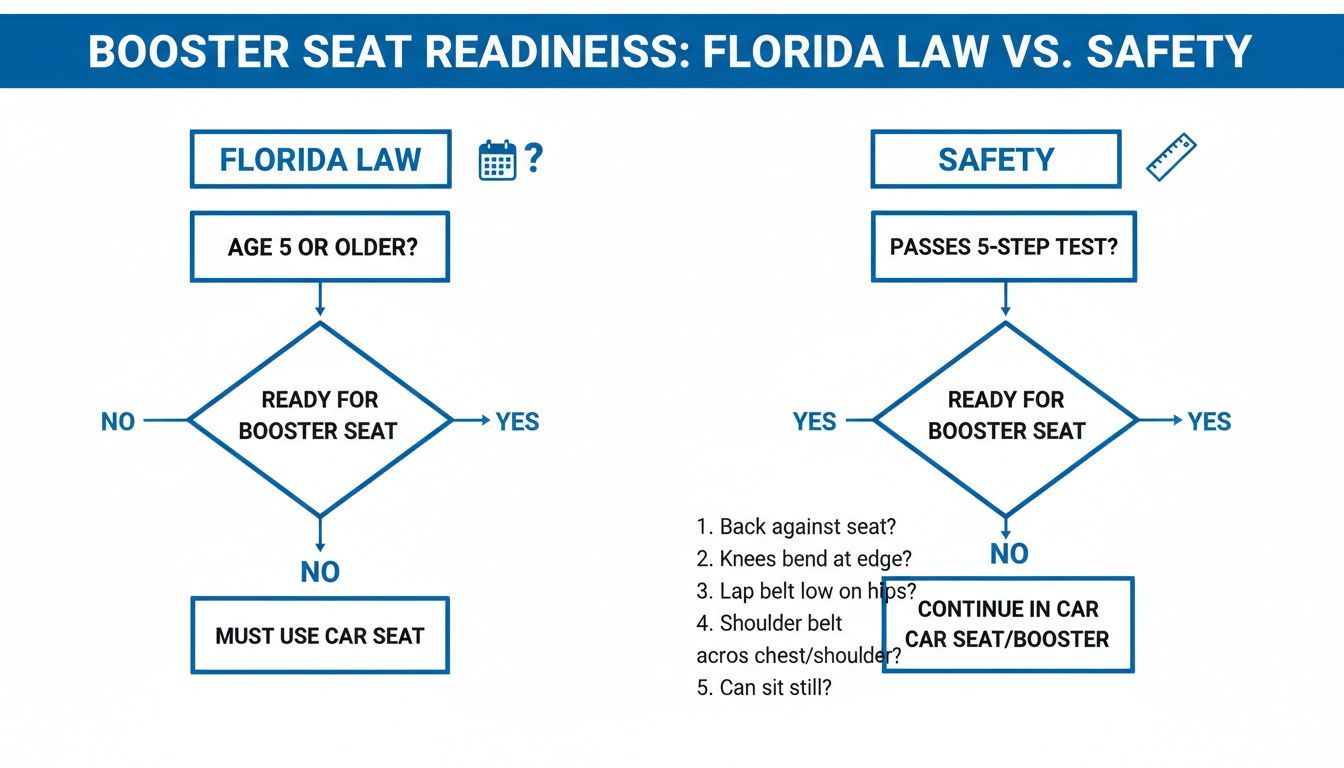
As you can see, the law gives you a simple age, but safety is all about getting the right physical fit.
Let’s walk through the 5 steps:
- Back Against the Seat: Can your child sit with their lower back flat against the vehicle’s seatback? No slouching.
- Knees Bend at the Edge: Do their knees bend naturally over the edge of the seat cushion? If their legs stick straight out, they’re too short and will slide down, pulling the lap belt up.
- Lap Belt on the Hips: The lap belt must sit low and snug across their upper thighs and strong hip bones. It should never be on their soft belly.
- Shoulder Belt on the Chest: The shoulder belt needs to cross the middle of their shoulder and chest, not dig into their neck or fall off their arm.
- Stays Seated Properly: This is the big one. Can they hold this exact position for the entire trip, without fidgeting, even if they fall asleep?
If you can’t say “yes” to all five, your child isn’t ready. Graduating to the next seat too early isn’t a milestone to celebrate—it’s a risk that can have devastating consequences in a crash. For a complete look at your options, see our guide on which car seat should my child be in?.
Choosing Between a High-Back and Backless Booster
So, your child is finally ready to move into a booster seat. That’s a huge milestone! But now you’re faced with another decision: do you go with a high-back or a backless model? This isn’t just a matter of looks or price; it’s a critical safety choice that hinges on your child’s maturity, your car’s features, and your family’s lifestyle.
At their core, both types of boosters have the same job: to lift your child up so the car’s seat belt fits them like it would an adult. A backless booster is the simplest form of this—basically, a sturdy cushion that gives them the height they need. A high-back booster does that too, but it also adds a protective shell with head, neck, and side support, almost like the seat they just grew out of.
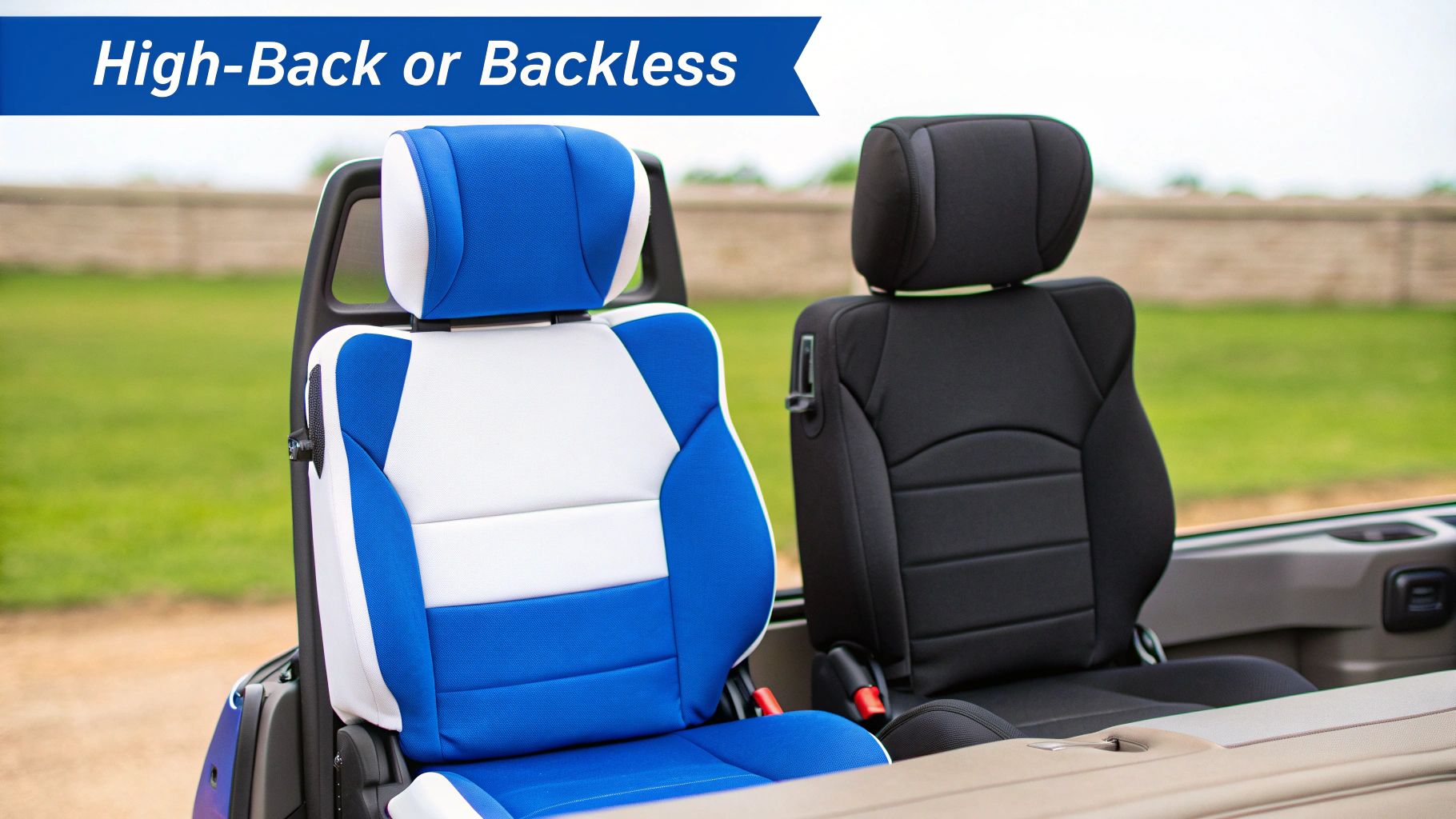
It seems more and more parents are recognizing the difference. According to the National Survey of the Use of Booster Seats, the use of backless boosters for kids aged 4 to 7 dropped from 14.1% in 2021 to 12.6% in 2023. At the same time, high-back booster use jumped from 17.0% to 21.1%. This shift suggests parents are getting the message about the extra safety these seats offer. If you’re interested in the data, you can review the full NHTSA survey findings yourself.
The Case for High-Back Boosters
For a child who has just graduated from a five-point harness, a high-back booster is almost always the best and safest first step. Think of it as a transition seat that still provides a ton of structure and support.
- Side-Impact Protection: Those “wings” around the head and body aren’t just for looks. In a side-impact crash, they act as a crucial barrier between your child and the car door, absorbing energy and shielding them from harm.
- Head and Neck Support: This is a lifesaver for kids who fall asleep on car rides. A high-back booster keeps their head from slumping over, which is not just about comfort—it prevents the shoulder belt from slipping off their shoulder and onto their neck.
- Shoulder Belt Guides: High-back models have built-in loops or guides that feed the shoulder belt through, ensuring it always stays perfectly positioned across the middle of your child’s collarbone.
If your car has low seat backs or lacks rear headrests, a high-back booster isn’t just a good idea—it’s absolutely essential. Without it, there’s nothing to protect your child from whiplash in a rear-end collision.
When a Backless Booster Makes Sense
While high-back boosters have clear safety advantages, backless models still have their place, especially for older, bigger, and more responsible kids who meet all the backless booster seat requirements. Their real selling point is convenience.
- Portability: They’re lightweight, compact, and incredibly easy to shuttle between cars. This makes them perfect for carpools, playdates with grandparents, or air travel.
- Fit for Older Kids: Sometimes, a child gets too tall for a high-back booster’s shoulder belt guide but still isn’t quite ready to pass the 5-Step Test for the vehicle belt alone. A backless booster is the perfect tool to bridge that gap.
- Independence: For an older child who feels “too babyish” for a big car seat, a backless booster can feel like a grown-up step while still providing the necessary safety lift.
A Real-World Florida Scenario
Let’s put this into practice. Picture a Florida family with two cars: an older sedan with low-profile back seats and no headrests, and a brand-new SUV with high seat backs and adjustable headrests. Their 7-year-old is big enough for a booster.
In the old sedan, a high-back booster is the only safe option. Putting the child in a backless booster would leave their head and neck completely exposed in a crash. It’s a non-negotiable.
But in the new SUV, the vehicle itself already provides that crucial head and neck support. Here, either a high-back or a backless booster could be a safe choice, as long as the child can sit correctly for the whole ride and the seat belt fits perfectly. This shows that the right booster often depends just as much on the car as it does on the child. The relationship between car seats and crashes is filled with these important details, and knowing them is what keeps kids safe. You can learn more by reading about how car seats are handled in auto accidents.
Getting the Installation Right for Maximum Safety
Choosing the right booster seat is a huge first step, but it’s only half the battle. A booster’s ability to protect your child in a crash comes down to one simple thing: using it correctly, every single time. Think of it as creating the perfect team between the booster seat, your car’s seat belt, and your child’s body.
Even the most expensive, top-rated booster is useless if it’s not installed properly. Misuse is a surprisingly common problem, and it can turn a minor fender-bender into a situation with serious injuries. Let’s walk through exactly how to make sure your backless booster is set up for maximum protection.
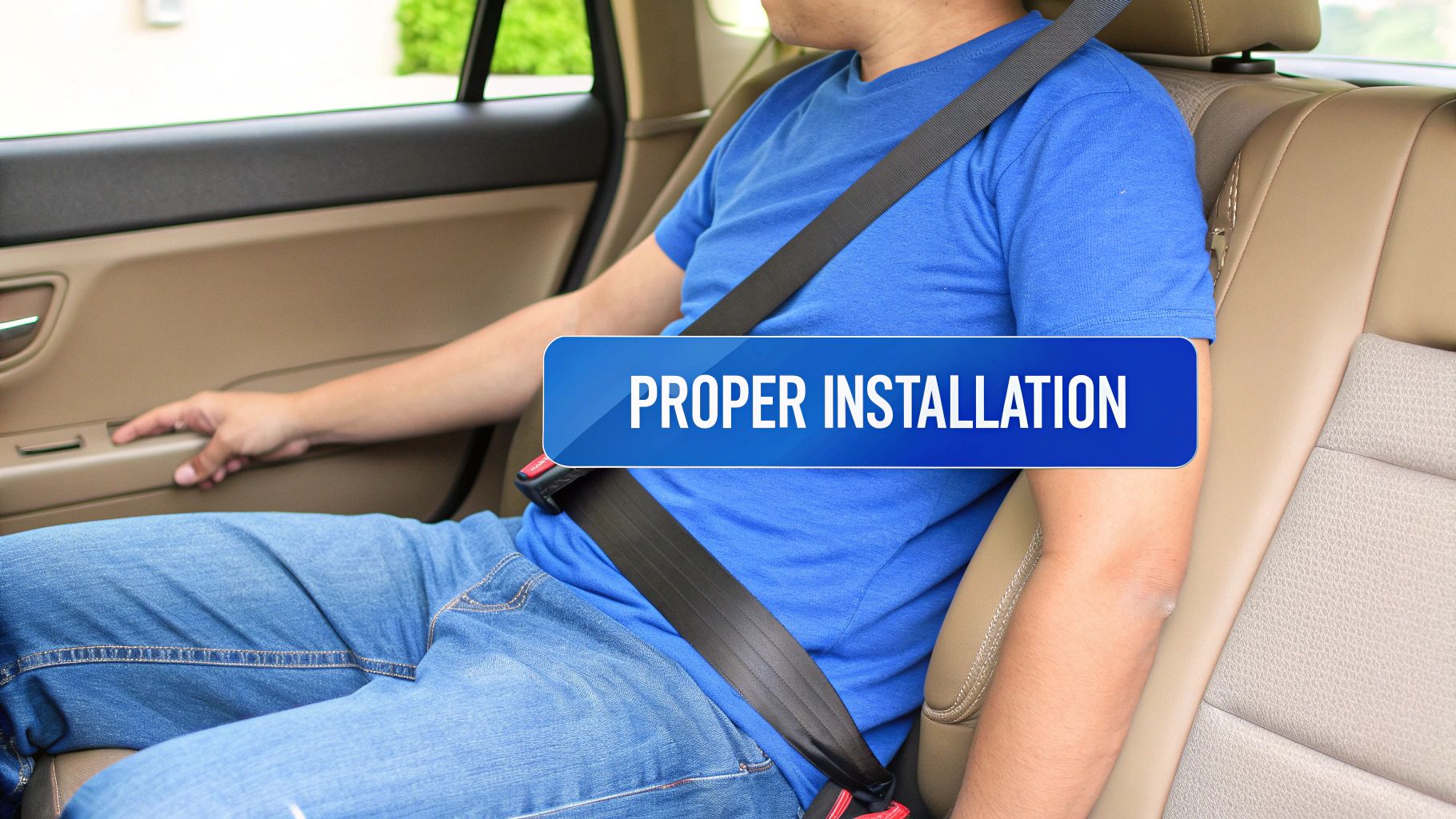
A Practical Guide to Proper Use
The booster seat itself isn’t the restraint—it’s a platform. Its whole job is to lift your child up so that the car’s seat belt, the actual restraint, can fit them perfectly across the strongest parts of their body.
Here’s what you need to do on every trip:
- Place the Booster Flat: The booster must sit completely flat and firm on the vehicle’s seat cushion. Make sure it doesn’t rock, tilt, or hang over the edge. Any wobble means it won’t be able to do its job of elevating your child correctly.
- Position Your Child: Have your child sit down, making sure their back is flat against the vehicle’s seat back. Their knees should bend naturally right at the edge of the seat cushion.
- Route the Lap Belt: This is the most important step. Pull the seat belt across your child and buckle it. The lap belt portion must sit low and snug across their upper thighs and pelvis—never across their soft belly. Most backless boosters have red or colored guides for the lap belt; they aren’t optional, so make sure you use them.
- Position the Shoulder Belt: The shoulder belt should lie flat across the middle of your child’s chest and collarbone. It shouldn’t be cutting into their neck or slipping off the edge of their shoulder. If your booster came with a shoulder belt positioning clip, this is what it’s for. Use it to get that just-right fit.
Common Mistakes That Compromise Safety
Even parents with the best intentions can make small mistakes that have big consequences. Knowing what these common errors are is the first step to avoiding them.
A booster seat’s effectiveness is completely nullified by improper use. Common errors, like allowing a child to put the shoulder belt behind them, are not minor issues—they can lead directly to severe abdominal, spinal, and head injuries in a crash.
Be sure to avoid these critical installation and usage mistakes:
- Using a Lap-Only Belt: A booster seat must be used with a lap-and-shoulder belt combination. Using one with a lap-only belt is incredibly dangerous and can cause severe internal and spinal cord injuries—a phenomenon known as “seat belt syndrome.” The vehicle’s system is designed as a 5-point restraint for adults, and the booster simply adapts this for a child’s smaller frame.
- Allowing Belt Misuse: Never, ever let your child tuck the shoulder belt behind their back or under their arm. This completely removes all upper body protection, which means their head and torso will fly forward in a collision.
- Ignoring Belt Guides: Those colored slots or hooks on the side of the booster are there for a reason. They lock the lap belt into the correct position over your child’s strong hip bones. Skipping them allows the lap belt to ride up onto the abdomen, where it can cause massive internal damage.
- Forgetting to Secure an Unoccupied Booster: When your child isn’t in the car, an unsecured booster seat becomes a heavy projectile in a sudden stop or crash. It can easily injure you or other passengers. Always buckle the seat belt over an empty booster or toss it in the trunk.
How Booster Seat Use Can Impact a Florida Car Accident Claim
Making sure your child is in the right backless booster seat isn’t just about safety—it can also have a major impact on your family’s legal rights after a car crash in Florida. Even when the other driver is clearly at fault, their insurance company will look for any excuse to reduce the compensation your child deserves. Improper car seat use is one of the first things they’ll latch onto.
Understanding this connection is absolutely critical for protecting both your child’s well-being and your potential injury claim.
Right after a collision, your only thought is your child’s health. But the other driver’s insurance company has a very different priority: minimizing their financial payout. They will scrutinize every single detail of the crash, searching for ways to shift blame away from their driver and onto you. This is why following all the safety guidelines becomes a crucial piece of your legal case.
The Doctrine of Comparative Negligence
Florida law follows a rule called comparative negligence. In plain English, it means that if you’re found to be partially at fault for an accident or the injuries that resulted, the money you can recover gets reduced by your percentage of fault. Insurance adjusters and their lawyers love to use this rule to their advantage.
They’ll argue that while their driver may have caused the crash, your child’s injuries are worse than they should have been because they weren’t in the correct booster seat. For instance, if your 7-year-old was using only a seat belt but hadn’t passed the 5-Step Test, the defense attorney will claim that this failure to use a proper restraint contributed to the severity of the injuries.
This is a legal tactic designed to shift the focus away from the negligent driver’s actions and onto your decisions as a parent. The goal is simple: convince a jury—or you—that you share responsibility for the outcome, which lowers the settlement amount.
It’s a cynical but incredibly common strategy used to save the insurance company money at your family’s expense.
A Florida Accident Scenario
Picture this happening right here in Florida: A family is stopped at a red light on a busy highway when they’re suddenly rear-ended by a distracted driver. Their 7-year-old son, who is over Florida’s minimum age but still way too small for an adult seat belt, is riding without a booster. He suffers serious internal injuries because the lap belt dug into his abdomen on impact.
The other driver is 100% at fault for causing the crash itself. But their defense lawyer will argue that the boy’s injuries wouldn’t have been nearly as severe if he had been properly buckled into a booster that met safety recommendations. They might even bring in an “expert” to testify that these “seat belt syndrome” injuries were a direct result of improper restraint, not just the crash.
If a jury is convinced you were 25% responsible for the severity of the injuries, your final compensation gets slashed by that same percentage.
How We Fight Back for Your Family
This is exactly where an experienced personal injury attorney becomes your most powerful advocate. Our job is to dismantle these arguments before they ever gain traction. We bring in our own team of biomechanical engineers and accident reconstruction experts to prove the true cause and full extent of the negligent driver’s liability.
We will work to demonstrate that the violent force of the impact—caused solely by the other driver’s carelessness—was the primary cause of your child’s injuries, regardless of the restraint used. By showing that even a perfectly restrained child could have been seriously hurt in such a severe collision, we protect your claim and hold the at-fault party fully accountable.
If your child has been hurt in a crash, it’s vital to know what to do if your child is injured in a car accident to protect their health and legal rights from the start. Our commitment is to fight for the maximum compensation your family needs to cover medical bills, future care, and your child’s pain and suffering.
Common Questions About Florida Booster Seat Laws
Even when you know the rules, real-life situations with kids and cars can get confusing. I get it. Parents in Florida often ask me about the gray areas between what’s technically legal and what’s actually safe. Let’s clear up some of the most common questions I hear so you can feel confident every time you hit the road.
These aren’t just hypotheticals; they’re the practical, everyday scenarios that families deal with all the time.
My Child Is 6. Is It Legal for Them to Ride Without a Booster Seat in Florida?
Legally, yes. Florida law only requires a child restraint system, like a booster, for kids aged five and under. Once your child turns six, you are no longer legally obligated to use one.
But here’s the thing—and this is crucial—the law is just a bare minimum. It’s not a safety benchmark. A child’s birthday has nothing to do with how an adult seat belt fits their body. Their size and bone structure are what truly matter.
Most six-year-olds are simply not big enough for an adult seat belt to work properly. A belt that rides up over the stomach or cuts across the neck can cause devastating internal injuries in a crash, a condition grimly known as “seat belt syndrome.”
Always use the 5-Step Test we talked about earlier. That’s the only reliable way to know if your child is ready. Their safety is worth so much more than meeting the minimum legal age.
Can I Use a Backless Booster in a Car That Only Has a Lap Belt?
No. Absolutely not. This is a non-negotiable safety rule. Any booster seat—backless or high-back—is designed to be used with a lap and shoulder belt combination. Full stop.
Using a booster with a lap-only belt is incredibly dangerous. Think about what a booster does: it lifts the child up so the vehicle’s existing lap and shoulder belt can sit correctly on the strongest parts of their body—the hips and collarbone.
Without that shoulder belt, a child’s upper body will fly forward in a crash. The lap belt would then dig deep into their soft belly, causing horrific damage to their internal organs and spine. If you have a seating position with only a lap belt, it’s not a safe spot for a child in a booster. You’ll need to find another spot or use a different vehicle.
Does My Child Need a Booster Seat in an Uber or Lyft in Florida?
Yes, they do. Florida’s car seat and booster laws apply to all non-commercial vehicles, and that includes rideshare cars from services like Uber and Lyft. Florida Statute 316.613 doesn’t give them a pass.
Now, the rideshare driver isn’t required to provide a car seat for you. The legal responsibility falls squarely on the parent or guardian to make sure their child is buckled in correctly. If your child needs a booster, you need to bring it with you.
For families traveling around Florida, it’s a smart habit to always bring your own portable booster. Here’s why it’s so important:
- It’s About Safety: This is the most obvious reason. It ensures your child is properly protected if a crash happens.
- No Hassles: A driver can—and probably should—refuse the ride if you don’t have the required safety seat for your child.
- Protecting Your Rights: If an accident does happen, not having your child in the proper restraint could seriously damage your injury claim and reduce the compensation your child deserves.
Planning ahead and bringing your own booster is the easiest way to guarantee a safe, stress-free ride for your family.
Navigating the aftermath of a car accident is challenging, especially when a child’s well-being is at stake. If your family has been impacted by another driver’s negligence, the dedicated team at Martin Hernandez, P.A. is here to help. We understand the complexities of Florida’s traffic laws and will fight to protect your legal rights and secure the full compensation your child deserves. Contact us for a free, no-obligation consultation to learn how we can support you. Learn more at https://injurylawyersoftampa.com.