
TL;DR:
- Getting to the emergency department after a pregnancy-related car crash is critical because serious complications can develop silently over hours or days. Continuous fetal monitoring and thorough evaluation are essential, especially for pregnancies beyond 20 weeks, to detect issues like placental abruption or preterm labor. Proper documentation and prompt medical attention protect both health and legal rights, with expert legal help available if complications occur.
If you’re pregnant and just had a car accident, get to an emergency department immediately — even if you feel fine and the crash seemed minor. The American College of Obstetricians and Gynecologists (ACOG), the U.S. National Library of Medicine (NLM/NIH), and the Centers for Disease Control and Prevention (CDC) all recognize motor vehicle crashes as a leading cause of traumatic injury during pregnancy. Complications like placental abruption can develop silently over several hours to a few days, which means feeling okay at the scene tells you almost nothing about what is happening inside.
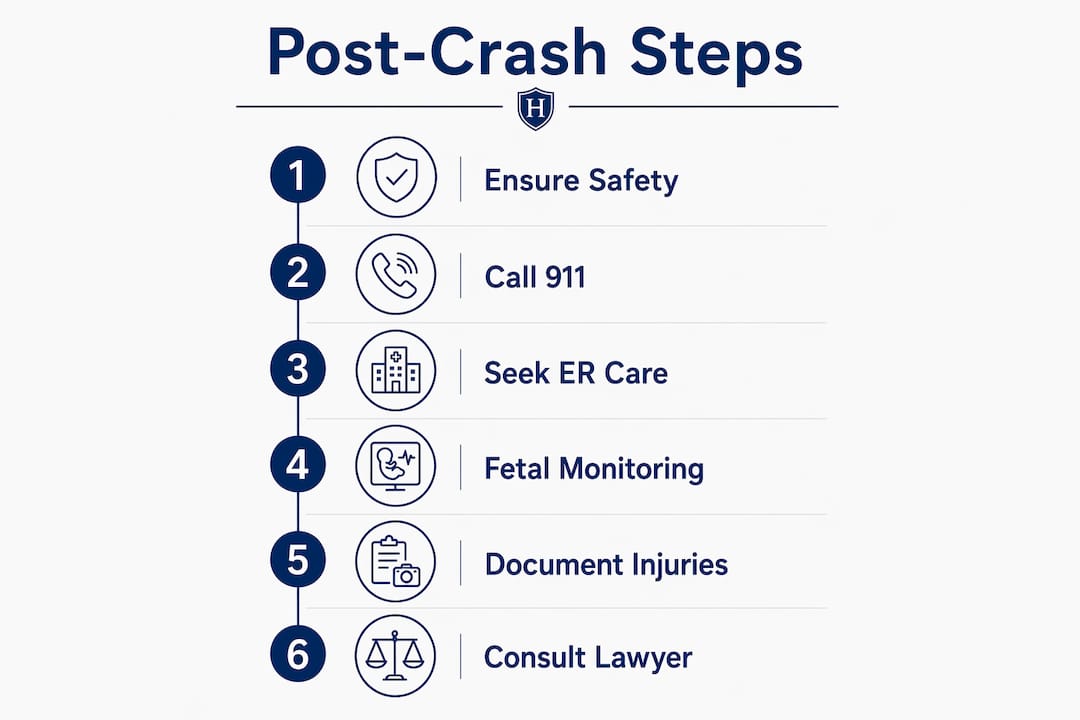
Here is what to do right now:
- Call 911 if anyone is injured, if you have pain, bleeding, or any concern — do not drive yourself to the hospital if you can avoid it.
- Tell EMS and first responders you are pregnant and share your gestational age immediately.
- Go to the emergency department for a full maternal and fetal evaluation, regardless of how minor the crash appeared.
- Request continuous fetal monitoring if you are at or beyond 20 weeks’ gestation — clinical guidance calls for a minimum of 4–6 hours of monitoring after abdominal trauma at this stage.
- Photograph the scene, vehicle damage, and any visible injuries before vehicles are moved when it is safe to do so.
- Get the police report number and exchange insurance and contact information with all other drivers.
What complications can a pregnancy car crash cause?
Motor vehicle crashes are the leading cause of hospitalized injury and injury-related death during pregnancy in the United States, with approximately 92,500 pregnant women injured in crashes each year. The stakes are high, and the specific risks shift depending on how far along you are.
Placental abruption is one of the most serious crash-related complications. The placenta can partially or fully separate from the uterine wall due to the force of impact, cutting off oxygen and nutrients to the baby. It can be clinically silent for hours or even days after the crash, which is exactly why delayed evaluation is so dangerous.
Preterm labor is another significant risk, particularly in the second and third trimesters. Uterine contractions triggered by trauma can begin hours after the event. A large retrospective cohort study published in the American Journal of Preventive Medicine found that after a single crash, pregnant drivers had an elevated rate of preterm birth (adjusted rate ratio of 1.23) and placental abruption (aRR of 1.34) compared to pregnant women who were not in crashes.
Uterine rupture is rare but catastrophic, more likely in later pregnancy or when direct abdominal trauma is severe. Maternal hemorrhage and shock can follow significant internal injury, and both threaten the pregnancy directly. In the first trimester, the primary concern shifts to miscarriage, since the uterus is still low in the pelvis and somewhat protected by the pelvic bones, but blunt force can still cause pregnancy loss.
The trimester matters for risk profile, but the rule stays the same across all three trimesters: get evaluated.
What to do at the crash scene and in the first hours
The minutes right after a crash feel chaotic. Having a clear sequence in your head helps you protect both your health and your legal options.
- Assess your immediate safety. If the vehicle is in a dangerous position (traffic, fire risk), move only if you can do so without pain or difficulty. If you have abdominal pain, back pain, or any bleeding, stay still and wait for EMS.
- Call 911. Even a low-speed collision warrants a call when you are pregnant. Describe your pregnancy and any symptoms to the dispatcher.
- Tell every responder you are pregnant. State your gestational age clearly. This triggers obstetric triage protocols and ensures the right specialists are alerted.
- Do not remove your seat belt unless a responder instructs you to for treatment purposes.
- Photograph everything while waiting for EMS: vehicle damage from multiple angles, the position of your seat belt across your body, any visible bruising or marks, and the overall crash scene. These images become evidence.
- Collect witness information. Names and phone numbers from anyone who saw the crash can be critical later.
- Obtain the police report number before you leave the scene or ask a bystander to get it for you if you are being transported.
- Choose ambulance transport when possible. If EMS is on scene, let them take you. Ambulance transport creates a documented chain of care from the moment of the crash. If you must use private transport, go directly to the nearest emergency department — do not go home first.
- Tell triage your full story. At the ED, say “I was in a motor vehicle collision, I am [X] weeks pregnant, and I need obstetric evaluation.” Do not downplay symptoms.
For a broader look at post-crash steps in Florida, the guidance from Martin Hernandez, PA covers the legal and procedural side in detail.
What should the ER check after a pregnancy car crash?
A thorough emergency department evaluation after a pregnancy car crash covers both you and your baby. Knowing what to expect helps you advocate for yourself if anything is skipped.
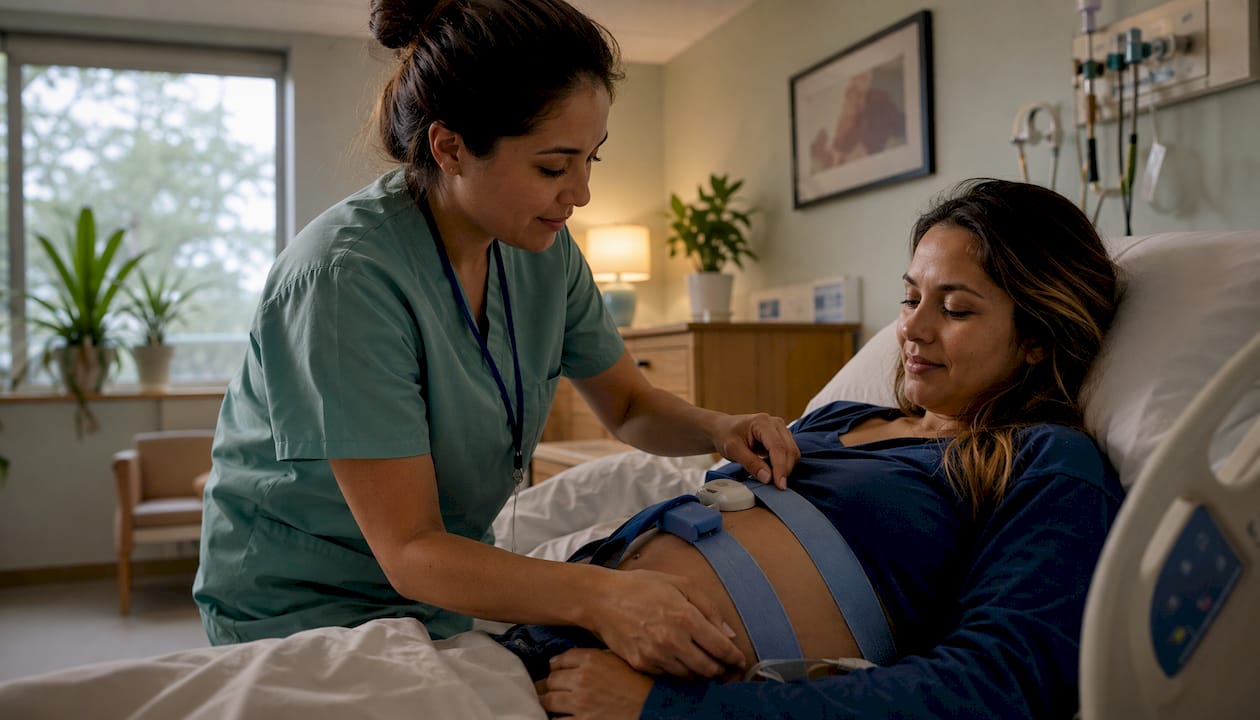
Standard elements of the ED evaluation typically include maternal vital signs (blood pressure, heart rate, oxygen saturation), an abdominal exam for tenderness or rigidity, a pelvic exam if there is any bleeding, and a fetal heart rate check. When clinically indicated, an obstetric ultrasound can assess placental position, fetal presentation, and amniotic fluid. Lab work, including a complete blood count and type-and-screen, is often ordered to check for internal bleeding and blood type compatibility.
The monitoring protocol is where many patients do not push hard enough. EAST practice management guidelines recommend continuous electronic fetal monitoring for at least 6 hours after abdominal trauma in pregnant patients, with obstetric consultation considered for any injured pregnant person. The rationale is straightforward: placental abruption and uterine contractions can develop well after the initial evaluation, and continuous monitoring catches patterns that a single spot-check misses.
Admission criteria include ongoing vaginal bleeding, uterine tenderness or contractions, a non-reassuring fetal heart tracing, maternal hypotension, or any signs of internal injury. If any of these are present, pushing for admission rather than discharge is appropriate.
Pro Tip: Before you leave the ED, ask staff to confirm that the fetal monitoring strip is filed in your medical record and that the discharge paperwork notes “pregnant patient, motor vehicle collision.” That language creates a direct, documented link between the crash and your care — something that matters enormously if complications appear later.
Warning signs to watch for after the crash
Even after a normal ED evaluation, your body can signal trouble in the hours and days that follow. Know these red flags and act on them immediately.
- Vaginal bleeding of any amount — call 911 or return to the ED right away.
- Abdominal pain, cramping, or uterine tenderness that is new or worsening.
- Regular contractions, even if they feel mild or irregular at first.
- Decreased fetal movement — if your baby is moving less than usual after 20 weeks, that is an urgent sign.
- Dizziness, fainting, or feeling faint — these can indicate internal bleeding or maternal shock.
- Leakage of fluid from the vagina, which may signal premature rupture of membranes.
- Severe headache or visual changes, which can indicate elevated blood pressure or neurological injury.
Placental abruption can present up to 72 hours after a crash, which is why the window after discharge is not a safe zone. Schedule an OB follow-up within 24–48 hours of your ED visit, even if everything looked normal at the hospital. When you call your OB’s office, mention both the crash and your ER visit so they can prioritize your appointment appropriately. If symptoms escalate before that appointment, go back to the ED and tell triage you were in a recent motor vehicle collision.
How should you wear a seat belt during pregnancy?
Seat belts do not harm pregnancies. The opposite is true. Research consistently shows that unbelted pregnant drivers face significantly worse outcomes: the stillbirth rate following a crash involving an unbelted pregnant driver was nearly three times higher than among belted drivers in a large North Carolina cohort study.
Correct positioning is what matters. NHTSA guidance and ACOG principles align on the same technique:
- Place the lap belt low across your pelvis and hip bones, below the abdomen — never across the belly itself.
- Route the shoulder belt across your clavicle and between your breasts, not behind your back or under your arm.
- Keep the seat pushed back as far as is practical while still reaching the pedals comfortably.
Wearing a seat belt correctly during pregnancy is one of the most protective things you can do for your baby in a crash. The belt should cross your pelvis, not your uterus. Tucking the shoulder belt behind your back removes a critical layer of protection and is never recommended — NHTSA and ACOG agree on this point without exception.
Airbags are a separate question many pregnant people worry about. Do not disable them. Airbags are designed to work with a properly worn three-point restraint, not instead of one. The combination of a correctly worn seat belt and a functioning airbag provides more protection than either alone. The concern about airbag proximity is reasonable, but the answer is seat position and belt use, not disabling a safety system.
How to document your injuries and protect your legal rights
If another driver’s negligence caused the crash, your medical records are the foundation of any injury claim. Insurers routinely challenge causation for complications that appear days after a crash, arguing that the pregnancy complication was unrelated. A complete, contemporaneous medical record makes that argument much harder to sustain.
Your documentation checklist:
- Emergency department records, including the fetal monitoring strip and discharge notes that reference the crash.
- OB follow-up notes from the 24–48 hour visit and any subsequent appointments.
- Photographs of vehicle damage, your seat belt positioning, and any visible injuries.
- The police report with the report number and officer’s name.
- Witness statements or contact information from anyone at the scene.
- A personal symptom timeline — write down what you felt and when, starting from the moment of impact. Do this the same day.
- All medical bills and receipts for prescriptions, co-pays, and travel to appointments.
- Repair estimates for your vehicle.
Understanding why documentation matters in injury claims goes beyond just having paperwork. The timing of each record matters. An ER visit the day of the crash, followed by an OB note two days later, followed by a specialist referral, builds a causal chain that connects the crash to every subsequent complication. Gaps in that chain give insurers room to argue.
When to call a personal injury lawyer: if the crash caused fetal injury, NICU costs, preterm delivery, placental abruption, or any serious maternal injury, consult an attorney before speaking further with the other driver’s insurer. The same applies if the insurer is disputing causation, offering a fast settlement, or pressuring you to give a recorded statement. A lawyer will request the police report, all medical records, fetal monitoring strips, and any available crash reconstruction data. Compensation in pregnancy-related crash cases can include medical bills, lost wages, future care costs, and emotional distress damages. Understanding what negligence means in a personal injury context is a useful starting point before that first consultation.

This article is general information, not legal or medical advice. Confirm current rules and your specific situation with a qualified attorney and your treating physician.
What does the research say about crashes and pregnancy outcomes?
The evidence base for monitoring and follow-up recommendations is solid, and it comes from large population-level studies and clinical guidelines, not just case reports.
A systematic review and meta-analysis published in BMJ Open pooled incidence data from studies of pregnant crash victims and found striking rates of adverse outcomes among exposed women. The table below summarizes key figures from that review alongside the monitoring standard from clinical guidelines.
| Outcome or Recommendation | Key Figure | Source |
|---|---|---|
| Induction of labor after crash | ~276.4 per 1,000 exposed pregnant women | BMJ Open systematic review |
| Preterm delivery after crash | ~191.9 per 1,000 exposed pregnant women | BMJ Open systematic review |
| Placental abruption after crash | ~16.14 per 1,000 exposed pregnant women | BMJ Open systematic review |
| Minimum fetal monitoring duration (≥20 weeks) | 4–6 hours of continuous monitoring | EAST/PubMed clinical guidance |
| Stillbirth rate, unbelted vs. belted drivers | nearly three times higher for unbelted | PMC cohort study, NC data |
Motor vehicle crashes account for a large share of pregnancy-related trauma and most trauma-related fetal deaths in the U.S. The 4–6 hour minimum monitoring window exists precisely because placental abruption and uterine contractions often do not present immediately. Catching a non-reassuring fetal heart pattern or early contractions during that window can be the difference between a managed delivery and an emergency.
Key Takeaways
A car accident during pregnancy requires immediate emergency evaluation and careful documentation — both protect your health and your legal options.
| Point | Details |
|---|---|
| Get evaluated immediately | Go to the ED after any crash, even minor ones — complications can develop silently over 24–72 hours. |
| Insist on fetal monitoring | Clinical guidance calls for 4–6 hours of continuous fetal monitoring after abdominal trauma at ≥20 weeks. |
| Watch for delayed symptoms | Vaginal bleeding, contractions, decreased fetal movement, or abdominal pain after discharge require urgent return to care. |
| Document everything | ER records, fetal monitoring strips, OB follow-up notes, photos, and a symptom timeline form the causal chain for any claim. |
| Martin Hernandez, PA can help | The firm handles pregnancy-related crash claims in Tampa on a contingency-fee basis, meaning no fees unless you win. |
A perspective on why early documentation changes everything
Most people assume the hardest part of a pregnancy crash claim is proving the other driver was at fault. In my experience handling personal injury cases in Tampa and Hillsborough County, that is rarely where claims fall apart. They fall apart on causation — specifically, the insurer’s argument that the placental abruption, the preterm delivery, or the NICU stay would have happened anyway, independent of the crash.
That argument is much easier to make when there is no ER record from the day of the crash. It becomes nearly impossible to sustain when there is a timestamped ED visit, a fetal monitoring strip filed in the medical record, an OB note 48 hours later, and a written symptom timeline the patient started the same evening. The medical record is not just clinical documentation. It is the evidence chain that connects the crash to every complication that follows.
Pregnant crash victims also face a specific vulnerability that other injury claimants do not: their complications often appear days later, which gives insurers a window to argue the crash was incidental. Closing that window requires acting fast, even when you feel okay. The 24–48 hour OB follow-up is not optional. The fetal monitoring strip is not just for the doctors. Every piece of contemporaneous documentation you create in the first 72 hours is working for you, whether or not you ever file a claim.
How Martin Hernandez, PA helps pregnant crash victims in Tampa
Facing a pregnancy complication after a crash is frightening enough without also navigating insurance disputes and medical bills. Martin Hernandez, PA represents pregnant crash victims in Tampa and Hillsborough County on a contingency-fee basis, meaning you pay nothing unless your case is resolved in your favor.
The firm handles accident investigation, coordination with medical experts, and the full documentation process, including obtaining fetal monitoring strips, ER records, and OB follow-up notes that build the causal chain insurers try to break. When cases involve disputed causation, serious fetal injury, NICU costs, or preterm delivery, having a trial-ready attorney matters. Martin Hernandez, PA prepares every case for court from day one, which consistently produces better settlement outcomes. All staff speak fluent Spanish.
If you are weighing whether your situation warrants legal help, the firm’s guide on when to hire a personal injury lawyer walks through the key thresholds clearly. For a broader overview of your rights and what compensation can cover, the personal injury law guide is a practical starting point. Contact Martin Hernandez, PA for a free consultation to understand your options before speaking further with any insurer.
Useful sources for further reading
These are the primary clinical and legal sources behind the guidance in this article. Share them with your treating clinician or attorney as needed.
- StatPearls: Pregnancy Trauma (NCBI) — Clinical overview of trauma in pregnancy, including crash-related injury patterns and management principles.
- BMJ Open Systematic Review and Meta-Analysis — Pooled incidence estimates for preterm delivery, placental abruption, and induction of labor after motor vehicle crashes.
- PMC: Motor Vehicle Safety During Pregnancy — Population-level data on crash incidence and the protective role of seat belts and airbags.
- PMC: Adverse Pregnancy Outcomes Following Motor Vehicle Crashes — Large North Carolina cohort study with adjusted rate ratios for preterm birth, placental abruption, stillbirth, and PROM.
- EAST Practice Management Guidelines: Trauma in Pregnancy — Clinical monitoring and obstetric consultation recommendations for trauma centers.
- NHTSA Restraint Guidance — Official seat belt and restraint positioning guidance for pregnant occupants.
- Martin Hernandez, PA: Why Documentation Matters — Practical guide to preserving evidence for Florida injury claims.
FAQ
Can a car accident affect an unborn baby?
Yes. Motor vehicle crashes are a leading cause of traumatic fetal injury and death in the U.S., with documented associations with preterm birth, placental abruption, premature rupture of membranes, and stillbirth — even after crashes that seem minor.
How do I know if my baby is okay after a car accident?
The only reliable way is a medical evaluation. Continuous electronic fetal monitoring for at least 4–6 hours after abdominal trauma at 20 weeks or beyond is the clinical standard, because some complications, including placental abruption, can develop silently for up to 72 hours.
What happens if you get in a car crash at 32 weeks pregnant?
At around mid to late pregnancy, the primary risks are placental abruption, preterm labor, and fetal distress. You should go to the ED immediately for fetal monitoring, an obstetric ultrasound, and maternal evaluation, then follow up with your OB within 24–48 hours even if the initial evaluation is normal.
What symptoms after a car accident during pregnancy require urgent care?
Vaginal bleeding, abdominal pain or uterine tenderness, regular contractions, decreased fetal movement, dizziness, fainting, or leakage of fluid all require immediate return to the emergency department — do not wait for a scheduled OB appointment if any of these appear.
When should a pregnant crash victim contact a personal injury lawyer?
Contact a lawyer if the crash caused fetal injury, NICU costs, preterm delivery, placental abruption, or any serious maternal harm — or if an insurer is disputing causation or pressuring you to settle quickly. Martin Hernandez, PA handles these cases in Tampa on a contingency-fee basis, with no fees unless you recover.
Recommended
- What to Do After You Call 911 From a Car Accident – Personal Injury Lawyers of Tampa
- What Steps Should You Take If You’re Involved in a Truck Accident? – Personal Injury Lawyers of Tampa
- What to Do if You are Injured by a Distracted Driver – Personal Injury Lawyers of Tampa
- What to Do After Accident: Florida Guide for Drivers – Personal Injury Lawyers of Tampa