
When you’re grieving the loss of a loved one, legal deadlines are the last thing on your mind. But in Florida, one of the most critical things to understand is the statute of limitations for a wrongful death claim. It’s not a suggestion; it’s a strict, non-negotiable two-year deadline that begins on the date of your loved one’s death.
This legal time limit is a ticking clock for families seeking justice. If you miss this window, the courts will almost certainly bar you from ever filing a lawsuit, no matter how strong your case is.
Florida’s Two-Year Countdown: What It Means for Grieving Families

It’s completely understandable that in the aftermath of a tragedy, legal matters feel overwhelming and distant. However, the Florida wrongful death statute of limitations is an urgent reality that grieving families must face.
Imagine a legal stopwatch starts the moment your loved one passes away. That’s exactly how this law works. It’s crucial to understand that the clock starts on the date of death—not the date of the car accident, medical mistake, or other incident that ultimately caused the fatal injuries. This small detail can make a huge difference, often shortening the time you have to take legal action.
Why Every Day Counts
The state sets this two-year rule to ensure claims are filed while evidence is still fresh and reliable. For families, though, two years can pass in a blur of grief.
Waiting too long can have devastating consequences for your case. Key evidence—like security camera footage, vehicle data recorder information, or witness testimonies—can disappear or fade with time. Acting quickly is essential to preserving the proof needed to build a strong claim.
To help clarify these timelines, here’s a breakdown of the key deadlines involved in a Florida wrongful death claim.
Florida Wrongful Death Statute of Limitations Key Deadlines
Understanding these distinctions is vital, as the specific circumstances of your loved one’s death will determine which deadline applies.
- Standard Wrongful Death: The time limit is 2 years from the date of death, as governed by Florida Statute § 95.11(4)(d). The most critical note for families is that the clock starts on the date of death, not the date of the accident.
- Medical Malpractice: The time limit is also 2 years. However, a “discovery rule” might extend this in complex cases where the malpractice wasn’t immediately known.
- Claim Against a Government Entity: The rules are different here. You must provide a formal notice of claim within 3 years, and you cannot file a lawsuit until a 180-day investigation period has passed.
How Is This Different From a Personal Injury Claim?
It’s easy to confuse the wrongful death deadline with other legal time limits, but the difference is significant. For a typical personal injury case, the statute of limitations clock usually starts ticking at the moment the accident or injury occurs.
However, for a wrongful death claim, the countdown is tied directly to the date of passing. This means every single day is precious as you and your family try to figure out what to do next. You can learn more about the statute of limitations for personal injury in Florida to see just how these deadlines compare.
Understanding What Qualifies as a Wrongful Death Claim
Before we even talk about deadlines, it’s critical to know what a wrongful death claim actually is here in Florida. This isn’t just another lawsuit. It’s a specific legal action that gives a grieving family a path toward justice and financial stability when a loved one is taken from them because of someone else’s carelessness or intentional wrongdoing.
Let’s picture a real-world scenario. Imagine a family in Tampa whose lives are turned upside down by a fatal crash on I-275. The at-fault driver was texting and blew through a red light. That single, negligent act caused an unthinkable, permanent loss. This is the exact situation where a wrongful death claim arises—the death simply would not have happened if not for that driver’s wrongful actions.
Who Can File the Claim and Who Benefits
Florida law is very clear about who holds the reins in a wrongful death case. The claim itself must be filed by the personal representative of the deceased person’s estate. This is usually someone named in a will, but if there isn’t a will, the court will appoint someone for this role.
But here’s a key distinction: while the personal representative is the one who officially files the lawsuit, they aren’t filing it for themselves. They act on behalf of the estate and its survivors, and it’s these survivors who ultimately receive any compensation, which the law calls “damages.”
In Florida, the law generally recognizes these individuals as survivors:
- The surviving spouse.
- Minor children (and in some cases, adult children).
- The parents of the deceased.
- Any other blood relatives or adoptive siblings who depended on the deceased for support, either fully or in part.
A lot of people mistakenly believe that any grieving relative can file a lawsuit. It’s a common point of confusion, but understanding the separate roles of the personal representative and the beneficiaries is one of the most important first steps. For a deeper dive into this, you can find more information on who can file a wrongful death lawsuit in Florida.
Differentiating Between Types of Damages
When a court awards compensation in a wrongful death case, it’s not just one lump sum. The damages are typically split into two different categories, and each one is designed to address a different type of loss the family has endured.
A wrongful death claim seeks to compensate survivors not just for the financial void left behind, but also for the profound, intangible loss of companionship, guidance, and love—losses that have no price tag but demand legal recognition.
First, you have economic damages. Think of these as the tangible, calculable losses. This category covers things like the wages the deceased would have earned over their lifetime, the value of the services they provided to the household, and any medical or funeral bills paid by a family member.
Then you have non-economic damages. These are meant to compensate for the deep, personal suffering that can’t be tallied on a calculator. This is compensation for a spouse’s loss of companionship and protection, a child’s loss of parental guidance, and the raw mental pain and suffering every survivor goes through. Proving the true extent of these losses takes a skillful and compassionate approach. Establishing a definitive cause of death is foundational, which is why some families explore options like private autopsies due to wrongful death cases to build the strongest case possible.
When the Two-Year Filing Deadline Can Be Extended
While Florida’s two-year deadline for wrongful death claims is strict, it isn’t set in stone. The law recognizes that some situations are anything but straightforward, and it wouldn’t be fair to penalize a family for circumstances completely beyond their control. In these rare cases, the legal clock can be paused—a concept lawyers call tolling the statute of limitations.
Think of it like hitting the pause button on a stopwatch. Tolling doesn’t reset the timer, but it does stop the countdown from running. This gives families a fair chance to pursue justice when they were initially prevented from doing so. These exceptions are incredibly specific and complex, so getting expert legal advice is non-negotiable.
The Discovery Rule and Hidden Negligence
One of the most important exceptions is the discovery rule. This comes into play when the real cause of a person’s death isn’t obvious right away or, worse, was actively hidden from the family. The law gets it—you can’t file a claim for something you don’t even know happened.
Imagine this scenario: a patient dies after a routine surgery, and the family is told it was due to unavoidable complications. A year later, a whistleblower exposes that the surgical device used had a known defect that the manufacturer deliberately covered up. In a case like that, the discovery rule could mean the two-year clock didn’t start on the day of the death, but on the day the family discovered (or reasonably should have discovered) the true, negligent cause.
The discovery rule is all about fairness. It ensures that wrongdoers can’t escape accountability just by successfully hiding their negligence. It moves the starting line from the date of death to the date of discovery.
This chart can help you visualize the basic path of a wrongful death claim.
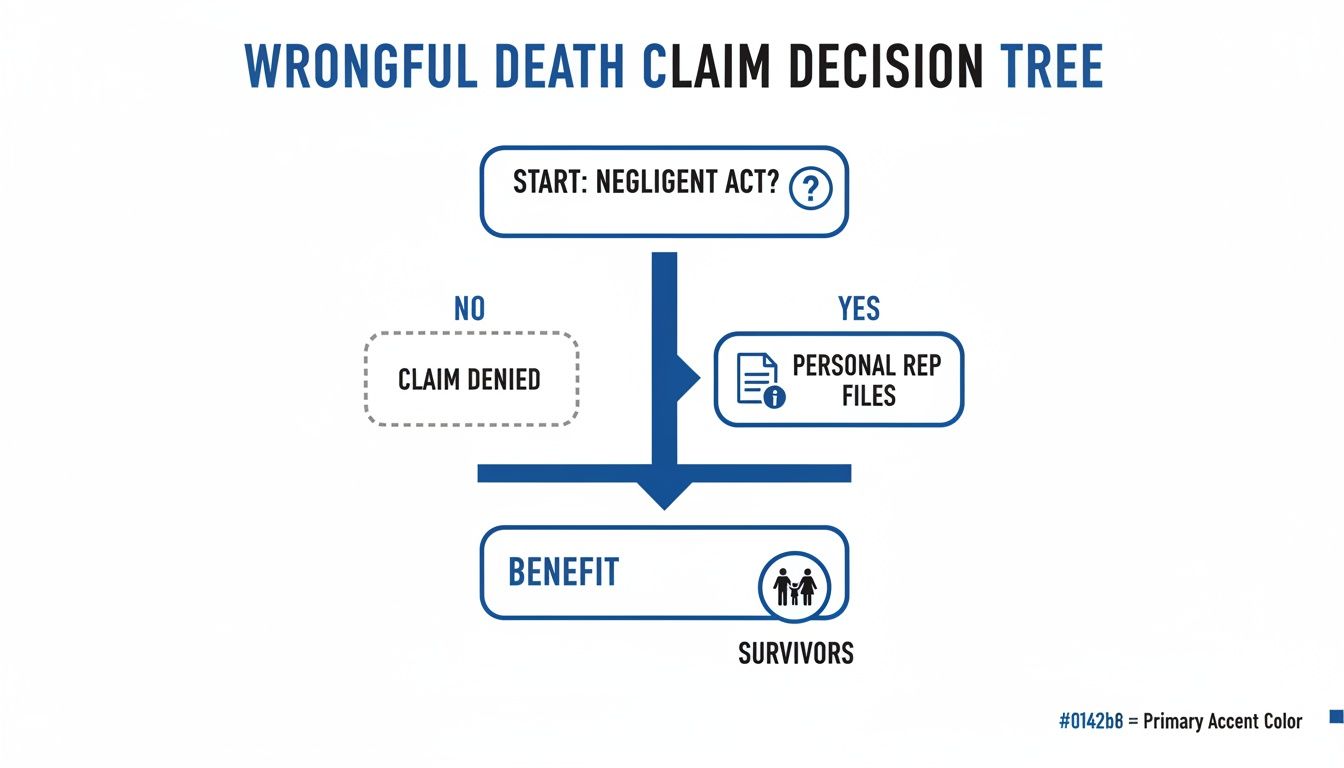
As the flowchart shows, the process is initiated by the personal representative after a negligent act, who then files the claim on behalf of the estate and its survivors.
Specific Circumstances That Can Pause the Clock
Beyond hidden negligence, Florida law outlines a few other situations that can extend the deadline. These aren’t loopholes; they are specific, legally recognized exceptions designed for genuine hardship.
A few key examples include:
- Fraudulent Concealment: This is a step beyond just hidden negligence. It involves the defendant actively and intentionally trying to hide what they did. For example, if a doctor deliberately falsifies medical records to cover up a fatal mistake, the clock might be paused until that fraud is uncovered.
- Minor Survivors: If a beneficiary of the wrongful death claim is a child (under 18), the statute of limitations may be tolled. The law protects a minor’s right to compensation, ensuring it isn’t lost just because they are too young to file a lawsuit themselves.
- Defendant Leaves Florida: What if the responsible person or company skips town? If the defendant leaves Florida after the incident, it makes serving them with a lawsuit nearly impossible. The law can pause the clock for the time they are absent, so they can’t just run away from accountability.
Knowing these exceptions exist is one thing, but proving one applies is a major legal battle. For families just starting out, learning how to file a wrongful death lawsuit provides a good overview of the steps. But never try to navigate these complexities alone. Only an experienced attorney can dig into the details of your case and determine if your family has a valid reason to extend the Florida wrongful death statute of limitations.
Navigating Claims Against Government Agencies in Florida

Pursuing a wrongful death claim is always an emotional and complex journey, but when a government entity is at fault, the process becomes a minefield of special rules and deadlines. Think about it: what if the person responsible wasn’t just another driver, but a city bus operator, a county road crew, or a state employee in a government vehicle? In these situations, the standard playbook goes out the window.
You’re no longer dealing with a private citizen or company. You’re up against the government, which is protected by a legal concept called sovereign immunity. While Florida law allows you to sue the government in certain cases, it forces you to jump through a series of unforgiving procedural hoops first.
This means you can’t just file a lawsuit. You have to follow a rigid, multi-step process that’s full of traps for families already coping with immense grief.
The Mandatory Pre-Suit Notice Requirement
Here’s the biggest hurdle: before a lawsuit can even be considered, you must provide a mandatory pre-suit notice. Florida Statute §768.28 requires you to formally notify the specific government agency involved—and the Florida Department of Financial Services—that you intend to file a claim.
This isn’t just a simple heads-up. It’s a formal legal document with its own strict deadline, completely separate from the two-year wrongful death statute of limitations. If you miss this notice deadline, your case is over before it starts. The court will dismiss it, no matter how strong your evidence is.
Think of it like this: you need a special key to unlock the courthouse door. Without providing the proper pre-suit notice on time, that door stays locked forever.
When suing the government, you’re not playing on a level field. The rules are designed to protect the state, and a single procedural misstep can end your family’s pursuit of justice before it even begins.
Once you submit the notice, the clock starts on a 180-day investigation period for the government agency. During these six months, you are legally forbidden from filing your lawsuit. The agency uses this time to review the claim, and they might offer to settle, deny it outright, or just let the time expire. Only after those 180 days are up can your personal representative officially file the wrongful death lawsuit in court.
Strict Caps on Financial Recovery
Another harsh reality of suing a government body in Florida is the heavy restriction on the compensation your family can receive. Sovereign immunity laws place strict financial caps on damages, which are often far below what a family truly needs.
The timeline is also tighter. While the standard wrongful death filing deadline is two years, §768.28(6) often requires that the written notice of the claim be sent to the government much sooner. The damages are also capped at $200,000 per person and $300,000 total for a single incident, regardless of how many people were affected. For a deeper dive into these complex rules, you can find more insights about the statute of limitations for government claims.
While it’s technically possible to ask the state legislature for more compensation through a special “claims bill,” this is an uphill political battle with no guarantee of success. The combination of this bureaucratic maze and the low financial caps makes it absolutely critical to work with an attorney who has specific, successful experience taking on government entities in Florida.
Steps to Take to Protect Your Family’s Rights
When you’re reeling from the loss of a loved one, the idea of a lawsuit is probably the last thing on your mind. But taking a few key steps early on is absolutely crucial to protecting your family’s right to seek justice down the road.
Your first and most urgent priority is to preserve evidence. Think of it as the foundation of your entire case. This is the proof that tells the story of what happened and connects the other party’s negligence directly to your loved one’s death. Without it, even the strongest claim can crumble.
Gathering and Protecting Critical Evidence
Every document, photo, and witness account adds another layer of strength to your claim, making it that much harder for insurance companies to deny responsibility. You have to move quickly, though. Evidence has a way of disappearing—security footage gets erased, witnesses move, and memories fade.
To help you get started, I’ve put together a practical checklist of key evidence you’ll want to secure.
Essential Evidence Checklist for a Florida Wrongful Death Claim
Building a compelling wrongful death claim starts with gathering the right documentation. Here are the essential pieces of evidence you’ll need and why they matter so much to your case.
- Official Records: Collect the official death certificate, police accident reports, and any incident reports from a workplace. These documents formally establish the cause of death and provide an unbiased account of the incident.
- Medical Documents: Gather all medical records, from ambulance and ER reports to hospital charts and final medical bills. This paperwork creates a clear link between the injuries and your loved one’s passing.
- Witness Information: Get the names, phone numbers, and email addresses for anyone who saw the incident or has relevant information. Their testimony provides a firsthand perspective, and your attorney will want to get formal statements before memories fade.
- Visual Proof: Secure any photos or videos from the scene, including vehicle damage, hazardous property conditions, or visible injuries. Visual evidence is incredibly persuasive for a judge or jury.
- Financial Records: Collect your loved one’s past pay stubs, tax returns, and employment records, along with bills for funeral expenses. This evidence is vital for calculating economic damages like lost income.
Gathering these items can feel overwhelming, but each one serves a critical purpose in demonstrating the full impact of your loss.
The Essential Step of Appointing a Personal Representative
Once you start gathering evidence, the next official legal step is getting a personal representative appointed for your loved one’s estate. This is a non-negotiable step in Florida. Only the personal representative has the legal standing to file a wrongful death lawsuit on behalf of the family.
Usually, the deceased names this person in their will. If there’s no will, the court will appoint someone, often a spouse or an adult child. This individual becomes the legal voice for the estate and its survivors.
The personal representative’s role is not just a piece of procedural red tape; it is the legal key that unlocks the courthouse doors. Without this official appointment, a wrongful death claim simply cannot move forward, no matter how strong the evidence is.
This process involves petitioning the probate court, something an experienced attorney can handle for you to make it as smooth as possible. It’s a vital milestone that has to be completed well before that two-year statute of limitations runs out. On a related note, this is why having comprehensive estate planning in place is so important for protecting your family’s future.
By taking these focused steps—preserving evidence and appointing a representative—you can turn a confusing and intimidating process into a clear path forward. It gives your family the power to hold the at-fault party accountable and fight for the financial stability you need and deserve.
Why You Cannot Afford to Wait to Hire an Attorney
That two-year deadline in Florida’s wrongful death statute isn’t just a technicality on a legal calendar. Think of it as a rapidly closing window. While it might seem like a long time, in the world of complex litigation, it’s a sprint. Every single day that goes by makes the path to justice for your family a little steeper.
Delay is the best friend of the insurance company on the other side. While you are trying to process an unimaginable loss, their legal teams are already in motion. They’re building a defense strategy, and their entire goal is to pay out as little as possible—or nothing at all. They are banking on time to erode the strength of your claim.
The Real-World Consequences of Delaying
The simple truth is that the core components of a strong wrongful death case are perishable. They have a shelf life, and waiting can do irreversible damage to your ability to hold the responsible party accountable.
- Evidence Vanishes: Security footage gets overwritten, sometimes in a matter of weeks. The black box data from a vehicle involved in a crash can be erased. The physical scene of an accident is often cleaned up within hours. A skilled attorney knows to send out evidence preservation letters immediately, legally demanding that this crucial proof be saved.
- Memories Fade: People’s recollections are crystal clear right after an event, but time clouds even the sharpest minds. Details get fuzzy, timelines blur, and witness testimony becomes less reliable and easier to challenge. Getting sworn statements early on is the only way to lock in what people saw and heard when it was fresh.
- The Defense Builds Its Case: The longer you wait, the bigger the head start you give the other side. Their investigators are already working, interviewing their own witnesses, and looking for any possible way to shift the blame. They are actively building their defense while you are standing still.
Waiting to call a lawyer doesn’t put the case on pause. It simply gives the other side a free pass to build their defense while the evidence you need to build yours slowly disappears.
Your First Step Is Risk-Free
Knowing when to hire a personal injury attorney can feel overwhelming, but the fear of legal bills should never stop you from getting the help you deserve. Our trial-ready law firm works on a contingency fee basis, which is a straightforward promise: you don’t pay us a dime unless we win your case.
This arrangement means we can get to work immediately, launching our own investigation while the evidence is fresh and memories are clear. It allows us to fight for you without adding any financial stress during an already impossible time.
Your first step is a free, no-obligation consultation to discuss what happened. It costs you nothing to learn your rights and see how we can help. In a situation like this, the one thing you can’t afford to do is wait.
Answering Your Questions About Florida Wrongful Death Claims
When you’re grappling with the loss of a loved one, the legal process can seem overwhelming. Let’s clear up some of the most common questions families have about Florida’s wrongful death statute of limitations and the claims process.
Can We Still File a Claim if Our Loved One Was Partially at Fault?
Yes, absolutely. Florida law recognizes that real-world accidents are rarely black and white. That’s why the state follows a legal doctrine called comparative negligence.
Think of it this way: if a jury finds your loved one was 20% responsible for the accident, your family isn’t barred from recovery. Instead, the total compensation award is simply reduced by that percentage. For example, on a $500,000 damage award, your family would receive $400,000. So, while it impacts the final amount, it doesn’t close the door on justice.
What is the Deadline if a Crime Caused the Death?
This is a crucial point that trips many people up. It’s vital to understand that a criminal case (like manslaughter) and a civil wrongful death claim are two completely different things. They run on separate tracks.
The state might have years—or even no time limit at all—to prosecute the person responsible for the crime. That timeline has zero impact on your civil case. Your family still has to file a wrongful death lawsuit within the standard two-year period, which almost always starts ticking on the date of death. You can’t afford to wait for the criminal case to wrap up.
The criminal justice system is about punishing the wrongdoer. The civil justice system is about compensating your family for their devastating loss. They have their own rules and their own clocks, and you must follow the civil deadline to protect your rights.
Does the Florida Deadline Apply if We Live Out of State?
It does. The law that matters is the law of the state where the fatal injury occurred, not where the surviving family lives.
If your loved one passed away due to an incident in Florida, then Florida’s two-year statute of limitations is the one you must follow. It doesn’t matter if you live in the next county or across the country. This is exactly why working with a local Florida attorney is so important. An expert in our state’s laws and the specific procedures of Hillsborough County courts will make sure every deadline is met, protecting your family’s right to seek accountability.
Trying to navigate the legal system while grieving is a burden no family should bear alone. The team at Martin Hernandez, P.A. is here to offer the compassionate, expert legal support your family deserves. We will manage every detail so you can focus on what matters most—healing.
For a free, no-obligation consultation to discuss your rights, please get in touch with us at https://injurylawyersoftampa.com.