
The insurance company is already calling, maybe even offering a quick check. It’s tempting. But if they’re disputing who’s at fault or the offer feels insultingly low—nowhere near enough to cover your actual costs—it’s time to pause.
This is the moment when hiring a personal injury lawyer becomes critical, especially if you’re dealing with serious injuries, mounting medical bills, and lost time from work. An attorney doesn’t just level the playing field; they make sure your rights are front and center so you can pursue the full compensation you’re owed.
Knowing When You Need a Personal Injury Lawyer
After a crash in Tampa, your head is spinning. You’re trying to manage injuries, doctor’s appointments, a wrecked car, and the stress of being unable to work. Legal action is probably the last thing on your mind, but here’s the reality: the clock is already ticking, and the insurance adjuster’s job has already begun.
Sure, for a tiny fender-bender in a parking lot with zero injuries, you might be able to handle the claim on your own. But the second things get complicated or someone is seriously hurt, the power dynamic shifts—and not in your favor. Insurance companies are built to minimize payouts. They have entire teams of professionals dedicated to protecting their profits.
Scenarios That Demand Legal Counsel
Think about a multi-car pile-up on I-275 during rush hour. With so many people involved, every insurance company will be pointing fingers, trying to shift the blame. You’ll be stuck right in the middle. Or picture a slip and fall at a store in Hyde Park Village, where the property owner immediately denies any responsibility.
In situations like these, hiring a personal injury lawyer isn’t an overreaction; it’s a necessity. Just having an attorney on your side signals to the insurance company that you’re serious and won’t be pushed around.
Here are a few times when getting legal help is absolutely non-negotiable:
- When Injuries are Serious: If you’re facing broken bones, a traumatic brain injury, spinal cord damage, or any injury that requires surgery or long-term therapy, you need an advocate. They know how to calculate the true, long-term cost of your medical care.
- When Fault is Disputed: The other driver says it was your fault? A lawyer can dig in and gather the evidence needed—from witness statements to accident reconstruction reports—to prove what really happened.
- When the Insurance Offer is Too Low: This is a classic move. Insurers often throw out a quick, lowball offer, hoping you’ll take it before you realize what your claim is actually worth. An experienced lawyer knows how to value a claim correctly.
This decision tree gives you a simple visual to work through when you’re trying to figure out if you need a lawyer on your side.
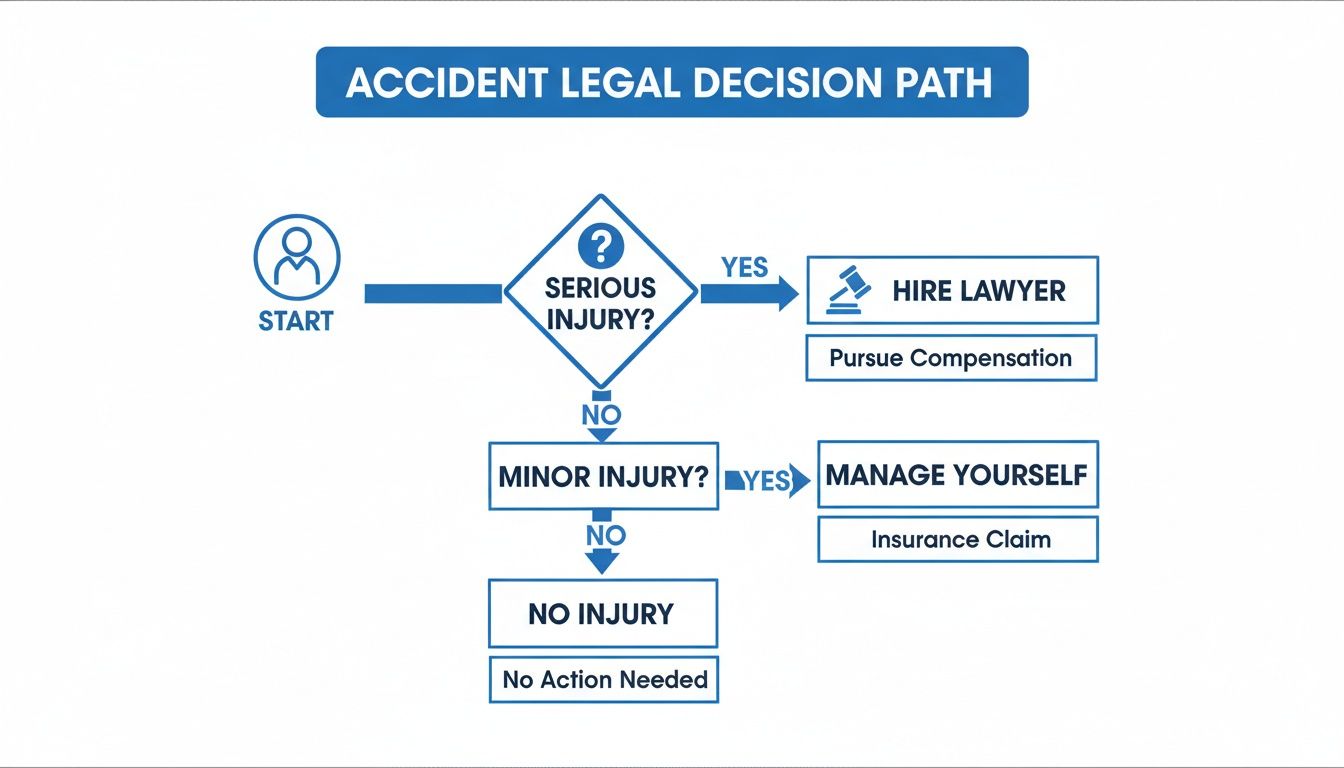
As you can see, the severity of your injury is the biggest factor in determining your next move.
The Financial Reality of Personal Injury Claims
The numbers don’t lie. Statistics consistently show that without a lawyer, insurance companies often pay out a fraction of what a case is truly worth.
On the other hand, clients with legal representation frequently recover significantly more in their settlements. That’s not just about covering the immediate hospital bills; it’s about accounting for lost wages, future care, and the real-world pain and suffering you’ve endured.
The biggest mistake you can make is underestimating what your claim is worth. A good attorney knows how to document every single loss, from the cost of physical therapy five years from now to the emotional toll the accident has taken on you and your family.
When an insurance company knows your legal team is prepared to take them to court right here in Hillsborough County, they’re far more likely to come to the table with a fair offer. That trial-ready approach, combined with a contingency fee where you pay nothing unless you win, gives you immediate, risk-free support when you need it most.
For a deeper dive, check out our guide on when to hire a personal injury lawyer.
How to Find and Vet the Right Tampa Attorney
After an accident, picking the right legal partner in Tampa isn’t about a quick Google search. You need an advocate who not only gets Florida law but truly understands the ins and outs of the Hillsborough County court system. This single decision can drastically shape your claim’s outcome.
The personal injury field is crowded. While giant national firms plaster their ads everywhere, local expertise is what really matters when you’re navigating Florida’s unique legal landscape.
Your mission is to find a firm that’s genuinely ready to fight for you—a true partner in your recovery.
Starting Your Search in Tampa Bay
A smart search goes way beyond the billboards and TV commercials. Those ads tell you a firm has a marketing budget; they don’t tell you about its track record or how it treats its clients.
A much better approach is to start building a list from trusted sources. Nothing beats a word-of-mouth referral from a friend, family member, or colleague who had a good experience.
Once you have a few names, do a quick check-in with professional organizations. The Hillsborough County Bar Association and The Florida Bar are great places to confirm an attorney is in good standing and doesn’t have a disciplinary history.
Digging Deeper with Online Research
With a shortlist in hand, it’s time to see what their online presence says about them. Look at client testimonials and reviews, but don’t just read one or two. You’re looking for patterns.
Are former clients consistently mentioning great communication? Do people say they felt supported and in the loop? Those recurring themes paint a far more accurate picture than a single glowing (or terrible) review.
A law firm’s website is also telling. Do you see detailed case results? Helpful blog posts? Clear explanations of their practice areas? That shows a commitment to empowering clients, not just signing cases. For more on this, we’ve put together a comprehensive resource on how to find the right personal injury lawyer that dives deeper into these steps.
Preparing for the Initial Consultation
The consultation is your interview. You’re sizing them up just as much as they’re evaluating your case. Don’t go in cold—have a list of questions ready.
This is your chance to get into the nuts and bolts of how they’d handle your case. Your goal is to walk out of that meeting with a solid feel for the firm’s process, communication style, and real-world experience with situations like yours.
The most important part of this whole process is feeling heard. If an attorney dismisses your questions or makes you feel rushed, they are not the right advocate for you.
Here are a few must-ask questions for that first meeting:
- Who will be my day-to-day contact? Will you be speaking directly with the lawyer you met, or will it be a paralegal or case manager? There’s no wrong answer, but you need to know what to expect.
- What’s your firm’s trial preparation process for cases in Hillsborough County? This question separates the firms that are truly trial-ready from the ones that just want to settle fast—even if it means leaving money on the table.
- How many cases like mine have you actually handled? You need a lawyer who has specific experience with your type of accident, whether it was a motorcycle wreck, a complex trucking collision, or a slip and fall.
- How will I be kept updated on my case? A professional firm will have a clear system for client communication so you’re never left in the dark.
Recognizing Critical Red Flags
Knowing what to look for is only half the battle; you also have to know what to avoid. Certain behaviors should be immediate deal-breakers when you’re hiring a personal injury lawyer.
Run, don’t walk, from any attorney who promises you a specific dollar amount. It’s impossible—and unethical—to guarantee a financial outcome. A good lawyer gives you a realistic assessment based on the facts, not a sales pitch.
Another huge red flag is a high-pressure sales pitch. You should never feel forced to sign a contract on the spot. A reputable attorney will encourage you to take your time and make an informed decision.
Finally, pay attention to how organized and responsive they are from day one. If they’re tough to get ahold of for a simple consultation, just imagine how frustrating it will be to get an update on your case later. Finding a responsive, ethical, and communicative attorney is the foundation of a successful claim.
Understanding the Contingency Fee Agreement

Let’s be honest: one of the biggest things that stops accident victims from calling a lawyer is the fear of cost. When you’re already staring at a pile of medical bills and missing work, the last thing you need is another expense.
This is exactly why personal injury law works on a contingency fee basis. It’s a system designed to give everyone access to justice, regardless of their financial situation.
In simple terms, you don’t pay us a dime upfront for our legal expertise. Our payment is contingent on us winning your case. If we secure a financial recovery for you—through either a settlement or a court verdict—our fee comes out of that amount. If we don’t win, you owe us nothing for our time.
This model is powerful because it means our goals are perfectly aligned with yours. We’re in this together, focused on getting you the best possible result. Before you sign anything, it’s always smart to understand the essential elements of a contract that make an agreement like this solid.
How Attorney Percentages Work in Florida
Here in Florida, the percentages an attorney can charge are regulated by The Florida Bar. This isn’t the Wild West; there are rules in place to protect you and ensure everything is transparent.
The fee is typically tiered, meaning the percentage can change depending on how much is recovered and how far into the legal process your case goes. A common structure you’ll see looks something like this:
- 33.3% of any recovery up to $1 million if we settle your case before a formal lawsuit has to be answered by the other side.
- 40% of any recovery up to $1 million if the case moves forward and resolves after a lawsuit is filed.
These percentages can be different for recoveries over $1 million. The key is that we will go over every single detail with you, and it will all be spelled out in a clear, written agreement before we ever start working on your case. That document is our roadmap for our financial relationship.
Covering the Costs of Your Case
Beyond our time and legal work (the “fee”), every case has out-of-pocket expenses, or “costs,” needed to build a strong claim. Think of these as the fuel needed to move your case forward.
It’s vital to understand the difference between fees and costs. Fees are what you pay the lawyer for their work. Costs are the expenses needed to move your case forward, which the law firm typically advances on your behalf.
Here are a few examples of common case costs:
- Court Filing Fees: The cost to officially file your lawsuit with the Hillsborough County court.
- Expert Witness Fees: Paying for the time of medical specialists, accident reconstructionists, or financial experts whose testimony is crucial.
- Deposition Costs: The expense for court reporters who create official transcripts of sworn testimony.
- Investigation Expenses: The cost of gathering evidence like police reports and your complete medical records.
The good news is that we handle these costs on a contingency basis, too. Our firm pays for them as they come up, and they are only reimbursed from the final settlement or award, after our attorney’s fee is calculated. If there’s no recovery, you don’t have to pay us back for these advanced costs. Getting a full picture from local contingency fee lawyers in Tampa can help you feel even more confident.
A Real-World Settlement Breakdown
Let’s walk through a quick example to make this crystal clear. Imagine you were hurt in a car crash and we settle your case for $100,000 before filing a lawsuit.
- Gross Settlement: $100,000
- Attorney’s Fee: The fee is 33.3%, which comes to $33,300.
- Case Costs: Let’s say we advanced $5,000 for medical records and an expert report.
- Medical Bills: Your doctors have placed liens on the settlement for $15,000.
- Your Net Recovery: This means you would receive a check for $46,700. ($100,000 – $33,300 – $5,000 – $15,000)
Total transparency is non-negotiable. Any reputable firm will give you a detailed breakdown—often called a settlement statement—that lists every fee, cost, and payment. You’ll see exactly where every dollar is going before you sign off, ensuring there are absolutely no surprises.
What Happens After You Hire Your Lawyer?

The moment you sign that contingency fee agreement, a huge weight should lift off your shoulders. It’s a turning point. You no longer have to field calls from insurance adjusters or try to decipher complex legal paperwork. Your job now is to focus on getting better. Our job is to take over the fight.
This is where our real work begins. It’s important to understand that every case moves at its own pace. Some claims can be wrapped up in a few months, while others, especially if they head toward a courtroom, will naturally take longer. We’ll set realistic expectations with you from the very beginning so you always know where things stand.
The Groundwork: Investigation and Gathering Evidence
The first thing we do is put on our detective hats. We dive deep into building your case, meticulously gathering every shred of evidence to construct a powerful, undeniable claim. Think of it as building the foundation of a house—it has to be solid.
This initial phase is all about action:
- Securing the Scene: We immediately get our hands on the official police report, track down and interview witnesses, and collect any photos or video footage that exists.
- Telling Your Medical Story: We request and carefully analyze every medical record connected to your injuries, from the first paramedic report and ER charts to notes from your physical therapist.
- Calculating the True Cost: This is about more than just medical bills. We help you document everything—lost income from missed work, prescription costs, and the very real, but less tangible, damages like your pain and suffering.
Every piece of paper, every statement, becomes a crucial part of the puzzle.
Making Our Case: The Demand and Negotiations
Once we have a complete and compelling file of evidence, we formally present your case to the insurance company. This isn’t just a simple letter; it’s a comprehensive demand letter. It’s a legal document that methodically lays out the facts, proves the other party’s fault, and details the full value of everything you’ve lost.
This letter officially kicks off the negotiation dance. The insurance adjuster will review our demand and come back with their own number, which is almost always a lowball counteroffer. This is precisely where having an experienced negotiator in your corner makes all the difference. We handle every call, every email, shielding you from their tactics and fighting for what you truly deserve.
Our goal is always to secure a fair settlement without stepping foot in a courtroom. But here’s our philosophy: we prepare every single case from day one as if it’s going to trial. This shows the insurance company we’re not bluffing and won’t be pushed into accepting a low offer.
When a Lawsuit is Necessary: Litigation and Discovery
What if the insurance company just won’t be reasonable? If they refuse to offer a settlement that fairly covers your damages, we don’t hesitate to file a lawsuit. It sounds intimidating, but it’s a structured process that we manage for you every step of the way. You can get a more detailed look at the steps in a personal injury lawsuit in our guide.
Filing the suit starts a formal phase called discovery. This is where both sides are legally required to share information and evidence under oath. As part of this process, your lawyer will guide you through things like depositions, where you might receive a deposition notice.
The reality is that many personal injury claims are filed in Florida courts each year. While some people settle quickly without a lawyer, statistics show they often walk away with less than their claim is actually worth. They miss out on compensation for future medical needs or emotional trauma. Getting an expert on your side early on flips that script, especially here in Tampa, where top firms use investigators and medical specialists to maximize what you can recover.
Why Local Tampa Insight Matters for Your Claim
When you’re hurt and trying to figure out your next steps, it’s tempting to think any lawyer with a slick website can handle your accident claim. But I can tell you from years of experience, that’s a mistake. The reality is that hiring a personal injury lawyer with deep roots right here in Tampa gives you a home-field advantage that a big, out-of-town firm simply can’t match.
Winning your case isn’t just about knowing the statutes in a law book; it’s about understanding the unique pulse of our local legal community. A genuinely local attorney brings a street-level perspective on how things really work in Hillsborough County. That’s not something you learn in law school—it’s earned in the trenches, day in and day out.
Knowing the Ins and Outs of the Hillsborough County Legal System
Every courthouse has its own rhythm and unwritten rules. An attorney who is a regular in the Thirteenth Judicial Circuit Court knows the clerks, the staff, and, most importantly, the judges. They have a real feel for which arguments land well with certain judges and how to present evidence in a way that our local courts expect.
This kind of firsthand knowledge helps sidestep the procedural hiccups and frustrating delays that can bog down a case led by an outsider. It’s the difference between fumbling around with a map and having a guide who knows every shortcut.
This local expertise also means knowing which expert witnesses carry the most weight. A local team knows the accident reconstructionists and the medical specialists from places like Tampa General Hospital who are seen as credible and trustworthy by our courts.
A national firm might have a long list of experts, but a local firm knows who a Hillsborough County jury will actually listen to and believe. That difference can make or break your case when it comes to proving the true value of your damages.
Understanding Our Juries and the Local Insurance Adjusters
Beyond the courthouse walls, a local lawyer understands the people who make up our community. They know the demographics and general mindset of potential jurors from different parts of the Tampa area. This insight is invaluable for crafting a narrative that truly resonates with the people who will decide the outcome of your claim.
They understand, for instance, that a jury in Plant City might see a commercial trucking accident differently than a jury in downtown Tampa would view a collision involving a rideshare.
This local edge is just as critical when you’re up against the insurance companies. A Tampa-based lawyer has likely gone head-to-head with the same local adjusters time and again. They know their tactics, their pressure points, and how far they can be pushed to do the right thing. When an adjuster sees a claim filed by a respected local trial attorney, they know they can’t get away with a lowball offer.
The Power of Being Prepared for Trial
Here’s a secret of the trade: insurance companies keep score. They know which law firms are all talk and which ones are ready and willing to go to trial. Preparing every single case for the courtroom from day one is one of the most powerful tools in our arsenal.
When an insurance company knows your legal team is not just willing but fully prepared to stand before a Hillsborough County jury, their entire calculation changes. Suddenly, they’re far more likely to offer a fair settlement to avoid the risk and expense of battling a well-prepared opponent in court.
This isn’t just about puffing out your chest; it’s about taking concrete action:
- Deploying Investigators Immediately: We get them out to the scene to preserve evidence before it’s gone and to locate crucial witnesses.
- Consulting Medical Experts Early: This helps us build an ironclad case connecting the accident to the full extent of your injuries.
- Using Modern Litigation Technology: We use the best tools to present your case clearly and persuasively, whether in negotiations or in front of a jury.
Ultimately, choosing a firm with deep local roots ties everything together. It means your case is built on a strong foundation of legal skill, strategic grit, and a genuine understanding of the Tampa community. This is how you clear a path to securing the resources you and your family need to truly recover.
If you need to get started with the official paperwork, our guide on how to get Hillsborough County accident reports is a great first step.
Your Top Questions About Tampa Injury Claims Answered
After an accident, your head is probably swimming with questions. The legal world can feel like a foreign country, but getting straightforward answers is the first step toward getting back on your feet. Let’s walk through some of the most common questions we hear from people right here in the Tampa Bay area.
What’s This Going to Cost Me?
This is usually the first question people ask, and I’m always glad to put their minds at ease. Starting your personal injury case with us will cost you absolutely nothing upfront.
We work on what’s called a contingency fee basis. In plain English, that means we only get paid if we win your case by securing a settlement or a court verdict for you. Our fee is a percentage of that recovery. If we don’t win, you don’t owe us a dime for our time or effort. This approach levels the playing field, ensuring everyone can afford a top-tier lawyer, regardless of their financial situation.
I Was Just in an Accident. What Are My First Steps?
What you do in the first few hours and days is critical. It can have a huge impact on both your health and the strength of your future legal claim. While every accident is different, some things are non-negotiable.
Here’s what you need to focus on right away:
- Get Medical Care. Period. Your well-being comes first. Even if you think you’re “fine,” get checked out. Adrenaline can mask serious injuries like concussions or internal bleeding that don’t show up for hours. A doctor’s visit also creates a crucial medical record that officially links your injuries to the accident.
- Report It Officially. If it’s a car crash, call 911. A police report from the Tampa Police Department or Hillsborough County Sheriff’s Office is an invaluable piece of evidence. For a slip and fall, report it to the store manager or property owner immediately. Insist that they create and give you a copy of an incident report.
- Become a Documentarian. Use your phone. Take photos and videos of everything—the scene, the damage to all vehicles, your injuries, even the weather conditions. If anyone saw what happened, get their name and phone number. Witnesses can be crucial down the road.
- Don’t Talk to Their Insurance. The other party’s insurance adjuster will likely call you, and they’ll sound friendly and helpful. Be polite, but do not give them a recorded statement. Their job is to find reasons to pay you as little as possible.
A quick heads-up: The insurance adjuster is not on your side. Their goal is to protect their company’s profits. Anything you say can be taken out of context and used against you to weaken your claim. It’s best to let your lawyer handle all of those conversations.
How Long Do I Have to File a Claim in Florida?
This is governed by a strict legal deadline called the statute of limitations. For most personal injury claims in Florida, including those from car accidents or slip and falls, you have just two years from the date of the incident to file a lawsuit.
Two years might sound like a long time, but in the legal world, it flies by. Building a powerful case takes time—we have to investigate, gather evidence, consult experts, and negotiate. If you wait too long, crucial evidence can disappear, and witnesses’ memories can fade. Miss that two-year deadline, and the courthouse doors will be closed to you forever. You’ll lose your right to recover anything.
The Driver Who Hit Me Has No Insurance. Now What?
It’s a nightmare scenario, and one that happens far too often on Tampa’s roads. The good news is, you’re not necessarily out of luck. This is exactly why Uninsured/Underinsured Motorist (UM/UIM) coverage exists in Florida.
This is an optional part of your own auto insurance policy, and it’s one we always recommend. If the at-fault driver has no insurance (or not enough to cover your bills), your own UM policy is there to cover your medical expenses, lost income, and pain and suffering, up to the limits you selected. Making a UM claim means dealing with your own insurance company, which can be surprisingly difficult. Having an experienced attorney in your corner is key to making sure they treat you fairly.
Trying to piece your life back together after an accident is tough enough without having to navigate a complex legal system alone. The team at Martin Hernandez, P.A. is here to give you the clear answers and strong advocacy you deserve. We are deeply committed to helping Tampa families get justice. For a free, no-pressure consultation about your situation, reach out to us today.