
When you’ve been hurt in an accident, one of the first and most pressing questions is always, “How long will my personal injury claim take?” In our experience here in Florida, most claims wrap up anywhere between 5 months and 2 years. That’s a huge range, and it all comes down to the specifics of your case.
A straightforward claim where fault is obvious might settle in just a few months. But a more complicated case that ends up in court is going to be a much longer journey.
Your Florida Personal injury Claim Timeline Explained

After you’re injured because of someone else’s carelessness, the road to getting compensated can feel incredibly foggy. Getting a handle on the typical timeline helps you know what to expect and why patience is so important. It can be tempting to grab that first quick offer from an insurance adjuster, but trust me, those early offers almost never cover what you truly need.
Our goal here is to pull back the curtain and make this whole process feel less like a mystery. Before we jump into specific timelines, it’s helpful to understand the general principles of personal injury law that form the foundation for every claim.
The Journey From Injury To Resolution
Think of a personal injury claim as a marathon, not a sprint. Every case follows a similar path with predictable stages, starting from the day you hire an attorney and ending when you receive your settlement or verdict. While the time spent in each stage can vary wildly, the overall sequence doesn’t change.
Below is a quick look at the typical stages of a claim. It’s a roadmap that shows you where you are in the process and what’s coming next.
Overview of Personal Injury Claim Stages
Here is a breakdown of what happens during each stage of a Florida personal injury claim and its typical duration.
- Investigation: Your attorney gathers all evidence, including police reports, medical records, photos, and witness interviews. This stage can take from a few weeks to several months.
- Medical Treatment: You focus on healing until you reach Maximum Medical Improvement (MMI)—the point where you are as recovered as you’re going to be. This phase can last from months to years.
- Demand & Negotiation: We calculate your total damages and send a formal demand package to the insurance company, which kicks off settlement talks. This typically takes 30 to 90 days or more.
- Litigation: If negotiations fail, a lawsuit is filed. This involves discovery (exchanging information), depositions, and potentially a trial. This part of the process can take 1 to 3 years.
This overview highlights how different parts of the process contribute to the total time it takes to resolve your case.
The reality is that the timeline is largely controlled by the facts of your case. A straightforward rear-end collision in Tampa will almost always resolve faster than a complex trucking accident with severe injuries.
A simple claim with clear fault and minor injuries might settle in 5 to 7 months. On the other hand, a serious case where the other side is fighting you on who’s to blame could easily take 1 to 3 years to see through to the end.
This process is designed to make sure every single loss—from your mounting medical bills to your pain and suffering—is fully accounted for. To get a more detailed breakdown, you can read our guide on the personal injury lawsuit process in Tampa.
Key Factors That Control Your Claim’s Timeline
Ever wonder why one personal injury case in Florida seems to wrap up in a few months, while a similar one drags on for years? It’s not random. A few key factors really dictate the pace of your claim, and understanding them from the start helps set realistic expectations for the road ahead.
Think of it this way: a simple fender-bender with minor scrapes is like a quick drive on a clear local road. But a complex commercial truck accident? That’s like hitting bumper-to-bumper rush hour traffic on I-275. There are more moving parts, the stakes are higher, and some slowdowns are just unavoidable.
Let’s break down the five main “traffic jams” that can affect how long your personal injury claim will take.
Severity of Injuries and Medical Treatment
The single biggest influence on your claim’s timeline is the seriousness of your injuries and how long it takes you to recover. We can’t even begin to talk seriously about a settlement until you’ve reached what we call Maximum Medical Improvement (MMI). This is simply the point when your doctor says you’ve healed as much as you’re going to.
Why wait? Because reaching MMI gives us the complete picture of your medical expenses—both what you’ve already paid and what you’ll need for the future. Settling before you reach MMI would be like selling a house without knowing its full value. You’d almost certainly leave money on the table that you might need for future surgeries, physical therapy, or long-term care.
In Florida, getting medical attention right away is also crucial for your insurance claim. You can learn more about this in our guide to the Florida PIP 14-day rule.
Disputes Over Fault and Liability
When it’s obvious who caused the accident—like a classic rear-end collision where the other driver got a ticket—things move much more smoothly. But the moment the other party denies they were responsible, or worse, tries to pin the blame on you, the timeline stretches out immediately.
A liability dispute is a roadblock. It forces your legal team to spend significant time gathering extra evidence—like accident reconstruction reports, witness depositions, and expert testimony—to prove the other party was negligent.
This back-and-forth process of proving fault can easily add months, or even years, to a claim as both sides dig in and build their cases.
The Insurance Company’s Approach
At the end of the day, insurance companies are businesses, and their adjusters are trained negotiators. Some are fair and willing to work toward a reasonable settlement. Others, however, will deliberately use delay tactics.
They might take weeks to return a phone call, ask for the same paperwork over and over, or make ridiculously low offers, all in the hope that you’ll get frustrated and take less than your case is truly worth. An experienced attorney knows how to push back against these strategies, but the negotiation process itself just takes time.
Total Value of Your Damages
The higher the stakes, the longer the fight. A case worth $25,000 is almost always going to resolve faster than one valued at $2.5 million.
Cases involving catastrophic injuries or wrongful death get intense scrutiny from insurance carriers. They will pour resources into fighting the claim to minimize what they have to pay out. Properly calculating and documenting every penny of your damages—from lost income and medical bills to your pain and suffering—is a detailed, painstaking process that takes time to get right.
One of the most critical legal deadlines impacting your claim’s timeline is the statute of limitations. In Florida, this law dictates the maximum time allowed to file a lawsuit and is a key factor in controlling your claim’s duration. For a deeper dive, understanding the statute of limitations is essential. While timelines vary, a Florida case that goes to court can often take up to 3 years.
The Two Roads of a Florida Injury Claim: Settlement vs. Lawsuit
Every personal injury claim starts down the same road. Right after the accident, we’re focused on investigating what happened. But soon enough, we hit a fork in that road, and your case will head down one of two very different paths.
Knowing which direction your claim is likely to go is the key to understanding how long this whole process might take. This visual guide lays out the two main routes – one leading to a relatively quick settlement, the other to a more involved court process.
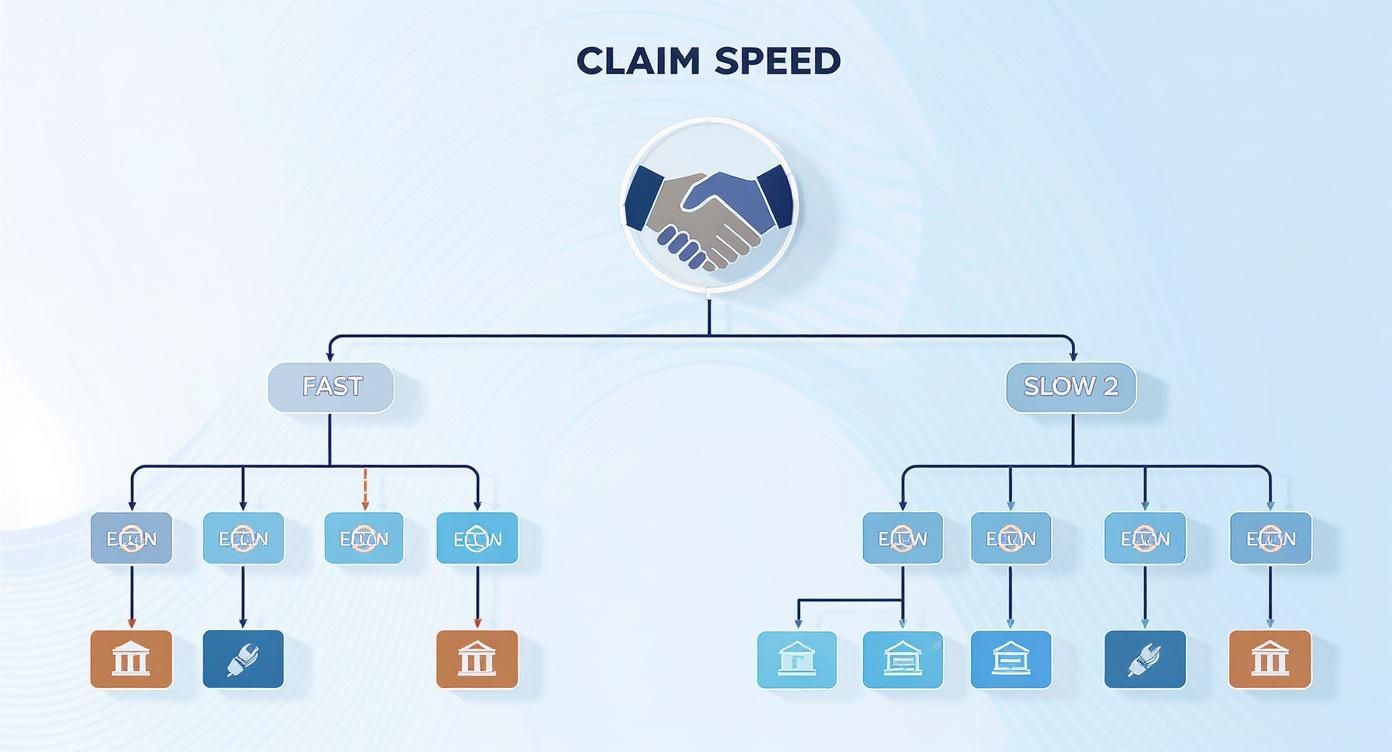
As you can see, things like a fight over who’s at fault can quickly push a case from the settlement path onto the litigation track. Let’s break down what each journey really looks like.
Path One: The Pre-Litigation Phase (Settlement)
The good news is that the vast majority of personal injury cases in Florida get resolved right here, without ever seeing the inside of a courtroom. This is what we call the pre-litigation or “settlement” phase. It’s the faster, more common route where we work to negotiate a fair agreement directly with the insurance company.
This phase isn’t just a single conversation; it’s a careful process of building your case and fighting for a fair outcome. It generally unfolds like this:
- Investigation and Evidence Gathering: We get to work immediately, collecting every piece of the puzzle—police reports, medical records, witness statements, photos, and any other evidence that paints a clear picture of what happened and why the other party is responsible.
- Calculating Your Damages: We can’t know the full value of your claim until your medical treatment is complete, or you’ve reached what doctors call Maximum Medical Improvement (MMI). At that point, we tally up everything: all medical bills, lost wages, the cost of future care, and the very real value of your pain and suffering.
- The Demand Letter: This is a big step. We package all of our findings and calculations into a comprehensive demand letter and send it to the at-fault party’s insurance company. This isn’t just a simple note; it’s a formal, detailed argument for why they owe you a specific settlement amount.
- Negotiation: Here’s where the back-and-forth begins. An insurance adjuster will review our demand and almost always come back with a lowball counteroffer. This kicks off a series of discussions where we go to bat for you. Knowing how to negotiate with insurance companies is an art, and it’s absolutely critical for getting the money you deserve without unnecessary delays.
If we can get the insurer to agree to a fair number during these talks, your case is settled. You’ll sign a release, they’ll issue a check, and the case is closed.
Path Two: The Litigation Phase (Filing a Lawsuit)
So, what happens if the insurance company just won’t budge? If they refuse to make a reasonable offer, we move to the second path: litigation.
This doesn’t mean your trial is starting tomorrow. In fact, filing a lawsuit is often a strategic move to apply legal pressure and unlock a new set of tools for resolving the dispute.
Filing a lawsuit is often the wake-up call an insurance company needs to take a claim seriously. It’s a powerful motivator, which is why more than 95% of personal injury cases that enter litigation still settle long before a trial ever begins.
Once we file a lawsuit, the process becomes much more formal and is governed by strict court rules. The key steps in this phase include:
- Discovery: This is the formal information-gathering stage. Both sides get to “discover” the other’s evidence. We can request documents, send written questions (called interrogatories), and take depositions.
- Depositions: You, the other driver, and key witnesses will almost certainly have to give a deposition. This is where the opposing attorney gets to ask you questions under oath, recorded by a court reporter. It’s like testifying, but it happens in a conference room, not a courtroom.
- Mediation: Florida courts require most civil cases to go through mediation before they can get to a trial. This is a confidential meeting where a neutral third-party mediator works to help both sides find common ground and hammer out a settlement.
If the case still doesn’t settle after all that, it will be scheduled for trial. Litigation definitely adds more time to your claim’s timeline, but sometimes it is the only way to force an insurer to pay the full and fair compensation you are owed.
Putting It All Together: Timelines for Common Florida Injury Cases
It helps to talk about the factors that can drag out a claim, but what does that look like in the real world? The truth is, the answer to “how long will my case take?” always comes down to the unique details of your accident and your injuries.
To give you a better feel for what to expect, let’s walk through a few scenarios we see all the time here in the Tampa Bay area. You’ll see how different variables can completely change the path from injury to resolution.
The “Straightforward” Tampa Car Accident
Let’s say you’re stopped at a red light on Dale Mabry Highway, and someone rear-ends you. It’s a classic open-and-shut case. The other driver is clearly at fault and even gets a ticket from the police. Your injuries are whiplash and a minor concussion, and after a few months of physical therapy, you’re feeling back to normal.
For a case like this, the timeline is usually on the shorter side:
- Medical Treatment: You reach what we call Maximum Medical Improvement (MMI) within 3-4 months. This just means you’ve recovered as much as you’re going to.
- Demand & Negotiation: Once your treatment is finished, we gather all your medical records and bills to build a demand package. The back-and-forth with the insurance company might take another 2-3 months.
- Total Estimated Timeline: Realistically, a claim like this often settles in 6 to 9 months from the day of the accident. Because liability is clear and the damages are easy to calculate, it’s simpler to get the insurance company to agree on a fair number.
The Complex Commercial Truck Crash on I-4
Now, let’s picture a much more serious situation: a collision with a semi-truck on I-4. You’ve suffered a fractured leg that required surgery, followed by a long, grueling rehabilitation process. To make matters worse, the trucking company’s insurer is fighting back, claiming you made an unsafe lane change and caused the crash.
This is where things get complicated, and the timeline stretches out considerably:
- Medical Treatment: Recovering from major surgery and the physical therapy that follows is a long road. Reaching MMI could easily take 12 to 18 months.
- Investigation & Liability Fights: With fault being disputed, we have to dig in. This means hiring accident reconstruction experts, interviewing witnesses, and taking depositions. This phase alone can add 6 or more months.
- Litigation: With a high-value claim and a stubborn insurer, filing a lawsuit becomes almost inevitable. The litigation process—which includes discovery, motions, and mediation—can easily add another 1 to 2 years to the clock.
- Total Estimated Timeline: A complex case like this frequently takes 2 to 4 years to resolve.
The severity of your injuries is one of the biggest factors. Studies have shown a direct link between the type of injury and how long a settlement takes. Cases involving broken bones might average 12 to 16 months, but catastrophic injuries are in a different league. Spinal cord damage claims can take 27 to 36 months, while those involving traumatic brain injuries can stretch from 33 to 48 months.
Each case has its own unique rhythm. The timeline is not just about waiting; it’s about methodically building a case strong enough to secure the full compensation you deserve for your specific losses.
The Sensitive Wrongful Death Claim
Wrongful death cases are, without a doubt, the most emotionally draining and legally complex. Imagine a family losing a loved one in a tragic motorcycle accident in Hillsborough County. The claim isn’t just about proving the other driver was negligent; it also involves navigating Florida’s probate laws to officially establish the estate and identify all the legal beneficiaries.
These extra legal steps add significant time:
- Establishing the Estate: Just getting the estate set up through the court system can take 2-4 months on its own, depending on how backed up the courts are.
- Valuing the Claim: How do you put a number on a life? It’s a painstaking process. We bring in experts to calculate the full value of the loss, which includes everything from lost future income to the immense pain of losing a companion.
- Total Estimated Timeline: Because of the added legal hurdles and the incredibly high emotional and financial stakes, these sensitive cases often take 2 to 3 years or longer to fully resolve.
These examples really show why there’s no “one-size-fits-all” answer to the timeline question. You can learn more about how different factors come into play by exploring our guide on the most common types of personal injury cases in Tampa.
Estimated Timelines for Different Florida Injury Cases
To help you visualize how these factors play out, here is a summary of potential timelines for common injury claims in Florida.
- Minor Car Accident (6 – 12 months): This timeline applies to cases with clear liability, minor “soft tissue” injuries, and a short treatment period.
- Serious Car Accident (1 – 2.5 years): For claims involving significant injuries like fractures or surgery, disputed fault, and a potential lawsuit, the process takes longer.
- Commercial Truck Accident (2 – 4+ years): These cases often involve catastrophic injuries, multiple defendants, federal regulations, and aggressive defense from the insurer.
- Slip and Fall (1 – 3 years): The timeline is extended by the need to prove the property owner’s negligence, find evidence of the hazard, and deal with disputed liability.
- Wrongful Death (2 – 3+ years): Probate court requirements, complex damages calculations, and high emotional stakes contribute to a longer timeline.
As you can see, the simpler the facts and the clearer the injuries, the faster a case tends to move. The moment you introduce complex medical issues, fights over who was at fault, or multiple parties, the timeline naturally extends.
How You Can Help Prevent Unnecessary Delays

While many factors controlling your case’s timeline are out of your hands, you are far from powerless. In fact, your actions—or inaction—can make a huge difference in how smoothly and quickly things move along. By being an active, engaged partner in your own case, you help us build the strongest claim possible and avoid frustrating, unnecessary roadblocks.
Think of it this way: your attorney is the driver, but you’re the navigator. We handle the mechanics of the legal system, but we absolutely rely on your clear directions and timely information to get to the destination—a fair settlement—without getting lost or delayed.
Be Diligent with Your Medical Treatment
Your health is priority number one, but from a legal standpoint, your medical journey is also the very foundation of your claim. This means going to every single doctor’s appointment, physical therapy session, and specialist visit is non-negotiable. Any gaps in your treatment history are giant red flags for the insurance company.
An adjuster will jump on missed appointments, arguing that your injuries must not be as bad as you claim. Consistent medical care, on the other hand, creates a solid, undeniable record of your injuries and the path to recovery.
Following your doctor’s orders to the letter gives us the powerful evidence we need to prove the true extent of your damages. The critical role of medical documentation in Tampa personal injury cases simply can’t be overstated; these records are the backbone of our demand for compensation.
Become an Expert Record-Keeper
Get in the habit of documenting everything, starting from day one. This simple step can shave significant time off the evidence-gathering phase and make your claim much stronger.
- Keep a Pain Journal: It doesn’t have to be elaborate. Just jot down daily notes about your pain levels, physical limitations, and how the injuries are disrupting your life. This creates a powerful narrative of your pain and suffering.
- Create an Expense Folder: Save every single receipt and bill related to the accident. This includes prescriptions, co-pays, mileage for doctor visits, and any other cost you’ve incurred.
- Preserve All Evidence: Whatever you do, don’t repair your car or throw away damaged items like a broken phone or torn clothing from the accident. Wait until your attorney has had a chance to document them. This physical proof can be incredibly valuable.
Stay Offline and Stay in Touch
It’s absolutely crucial to be careful with social media after an accident. You can bet the insurance company’s investigators will be combing through your profiles, looking for anything they can twist to their advantage. A simple photo from a family barbecue could be used to argue you aren’t really hurt. The safest bet is to stay off social media entirely until your case is over.
Finally, keep the lines of communication with your legal team wide open. When we ask for information or a signature, responding quickly helps us keep your case file moving forward without a hitch.
A Few Common Questions We Hear About Florida Injury Claims
When you’re dealing with an injury, the last thing you need is more uncertainty. We find that clients often have similar questions about how the process works and what to expect. Here are some straightforward answers to the things we’re asked most often here in Tampa.
Should I Take the Insurance Company’s First Offer?
In a word? No. It’s almost never a good idea. That first offer you receive isn’t a gesture of goodwill; it’s a strategic business decision. The insurance adjuster’s goal is to close your case as quickly and cheaply as possible.
They often make these lowball offers before anyone truly knows the full extent of your injuries or future medical needs. Remember, once you accept an offer, you sign away your right to any future compensation for this accident—even if your condition worsens. Think of their first offer as the starting whistle for negotiations, not the finish line.
If We File a Lawsuit, Does That Mean We’re Going to Trial?
This is a huge misconception. Filing a lawsuit doesn’t mean you’ll be seeing the inside of a courtroom anytime soon. In reality, it’s a powerful tool in the negotiation process. It signals to the insurance company that you mean business and opens up legal avenues for gathering evidence, like depositions and formal requests for documents.
The truth is that the overwhelming majority of personal injury cases—well over 95%—settle before ever reaching a trial. Filing suit is often the very thing that convinces a stubborn insurer to come to the table and negotiate a fair settlement.
Think of filing a lawsuit as turning up the heat. It tells the other side we’re serious about getting what you deserve and won’t be put off by their delays.
Can You Guarantee When My Case Will Be Finished?
We wish we could, but no ethical lawyer can ever promise a specific finish date. There are just too many factors that are completely out of our control. The timeline can be affected by the insurance company’s stalling tactics, the cooperation of the other party, and even the local court system’s schedule.
What we can do is give you an educated estimate based on our years of experience with similar cases. We’ll always keep you informed, but that estimate will be a projection, not a guarantee.
How Does Florida’s “No-Fault” Law Affect My Timeline?
Florida’s no-fault law can feel a bit confusing. It simply means that your own auto insurance policy, specifically your Personal Injury Protection (PIP) coverage, is the first place you turn for your initial medical bills, no matter who caused the crash. It’s crucial to get medical attention within 14 days of the accident, or you could lose the right to use these benefits.
The law also sets a specific “serious injury” threshold. You can only step outside the no-fault system to sue the at-fault driver for things like pain and suffering if your injury is considered permanent. Proving this adds another necessary step to the claims process, which naturally influences the overall timeline.
At Martin Hernandez, P.A., we know you’re going through a difficult time and that waiting can be frustrating. Our entire team is committed to keeping you in the loop while we fight aggressively to get you the full compensation you deserve.
If you have questions about your own case and what the road ahead might look like, please reach out. We offer a free, no-pressure consultation to help you understand your options. Find out more at https://injurylawyersoftampa.com.