
In the chaotic moments after a car accident, your mind is racing. Amid the confusion, one question needs a clear answer: how long do you have to report the crash to your insurance company?
While your policy might use vague language like “promptly,” here’s the reality from an experienced perspective: you need to notify your insurer within 24 to 72 hours. Period. Waiting any longer opens the door to unnecessary risks that can seriously jeopardize your claim before it even gets off the ground.
The First 72 Hours: What You Must Do Immediately
Right after a collision, you’re actually juggling two separate, but equally important, clocks. One is for notifying your insurance company, and the other is for filing the formal crash report required by the state of Florida. Your absolute first priority should be calling your insurer.
This initial call isn’t about giving a full, recorded statement. It’s simply about putting them on notice. Think of it as planting your flag—you’re officially documenting the incident, locking in the timeline, and protecting your rights under the policy you pay for. It’s your chance to control the narrative before memories fade or other parties try to spin the story.
Most major insurance carriers, including all the big names in Florida, expect to hear from you within that 24 to 72-hour window. Some policies are even stricter, leaning closer to 24 hours. Pushing this deadline is a gamble that could lead to an outright claim denial. You can get a deeper understanding of this process by reading more about what to do after a car accident in Florida.
Understanding Key Deadlines
Getting these timelines right is non-negotiable for a successful claim. If you wait, you hand the insurance adjuster an easy reason to doubt the severity of your injuries or question the facts of the crash.
- Insurance Notification: This is your first call. Make it within 24 hours if possible. This simple action gets the ball rolling and establishes a clear record.
- Official Crash Report: In Florida, if the police don’t file a report at the scene, you are required by law to file one yourself with the Department of Highway Safety and Motor Vehicles (DHSMV) within 10 days. This applies to any crash involving injury, death, or apparent property damage of $500 or more.
A Quick Look at Florida Accident Reporting
Here are the critical deadlines to keep in mind to protect your rights and build a strong foundation for your claim in Florida:
- Notify Your Insurance Company: The recommended deadline is within 24 hours. This fulfills your policy’s “prompt notice” clause and helps prevent a potential claim denial.
- Seek Medical Attention: It’s crucial to do this within 24-72 hours. This documents any injuries early and connects them directly to the accident, which is vital for your claim.
- File a DHSMV Crash Report: You have up to 10 days if the police do not file one at the scene. This satisfies Florida’s legal requirement and creates an official record of the incident.
This timeline helps visualize the critical actions you need to take in the immediate hours and days following a crash.
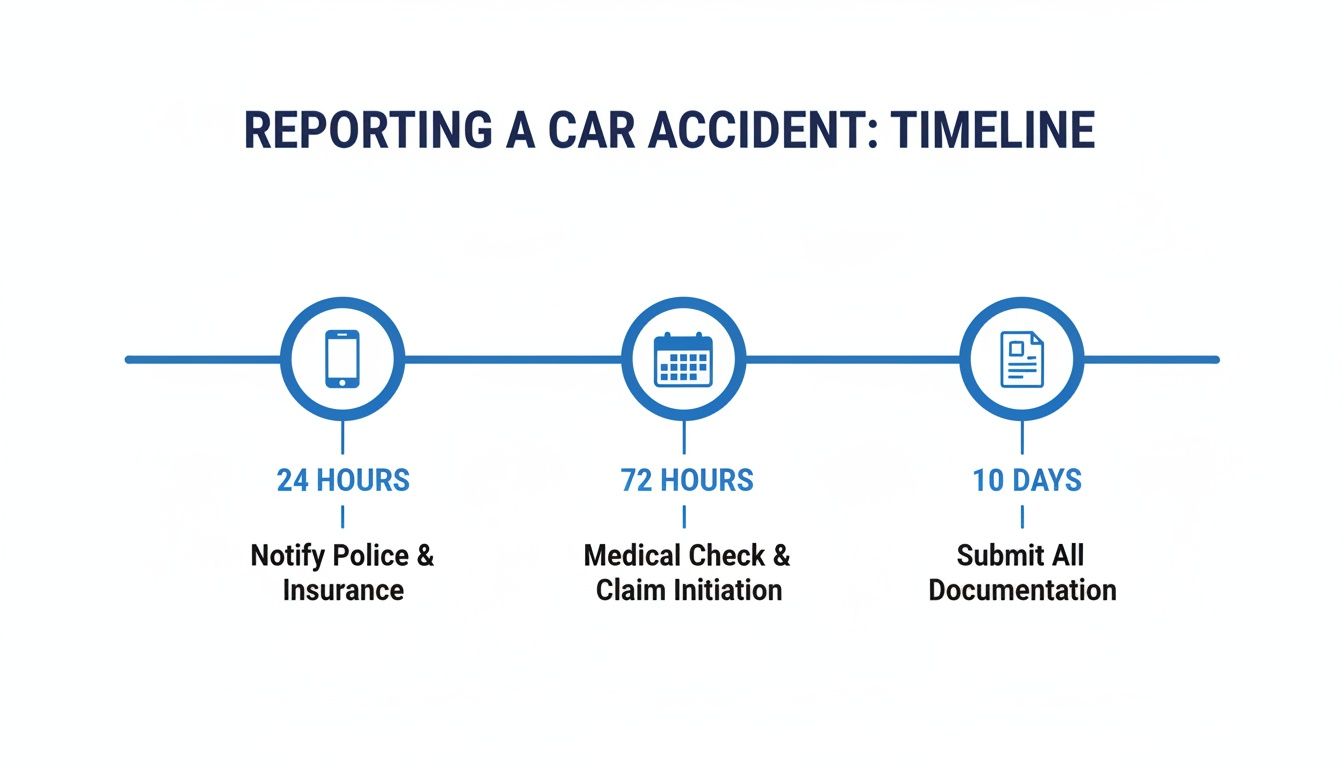
As the graphic shows, the most crucial steps happen almost immediately. While the state gives you a bit more breathing room for the official paperwork, your insurance company expects to hear from you right away.
Insurance Rules vs. Florida State Law: What’s the Difference?
After a car accident, you’re suddenly juggling two different sets of deadlines, and it’s easy to get them mixed up. On one hand, you have a legal duty to the state of Florida. On the other, you have a contractual duty to your insurance company.
Understanding the difference is critical, because one timeline is far more forgiving than the other.
Think of your insurance policy as a private agreement. To get the benefits you pay for—like having your medical bills and car repairs covered—you have to play by their rules. The most important rule here is the “prompt notice” clause.
This clause basically says you need to tell them about the accident as soon as it’s reasonably possible. That sounds a little vague, but in the real world, insurance companies expect to hear from you within a day or two. If you don’t, they can see it as a breach of your contract, giving them an opening to deny your claim.
Florida’s 10-Day Crash Report Law
Now, let’s look at the state’s rules, which are focused on public safety and official record-keeping, not your insurance benefits.
Florida law requires you to report any crash that involves an injury, death, or apparent property damage of $500 or more. If the police don’t file a report at the scene, you have 10 days to submit a crash report to the Florida Department of Highway Safety and Motor Vehicles (DHSMV).
This 10-day window is a legal deadline, not an insurance one. It’s about making sure the state has an official record of what happened. This requirement has little to do with your ability to use your insurance coverage, like your Personal Injury Protection (PIP) benefits for medical care. You can dive deeper into how that coverage works by reading our guide on what PIP insurance is in Florida.
Why Your Insurance Company’s Deadline Is the One That Matters Most
So, which deadline should you focus on first? Without a doubt, your insurer’s.
While you technically have 10 days to file a report with the state, your insurance company needs to know what happened right away. Waiting a week might keep you in the clear with Florida law, but it could completely jeopardize your insurance claim.
Here’s a simple way to think about it:
- Your Insurance Policy: This is your private contract. The goal is to protect your access to the benefits you pay for. The timeline is immediate—think 24 to 72 hours.
- Florida State Law: This is your public duty. The goal is to create an official crash record. The timeline is 10 days (only if police don’t file a report).
Don’t make the mistake of thinking the state’s 10-day rule gives you a free pass with your insurer. It doesn’t. Your first reporting priority is always your insurance company.
The Real Financial Cost of a Delayed Report
Putting off that call to your insurance company after an accident isn’t just a simple mistake—it can be a financially catastrophic one. With every day that goes by, you’re essentially handing the insurance adjuster more and more ammunition to question, slash, or even flat-out deny your claim. Procrastination is the best tool you can give them to use against you.
Right away, a delay plants a seed of doubt. The adjuster’s first question will be, “If the damage and injuries were so bad, why did they wait to report it?” This skepticism immediately puts you on the defensive and can sour the entire claims process from the very beginning.
How Delays Weaken Your Claim
The biggest risk you run by waiting is breaking the terms of your own insurance contract. Every policy includes a “prompt notice” clause. If you fail to meet that obligation, the insurance company can argue you’ve breached the contract, giving them grounds to deny your claim entirely. Their argument is that your delay prevented them from doing a proper, timely investigation, which releases them from their duty to pay.
Even if they don’t deny the claim outright, waiting almost guarantees you’ll face a lowball settlement offer. Evidence has a very short shelf life, and adjusters know this all too well.
- Witness Memories Fade: Someone who could give a crystal-clear account hours after the crash will have a much fuzzier memory a week later. Details get mixed up, and contradictions start to appear, making their testimony far less powerful.
- Surveillance Footage Is Erased: Most security and traffic cameras run on a loop, meaning they automatically record over old footage every few days. If you wait too long, that objective, undeniable proof of what happened could be gone forever.
- Physical Evidence Disappears: Cars get moved, cleaned, or even repaired. Those crucial scuff marks, fluid leaks, and bent metal that tell the story of the crash can be altered or washed away, making an accurate accident reconstruction nearly impossible.
Waiting to report an accident is like trying to solve a puzzle after half the pieces have been thrown away. The picture you’re left with will be incomplete, and you’ll almost certainly be the one paying the price for the missing information.
The Financial Impact of Waiting
This link between waiting and getting less money isn’t just a theory; the numbers prove it. A 2023 report from the National Association of Insurance Commissioners (NAIC) found that a staggering 65% of disputed auto claims involved a reporting delay of more than seven days. Even worse, those delays led to payouts being cut by an average of 35%. Why? Because evidence like witness statements and vehicle damage had degraded. You can dig deeper into these numbers by reviewing these insights on car accident reporting.
Finally, a delay gives the insurer a golden opportunity to dispute your injuries. If you don’t see a doctor or report the accident for a week, the adjuster will jump on that. They’ll argue your injuries could have happened anytime in the days following the crash, not because of it. Each day you wait is another reason for them to devalue your claim and pay you far less than you deserve.
How To Report Your Accident Without Harming Your Claim
Knowing you have to report an accident is one thing. Knowing how to do it without torpedoing your own claim is another thing entirely. That first phone call to your insurance company is a critical moment, and what you say—or don’t say—can make all the difference.
Your goal here is simple: fulfill your duty to notify your insurer. That’s it. You’re not there to give a detailed confession, speculate on what happened, or offer a full-blown interview. You are just giving them the bare-bones, undisputed facts.
Why the caution? Because the person on the other end of the line, the insurance adjuster, is trained to find any reason to devalue or deny your claim. Every word you say is being noted, and anything that sounds like an admission of fault or an inconsistency will be used against you later.
Stick To The Facts Only
Before you even dial the number, take a deep breath and get organized. Having your information ready helps you stay on track and keeps you from rambling or guessing. This isn’t just about being efficient; it’s a crucial step in protecting your rights from the very start.
Think of it as a kickoff meeting, not the final presentation. You’re just getting the process started. For more general insights into managing insurance claims, it can be helpful to see how the principles apply across different situations.
A little preparation goes a long way in keeping the conversation brief, factual, and focused on what truly matters at this early stage. Here’s a simple checklist of what you’ll need:
- Your Policy Number: This is the first thing they’ll ask for to pull up your account.
- Accident Basics: Have the exact date, time, and location (e.g., “the intersection of Main and Oak”) ready.
- Other Party’s Info: Provide the full name, phone number, and insurance details for the other driver.
- Police Report Number: If law enforcement came to the scene, have the official crash report number handy.
What To Say And What To Avoid
The language you use matters immensely. Simple, common phrases can be twisted to mean you’re accepting blame or that your injuries aren’t serious. Your guiding principle should be: facts, not feelings.
Never, ever admit fault. Even a simple, polite “I’m so sorry” can be interpreted as an admission of guilt. Don’t speculate or assign blame to anyone—including yourself. Just state the basic sequence of events.
It’s also incredibly important not to downplay potential injuries. Right after a crash, adrenaline is pumping, and you might not feel the full extent of the damage. Saying “I’m fine” or “I’m not really hurt” can come back to haunt you.
Instead, use a neutral phrase like, “I will be seeking a medical evaluation to assess any injuries.” This statement is factual and leaves the door open for you to claim medical benefits once a doctor has properly diagnosed you. Remember, the deeper investigation and discussions can happen later, ideally after you understand how to negotiate with insurance companies to ensure your rights are protected.
What About Complicated Accidents, Like a Hit-and-Run or an Uber Crash?

Not every car accident is a simple fender-bender where both drivers pull over and trade insurance cards. Life is often messier than that. You might be the victim of a hit-and-run, or find yourself in a wreck with a rideshare driver.
These situations can be incredibly confusing, and the question of how long to report an accident to insurance takes on a whole new level of urgency. Getting the reporting steps right is crucial for protecting your right to compensation.
Navigating a Hit-and-Run Accident in Florida
If a driver hits your car and then speeds off, your first call should be to 911. It’s not just a good idea; it’s the single most important step you can take. A formal police report is the key that unlocks your ability to file a successful claim.
Why? Because without it, you can’t really prove the accident happened the way you say it did. Your insurance company will need that official documentation to move forward with an Uninsured Motorist (UM) claim.
Legally speaking, a hit-and-run is treated just like an accident with an uninsured driver. The police report is your official proof, allowing you to use your own UM coverage for things like medical bills, lost wages, and other damages.
Once you have that police report, call your insurance company immediately. The clock is already ticking. Any delay gives your insurer an opening to question your story or the validity of your claim. If you’ve found yourself in this frustrating situation, you can find more detailed steps on what to do when an uninsured driver hit your car in Florida.
Reporting Accidents Involving Uber or Lyft
Wrecks involving rideshare vehicles like Uber or Lyft are a completely different ballgame. They have a tangled web of insurance policies, and figuring out which one applies depends entirely on what the driver was doing when the crash happened.
It all boils down to the driver’s status in the app:
- App Off / Driver is Offline: If the driver wasn’t logged into the app, you’re dealing with their personal car insurance, just like in any other accident.
- App On / Waiting for a Ride: If the driver was online but waiting for a ride request, a smaller liability policy from the rideshare company might kick in.
- Ride Accepted or in Progress: The moment the driver accepts a ride or has a passenger, Uber or Lyft’s huge $1 million commercial liability and UM policies are triggered.
Because of this complexity, you need to report the accident to your own insurance company and to the rideshare company’s insurance carrier. Don’t wait. These corporate insurers are notorious for trying to minimize payouts. Reporting the crash to everyone involved, and doing it quickly, is your best defense.
Why an Attorney Should Be Your First Strategic Call
You have to tell your insurance company about the crash, that’s a given. But your first strategic call? That should be to a personal injury attorney. Getting a lawyer’s advice before you ever speak to an adjuster can completely change the dynamic of your claim, putting the power back on your side.
Think of an experienced attorney as your shield and your advocate. They immediately take over all communication with the insurance companies, which is a huge relief. This also prevents you from accidentally saying something that an adjuster could twist to weaken your case. Remember, the adjuster’s job is to protect their company’s bottom line; your lawyer’s only job is to protect you.
Protecting Your Claim From Day One
The moment you bring an attorney on board, they get to work preserving crucial evidence. This isn’t something you can do weeks later. It means getting security camera footage before it gets recorded over, tracking down witnesses while their memories are still clear, and professionally documenting your vehicle’s damage.
Your legal team also starts building a clear picture of what your claim is actually worth. It’s never just about the first set of medical bills or the initial repair estimate. A thorough attorney documents everything, including:
- All current and future medical expenses, from ambulance rides and physical therapy to long-term care or potential surgeries.
- Lost income and diminished earning capacity if your injuries keep you out of work or limit what you can do in the future.
- Non-economic damages like pain, suffering, and emotional distress—real losses that insurance companies are notorious for downplaying.
An attorney doesn’t just file a claim for you; they build the strongest possible case from the ground up. They often bring in medical experts and accident reconstruction specialists to establish the facts so clearly that the insurance company can’t just brush them aside.
This proactive approach makes all the difference in Florida’s complex insurance landscape. By having a skilled legal professional fighting for you, you can focus on what truly matters: your recovery. Understanding the full benefits of getting a lawyer after a car accident is the most important step toward getting the compensation you deserve.
Got Questions? We’ve Got Answers
Even after laying everything out, you probably still have a few specific questions swirling around. That’s completely normal. Let’s tackle some of the most common things Florida drivers ask about reporting a crash and dealing with the insurance fallout.
What if it’s just a “fender bender”? Do I still have to report it in Florida?
The short answer is yes. Florida law is pretty clear: you must report any crash that involves an injury, a death, or property damage that looks like it’s $500 or more.
Think about it—with the cost of parts and labor these days, even a minor dent or a broken taillight can easily cost more than $500 to fix. Reporting it isn’t just about following the law; it’s about protecting yourself. If that other driver suddenly decides their neck hurts a week later or claims the damage was way worse, that official crash report is your objective proof of what really happened.
What happens if I don’t file the crash report within the 10-day deadline?
Missing that 10-day window to file your crash report with the Florida Department of Highway Safety and Motor Vehicles (DHSMV) can cause some serious headaches. While it’s considered a noncriminal traffic infraction, the real penalty stings.
The state can actually suspend your driver’s license, and that suspension stays in place until you finally file the report. On top of that, it hands your insurance company a perfect reason to second-guess your claim and create unnecessary delays.
Should I talk to the other driver’s insurance adjuster?
It’s best to politely decline. We strongly advise you not to give a recorded statement or go into detail with the other driver’s insurance company before you’ve spoken with an attorney. Their job is to protect their company’s bottom line, which often means finding ways to pay you as little as possible.
Remember, the other driver’s insurance adjuster is not your friend. They are trained to ask questions that can get you to say something that undermines your own claim.
Let your lawyer be the gatekeeper. Having them handle all conversations with the at-fault driver’s insurer is one of the smartest moves you can make. It protects you from accidentally saying something that could damage your case down the road.
Trying to figure all this out after a car accident is stressful, but you’re not in this alone. The team at Martin Hernandez, P.A. knows how to deal with the insurance companies. We’re here to protect your rights and fight for every penny you deserve. Reach out today for a free, no-obligation consultation at https://injurylawyersoftampa.com.