
When you’re recovering from a car accident, the last thing you want is uncertainty. One of the first questions we always hear is, “How long is this going to take?” It’s a completely fair question, and the honest answer is: it depends.
A straightforward case with clear facts and minor injuries might wrap up in a few months. But for a more complex situation, you could be looking at a year or even longer. Think of it this way—the journey to a fair settlement is unique to you. Everything from how badly you were hurt to how cooperative the insurance company decides to be will play a role.
Your Florida Car Accident Settlement Timeline Explained
After a crash, with medical bills piling up and your life on hold, that question of “how long?” becomes a huge source of stress. The truth is, there’s no magic number. It’s more like a spectrum. A simple fender-bender claim is like a short drive across town, while a case involving serious injuries is a cross-country road trip—it takes more time, planning, and navigation to reach the right destination.
Your case will move through several distinct stages, and each one runs on its own clock. We’ll investigate, you’ll focus on getting better, and then we’ll negotiate. Knowing what to expect at each step can make the entire process feel more manageable.
This visual gives a good snapshot of how different factors can stretch or shrink the timeline.
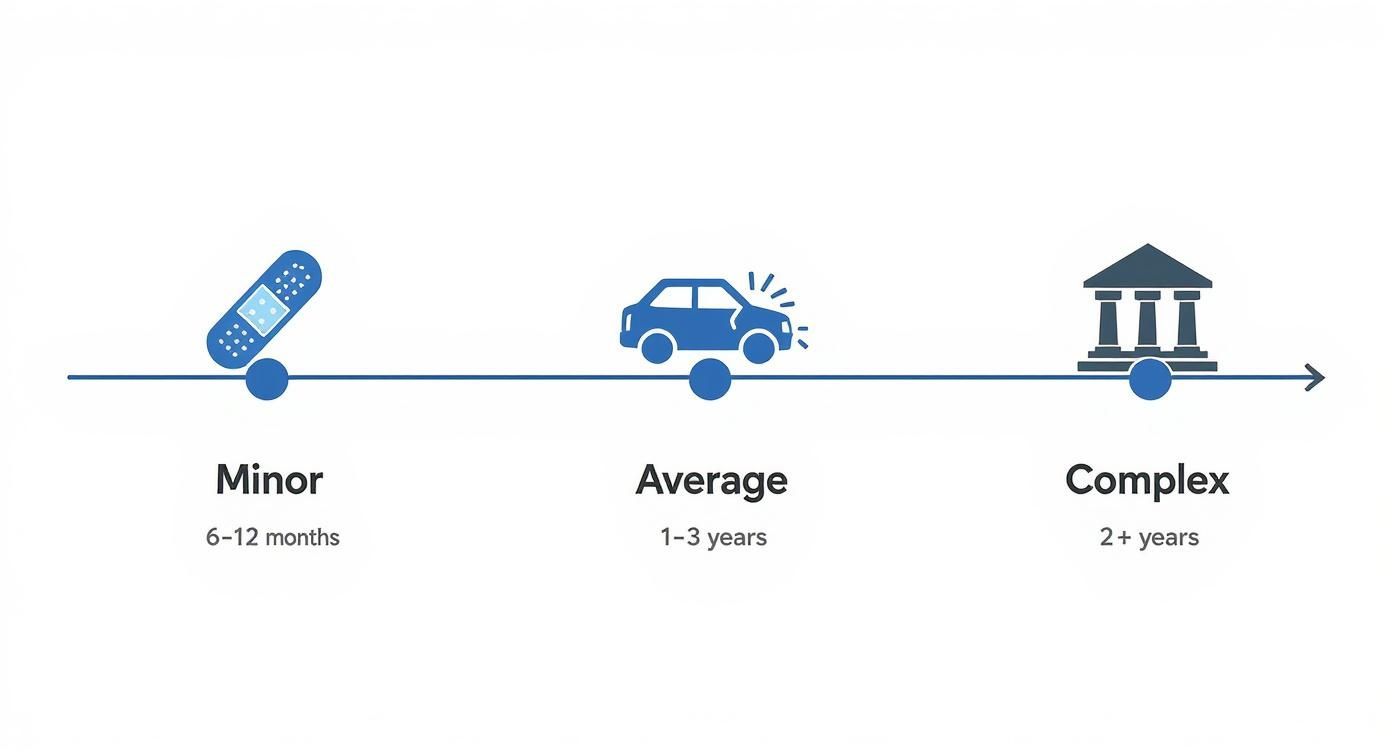
As you can see, a simple claim might be settled in under a year. Add in serious injuries or a dispute over who’s at fault, and the process can easily extend beyond the two-year mark.
To give you a clearer picture, here’s a breakdown of what you might expect based on common scenarios.
Estimated Settlement Timelines for Florida Car Accident Cases
The timeline for a Florida car accident settlement can vary significantly based on its complexity:
- Minor Case (3 to 9 months): These cases typically involve clear fault, minor injuries like whiplash with minimal medical treatment, and no long-term impact.
- Moderate Case (9 to 18 months): These might involve more significant but non-permanent injuries, moderate medical bills, and some dispute over fault or the amount of damages.
- Complex Case (18 months to 3+ years): These are cases with severe or permanent injuries, high medical costs, significant disputes over who is at fault (liability), and a higher potential for going to court.
These are just general guides, of course. Every case has its own unique twists and turns that can affect how long it takes to resolve.
Key Stages Influencing the Clock
So, what actually happens during this time? The settlement process isn’t just one long waiting game; it’s a series of crucial steps. How long each one takes directly impacts your total timeline.
- Investigation and Evidence Gathering: Right away, we get to work. This means rounding up the police report, tracking down and interviewing witnesses, and gathering photos and videos from the scene.
- Medical Treatment and Recovery: This is the most important—and often the longest—phase. You need to reach what’s called Maximum Medical Improvement (MMI). This is the point where you’ve healed as much as you’re going to. We can’t know the full value of your claim until we know the full extent of your injuries and future medical needs.
- The Demand and Negotiation: Once you’ve reached MMI, we put together a comprehensive demand package. This lays out the facts, your injuries, and all your damages for the insurance company. This kicks off the back-and-forth of negotiation.
- Resolution or Litigation: If we can get the insurance company to make a fair offer, we settle. If they refuse to be reasonable, filing a lawsuit becomes the next logical step, which adds a new chapter—and a longer timeline—to the process.
Patience is key, but so is having an experienced legal team pushing your case forward at every stage. For a more detailed look at what to expect, check out our guide on how long a personal injury claim can take.
The Foundational Stage: Evidence and Medical Stability

The journey to a fair settlement starts the moment a crash occurs, and honestly, these first steps are the most important. This initial phase sets the tone for everything that follows. Think of it like building a house—if you don’t pour a solid, carefully laid foundation, the whole structure is at risk of crumbling later on.
During this time, two things are happening at once. First, we’re gathering all the evidence that tells the story of the crash. Second, and often what takes the most time, is your physical recovery. The way we handle these two elements will directly shape how long your case takes and what it’s ultimately worth.
Gathering the Building Blocks of Your Claim
Right after an accident, the clock is ticking to preserve evidence. This isn’t just about shuffling papers; it’s about capturing a crystal-clear, undeniable picture of what happened and who was responsible. A strong evidence file is your number one weapon against the insurance company’s attempts to downplay your claim or deny it altogether.
Our team immediately gets to work securing several key pieces of the puzzle:
- The Official Police Report: This is the first official record of the incident. It gives us the officer’s initial assessment, often with diagrams, notes on who they believe was at fault, and contact info for witnesses.
- Witness Statements: Getting independent accounts from people who saw the crash can be a game-changer. Their stories can back up your version of events and shut down any conflicting narratives from the other driver.
- Photo and Video Evidence: A picture really is worth a thousand words. We gather photos of the vehicle damage, skid marks, the accident scene, and your injuries to create a visual record that is impossible to argue with.
This evidence-gathering part of the process can take anywhere from a few weeks to a couple of months. It all depends on how quickly reports become available and how responsive witnesses are. The key is to act fast so that crucial details aren’t lost or forgotten.
The Non-Negotiable Wait for Medical Stability
While we’re collecting evidence, your number one job is to focus on your health. This brings us to the most critical—and often longest—part of this initial stage: reaching what’s known as Maximum Medical Improvement (MMI).
MMI is simply the point where your doctor says your condition has stabilized. It means you’ve recovered as much as you’re medically expected to. This doesn’t mean you’re 100% healed or back to your old self. It just means we now have a clear picture of your long-term prognosis.
Rushing to settle before you hit MMI is one of the biggest mistakes you can make after an accident. Until your doctors know the full story, it’s impossible to calculate the true cost of your injuries—things like future surgeries, ongoing physical therapy, or the need for long-term care.
If you settle too early, you could be stuck paying for future medical bills out of your own pocket. The insurance company would love nothing more than to close your case quickly, long before the full extent of your damages comes to light.
Being patient during your recovery isn’t just about your health; it’s a strategic necessity for your case. It allows us to meticulously document every single medical expense—past, present, and future—and include it in our settlement demand. We can’t even begin to negotiate seriously until this medical milestone is reached.
The role of medical documentation is absolutely central to securing your claim, as it provides the hard proof needed to justify the full compensation you deserve.
Navigating the Negotiation Process with Insurers

Once your doctor confirms you’ve reached what’s called “maximum medical improvement,” the focus of your case shifts dramatically. The long phase of healing and waiting is over. Now, it’s time to actively push for fair compensation.
This is where your attorney moves to the forefront, formally demanding payment from the at-fault driver’s insurance company. This step kicks off a critical stage that has a huge impact on how long it takes to finally settle your car accident case.
Crafting the Settlement Demand Letter
The whole negotiation process starts with one crucial document: the settlement demand letter. Don’t let the name fool you—this is far more than a simple request for money. It’s a comprehensive legal argument, backed by all the evidence we’ve collected, that tells the complete story of your accident and its consequences.
You can think of the demand letter as our opening argument. It’s our first, best chance to lay all our cards on the table and show the insurance adjuster that we’re organized, prepared, and absolutely serious about getting what you deserve.
A powerful demand package always includes:
- A Clear Narrative: We detail exactly how the crash happened, using the police report and witness statements to prove the other party was at fault.
- Complete Medical Records: This is an undeniable record of your physical journey, including every single bill, doctor’s note, therapy session, and prescription.
- Proof of Financial Losses: We meticulously calculate every dollar of income you lost from being out of work, plus any other out-of-pocket expenses.
- Explanation of Pain and Suffering: This is where we translate your very human experience—the physical pain, the mental stress, the loss of enjoyment in life—into a monetary value the insurer is required to consider.
After we send this detailed package, the ball is officially in the insurance company’s court. In Florida, they have a set period to review the demand and respond, but this is where the timeline can often become unpredictable.
The Back-and-Forth of Negotiations
Once the insurance adjuster has reviewed our demand, you can be almost certain they won’t agree to the initial amount. Their primary job is to protect their company’s profits, which means paying out as little as they possibly can. This kicks off the real negotiation—a phase that can last anywhere from a few weeks to several months.
During this time, adjusters pull from a standard playbook of tactics designed to wear you down and make you doubt what your claim is really worth.
An insurance company’s first offer is almost always a “lowball” offer. It’s a test to see if you are desperate enough to accept a fraction of what your case is truly worth. This is a critical moment where having an experienced attorney is essential.
Some of their most common delay tactics include:
- Requesting Unnecessary Documents: An adjuster might ask for old medical records that have nothing to do with your accident, hoping to find a pre-existing condition to blame for your pain.
- Disputing the Severity of Injuries: They might argue your injuries aren’t as bad as your doctors say, or even claim you received “too much” medical treatment.
- Creating Unexplained Delays: Sometimes, the best tactic is simply silence. By dragging their feet, they hope your growing financial pressure will force you to take an unfair offer.
This constant back-and-forth is exactly why the negotiation stage adds so much time to a settlement. Our job is to counter every argument with hard facts, expert opinions, and the ever-present possibility of taking them to court. You can learn more about how to negotiate with insurance companies and see the strategies they use. At our firm, we know their playbook inside and out, and we refuse to let them control the timeline or the outcome.
Key Factors That Speed Up or Slow Down Your Settlement
Ever wonder why one car accident case here in Tampa wraps up in a few months, while a nearly identical one seems to drag on forever? It’s not random. A handful of critical factors can either hit the gas or pump the brakes on your settlement timeline.
Getting a handle on these variables is the first step to setting realistic expectations. Every single claim moves at its own pace, dictated by the unique facts of the crash, the injuries, and the people involved.
Injury Severity and Medical Treatment
Without a doubt, the biggest driver of your case’s timeline is how badly you were hurt. A minor whiplash claim that’s resolved after a few weeks of physical therapy is going to settle worlds faster than a case involving a serious spinal injury or surgery that needs months of rehab.
There’s a simple reason for this: we can’t even think about starting serious negotiations until you’ve reached what’s called Maximum Medical Improvement (MMI). This is the point where your doctor says you’re as recovered as you’re going to get. Rushing this would be a huge mistake—it’s like trying to sell a house before you know its true value. A longer, more complicated recovery just means a longer wait before we can send a demand to the insurance company.
Disputes Over Fault and Liability
When fault is crystal clear—think a classic rear-end collision at a red light—the road to a settlement is usually much smoother. But if there’s any argument over who caused the wreck, get ready for delays. The other driver’s insurance company will pour time and money into trying to pin some, or all, of the blame on you.
Here in Florida, we operate under a comparative negligence system. This means your final payout can be reduced by your percentage of fault. Insurance adjusters know this and often use it to muddy the waters, creating disputes that drag out negotiations. Proving you weren’t at fault might mean we have to hire accident reconstruction experts or track down more witnesses, all of which adds time to the clock.
The Value of Your Claim
It sounds backward, but the more your case is worth, the longer it often takes to settle. When a claim involves massive damages—huge medical bills, significant lost wages, and life-altering pain and suffering—the insurance company has a lot more to lose.
An insurer will put a high-value claim under a microscope. They’ll pick apart every medical record, question every treatment, and fight every calculation for future expenses. Their goal is simple: minimize their payout.
This intense scrutiny naturally leads to a tougher, more drawn-out negotiation. The back-and-forth is more aggressive simply because the stakes are so much higher.
Insurance Company Tactics and Policies
Finally, the insurance company on the other side plays a massive role. Let’s be frank: some insurance carriers are notorious for using delay tactics as a core business strategy. They might take weeks to return a phone call, send a ridiculously low first offer, or bury us in requests for paperwork they already have. It’s all designed to wear you down and make you accept a lowball offer out of sheer frustration.
Things get even more complicated in a multi-car pile-up where you’re dealing with several insurance companies. Each one will conduct its own investigation and will likely try to blame the others, creating a tangled mess that takes time to sort out. This is also why it’s so important to act fast to protect your own benefits. For instance, you need to understand what the Florida PIP 14-day rule is to make sure you don’t lose your own PIP coverage while the other insurers are pointing fingers.
When Filing a Lawsuit Becomes Necessary
While most car accident claims in Florida settle out of court, there are times when the insurance company just won’t budge. They draw a line in the sand, and their “best” offer is nowhere near what your case is actually worth.
When you hit that wall, you’ve reached a crossroads. This is the point where filing a lawsuit isn’t just a threat—it becomes the next logical step to get the compensation you deserve.
It’s a common myth that filing a lawsuit automatically means you’re headed for a dramatic trial you see on TV. That couldn’t be further from the truth. In most cases, filing the suit is simply the move that forces an insurance company to finally take you seriously. It’s like kicking things up a notch.
What Really Happens When You Sue
Deciding to sue will, without a doubt, extend the timeline of your case, often adding a year or more. But that extra time isn’t wasted; it’s spent building an ironclad case. The process starts when we file a formal Complaint with the court, which is the legal document that lays out exactly why the other driver is responsible for your injuries.
Once the complaint is filed, we enter a phase called discovery. Think of it as a mandatory show-and-tell, where both sides are legally required to lay their cards on the table.
This stage involves a few key steps:
- Interrogatories: We send written questions to the other side, and they have to answer them under oath.
- Requests for Production: We can legally demand they turn over crucial evidence, like their vehicle’s maintenance records or even their cell phone records from around the time of the crash.
- Depositions: This is where we get to question the other driver, witnesses, and experts under oath, with a court reporter recording every word.
Discovery is incredibly powerful. It lets us uncover evidence the insurer might prefer to keep hidden and locks the at-fault driver into a single story, preventing them from changing their tune later on.
Why Litigation Often Leads to a Fair Settlement
Here’s the inside scoop: litigation is expensive and a major headache for everyone involved, including the insurance company. They suddenly have to pay their own team of lawyers to handle depositions, draft legal responses, and prepare for a potential trial.
That mounting pressure is often the exact motivation they need to come back to the negotiating table with a much more reasonable offer.
A huge number of car accident cases settle shortly after the lawsuit is filed or deep into the discovery process. The very act of filing shows you won’t back down, forcing the insurer to seriously rethink the risk of losing a lot more money in front of a jury.
But you can’t wait forever to make this move. It is absolutely critical to understand the Florida statute of limitations for personal injury. Miss that deadline, and your right to recover anything is gone for good. While litigation definitely lengthens how long it takes to settle a car accident case, sometimes it’s the only road to justice.
How We Strategically Manage Your Case Timeline

At Martin Hernandez, P.A., we get it. After a car wreck, you’re looking for two things: fair compensation for what you’ve been through and a resolution that doesn’t drag on forever. Our entire approach is built around balancing these two critical goals. We are proactive, not reactive, and focus on controlling the parts of the timeline we can, pushing back against insurance company delays, and building the strongest possible case for you from the very beginning.
Answering the question of how long a car accident case takes to settle often comes down to the actions taken in the first few days. We don’t sit back and wait for the insurance company to make the first move. Our work starts immediately.
Immediate Investigation and Evidence Preservation
The moment you hire our firm, we spring into action. Our team is dispatched to secure police reports, track down and interview witnesses while their memories are still fresh, and gather critical evidence before it can be lost or destroyed.
This rapid-response approach is non-negotiable. By front-loading the investigation and building a rock-solid foundation of evidence from day one, we head off many of the needless disputes and delays that insurance adjusters love to create. A claim that is thoroughly documented from the start is a claim that moves forward.
Leveraging Our Trial-Ready Reputation
Insurance companies keep score. They know which law firms will settle for pennies on the dollar to avoid a courtroom and which ones are ready, willing, and able to go to trial. Our reputation in Tampa and throughout Florida precedes us. We prepare every single case as if it’s headed for a jury.
This trial-ready approach is our most powerful negotiating tool. When insurers see that we’ve meticulously prepared a case and aren’t afraid of litigation, they are far more motivated to offer a fair settlement. They know a courtroom battle against us is an expensive, risky, and unpredictable gamble for them.
Our deep familiarity with the delay tactics used by Florida insurance carriers gives us a clear advantage. We know their playbook, so we can anticipate their moves and counter them with facts, legal precedent, and aggressive advocacy. We simply refuse to let them control the pace of your claim.
Empowering You with Transparent Communication
Finally, managing the timeline also means managing expectations with honest, consistent communication. We make sure you understand every step of the journey—from the day you reach maximum medical improvement to the back-and-forth realities of negotiation.
You will never be left in the dark wondering what’s happening with your case. By keeping you fully informed, we empower you to make confident decisions that align with your goals, both for your financial recovery and for the timing of your settlement.
Common Questions About Settlement Timelines
When you’re dealing with the fallout from a car accident, it’s natural to have a ton of questions about how long everything will take. Let’s tackle some of the most common concerns we hear from our clients here in Florida.
Can I Do Anything to Speed Up My Settlement?
Yes, absolutely. While some parts of the process are simply out of your hands, you can definitely help move things along. The single most important thing you can do is focus on your recovery. Go to every single doctor’s appointment and follow your treatment plan to the letter. This creates a rock-solid medical record that’s hard for an insurance company to dispute.
Beyond that, keeping the lines of communication open with your attorney is crucial. When we ask for a document or a piece of information, getting it back to us quickly helps us keep your file moving forward without any unnecessary hiccups.
Why Is the Insurance Company Delaying My Claim?
It’s easy to feel like the insurance company is personally targeting you, but delays are almost always a business tactic. Their main objective is to pay out as little as possible, and making you wait is a surprisingly effective way to achieve that. They’re hoping that the mounting medical bills and financial stress will push you into accepting a lowball offer just to get it over with.
We see the same delay tactics over and over again:
- Questioning Your Injuries: They might claim your injuries aren’t as bad as your doctor says they are.
- The Endless Paperwork Loop: An adjuster will ask for documents you’ve already sent, just to create frustrating hurdles.
- Radio Silence: Sometimes, they just stop responding altogether, hoping you’ll get discouraged and give up.
An experienced lawyer knows these games well. We know how to push back, create pressure, and force the insurance company to stop stalling and start negotiating seriously.
What Happens After We Agree to a Settlement?
Reaching a settlement agreement is a huge milestone, but it’s not quite the final step. A few administrative things need to happen before you get your money.
First, you’ll sign a release document. This is a formal contract where you agree not to take any more legal action related to this specific accident. Once the insurance company gets that signed release, they cut the settlement check. From there, we use the funds to pay off any outstanding medical bills or liens, and then the final amount is disbursed directly to you.
It’s worth remembering that the vast majority of personal injury cases—well over 95%—end in a settlement. Going to trial is rare. Our goal is always to get you a fair resolution without ever having to step foot in a courtroom.
If you’re still wondering how long to settle a car accident case in the Tampa area, the honest answer is: it depends. The best way to get a clear picture is to talk about the specifics of your situation. Contact Martin Hernandez, P.A. for a free, no-pressure consultation today and let our experience guide you. Learn more at https://injurylawyersoftampa.com.