
If you’re just dealing with a banged-up car, a Florida accident claim can wrap up in a few weeks. But if you’ve been injured, you’re looking at a much longer road—often several months, and sometimes over a year.
The single biggest factor dictating this timeline is your health. We can’t know the true value of your claim until you’ve reached what’s called Maximum Medical Improvement (MMI). Getting this right from the start is absolutely crucial.
Setting Realistic Expectations for Your Claim Timeline

One of the first questions people ask after a crash is, “How long is this going to take?” It’s a source of major stress, and unfortunately, the answer is almost always: “It depends.”
Every accident claim is different. Your case has its own unique facts, specific injuries, and legal hurdles. To get a handle on your situation, it helps to understand the fundamental stages that control the pace of every claim.
Think of it like building a house. You can’t start putting on the roof before you’ve poured the foundation and framed the walls. It’s the same with a settlement. You can’t rush to the finish line before all the evidence is gathered and we know the full extent of your damages.
The Core Phases of a Claim
From the moment of impact to the day you get a check, every claim moves through a few critical phases. They have to happen in order, and a delay in one phase can easily push back the entire timeline.
Here’s a look at those initial steps:
- Immediate Aftermath and Reporting: This is everything that happens right away—seeking medical care, calling the police, and notifying your insurance company.
- Evidence Gathering: This is where we collect the proof: photos from the scene, witness statements, the official police report, and other key documents that tell the story of what happened.
- Liability Investigation: The insurance companies will dig in to figure out who was at fault. This determination is a make-or-break factor for any settlement.
- Medical Treatment and Documentation: As you focus on healing, every doctor’s visit, therapy session, and medical bill becomes a vital piece of evidence that builds the value of your claim.
A fast settlement is rarely a good settlement. Rushing the process almost always means leaving money on the table, especially if you accept an offer before your long-term medical needs are fully understood.
Florida Claim Timelines
When liability is clear and injuries are moderate, many Florida car accident claims settle within 3 to 9 months. For straightforward cases where fault isn’t disputed, a timeline of 6 to 9 months after you’ve finished medical treatment is common.
Understanding the general insurance claim process timeline can give you a good baseline. While the stages are similar, Florida’s specific laws create some unique twists in the process, which we’ll cover next. For a deeper dive, check out our other guide at: https://injurylawyersoftampa.com/how-long-does-personal-injury-claim-take/
To give you a clearer picture, here’s a quick-reference guide for typical Florida timelines.
Estimated Settlement Timelines for Florida Car Accidents
- Property Damage Only: 2-6 weeks
- Minor Injuries (Soft Tissue): 3-9 months
- Moderate Injuries (Fractures, etc.): 9-18 months
- Severe/Catastrophic Injuries: 1-2+ years
- Claim Requiring a Lawsuit: 2-3+ years
Remember, these are just estimates. The specific details of your case, like a fight over who was at fault or a difficult insurance company, can easily change how long things take.
Key Factors That Influence Your Settlement Timeline

If you’re wondering how long your car accident settlement will take, think of it less like a straight highway and more like a road with potential detours and traffic jams. It’s not a one-size-fits-all timeline. While every accident is different, my experience shows that four key factors almost always dictate the pace of the journey from the crash to the final check.
Getting a handle on these variables is the first step to understanding why some claims wrap up in a few months, while others can stretch out for a year or even longer.
The Severity of Your Injuries
The single biggest element controlling your claim’s timeline is your physical recovery. We simply can’t—and shouldn’t—even think about settling a case until you’ve reached what we call Maximum Medical Improvement (MMI). This is the point when your doctor says you’ve healed as much as you’re ever going to.
Hitting MMI is a critical milestone. If you settle before you get there, you’re taking a massive gamble. You might accept an offer that doesn’t cover a future surgery or the long-term physical therapy you didn’t know you’d need. Insurance companies are well aware of this and will sometimes push for a quick settlement, hoping to close the book on your claim before the true, full cost of your care is known.
The rule of thumb is simple: the more serious the injury, the longer the recovery, and the longer it takes to settle the claim. A straightforward soft-tissue injury might be ready to settle in a few months, but a case involving a spinal cord injury or a traumatic brain injury will, and should, take much more time to fully understand.
This is why proper medical records are so vital. To see how each doctor’s note and report builds the value of your case, learn more about https://injurylawyersoftampa.com/securing-your-claim-the-critical-role-of-medical-documentation-in-tampa-personal-injury-cases/. That paperwork is the undeniable proof of everything you’ve been through.
Disputes Over Liability
In a perfect world, the driver who hit you would immediately admit fault. But we don’t live in a perfect world. The reality is that liability is often contested. When the other driver denies responsibility or, even worse, tries to pin the blame on you, the timeline gets longer instantly.
A fight over who’s at fault turns your claim into a full-blown investigation. It’s on us to gather the evidence needed to prove the other party’s negligence beyond any doubt.
This process involves:
- Digging for Evidence: We’ll get the police report, track down witnesses for interviews, and hunt for any traffic camera or dashcam footage that captured the crash.
- Accident Reconstruction: For complicated collisions, we often bring in an expert to analyze the scene, the vehicle damage, and the physics of the crash to provide a scientific opinion on what happened.
- Taking Depositions: This is where we get sworn, recorded testimony from everyone involved to lock in their stories under oath.
Each one of these steps can add weeks or months to the process. An insurance company isn’t going to put a fair offer on the table until they know they can’t wiggle out of paying.
Insurance Company Tactics
Let’s be clear: insurance companies are for-profit businesses, and their main goal is to protect their bottom line. The adjusters they employ are trained negotiators whose job is to pay out as little as possible. They have a playbook of tactics designed to delay your settlement.
One of the most common is the “delay, deny, defend” strategy. They might take forever to return your calls, bury you in requests for unnecessary paperwork, or make a ridiculously low first offer, hoping your financial stress will force you to take it. It’s a calculated strategy to wear you down.
They might also question whether your medical treatments were truly necessary or argue your injuries aren’t as bad as you say. It’s not uncommon for them to hire their own doctors to review your file and claim your condition isn’t even from the accident. Pushing back against these tactics takes persistence, solid evidence, and frankly, a lawyer who knows their game.
The Overall Complexity of the Case
Finally, the unique details of the accident itself play a huge role. A simple rear-end collision between two cars is a world away from a multi-vehicle pileup on I-4 or a crash involving a commercial semi-truck.
Certain factors automatically make a case more complex and time-consuming:
- Multiple At-Fault Parties: When more than one driver or company could be at fault, we have to investigate and negotiate how to split the blame, which adds layers of work.
- Commercial Vehicles: Accidents with trucks, delivery vans, or rideshare cars mean dealing with corporate insurance policies and their aggressive legal teams.
- Government Entities: If a city bus or a poorly maintained road caused the crash, the claim has special rules and much shorter deadlines.
- Property Damage Disputes: Even getting your car fixed can create delays. For instance, arguing over the quality of replacement parts can be a real sticking point, as seen in disputes over OEM vs. aftermarket parts.
Each of these elements adds time to the clock, requiring a more thorough investigation to make sure every responsible party is held accountable.
Navigating Florida’s Unique No-Fault System
Florida handles car accidents differently than most other states, and these specific rules play a huge role in how long it takes to settle your claim. We operate under what’s called a “No-Fault” system, which completely changes the first moves you need to make after a crash. Getting a handle on this system is the first step toward protecting your rights and having a realistic idea of the timeline ahead.
So, what does “No-Fault” actually mean? In simple terms, it means you turn to your own insurance company first for initial expenses, no matter who was at fault for the accident. This is all handled through your Personal Injury Protection (PIP) coverage, something every single driver in Florida is required to have.
Think of your PIP benefits as your immediate financial first-aid kit. It’s designed to get you quick cash for medical bills and a portion of your lost wages, letting you bypass the often long and drawn-out process of proving the other driver was negligent. But this system has some very strict rules, and you have to follow them to the letter.
The Critical 14-Day Rule for Medical Treatment
Florida law gives you a firm, non-negotiable deadline: you must get your initial medical evaluation from a qualified provider within 14 days of the car accident. If you wait until day 15, your PIP insurer has the legal right to flat-out deny all of your medical claims. You’d be on the hook for those bills yourself.
This is a true “use it or lose it” situation. Even if you think your injuries are minor, putting off a trip to the doctor or an urgent care clinic beyond that two-week mark can be a devastating financial mistake. It also gives the insurance company a perfect excuse to argue that your injuries weren’t really caused by the crash.
As soon as an accident happens, a clock starts ticking. Getting a medical evaluation right away—and absolutely within that 14-day window—is the most important thing you can do to protect your right to compensation in Florida.
This deadline is a big deal for your settlement timeline because it officially kicks off your medical treatment, which is the foundation of what your case is ultimately worth.
Understanding Florida’s Statute of Limitations
PIP is great for covering your immediate needs, but what if your injuries are serious and the costs go way beyond your policy limits? That’s when you need to file a personal injury claim against the driver who caused the wreck. This brings another critical deadline into the picture: the statute of limitations.
In Florida, you typically have just two years from the date of the accident to file a lawsuit. That might sound like a lot of time, but it flies by when you’re busy with doctor’s appointments, physical therapy, and just trying to get your life back on track. If you miss this deadline, you lose your right to seek justice in court forever. A good attorney makes sure this never happens, which keeps the pressure on the insurance company to negotiate fairly.
The Role of Uninsured and Underinsured Motorist Coverage
Now for the million-dollar question: what happens if the driver who hit you has zero insurance, or just the bare-minimum coverage that won’t even scratch the surface of your bills? Unfortunately, this is an all-too-common scenario in Florida. We have one of the highest rates of uninsured drivers in the U.S.—an estimated 1 in 5 drivers on our roads has no bodily injury liability coverage.
This is where Uninsured/Underinsured Motorist (UM/UIM) coverage can be a lifesaver. It’s an optional type of coverage you add to your own policy.
- Uninsured Motorist (UM): Kicks in when the at-fault driver has no bodily injury insurance at all.
- Underinsured Motorist (UIM): Applies when the at-fault driver has insurance, but their policy limits are too low to cover the full extent of your injuries and losses.
When you have UM/UIM coverage, your own insurance company is supposed to step in and pay what the at-fault driver’s insurer should have. While it’s a crucial safety net, it can also make the settlement process longer. Suddenly, you’re in a fight with your own insurance company, and they will defend the claim just as aggressively as any other insurer would. These negotiations can add months to your timeline, but they are absolutely necessary to get the full compensation you deserve.
For a deeper dive into these complexities, you can read our detailed guide on the Florida No-Fault Insurance laws.
The Step-by-Step Florida Settlement Process
Trying to understand the Florida car accident claim process can feel overwhelming, like you’ve been handed a complex puzzle without the picture on the box. But when you break it down, you start to see a clear, logical path from the crash scene to the final check.
Each step naturally flows into the next. Knowing what to expect—and why each stage matters so much—can give you a sense of control and help you make smarter decisions for your recovery.
Phase 1: Initial Actions and Investigation
Everything that happens in the first few days and weeks after an accident lays the groundwork for your entire claim. Your health is, without question, the top priority. Getting medical attention right away is critical, especially since you must see a doctor within Florida’s mandatory 14-day PIP window to use those benefits.
Once you’re medically stable, the focus pivots to gathering evidence. This is where a good legal team really digs in. We start collecting the police report, photos from the scene, pictures of the vehicle damage, and statements from anyone who saw what happened. We’ll even hunt for nearby security or traffic camera footage to build a rock-solid story of how the accident occurred and who was responsible.
Phase 2: Medical Treatment and Documentation
This is often the longest stretch of the journey, and for good reason. It’s where the true value of your claim is determined. As you’re going to doctor’s appointments, doing physical therapy, and following your treatment plan, we are behind the scenes, carefully gathering every single medical record and bill.
It’s absolutely vital to wait until your doctor says you’ve reached Maximum Medical Improvement (MMI). MMI is just a technical term for the point where your condition has stabilized as much as it’s going to. Settling before you hit MMI is a huge gamble because you have no real way of knowing what future medical care you might need.
This infographic lays out the crucial legal milestones every Florida accident victim needs to know.
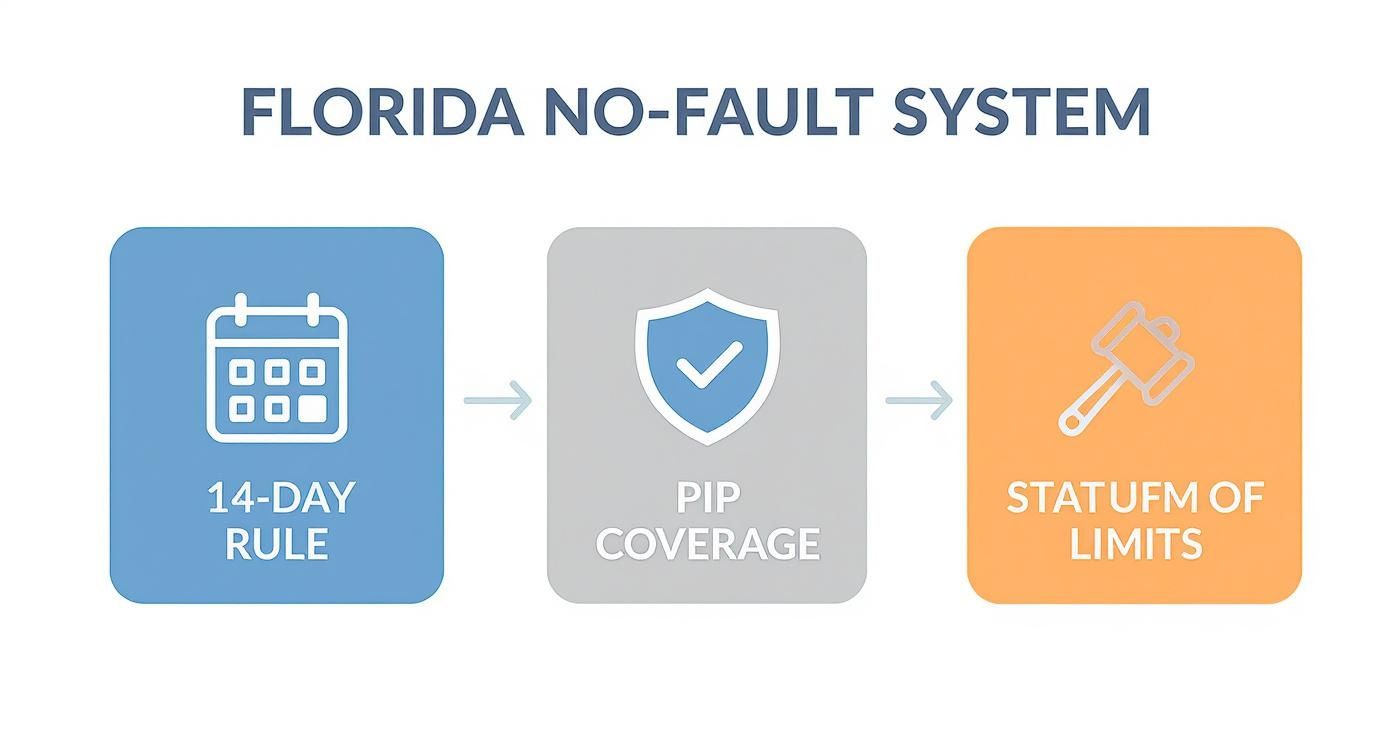
As you can see, the timeline is bookended by two hard deadlines: the 14-day rule to get medical care and the final statute of limitations to file a lawsuit.
Phase 3: The Demand and Negotiation
Once you’ve reached MMI and we have a complete file—all medical records, bills, and proof of lost income—your attorney will put together a demand letter. Think of this as the opening argument in your case. It’s a detailed legal document sent to the other driver’s insurance company that lays out the facts, proves they were at fault, and itemizes every single dollar of your damages, both economic and non-economic.
The demand letter officially starts the negotiation process. The insurance adjuster will review everything and then, almost without fail, come back with a lowball counteroffer. This kicks off a strategic back-and-forth.
An insurance company’s first offer is almost never its best offer. It is a calculated starting point designed to test your resolve and see if you will accept less than your claim is worth.
An experienced lawyer knows these tactics inside and out. We push back with hard evidence, legal arguments, and the very real possibility of a lawsuit if they refuse to be fair. To get a better handle on this part of the process, you can learn more about how to negotiate with insurance companies in our guide. This stage is a mix of patience and persistence.
Phase 4: Reaching a Settlement Agreement
When the negotiations finally pay off, a settlement agreement is reached. This is a formal, legally binding contract. In it, you agree to release the at-fault driver from any future claims related to the accident in exchange for the payment you’ve both agreed on.
Before the money lands in your bank account, a few housekeeping items need to be handled:
- Signing the Release: You’ll sign the official settlement release paperwork, which formally closes the book on your claim.
- Resolving Liens: Your attorney will work with your medical providers or health insurer to negotiate down any liens they have on your settlement, which means more money stays in your pocket.
- Receiving the Funds: The insurance company cuts the check and sends it to your attorney. Your lawyer then pays off any remaining medical bills or liens and their legal fees before issuing the final net settlement check directly to you.
This last part can take a few weeks, but it represents the end of a long, difficult process. More importantly, it gives you the financial resources you need to truly start moving forward with your life.
When to Hire a Florida Car Accident Attorney

Trying to handle a car accident claim by yourself can feel like you’re navigating a maze blindfolded. Sure, you might be able to manage a straightforward fender-bender with only property damage. But certain situations are bright red flags, signaling it’s time to bring in a legal professional.
Spotting these signs early can be the difference between getting a fair settlement that covers all your needs and walking away with a fraction of what you deserve.
An experienced Florida car accident lawyer does so much more than file paperwork. They step in as your dedicated advocate, building a powerful case while shielding you from the tactics of aggressive insurance adjusters. From the moment you hire them, they take over all communication, which is crucial for preventing you from accidentally saying something that could damage your claim.
Clear Signs You Need Legal Representation
If you’re facing any of the scenarios below, the answer to “how long will this take?” is likely to be much longer—and far more complicated—without a lawyer on your side. It’s a good idea to seek legal advice right away.
- You Suffered Serious or Lasting Injuries: If the crash left you needing surgery, ongoing physical therapy, or facing long-term medical problems, you absolutely need an attorney. Calculating the true cost of future medical care, lost earning capacity, and pain and suffering is a complex task. You can bet the insurance adjuster won’t be doing it in your favor.
- Liability is Disputed or Unclear: The other driver is denying fault or, even worse, trying to pin the blame on you. When this happens, their insurance company will dig in its heels and fight hard to avoid paying. An attorney will launch a proper investigation to gather the evidence needed to prove who was really at fault.
- The Insurance Company Denied Your Claim: Don’t assume a denial is the final word. A skilled lawyer can dissect the insurance company’s reasoning, build a strong counter-argument, and formally challenge their decision.
- You Received a Lowball Settlement Offer: That first offer is almost never the best one. If the amount they’ve offered feels insulting or doesn’t even cover your medical bills and lost wages, it’s a clear signal that you need a tough negotiator in your corner.
Hiring an attorney sends a powerful message to the insurance company: you’re serious, you know your rights, and you won’t be pushed into accepting less than your claim is truly worth. This single action often forces them to the negotiating table much faster.
How an Attorney Can Prevent Delays
A good lawyer doesn’t just fight for more money; they can actually help streamline the process. While some national data exists on claim timelines, the core principle holds true in Florida: legal expertise makes a difference. You can find more insights on this at InjuryLawyers.com.
An attorney from a firm like Martin Hernandez, P.A., makes sure every critical deadline is met, from Florida’s strict 14-day rule for seeking initial medical care to the two-year statute of limitations for filing a lawsuit. They manage the mountains of paperwork, handle every phone call, and assemble a comprehensive demand package that leaves little room for the adjuster to argue.
By preparing every case as if it’s headed for trial, they put maximum pressure on the insurer to settle fairly and quickly. If you’re feeling overwhelmed, bringing in an attorney provides the clarity and strength you need to move forward.
Your Florida Accident Settlement Questions, Answered
After a car wreck, the path forward can feel incredibly foggy. You’re trying to heal, the bills are piling up, and the whole legal process seems confusing and overwhelming. It’s completely normal to have a ton of questions about how long things will take and what to expect.
We want to cut through the legal jargon and give you clear, straightforward answers to the questions we hear most often from our clients here in Florida. The goal is to replace that uncertainty with confidence.
Why Is My Florida Car Accident Claim Taking So Long?
This is easily the number one frustration we hear. You feel like your claim is stuck in park, and you’re not wrong to wonder why. While every single case moves at its own pace, the delays usually come down to a few common culprits.
The biggest factor, by far, is your medical treatment. We can’t put a final, accurate number on your claim until you’ve reached what’s called Maximum Medical Improvement (MMI). Only then do we have the full picture of your medical costs, both past and future.
Other common reasons for a slowdown include:
- Disputes Over Fault: If the other driver won’t admit they caused the crash, the insurance company will dig in its heels. Proving liability means we have to do a much deeper investigation to gather the evidence needed to force their hand, and that takes time.
- Insurance Company Games: Let’s be blunt—some insurance adjusters use delay as a tactic. They might “forget” to return your calls, ask for the same paperwork over and over, or throw out a laughably low offer, all in the hopes that you’ll get desperate enough to take less than you deserve.
- A Complex Case: Crashes involving commercial trucks, multiple cars, or catastrophic, life-changing injuries are just more complicated. They demand a much more extensive investigation and a mountain of documentation, which naturally extends the timeline.
Does Filing a Lawsuit Automatically Mean My Settlement Will Take Longer?
It’s a huge myth that filing a lawsuit means you’re signing up for years in a courtroom. While it can add time to the process, it often has the opposite effect. In reality, filing a lawsuit is one of the most powerful tools we have to make an insurance company sit up and take your claim seriously.
Think of it as calling their bluff. An insurer might drag its feet and make lowball offers during negotiations, gambling on the idea that you won’t take things to the next level. Filing a suit sends a clear message: we’re ready to fight, and we won’t be pushed into an unfair settlement.
Many car accident cases settle shortly after a lawsuit is filed but long before the case ever sees the inside of a courtroom. It forces the insurer to the negotiating table with a new sense of urgency.
This legal step kicks off the “discovery” phase, where we can take sworn testimony and demand internal documents. This process often uncovers critical evidence that strengthens your case and motivates the insurer to finally offer a fair deal. You can learn more about this critical deadline by reading about the time you have to file a suit after a Florida auto accident.
How Can I Help Speed Up My Car Accident Settlement?
While you can’t control an insurance adjuster’s tactics, you absolutely can take steps to keep your case moving forward. The best thing you can do is be organized and proactive from the very beginning.
Here are a few practical ways you can help prevent unnecessary delays:
- Get Medical Care Immediately: Don’t wait. See a doctor right away to comply with Florida’s 14-day rule, and make sure you go to all your follow-up appointments. This creates a solid, uninterrupted record of your injuries.
- Become a Record-Keeping Machine: Save everything. We’re talking medical bills, receipts for prescriptions, photos of your car and your injuries, and even a simple journal about how the pain is impacting your daily life.
- Be Responsive: When your attorney asks you for a document or a piece of information, get it back to them as quickly as you can. Your cooperation is essential for keeping the momentum going.
At the end of the day, the single best way to protect your claim and sidestep needless delays is to hire an experienced Florida car accident lawyer as soon as possible. They’ll handle the insurance company, anticipate their next move, and make sure every deadline is met.
What Is a Typical Car Accident Settlement in Florida?
There’s simply no such thing as an “average” or “typical” settlement amount. Anyone who throws a number at you without knowing every detail of your case is just guessing. The value of your claim is a unique calculation based on your specific losses.
We break those losses down into two main buckets:
- Economic Damages: These are the concrete, calculable financial hits you’ve taken. Think past and future medical bills, lost income from being out of work, and any impact on your ability to earn a living down the road.
- Non-Economic Damages: This bucket is for the human cost of the crash. It includes things like your physical pain and suffering, emotional distress, and the loss of your ability to enjoy your life the way you used to.
A minor whiplash case that resolves quickly might settle for a few thousand dollars. A case that requires surgery or results in a permanent disability, on the other hand, could be worth well into the six figures or more. A good attorney’s job is to meticulously document every single loss to arrive at the full, fair value of your claim, making sure nothing gets left on the table.
If you are tired of waiting and wondering how long it will take to settle your car accident claim, it’s time to get answers. The dedicated team at Martin Hernandez, P.A. is ready to evaluate your case, explain your rights, and take decisive action to get you the compensation you deserve. Contact us today for a free, no-obligation consultation at https://injurylawyersoftampa.com.