
Trying to pin down a specific dollar amount for a whiplash injury is tricky. The truth is, compensation can range from a few thousand dollars for a minor sprain to well over $100,000 if the injury leads to long-term, debilitating problems. There's no set price tag; the final number is built piece by piece, based entirely on the losses you've actually faced.
Understanding Your Whiplash Claim's Potential Value

When people ask, "How much can I get for my whiplash injury?" the only honest answer is: it depends on your unique situation. Think of your settlement as a puzzle. Each piece represents a different type of loss you suffered because of the accident, and the final value only becomes clear when all those pieces are put together.
Here in Florida, the process starts with our no-fault insurance system. This means your own Personal Injury Protection (PIP) insurance is your first line of defense, covering up to $10,000 in initial medical bills and lost income. But for a serious injury, that $10,000 is often just the beginning.
What Goes into the Calculation
So, what are those puzzle pieces? Let's break down the main components that insurance adjusters and attorneys use to figure out what a claim is really worth.
- Medical Expenses: This is more than just the ER bill. It includes everything—MRIs, chiropractic care, physical therapy, pain medication, and even any future treatment you're likely to need.
- Lost Wages: If you couldn't work, you deserve to be compensated for that lost income. This also includes any lost earning potential if the injury impacts your ability to do your job long-term.
- Pain and Suffering: This is the human element. It's compensation for the physical pain, the emotional toll, and the way the injury has disrupted your daily life and ability to enjoy things.
- Injury Severity: A mild neck strain that heals in a few weeks is valued very differently than a severe sprain that leads to chronic headaches, nerve pain, or permanent damage.
A common mistake I see is people settling too early, underestimating the true impact of whiplash. What feels like a simple sore neck right after the crash can easily turn into chronic pain, migraines, and mobility problems down the road. Those long-term issues are what can dramatically increase a claim's value.
Looking at national data, you can see just how much the numbers vary. Research from personal injury law firms across the country shows that typical whiplash settlements fall somewhere in the $7,500 to $50,000 range. However, for severe cases involving things like nerve damage or the need for surgery, it's not uncommon to see payouts exceed $100,000.
Ultimately, the specific details of your medical records and recovery journey are what drive the final number. To see how these factors play out locally, take a look at our guide on the average car accident settlement in Florida.
The Building Blocks of Your Whiplash Settlement Value
When you’re trying to figure out what a fair whiplash settlement looks like, it helps to understand how that final number is put together. It isn’t just a random figure an insurance adjuster comes up with. Instead, it’s built by carefully adding up two very different kinds of losses: your economic damages and your non-economic damages.
Think of economic damages as everything you can track with a receipt. These are the concrete, out-of-pocket costs and financial losses that piled up because of the accident. They form the solid foundation of your claim.
Non-economic damages, on the other hand, are meant to compensate for the human side of the injury. This is the part that accounts for your physical pain, the emotional toll it takes, and the ways it has disrupted your everyday life. Both pieces are crucial for reaching a fair value.
Tallying the Tangible Costs: Economic Damages
The most straightforward part of any whiplash claim is simply adding up the bills. These are the direct financial hits you took because of someone else's mistake, and a good attorney will meticulously gather proof for every single dollar.
Here’s what typically gets counted:
- Medical Treatment Costs: This is often the biggest piece of the puzzle. It includes the ambulance ride, the ER visit, MRIs or other imaging, visits with specialists, and the cost of prescriptions.
- Ongoing Rehabilitation: Whiplash isn't a one-and-done injury. Recovery often means ongoing physical therapy, chiropractic care, and sometimes treatments like deep tissue massage therapy to manage chronic pain. The costs of this long-term care are part of the claim.
- Lost Wages and Income: If the injury forced you to miss work, that lost income is a key damage. Even if you used sick days or vacation time to cover your absence, you’re entitled to be compensated for that.
- Loss of Earning Capacity: In severe cases, whiplash can leave you with limitations that affect your career long-term. If you can't do your old job anymore or have to switch to a lower-paying role, you can be compensated for that future loss of income.
We prove these costs with a clear paper trail—medical bills, pay stubs, and letters from your employer. This creates a hard-numbers baseline for your claim’s value before we even get to the more personal impacts.
Valuing Your Pain and Suffering: Non-Economic Damages
Bills are easy to add up, but how do you put a dollar value on a headache that won't go away or not being able to pick up your kids? That’s what non-economic damages are for. This is compensation for the actual physical pain and emotional distress the accident forced on you.
The true cost of whiplash is rarely just the medical bills. It’s the constant neck stiffness that ruins your favorite hobby. It's the anxiety you feel every time you get in a car. It's the frustration of not being able to do the simple things you used to take for granted.
Insurance companies don't just pull a number out of a hat for this. A common starting point is the "multiplier" method.
Here's a simple breakdown of how it works:
- Calculate Total Economic Damages: First, we add up all your medical expenses and lost wages.
- Apply a Multiplier: That total is then multiplied by a number, usually somewhere between 1.5 and 5.
- Severity Determines the Multiplier: The multiplier depends entirely on how bad your injuries are. A minor sprain that heals in a few weeks might get a 1.5x multiplier. A serious injury causing chronic pain and permanent limitations could justify a multiplier of 4x, 5x, or even more.
For example, say you have $10,000 in medical bills and lost wages from a moderate whiplash injury. An attorney might argue for a 3x multiplier, which would mean $30,000 for your pain and suffering. Added together, the total starting point for settlement negotiations would be $40,000.
This isn't a rigid formula, but it gives us a logical framework for turning your experience into a value the insurance company can understand. To get a better sense of the big picture, you can learn more about how much your car accident case is worth and the different factors that play a role.
Navigating Florida's Unique Car Accident Laws
To get a handle on what a whiplash settlement might look like in Florida, you first have to understand our state's unique car accident laws. It's a bit different here. Florida is a "no-fault" state, which can feel backward if you're not used to it.
Basically, this means your own car insurance is your first stop for covering medical bills after a crash, no matter who was at fault. Every driver in Florida is required to have Personal Injury Protection (PIP) coverage, which acts as your initial financial safety net.
Your First Step: Personal Injury Protection (PIP)
The whole point of PIP is to get money into your hands fast to cover immediate expenses. Your PIP policy will typically pay for a percentage of your initial medical bills and lost wages, but only up to your policy limit—which for most people in Florida is $10,000. This is true whether you caused the accident or were the victim of a rear-end collision.
The problem is, a serious whiplash injury can blow through that $10,000 in a heartbeat. A single ER visit with a CT scan and an MRI can eat up that entire amount. We've got a detailed guide that breaks down what PIP covers in Florida, but this is where you start to see the limits of the no-fault system.
Unlocking a Full Claim: The "Serious Injury Threshold"
So what happens when your bills and losses are way more than your PIP coverage? This is the crucial part. You can’t just sue the at-fault driver for your pain and suffering. First, your whiplash injury has to meet a specific legal standard called the "serious injury threshold."
Meeting this threshold is the key that unlocks your ability to file a true personal injury claim against the other driver’s insurance for full compensation. To get there, a doctor has to officially document that your injury is one of the following:
- A significant and permanent loss of an important bodily function.
- A permanent injury, within a reasonable degree of medical probability.
- Significant and permanent scarring or disfigurement.
- Death.
When it comes to whiplash, proving a permanent injury is the most common route. This doesn't mean you have to be laid up for life. It simply means that a doctor has concluded that, more likely than not, your body will never fully return to its pre-accident condition.
How Blame Can Affect Your Payout: Comparative Negligence
Florida law also has a way of handling accidents where more than one person is partly to blame. We use what’s called a modified comparative negligence rule, with a 51% bar. It sounds more complicated than it is.
Let’s say a jury decides the total value of your whiplash claim is $50,000. But they also decide you were 20% at fault for the accident—maybe you glanced at your phone for a second. Your final award gets reduced by your percentage of fault. In this case, your $50,000 award would be cut by $10,000, and you'd walk away with $40,000.
The most important thing to know is that if you are found to be 51% or more at fault, Florida law says you get nothing from the other driver. Insurance adjusters are experts at using this rule to try and shift blame onto you, hoping to reduce what they have to pay or get out of it completely.
This infographic breaks down the two main components that form your total settlement value.
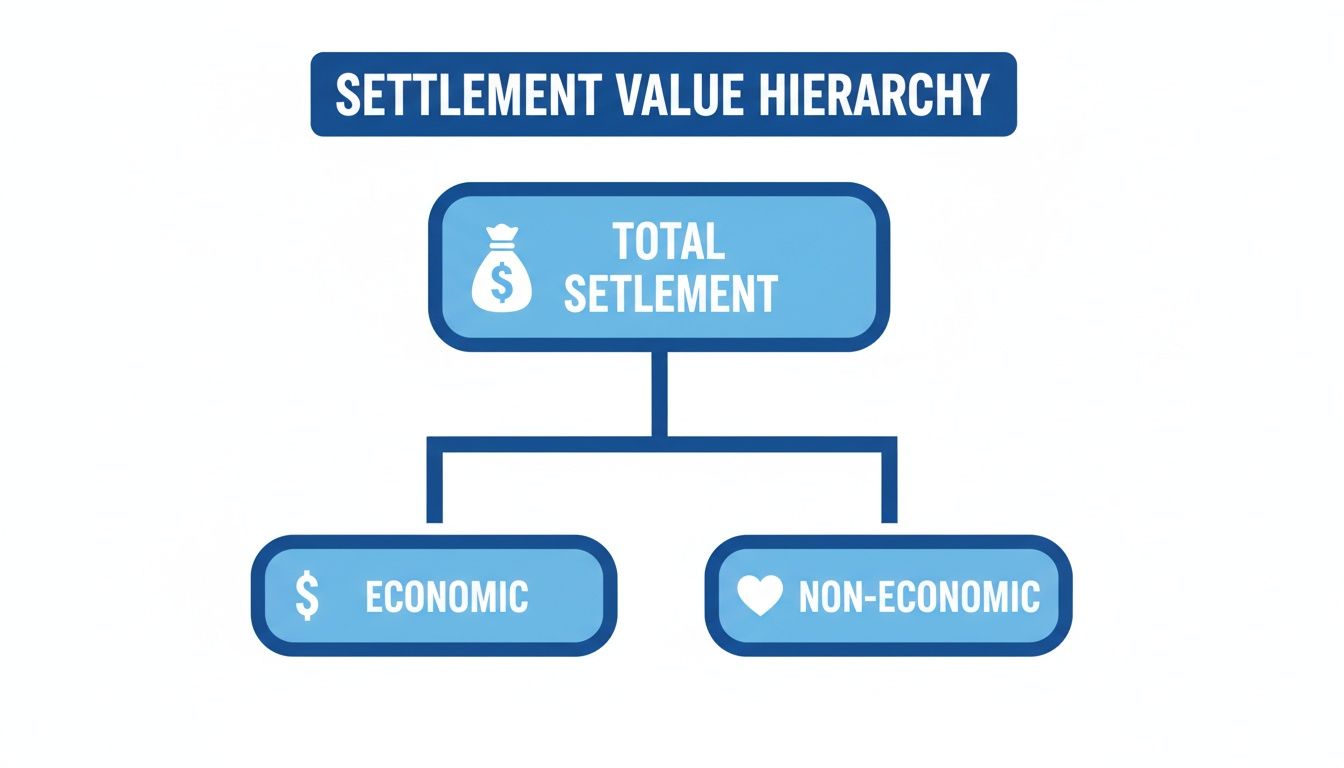
As you can see, your final compensation is built from two key pieces: the tangible, out-of-pocket financial losses (economic damages) and the very real, but less tangible, personal impact of the injury (non-economic damages).
Real Stories Behind Whiplash Settlements
The rules and formulas are one thing, but nothing makes sense of whiplash compensation quite like seeing how it plays out for real people. A settlement isn't just about a medical diagnosis; it’s about the full story of how that injury turned someone's life upside down.
Let's walk through a few scenarios based on common Florida accidents. You'll see how quickly the value of a claim can change based on the crash, the medical care required, and the very real disruption to a person's life.
The Minor Tampa Fender-Bender
Picture this: a classic low-speed bump in a busy parking lot, maybe at International Plaza in Tampa. The driver, we'll call her Maria, feels a jolt and some neck soreness but figures she’s probably fine. The next morning, she wakes up to a stiff neck and a throbbing headache.
Her doctor diagnoses a mild whiplash strain. All told, Maria needs a few physical therapy sessions over three weeks and has to miss a handful of shifts at her part-time retail job. Her own Personal Injury Protection (PIP) insurance covers the first chunk of her medical bills.
- Injury Impact: Mild pain, temporary stiffness, a few missed days of work.
- Medical Needs: One doctor visit and a short course of physical therapy.
- Settlement Focus: Making sure her co-pays and lost wages are covered.
- Outcome: Maria’s case would likely settle on the lower end, probably in the $7,500 to $15,000 range. The goal here is simple: to make her financially whole after a minor but still frustrating injury.
The Moderate Dale Mabry Highway Crash
Now, let's turn up the intensity. David is driving on Dale Mabry Highway when someone blows a red light and T-bones his car. The impact is serious, leaving him with immediate, sharp neck pain and dizziness.
An MRI confirms he has a moderate whiplash injury with ligament sprains and muscle damage. His recovery involves months of chiropractic care, physical therapy, and prescription pain medication. More importantly, it forces him to miss six weeks at his construction job, which is a huge financial hit.
Because David's doctor documented that his injury was permanent, he was able to step outside of Florida’s no-fault system to make a claim for pain and suffering. His settlement had to cover not just his medical bills that went way past his PIP limit, but also his significant lost income and the months of pain that kept him from working and living his life normally.
The Severe I-275 Truck Accident
Finally, a truly life-altering crash. Susan is on I-275 when her car is slammed from behind by a semi-truck. The sheer force causes a severe whiplash injury, leaving her with two herniated discs in her neck. She’s now dealing with chronic nerve pain shooting down her arm and debilitating migraines that just won't quit.
Her medical journey becomes a full-time job. It involves neurologists, pain management specialists, a series of epidural steroid injections, and eventually, the recommendation for cervical fusion surgery. The injury makes it impossible for her to return to her career as a graphic designer—she simply can't sit at a desk for long periods.
When an injury is this severe, the compensation has to account for a lifetime of consequences. It's not about past bills. It’s about future surgeries, ongoing pain management, a permanent loss of earning capacity, and the profound, irreversible impact on her quality of life.
This is where you see settlements reach well into the six figures, and sometimes more. Real-world case results show just how much these values can differ. For instance, one 61-year-old man who needed injections and neck surgery received a $550,000 settlement. In another case, a broadside collision that caused whiplash and sprains resulted in a $45,000 verdict.
You can explore more about whiplash settlement compensation payouts to see just how varied the outcomes can be. These stories drive home one crucial point: meticulous documentation and a solid legal strategy are everything when it comes to getting a fair result.
Actionable Steps to Protect Your Whiplash Claim

The minutes and hours right after a car accident are chaotic, but what you do next can make or break your whiplash claim. Think of it as laying the foundation for a house—get it right from the start, and everything that follows is stronger. Every step you take helps build a solid, credible case that an insurance company simply can't ignore.
It's easy to feel lost and overwhelmed, but a methodical approach will ensure you don't miss anything. From getting a medical check-up to jotting down notes, each action pulls double duty: it helps you heal and protects your right to fair compensation. Let’s walk through the exact steps you need to take.
Seek Immediate Medical Attention
After a crash, your health is priority number one. Even if you feel okay, get checked out by a doctor. Whiplash is notorious for being a "delayed-symptom" injury, meaning the real pain might not show up for hours or even a few days.
What starts as a little neck stiffness can quickly turn into debilitating pain, migraines, and an inability to turn your head. Seeing a doctor right away creates an official, time-stamped record connecting the accident to your injuries—something that is absolutely crucial for your claim. In Florida, there's another pressing reason: the 14-day rule.
You have to get initial medical treatment within 14 days of the accident to even qualify for your own Personal Injury Protection (PIP) benefits. If you wait, you could lose access to the $10,000 in coverage you’ve been paying for.
Document Everything Meticulously
Evidence is the heart and soul of any injury claim. The more you have, the stronger your negotiating position. Memories fade, but pictures and notes don't lie.
Here’s what your evidence checklist should look like:
- Photos from the Scene: Snap pictures of everything—the damage to both cars, the road conditions, any skid marks, and even any visible cuts or bruises on yourself.
- Official Paperwork: Make copies of the police report, your initial medical evaluation, and every single bill or receipt that comes your way.
- A Personal Journal: This is more powerful than you might think. Every day, write down a few notes about your pain level, what you can't do that you normally could, and how it’s messing with your life. Did you have to miss your kid's game? Couldn't do the grocery shopping? Write it down.
This journal tells the story of your suffering in a way that sterile medical records never can. It puts a human face on your pain and gives real weight to the "pain and suffering" part of your settlement.
Follow Your Doctor’s Orders Exactly
When your doctor gives you a treatment plan, follow it to the letter. Go to every physical therapy appointment. Take your medication as prescribed. Don't miss your follow-ups. If you start skipping appointments, the insurance adjuster will pounce on it.
They’ll argue that you must not have been that hurt if you weren't committed to getting better. Sticking to your treatment plan shows how serious your injuries are and proves you're doing your part. This is also critical for reaching what's known as maximum medical improvement—the point where your doctors agree you've recovered as much as you're going to, which is a key moment for calculating your claim's final value.
Be Cautious When Speaking to Insurers
You have to report the accident to your own insurance company, but that’s where it should stop for now. Be incredibly careful when talking to the other driver’s insurance company. Their adjusters are trained to ask for a recorded statement, hoping you’ll say something—anything—that they can use to downplay your injury or pin some of the blame on you.
Here's the key: you are under no obligation to give a recorded statement to the at-fault driver's insurer. The best response is to politely decline and tell them your attorney will be in touch. Just stick to the absolute basic facts of when and where the accident happened. Don’t get into a discussion about fault or how you’re feeling until you've spoken with a lawyer. A single misplaced word can be used to slash your final compensation.
Why a Skilled Attorney Is Your Strongest Advocate
Trying to handle a whiplash claim by yourself pits you directly against insurance adjusters. These aren't just customer service reps; they are highly trained professionals whose entire job is to protect their company’s profits by paying out as little as possible. That's a tough battle to fight alone.
This is exactly why bringing in a skilled personal injury attorney can completely change the game. A good lawyer is more than just someone who files forms—they become your strategic partner, dedicated to building a rock-solid case that aims for the full compensation you truly deserve. It’s how you level the playing field.
Building Your Case for Maximum Value
One of the first things a good attorney does is figure out what your claim is actually worth. It's not as simple as just adding up the medical bills you have so far. A thorough valuation means looking at the bigger picture, often by working with medical experts to forecast the costs of future treatments, whether that's months of physical therapy or even surgery down the road.
They also dig deep to document every single way this injury has impacted your life. This involves:
- Gathering powerful evidence: They'll get testimony from your doctors to clearly explain the long-term effects of the whiplash injury.
- Demonstrating lost earning capacity: It's not just about the paychecks you've missed. They work to prove how this injury could limit your ability to earn an income in the future.
- Telling your story: They compile the evidence needed to paint a clear, compelling picture of your daily struggles, which is the foundation of a strong pain and suffering claim.
Insurance adjusters are masters at using your own words against you, especially during recorded statements. A smart lawyer takes over all communication, protecting you from these traps and making sure you don't accidentally say something that hurts your case.
A Proactive Approach to Negotiation and Litigation
An experienced attorney knows all the tricks in the insurance company's playbook—the delays, the lowball offers, and the outright denials. Because of this, they prepare every single case from the very beginning as if it's headed for a jury trial.
That preparation sends a powerful message: we're serious, and we won't be pushed around. This willingness to go to court is what gives your lawyer real leverage in negotiations, often forcing the insurer to come to the table with a much better settlement offer. In the end, your attorney is the advocate in your corner, fighting to make sure you get what's fair.
If you're considering your options, it's worth learning more about the benefits of hiring a personal injury lawyer and how the right legal partner can make a critical difference.
Common Questions About Florida Whiplash Claims
After a car wreck, it’s only natural for your mind to be racing with questions. Let's walk through some of the most common concerns we hear from people dealing with whiplash injuries in Florida.
How Long Do I Have to File a Whiplash Lawsuit?
In Florida, there's a strict deadline for filing a personal injury lawsuit, and it’s called the statute of limitations. You generally have two years from the date of the accident to take legal action.
If you let this two-year window close, you will almost certainly lose your right to pursue compensation in court, no matter how strong your case is.
Is My Whiplash Case Going to Court?
It's a common fear, but the reality is that most whiplash claims never see the inside of a courtroom. The vast majority are settled out of court through direct negotiations between your attorney and the insurance company.
A good lawyer prepares every single case as if it's heading to trial. This meticulous preparation is what often convinces the insurance company to come to the table with a fair settlement offer, because they know you're serious.
We always aim to get you a fair settlement without a drawn-out court battle. But funny enough, it's our readiness and willingness to go to trial that often pressures an insurer to make their best offer.
What if the At-Fault Driver Is Uninsured?
This is a scary but surprisingly common situation. If the driver who caused your accident doesn't have insurance—or doesn't have enough to cover all your medical bills and lost wages—you're not necessarily out of luck.
Hopefully, you have Uninsured/Underinsured Motorist (UM/UIM) coverage on your own auto insurance policy. This is an optional but incredibly valuable protection designed for this exact scenario, allowing you to file a claim with your own insurer to cover the gap.
If you're trying to figure out what to do after a whiplash injury, you don't have to do it alone. The team at Martin Hernandez, P.A. is here to give you straight answers and the strong legal support you need.
Contact us to get a clear picture of your rights and learn how we can help you get the compensation you deserve. You can find more information on our website at https://injurylawyersoftampa.com.