
It’s the first question on everyone’s mind after a crash: “How much is my car accident case worth?” There’s no simple, one-size-fits-all answer. The truth is, the value of your case depends entirely on your specific financial losses, how badly you were hurt, and the real-world impact the accident has had on your life.
A minor fender-bender with a few bumps and bruises might resolve for a modest amount. But a collision that causes serious, life-altering harm? That’s a completely different story, and the value will reflect that.
Your Guide to Florida Car Accident Case Value

After a car wreck in Florida, your first priority is healing. But it doesn’t take long for the medical bills and financial worries to pile up, making it crucial to understand what your claim might actually be worth. Forget any idea of an automatic settlement calculator; every single case is different. Instead, your case’s value is meticulously pieced together by looking at several key factors.
Think of it like building a house. Your provable, out-of-pocket costs are the solid foundation. The more personal, human costs—like your pain and suffering—are the floors built on top of that foundation.
The Two Core Building Blocks of a Settlement
Every personal injury claim is built around two fundamental types of damages. Getting a handle on these two categories is the first step to seeing the full potential value of your case.
- Economic Damages: These are the black-and-white, tangible losses you can prove with a receipt or a pay stub. We’re talking about all your medical bills, the income you lost from being out of work, and the estimated cost of any future medical care you’ll need. This is the concrete financial base of your claim.
- Non-Economic Damages: This is compensation for the very real, but less tangible, human cost of the accident. It covers your physical pain, emotional trauma, and the loss of your ability to enjoy your life and hobbies the way you used to.
For a case to have a higher value, you generally need a few things to line up: clear proof the other driver was at fault, significant injuries that required a lot of medical care, and enough insurance coverage available to actually pay the claim. If one of those pieces is missing, even a strong case can hit a ceiling.
The goal is to present a complete picture of everything you’ve lost—not just the bills you’ve paid, but the life you’ve endured. A skilled attorney knows exactly how to document and argue for both sides of that coin.
Settlement amounts can swing wildly depending on the details. Some sources suggest average settlements for more straightforward cases can range from modest amounts for minor injuries to significantly more for severe ones. However, these averages can be misleading because every case is unique. The huge range of potential outcomes is precisely why getting a professional evaluation of your specific Florida case is so important. You can learn more about average car accident settlement amounts in Florida from our detailed guide.
This gives you a realistic starting point. In the rest of this guide, we’ll break down each of these factors, showing you how they’re calculated and how Florida’s unique laws can change the final number.
Calculating the Tangible Costs of Your Accident
When we start figuring out what your car accident case is worth, we begin with the most straightforward part: the numbers. We’re talking about the concrete, calculable losses you’ve suffered because someone else was careless. These are called economic damages, and they represent every single dollar you’ve had to spend or have lost out on since the crash.
Think of it as building a case with a stack of receipts, bills, and pay stubs. This is the financial story of your accident, and it forms a solid foundation for your claim that insurance companies can’t easily argue with. Getting this part right is the first critical step toward a fair settlement.
Tallying Your Medical Expenses
The bills start piling up from the moment of impact. For most people, medical costs are the biggest and most significant piece of their economic damages. It’s absolutely crucial to keep a meticulous record of every single expense, no matter how minor it might seem at the time.
This isn’t just about the big hospital bill. A truly complete list includes everything:
- Emergency Services: That ambulance ride and the initial ER visit are often the first major costs to hit.
- Hospital Stays: If you were admitted for an overnight stay, had surgery, or needed intensive care, these expenses add up fast.
- Ongoing Treatment: This is a broad category covering all your follow-up visits with specialists, physical therapy sessions, chiropractic adjustments, and any other rehabilitation services.
- Future Medical Needs: This is a big one. If your injuries will require long-term care, future operations, or permanent medical equipment, we need an expert to project those future costs.
Here in Florida, your own Personal Injury Protection (PIP) policy acts as your first safety net. It covers the initial portion of your medical bills, regardless of who caused the accident. You can learn more about what PIP insurance in Florida covers to see how those immediate benefits work. But for serious injuries, you’ll blow past your PIP limits quickly, which makes documenting every last penny essential for your claim against the at-fault driver.
Accounting for Lost Income and Earning Potential
A serious car wreck doesn’t just hurt your body; it hits your wallet, too. When an injury keeps you from doing your job, the lost income can create a massive financial strain on your family. This is another major component of your economic damages.
You absolutely have the right to be compensated for every dollar of income you lost while you were out recovering. We calculate this using your pay stubs or other income proof for all the time you were forced to miss work.
But what happens if the injuries are permanent?
If a crash leaves you with a lasting disability that keeps you from returning to your old job or from earning what you used to, you can claim for diminished earning capacity. This is a complex calculation that projects the lifetime difference between what you would have earned and what you can now earn with your physical limitations.
For cases involving severe or long-term injuries, proving these future losses is critical. Sometimes, bringing in specialized medico-legal consultancy services can be a game-changer. They provide expert analysis and reports that give a clear, professional assessment of your prognosis, which is vital for proving these long-term financial damages.
Other Out-of-Pocket Costs
Finally, let’s not forget all the other “little” expenses that can add up to a surprisingly large number. This bucket includes the obvious cost of repairing or replacing your vehicle, but it also covers any other personal property that was destroyed in the wreck, like a cell phone, laptop, or car seat.
It also includes things like prescription co-pays, gas money for driving to and from doctor’s appointments, and even the cost of modifications to your home if you’re dealing with a new disability. Every single receipt is a piece of the puzzle, helping to build the full picture of your tangible losses.
Putting a Price on Pain and Suffering
When you’re hurt in a car accident, some costs are easy to track. Medical bills, repair estimates, and lost paychecks all come with a clear price tag. But what about the costs that don’t have a receipt?
How do you calculate the value of sleepless nights from back pain, the panic attack that hits every time a car gets too close, or the frustration of not being able to pick up your grandchild? This is where non-economic damages, more commonly known as “pain and suffering,” enter the picture.
These damages are meant to compensate for the very real, but intangible, human cost of a car accident. They acknowledge the life that was disrupted—the suffering you’ve been forced to endure long after the twisted metal has been cleared away.
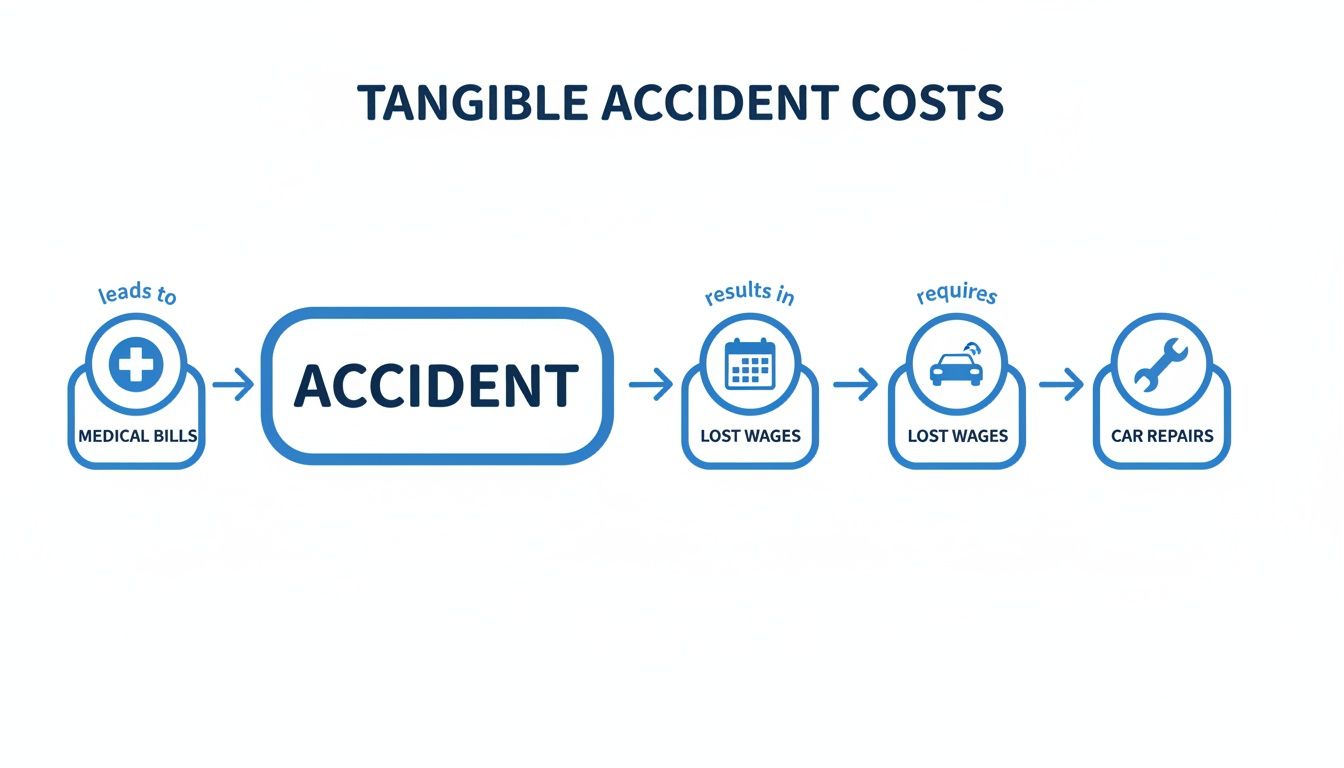
The tangible costs—medical bills, lost income, and car repairs—are just the starting point. They form the foundation for the rest of the calculation.
What Actually Counts as Pain and Suffering?
“Pain and suffering” is a catch-all legal term that covers the entire spectrum of physical and emotional harm you experience after a crash. It’s not just about the initial ache from your injuries; it’s about the ripple effect on your entire life.
Common types of these damages include:
- Physical Pain: This is the direct physical hurt from your injuries—both the immediate pain and any chronic conditions that linger for months or years.
- Emotional Distress: The trauma of a crash often leads to anxiety, depression, insomnia, and even Post-Traumatic Stress Disorder (PTSD). This is a very real part of your suffering.
- Loss of Enjoyment of Life: If an injury stops you from golfing on weekends, working in your garden, or playing with your kids, you deserve to be compensated for that loss.
- Permanent Impairment or Disfigurement: This covers life-altering outcomes like lasting scars, the loss of a limb, or any permanent disability that changes how you live.
This is why two people with identical medical bills can have vastly different case values. One person’s whiplash might heal completely, while another’s prevents them from ever returning to their career as a surgeon. The impact is what matters.
How Is a Value Assigned to All This?
Since you can’t get a receipt for anxiety or an invoice for chronic pain, attorneys and insurance companies in Florida have to use established methods to land on a fair number. The most common approach by far is the multiplier method.
Here’s how it works: you take the total of your “hard” economic damages (all your medical bills and lost wages) and multiply that figure by a number. This multiplier is usually somewhere between 1.5 and 5.
The multiplier isn’t random; it reflects the severity of your injuries and the impact on your life. A minor sprain that heals in a few weeks might get a 1.5 multiplier. A devastating injury requiring multiple surgeries and causing a permanent disability could easily justify a multiplier of 5 or even higher.
This is often the most heavily debated part of any settlement negotiation. The insurance adjuster will want to use the lowest multiplier possible, while your attorney will build a case to justify a much higher one. It comes down to telling your story effectively and backing it up with solid evidence from doctors, therapists, and even friends and family.
To get a better handle on the specifics, you can learn more about how to calculate pain and suffering damages in our more detailed guide.
How Florida’s Laws Shape Your Settlement
Figuring out the raw value of your damages is just the first step. To get a real sense of what your car accident case is worth, you have to see it through the lens of Florida law. The rules here in the Sunshine State can dramatically help—or hurt—your final settlement amount.
Think of these laws as a filter. They take the initial calculation of your losses and adjust it, sometimes significantly. A seasoned Tampa personal injury lawyer knows these rules inside and out and uses them to protect your claim. Not understanding them is like walking into a negotiation blindfolded; you risk leaving a lot of money on the table.
Florida’s No-Fault System and Your PIP Coverage
Florida is a “no-fault” state, a term that trips up a lot of people. It doesn’t mean fault is irrelevant. It simply means that for your initial medical bills, you turn to your own insurance first, no matter who caused the crash.
This is where your Personal Injury Protection (PIP) coverage comes in. It’s designed to get you quick access to money for medical care and lost wages, typically up to a $10,000 limit. For a minor fender-bender, that might be enough. But for anything serious, that $10,000 can evaporate in the blink of an eye.
To go beyond your PIP and file a claim against the at-fault driver for things like pain and suffering, you have to break through what’s called the “tort threshold.” Florida law says your injury must be serious enough to qualify. This means you must have suffered a:
- Significant and permanent loss of an important bodily function.
- Permanent injury (within a reasonable degree of medical probability).
- Significant and permanent scarring or disfigurement.
- Death.
If your injury meets one of these criteria, the door opens for you to pursue the full range of damages, including all those non-economic losses we covered earlier.
The Critical Impact of Modified Comparative Negligence
Here’s another Florida law that has a huge say in your final payout: modified comparative negligence. This rule comes into play when there’s a question of shared blame for an accident. It dictates how your own percentage of fault impacts what you can recover.
The concept is simple, but the cut-off is brutal. You can collect damages from the other party as long as you are found to be 50% or less at fault. Your total award is just reduced by your share of the blame.
For example, let’s say a jury decides your total damages are $100,000. But they also determine you were 20% responsible for the crash. Under Florida’s rule, your $100,000 award would be cut by 20% (or $20,000), so you would walk away with $80,000.
Now for the harsh part. If that same jury decides you were 51% or more at fault, your award drops to zero. You get nothing. This is precisely why insurance adjusters work so hard to pin even a little bit of the blame on you—every percentage point they can shift in your direction saves them money. A good lawyer’s job is to fight back against those tactics and prove the other driver was the one at fault.
Why Insurance Policy Limits Can Cap Your Recovery

After tallying up your medical bills, lost wages, and pain and suffering, you might arrive at a number that seems fair and just. But there’s a tough reality we have to confront in every personal injury case: a claim is ultimately only worth what you can actually collect.
The single biggest factor that can put a hard ceiling on your financial recovery is the at-fault driver’s insurance policy limit.
Let’s use a real-world example. Say your total damages from a catastrophic injury legitimately add up to $500,000. But the driver who hit you only has a $25,000 Bodily Injury liability policy. In that scenario, their insurance company is only on the hook for that $25,000—not a penny more.
This creates an enormous, often devastating gap between the true value of your claim and what you can get from their insurance.
The Problem of Underinsured Drivers in Florida
It’s a frustrating fact that many drivers in Florida carry only the bare minimum insurance required by law, and some carry none at all. When one of these drivers causes a serious crash, their policy is often just a drop in the bucket compared to the mountain of bills the victim is facing.
In the situation we just described, you’d be left with $475,000 in uncompensated damages. And while you can technically sue the at-fault driver personally for that amount, it’s usually a dead end. Someone carrying a low-limit policy rarely has the personal savings, property, or assets to satisfy a large judgment.
This is a critical point to understand when asking, “How much is my car accident case worth?” The answer is often limited not by the severity of your injuries, but by the amount of available insurance coverage.
This is why having a strong case on paper isn’t always enough. A big part of an experienced attorney’s job is to play detective, hunting down every possible source of recovery to bridge that gap.
Your Best Defense Is Your Own Insurance Policy
This is precisely where your own auto insurance policy can become your most important lifeline. Having Uninsured/Underinsured Motorist (UM/UIM) coverage is the single best way to protect yourself and your family from this exact scenario. It’s your financial safety net.
If the at-fault driver’s policy is too small to cover your damages, you can turn around and file a claim against your own UM/UIM policy to make up the difference.
Here’s how it helps you:
- It covers the shortfall when an underinsured driver’s policy is exhausted.
- It protects you if you’re hit by a driver with no insurance whatsoever.
- It applies in hit-and-run crashes where the at-fault driver is never found.
Without this coverage, you could be left with massive medical debt and uncompensated losses, even when the other driver was clearly 100% at fault. Understanding what bodily injury liability coverage is and why having a solid UM policy is so critical can make all the difference in your recovery. A skilled attorney will meticulously review every policy involved to ensure we find every dollar you are entitled to.
Navigating the Car Accident Settlement Process
Knowing what your car accident claim might be worth is just the first step. The real challenge is actually getting that compensation into your hands. This whole process is a journey, not a sprint, and having a little patience will be your biggest advantage.
It’s tempting to jump at the first offer an insurance company throws your way, especially when bills are piling up. But you have to remember: the first offer is almost never the best one.
A quick settlement is usually a low settlement. Insurance adjusters are trained to recognize that you’re under a lot of stress. They often dangle a fast payout hoping you’ll take less than you deserve, just to have it over with. A careful, strategic approach takes time, but it’s the only way to make sure every last dollar of your damages is accounted for.
The Phases of a Car Accident Claim
The moment you bring an attorney on board, a systematic process kicks off to build the strongest possible case for you. Every single step is designed to reinforce your claim and prove why you deserve full and fair compensation.
- Initial Investigation: Your legal team hits the ground running. They’ll start collecting all the critical evidence—the police report, statements from anyone who saw the crash, photos of the scene and vehicle damage, and any traffic or security camera footage they can get their hands on.
- Medical Treatment Period: This is, without a doubt, the most important phase for both your health and your case. It is absolutely essential that you follow your doctor’s orders and go to every appointment until you reach what’s called Maximum Medical Improvement (MMI). MMI is the point where your condition is as good as it’s going to get, giving everyone a clear picture of your long-term needs.
- Building the Demand Package: After you hit MMI, your lawyer will gather up every medical record, bill, and pay stub to prove your lost income. All this documentation gets bundled into a formal demand package. This powerful document clearly lays out why the other driver was at fault and calculates the exact value of both your economic and non-economic damages.
Think of the demand package as the opening move in a high-stakes negotiation. It’s a detailed, evidence-backed story that tells the insurance company, “Here’s what happened, here’s how it devastated our client’s life, and here’s what you need to pay to make things right.”
Negotiation and Resolution
Once the demand package is sent, the back-and-forth really begins. The insurance adjuster will review everything and come back with a counteroffer, which will almost certainly be much lower than what you demanded. This is where a skilled attorney shines, using the evidence to dismantle the adjuster’s arguments and push them toward a number that is actually fair.
The timeline for resolving a claim can vary quite a bit. Most car accident cases tend to settle within 12 to 36 months, but simpler cases with minor injuries might wrap up in just six to nine months once medical care is finished.
What happens if the insurance company just won’t budge? If they refuse to offer a fair amount, the next step is filing a lawsuit. Don’t let that scare you—the vast majority of cases still settle long before they see the inside of a courtroom. Filing the suit is a strategic move that shows the insurer you mean business. You can learn more about the steps in a personal injury lawsuit to see what’s involved. Often, that legal pressure is exactly what’s needed to finally get the compensation you deserve.
Answering Your Top Questions About Florida Car Accident Claims
After a car wreck, your mind is probably swimming with questions. It’s a confusing time, and getting straight answers is the first step toward feeling in control again. Let’s tackle some of the most common questions we hear from our clients right here in Florida.
Can I Still Get a Settlement If I Was Partially at Fault?
Yes, absolutely. This is a huge point of confusion for many people, but Florida law is clear on this.
We operate under a modified comparative fault system. Think of it like a sliding scale. As long as you are not found to be more than 50% responsible for the crash, you can still recover money for your damages. The amount you receive is just reduced by whatever percentage of fault is assigned to you.
Let’s say a jury decides your case is worth $100,000, but they also find you were 20% to blame for the accident. Your final award would be reduced by $20,000, so you’d walk away with $80,000. The crucial part? If you’re found to be 51% or more at fault, you get nothing. That’s why it’s so important to have an advocate fighting back against any unfair blame the insurance company tries to pin on you.
Do I Really Have to Go to Court?
Probably not. The image of a dramatic courtroom trial is mostly for TV. The reality is that the vast majority of car accident cases—well over 90%—never see the inside of a courtroom. They’re settled through negotiations between your lawyer and the insurance adjuster.
A good attorney prepares every single case as if it’s heading to trial. That level of preparation is what gives them the leverage to negotiate a fair settlement without going to court.
Insurance companies want to avoid the time, expense, and uncertainty of a jury trial just as much as you do. A lawsuit is usually the last resort, only used when an insurer simply refuses to offer a fair settlement that truly covers your losses.
How Much Will a Car Accident Lawyer Cost Me?
This is the best news of all: you pay nothing out of pocket. Personal injury lawyers in Florida work on what’s called a contingency fee basis.
What does that mean? No retainers, no hourly bills, no upfront costs whatsoever. You can focus completely on your recovery.
Your attorney’s fee is simply a percentage of the final settlement or award they win for you. It’s all agreed upon in advance. The most important part of this arrangement is that if you don’t get paid, neither does your lawyer. It ensures everyone has access to top-tier legal help, no matter their financial situation after a crash.
Figuring out what your car accident case is truly worth isn’t a simple calculation; it takes a professional analysis of every detail of your specific situation. If you’ve been hurt in the Tampa area, the team at Martin Hernandez, P.A. is here to fight for the full and fair compensation you’re owed. Get in touch with us today for a free, no-obligation case review.