
When you’re trying to file a personal injury claim, the whole process really boils down to this: document everything. From the second the incident happens, every detail you can meticulously record helps build the foundation for getting the compensation you deserve.
What To Do Immediately After an Injury in Florida
The moments right after an injury are a total blur. You’re dealing with pain, confusion, and a rush of adrenaline. But what you do in these first few minutes and hours is absolutely critical, both for your health and for any potential personal injury claim. Getting these first steps right protects your well-being and locks in crucial evidence.
Your immediate focus should always be on safety. If you’ve just been in a car crash, try to move to a safe spot off the road if you can, but never leave the scene. If you slip and fall in a store, it’s often best not to move at all if you’re seriously hurt; just wait for help to arrive.
Seek Prompt Medical Care
This is non-negotiable. Your health comes first, period. Even if you think you just have a few bumps and bruises, you need to get a medical evaluation right away. So many serious injuries—whiplash, internal bleeding, even traumatic brain injuries—don’t show obvious symptoms at first.
Seeing a doctor isn’t just about getting treatment; it creates an official, time-stamped record of your injuries. This medical report becomes one of the single most powerful pieces of evidence you can have, directly linking your physical harm to the incident.
I can’t stress this enough: waiting days or weeks to see a doctor is a gift to the insurance company. They’ll argue your injuries couldn’t have been that bad or that something else must have caused them. A prompt medical exam shuts down that argument before it can even start.
Report the Incident Officially
Next up, you need an official report. This is what validates the “who, what, when, and where” of your injury. How you do this depends entirely on the situation.
- Vehicle Accidents: Always, always call 911. A police officer will come to the scene, take statements, and create an official crash report. This document is a goldmine of information, capturing driver details, witness accounts, road conditions, and often a preliminary assessment of who was at fault. We’ve put together a more detailed checklist on what to do after a car accident that you might find helpful.
- Premises Incidents: If you get hurt on someone else’s property—a slip-and-fall at a Publix or tripping over a broken step at an apartment complex—find the manager or owner immediately. Insist that they create a written incident report and make sure you get a copy before you leave.
This simple flowchart breaks down those crucial first moves after an injury.
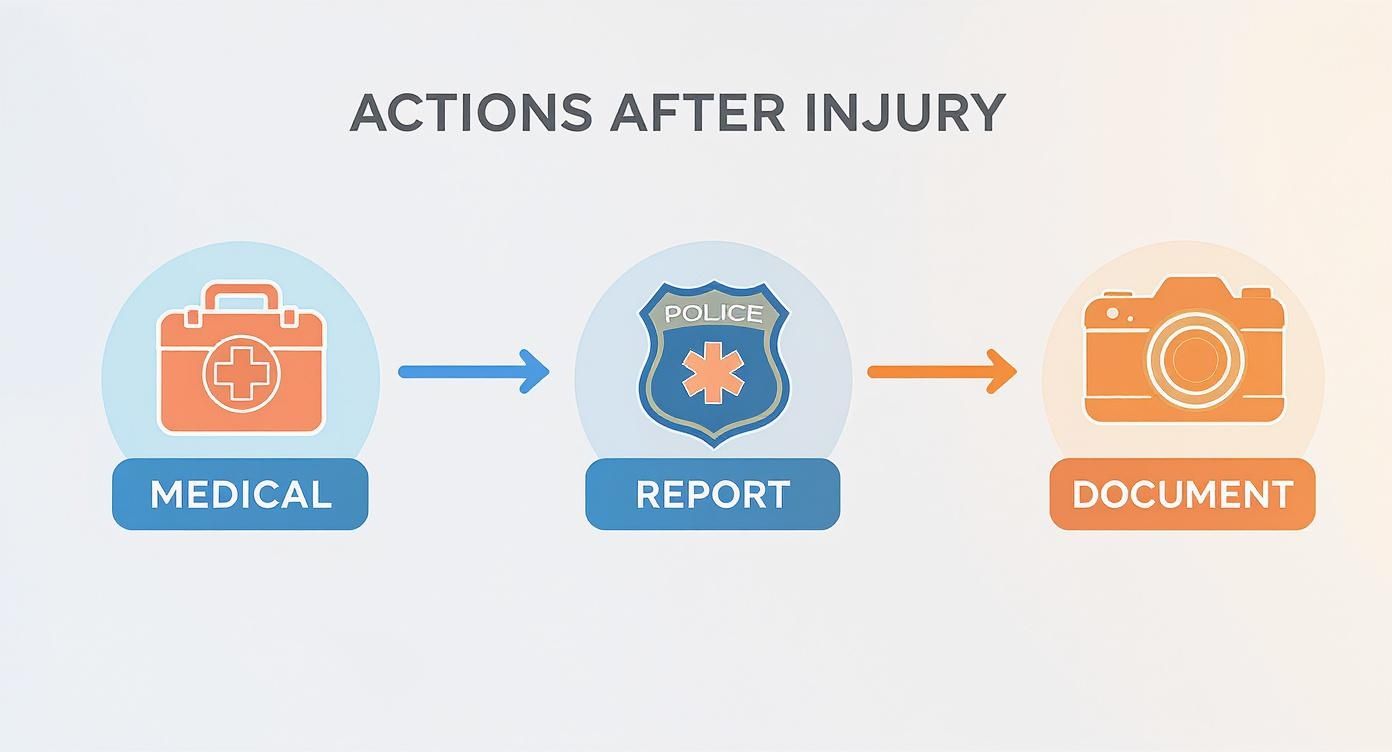
Following this sequence—health first, then official report, then evidence—lays the groundwork for a much smoother claims process down the road.
Document Everything at the Scene
If you’re physically able, turn your smartphone into your best investigative tool. Memories get fuzzy and evidence disappears fast, so capturing the scene exactly as it was is invaluable. Snap photos and take videos from every possible angle.
Make sure you get shots of:
- Whatever caused your injury (the puddle on the floor, the pothole, the mangled cars).
- Any visible injuries you have.
- The general area, including the weather, lighting, and any relevant signs or signals.
- For car crashes, the other driver’s license, insurance card, and license plate.
Also, be sure to get the names and phone numbers of anyone who saw what happened. An independent witness account can be incredibly powerful later on.
These steps are so important when you consider that a significant number of personal injury claims are filed every year in the U.S. Motor vehicle accidents make up a huge chunk of those cases. With that many claims being processed, having crystal-clear evidence from the very beginning makes yours stand out and proves its legitimacy from day one.
Building a Rock-Solid Evidence File for Your Claim
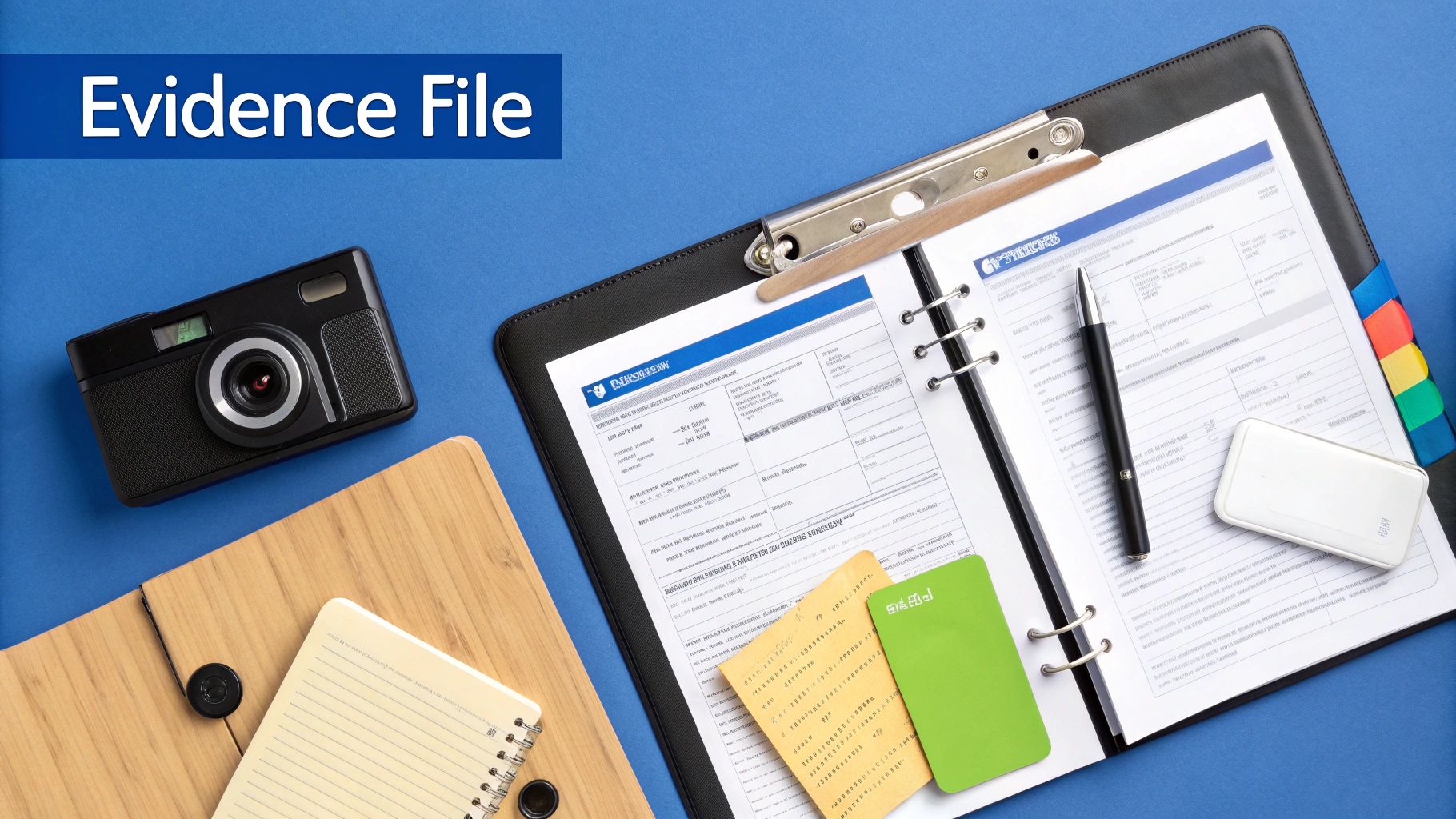
Once the dust settles after an accident, the real work begins. A strong personal injury claim isn’t built on assumptions; it’s built on a foundation of hard, organized evidence. This is the point where you shift from just reacting to the accident to proactively documenting every single way it has affected your life.
Think of yourself as the lead detective on your own case. Every receipt, photo, and note you gather is a crucial clue that tells the full story of your injury and its aftermath. This disciplined approach is absolutely vital for justifying the compensation you’re asking for.
Document Your Journey from Day One
The true impact of an injury goes far beyond the initial emergency room visit. It seeps into every corner of your daily life in ways you might forget weeks or months down the line. That’s why keeping a detailed journal from the very beginning is one of the most powerful things you can do.
Your journal needs to capture more than just physical symptoms. Try to make regular entries that describe:
- Your pain levels on a scale of 1 to 10.
- Specific things you can no longer do easily, like lifting groceries, walking the dog, or getting a good night’s sleep.
- The emotional fallout—any anxiety, frustration, or depression you’re experiencing.
- The life you’re missing out on, whether it’s family dinners, hobbies, or just time with friends.
This journal gives a voice to your experience. It turns the legal term “pain and suffering” into a real, day-by-day story that an insurance adjuster or jury can actually connect with. It shows the human cost of the accident in a way medical bills never could.
Gather Every Piece of Paperwork
Your financial losses, which we call economic damages, must be backed up with cold, hard proof. Get a dedicated folder—or create a digital one—and start collecting every single piece of paper related to your injury. Being organized from the start will save you massive headaches later.
Start a collection system immediately. Use a simple accordion file or a cloud storage folder labeled “Injury Claim.” Every time you get a new bill, receipt, or letter, file it right away. This habit prevents the last-minute scramble to find documents when you need them most.
Make sure your file includes:
- Medical Bills: Every last one. From the ambulance ride and ER visit to appointments with specialists, physical therapists, and chiropractors.
- Prescription Receipts: Don’t forget the receipts for medications, crutches, braces, or any other medical equipment you needed.
- Proof of Lost Wages: This is huge. You’ll need pay stubs from before the accident and an official letter from your employer confirming the exact dates and hours you missed from work.
- Travel Vouchers: Keep a log of your mileage or save receipts for Ubers to and from your doctor’s appointments. These small expenses add up quickly.
Secure Official Records and Statements
Beyond the documents you collect yourself, official reports and witness accounts add a serious layer of credibility to your claim. You’ll need to formally request these. Here in Florida, you can get a copy of the crash report from the Florida Highway Patrol or the local police department that handled the accident.
You also need to request your complete medical records from every single provider who treated you. These files contain the official diagnoses and treatment plans that prove the extent of your injuries. Finally, getting witness statements is critical. An account from an impartial third party who saw what happened can be incredibly powerful, backing up your side of the story and making it much harder for the other party to dispute.
For a deeper dive into this topic, you can learn more about what evidence to preserve after a car accident in Tampa in our detailed guide.
Communicating with Insurance Companies Effectively
Once your claim is filed, you’ll enter a new phase: dealing with the insurance adjuster. Let me be blunt—this is a delicate dance. Adjusters are trained professionals, and their job isn’t to be your friend; it’s to protect their company’s bottom line by paying out as little as possible.
Anything you say can and will be used against you. Knowing how to handle these conversations is absolutely critical. That first call with the adjuster really sets the tone for everything that follows.
Navigating the First Phone Call
You can bet that the at-fault party’s insurance adjuster will call you, and it will probably be sooner than you expect. They often try to reach you quickly, hoping to get to you before you’ve had a chance to think clearly or, more importantly, talk to a lawyer.
When that phone rings, keep your guard up and stick to the absolute basics. You can confirm your name, address, and where and when the accident happened. That’s it. Don’t get drawn into a conversation about who was at fault, how the accident happened, or how you’re feeling.
A simple, firm “I’m still under medical care and not in a position to discuss my injuries right now” is a perfect response. It’s polite, professional, and it shuts down a line of questioning that can only hurt you.
Never, ever agree to give a recorded statement without speaking to an attorney first. Adjusters use these recordings to lock you into a story, and they will pick it apart later looking for the tiniest inconsistency. Just say, “I won’t be providing a recorded statement at this time.”
Common Adjuster Tactics and How to Respond
From years of experience, I can tell you that insurance adjusters have a playbook they follow to weaken claims. They are counting on the fact that you’ve never been through this before. Recognizing their moves is the best way to protect yourself.
Here are a few of the most common tactics you’ll see:
- The Quick Settlement Offer: They might dangle a check in front of you within days of the accident. When you’re out of work and medical bills are rolling in, this can feel like a lifeline. It’s not. It’s a trap, and it’s almost always a fraction of what your claim is actually worth. They want to close your case before you understand the full extent of your injuries.
- Requesting a Blanket Medical Authorization: The adjuster will send you a form and ask you to sign it, giving them access to your entire medical history. Do not sign this. This allows them to go on a fishing expedition, looking for any pre-existing condition they can use to argue that your current injuries are not from the accident.
- Downplaying Your Injuries: They will listen for any little thing you say. If you say you’re feeling “fine” or “a little better,” they’ll note it down. Even a simple, polite response can be twisted to argue that your pain and suffering isn’t as bad as you claim.
Learning to sidestep these tactics is a skill. For a deeper dive into these strategies, take a look at our guide on how to negotiate with insurance companies.
Keep Everything in Writing
After that first call, do yourself a huge favor and move all important communication to email. This creates a paper trail—a written record of every single conversation, request, and promise. It completely eliminates any “he said, she said” arguments down the road.
A great habit to get into is sending a quick email to summarize any phone call you do have. Something like: “Hi [Adjuster’s Name], just wanted to confirm our phone call today where you asked for copies of my initial medical bills. As discussed, I will get those to you.”
This simple step keeps everyone accountable and builds a detailed log of your interactions for your attorney. While every injury case has its own unique path, understanding the general process of filing an insurance claim can give you a solid foundation.
It’s important to understand the landscape you’re operating in. The vast majority of personal injury cases—about 95-96%—are settled out of court. This tells you that negotiation is where the battle is usually won or lost.
Here in Florida, the stakes are even higher. Our state’s personal injury case rate is significantly higher than the national average, making this a uniquely complex environment. Knowing this helps you see just how critical every conversation is to getting a fair result.
How to Write a Demand Letter and Negotiate a Fair Settlement

Once you’ve gathered all your evidence and your medical treatment has stabilized, it’s time to formally demand compensation. This happens through a powerful tool called a demand letter. Think of it as the official kickoff to settlement negotiations.
This letter is far more than just a note asking for money. It’s your opportunity to lay out your entire case in a clear, compelling narrative, showing the insurance company exactly why their client is at fault and what this injury has cost you—in dollars, in pain, and in life disruption.
Structuring Your Demand Letter
A strong demand letter is your opening argument. It needs to be logical, fact-based, and persuasive, leaving no doubt in the adjuster’s mind about the seriousness of your claim. Each section should build on the last, painting an undeniable picture of what happened and the damages you’ve suffered.
Here’s what a well-crafted demand letter should include:
- The Factual Narrative: Start with a clear, concise summary of how the accident occurred. State plainly why the other person was negligent and at fault.
- The Proof of Liability: This is where you connect your story to the evidence. Reference the police report number, quote a key witness statement, or point to a specific traffic violation to prove the other party’s responsibility.
- A Detailed Breakdown of Your Injuries: Describe your injuries exactly as they appear in your medical records. Detail the initial diagnosis, the treatments you endured, and what your doctors say about your long-term prognosis.
- A Complete List of Economic Damages: Itemize every single cost. This means attaching copies of medical bills, prescription receipts, and a clear calculation of your lost income. Precision is key here.
Presenting your claim this way shows the adjuster you’re organized, serious, and have done your homework. It immediately establishes a professional, no-nonsense tone for the negotiation to come.
Calculating Your Total Damages
This is the most critical part of your demand letter. You need to arrive at a specific, justifiable number that covers every penny you’ve lost and everything you’ve suffered.
Your total demand is a combination of two distinct categories:
- Economic Damages: These are the black-and-white financial losses. You’ll tally up every medical bill, the exact wages you lost from missing work, and any other expenses you paid out of pocket.
- Non-Economic Damages: This is compensation for the human cost of the injury—your physical pain, emotional distress, and the loss of enjoyment in your life. While this number is more subjective, it’s just as real and just as important.
Figuring out the value of non-economic damages is tricky. Insurance adjusters often rely on formulas, but the personal story you tell—backed by your pain journal and medical records—is what gives this number its true power. For a deeper dive into this crucial calculation, you can learn more about how to calculate pain and suffering damages in our dedicated guide.
Expect the First Offer to Be Low
I can’t stress this enough: the insurance company’s first offer will likely be a lowball. Sometimes, it’s so low it feels insulting. This is a standard tactic. They are testing you to see if you know what your claim is really worth. Never, ever accept a first offer without pushing back.
Navigating the Negotiation Process
After you send the demand letter, the adjuster will review your file and respond, almost always with a counteroffer that’s far below what you asked for. This is where the real work begins.
The key is to stay professional, patient, and firm. When you get that low offer, respond with a counteroffer of your own, calmly explaining again why your initial demand was fair. Point back to your evidence: the severity of your injuries, the stack of medical bills, the documented time off work.
This back-and-forth can be a grind, but it’s a standard part of the process. The vast majority of personal injury cases are settled this way, without ever needing to go to court. By demonstrating that you have a well-documented case and a realistic valuation, you significantly increase your odds of reaching a fair settlement that truly compensates you for everything you’ve been through.
Settle or Sue? Making the Right Call in Your Florida Injury Claim
Every personal injury claim eventually hits a critical juncture. The insurance company has laid its “final” offer on the table, and you’re left with a monumental decision: take the settlement, or take them to court?
This is, without a doubt, one of the most important choices you’ll make. It’s a classic head-versus-heart dilemma, weighing the certainty of a settlement against the possibility of a larger verdict from a jury.
Accepting a settlement means you know exactly what you’re getting and when. It’s faster, brings finality, and lets you close a difficult chapter. On the other hand, filing a lawsuit, while a much tougher road, can sometimes lead to a much better outcome if a jury really understands what you’ve been through. This isn’t a decision to take lightly—it’s a calculated risk that pits a sure thing against a potentially bigger reward, all while factoring in the time and stress a lawsuit demands.
The Clock is Ticking: Florida’s Statute of Limitations
Before you even think about your options, you need to know about the hard deadline hanging over your case. In Florida, the statute of limitations for most personal injury claims based on negligence was recently shortened to just two years from the date of the accident.
Let me be clear: this is a non-negotiable, absolute deadline.
If you don’t file a lawsuit within that two-year window, your right to seek justice in court is gone. Forever. It doesn’t matter how badly you were hurt or how clear the other party’s fault is. The courthouse doors will be shut for good.
This deadline is a weapon for insurance companies. They sometimes drag out negotiations, hoping you’ll lose track of time and miss the filing deadline. If that happens, your leverage disappears, and you’re stuck with whatever lowball offer they feel like giving you.
Weighing Your Two Paths: The Pros and Cons
The choice between settling and suing is about so much more than just the final dollar amount. It’s about your time, your emotional energy, and your tolerance for risk.
Let’s break it down into real-world terms.
- Settling Your Claim
- The Upside: It’s quick, certain, and way less stressful. You get the money you need to pay bills and move forward without the anxiety of a trial.
- The Downside: You might be leaving money on the table. The settlement is often less than what a sympathetic jury might award.
- Filing a Lawsuit
- The Upside: You have the potential to win a significantly larger award if the evidence is on your side. It also forces the at-fault party to be held publicly accountable.
- The Downside: Lawsuits are long, expensive, and emotionally draining. And here’s the biggest risk: there are no guarantees. You could go through the entire process and end up with nothing.
The truth is, very few personal injury cases ever see the inside of a courtroom. The vast majority of claims come from settlements, not trials. The process to resolve a claim can take anywhere from a few months to two years, highlighting why a faster settlement is often appealing.
Making a Strategic Decision
So, what’s the right move for you? It all comes down to the unique facts of your case. You and your attorney need to take a hard look at the strength of your evidence, the full extent of your injuries and losses, and the insurer’s final offer.
If the offer is fair and genuinely covers your medical bills, lost wages, and suffering, settling is usually the smart play.
But if the insurance company is stonewalling and refusing to offer a reasonable amount despite overwhelming proof, a lawsuit may be your only option. This is where having an experienced Tampa personal injury lawyer in your corner is non-negotiable. They can give you a realistic preview of what to expect from the personal injury lawsuit process in Tampa, help you weigh the risks and rewards, and guide you toward the decision that truly serves your best interests.
Your Top Questions About Florida Injury Claims Answered
When you’re trying to heal from an injury, the last thing you want is a mountain of confusing legal questions. It’s completely normal to feel overwhelmed. Getting straight answers is the first step toward taking back control. Let’s tackle some of the most common questions we hear from people just like you.
The legal landscape isn’t static, either. It’s always a good idea to be aware of major shifts that could influence your case, like the recent Florida Tort Reform changes, which have definitely shaken things up in personal injury law.
What if I Was Partially to Blame? Can I Still Get Compensation?
Yes, you usually can. Florida follows what’s called a modified comparative negligence rule. In plain English, this means you can still recover money even if you share some of the blame for what happened.
But here’s the crucial part: your final award gets reduced by your percentage of fault.
Let’s say a jury decides your damages are worth $100,000, but they also find that you were 20% at fault. Your award would be cut by $20,000, so you’d end up with $80,000.
Now, the “modified” part is a hard line in the sand. If a court determines you were 51% or more responsible for the incident, you get nothing. This is a massive change from the old law, and it makes proving the other party was mostly at fault absolutely critical.
Do I Really Need to Hire an Attorney?
Legally, no one can force you to hire a lawyer. But going it alone is a huge gamble. Remember, you’re not just dealing with the person who hurt you; you’re up against a massive insurance company with a whole team dedicated to paying you as little as possible.
Bringing an experienced Florida injury attorney on board completely changes the dynamic. Here’s what they do for you:
- Figure Out What Your Claim is Really Worth: They know how to calculate everything—from future surgeries and lost earning potential to the real-world impact of your pain and suffering.
- Handle the Headaches: A good lawyer manages all the deadlines, complicated paperwork, and back-and-forth with the insurance company so you don’t have to.
- Fight Back Against Lowball Offers: They’re professional negotiators who know all the insurance adjusters’ tricks and won’t be intimidated into accepting an unfair settlement.
It’s a well-documented fact: people who hire a personal injury lawyer consistently walk away with significantly more money than those who try to handle it themselves. This is true even after you account for the attorney’s fee.
What Does a Personal Injury Lawyer Cost? I Can’t Afford That.
This is the number one worry we hear, and the answer is usually a relief. Nearly every reputable personal injury lawyer in Florida works on a contingency fee basis.
It’s a simple, risk-free model for you:
- It costs you nothing out of pocket to hire the attorney.
- The lawyer’s fee is just a percentage of the money they win for you.
- If they don’t get you a settlement or win your case at trial, you owe them zero in attorney fees.
This system puts you and your lawyer on the same team. Their success is tied directly to yours, which is exactly how it should be. It gives you access to top-tier legal help without any upfront financial burden, letting you focus on what matters most—your recovery.
If you’ve been hurt and don’t know where to turn, you aren’t alone. At Martin Hernandez, P.A., we approach every case as if it’s going to trial. This aggressive preparation puts our clients in the strongest possible negotiating position. Contact us for a free, no-pressure consultation to discuss your rights. Visit us at https://injurylawyersoftampa.com to see how we can fight for you.