
When you’re trying to figure out how to file a wrongful death lawsuit, the first thing to grasp is what it actually means under Florida law. Essentially, you’re building a case to show that a person’s death was a direct result of someone else’s wrongful act, negligence, or default. This isn’t a criminal case—no one is going to jail. Instead, it’s a civil claim designed to secure financial justice for the family members left behind and for the estate of the person who passed away. The lawsuit itself has to be filed by a court-appointed personal representative on behalf of all the survivors.
Understanding Wrongful Death in Florida

When your family is reeling from the sudden loss of a loved one, the last thing you need is a crash course in confusing legal jargon. Let’s break it down. At its heart, a wrongful death claim in Florida is a civil action, which means the goal is to hold the responsible person or company financially accountable for the ripple effects of their actions.
The foundation of any wrongful death case is proving that the death was caused by someone else’s mistake. This could be a wrongful act, simple negligence, or even a breach of contract or warranty. This covers a huge range of heartbreaking scenarios, from a fatal car accident or a surgical error to a faulty product or an unsafe condition on someone’s property.
The Core Elements of a Claim
To have a successful claim, you have to prove a few key things. It’s not enough to show that a death happened; you must draw a clear, direct line from the at-fault party’s actions to the fatal outcome.
Here are the essential pieces of the puzzle:
- A Duty of Care Was Owed: The defendant had a legal responsibility to act with a certain level of care. Think of a driver on the road—they have a duty to operate their vehicle safely.
- The Duty Was Breached: They failed to live up to that responsibility, either through a careless mistake or an intentional act.
- Causation: This failure, or breach of duty, is what directly caused the fatal injuries.
- Damages: The death resulted in tangible losses—both financial and emotional—for the surviving family and the estate.
Getting a handle on these points is the very first step in moving forward with a wrongful death lawsuit.
Proving Negligence Is Key
The legal idea of negligence is the engine that drives most wrongful death claims. It simply means the at-fault party didn’t act like a reasonably careful person would have in the same situation, and that failure caused the death. To build a solid case, it’s absolutely vital to have a clear picture of the medical evidence. It can be helpful to start by understanding the difference between cause and manner of death, as these terms are fundamental to any death investigation. For a closer look at how this works in our state, you can learn more about what negligence is here: https://injurylawyersoftampa.com/what-is-negligence-in-a-personal-injury-case/
Traffic accidents, unfortunately, remain one of the most common reasons for these lawsuits. In the first half of 2023 alone, the state of Florida saw approximately 1,780 traffic fatalities. While that number is staggering, it also highlights just how often these preventable tragedies occur on our local roads and highways.
A wrongful death claim provides a path for families to seek answers and accountability. It acknowledges that the loss was not just a tragic accident but a preventable event caused by another’s failure to act responsibly.
This is a critical distinction. A criminal case like manslaughter is about punishing the wrongdoer. Your civil claim is about providing for your family’s future and finding a measure of justice for your profound loss.
Who Can File a Claim and Florida’s Strict Deadlines
https://www.youtube.com/embed/DWma7-Dy-oE
When a family is reeling from an unexpected loss, the last thing on anyone’s mind is legal procedure. But Florida law has very specific rules about who is allowed to step forward and file a wrongful death lawsuit. Getting this right from the very beginning is absolutely critical.
A lot of people assume that any immediate family member—a spouse, a parent, or a child—can file the lawsuit. That’s a common and understandable mistake, but in Florida, it’s not how it works. The only person with the legal authority to file the claim is the personal representative of the deceased person’s estate.
The Role of the Personal Representative
Think of the personal representative as the legal voice for the estate and for all the survivors. This person is responsible for bringing the lawsuit on behalf of everyone who has been impacted by the loss.
So, how is this person chosen?
- Named in a Will: If your loved one had a valid will, they most likely named a personal representative (sometimes called an executor) in the document. The court will almost always honor that designation.
- Appointed by the Court: When there is no will, the court steps in to appoint someone. Florida Statutes provide a clear order of preference, which usually starts with the surviving spouse, followed by adult children, and then other relatives.
Once the court officially appoints them, the personal representative manages the lawsuit, works with the attorneys, and, if the case is successful, distributes the financial recovery to the survivors as directed by Florida law.
The Clock Is Ticking: The Statute of Limitations
Beyond figuring out who can file, you have to be acutely aware of the when. There’s a non-negotiable deadline called the statute of limitations, which sets a final time limit for filing a lawsuit. For the vast majority of wrongful death cases in Florida, you have just two years from the date of death to get your claim filed with the court.
This two-year window isn’t a suggestion—it’s a hard and fast rule. If you miss it, even by a single day, the court will almost certainly throw your case out, no matter how clear the evidence is.
This tight deadline is why you can’t afford to wait. Building a compelling wrongful death case takes time. We need to investigate, gather evidence, consult with experts, and draft the necessary legal filings. Delaying can seriously jeopardize your family’s ability to seek justice. The deadlines for other types of injury claims can vary, which we cover in our guide on how long you have to file a suit after a Florida auto accident.
Are There Any Exceptions to the Deadline?
While that two-year rule feels absolute, a few very rare exceptions exist that might “toll,” or pause, the clock. For example, in some complicated medical malpractice situations, the “discovery rule” could come into play. This means the two-year period might not start until the family discovered, or reasonably should have discovered, that a medical error was the cause of death.
Another potential exception could be a case where the defendant actively and fraudulently hid their involvement. But I have to be clear: relying on these exceptions is extremely risky and they are very difficult to prove. The safest and smartest strategy is to operate as if the two-year deadline is set in stone. The goal isn’t to create panic, but to underscore the urgency of taking action to protect your family’s rights.
Gathering Evidence to Build a Powerful Case
A wrongful death lawsuit isn’t won on grief or emotion. It’s won with cold, hard facts. To get justice for your family, we have to build a case so strong that it’s undeniable, proving that another person’s negligence directly caused your loved one’s death. This process of gathering evidence starts on day one, sometimes long before a lawsuit is ever officially filed.
Think of it like building a bridge. On one side, you have the negligent act. On the other, the profound loss your family has suffered. Every document, photograph, and witness statement is a crucial piece of that bridge, connecting the two sides and leaving no room for doubt.
The Essential Paperwork to Secure
The foundation of any wrongful death case is the official documentation surrounding the incident. Getting your hands on these records is one of the most critical first steps you can take. Your attorney will use them to lock down the core facts and timelines.
Here’s the key paperwork we always track down first:
- The Official Death Certificate: This is ground zero. It formally states the cause and manner of death, creating the primary link between the incident and the tragic outcome.
- Police or Incident Reports: If the death resulted from a car crash or a workplace accident, these reports are invaluable. They contain an officer’s initial findings of fault, contact information for witnesses, and often a diagram of the scene.
- Medical Records and Bills: We need a complete picture—every record from the moment of injury to the time of death. This includes ambulance run sheets, hospital charts, and the final medical bills that prove the financial costs of the injury.
- The Autopsy Report: This report provides a detailed, clinical explanation for the cause of death. Sometimes, if the circumstances are unclear, families may need to pursue independent investigations. For instance, ordering private autopsies due to wrongful death cases can uncover evidence that might otherwise be missed.
Proving What Your Family Has Lost
Evidence isn’t just about proving what happened; it’s about proving the full value of your loss. This means showing the tangible financial damages as well as the profound, intangible loss of your loved one’s presence.
For example, to demonstrate lost future income, we’ll collect years of your loved one’s pay stubs, W-2 forms, and tax returns. This financial history isn’t just a stack of paper; it’s the data an economic expert uses to project the lifetime of earnings your family will now go without.
Proving negligence is the absolute cornerstone of a wrongful death claim. Every single piece of evidence, from a simple cell phone photo to a complex expert analysis, is another brick in the foundation of your case for accountability.
Learning about the role of evidence in proving negligence in personal injury cases in Tampa can give you a better grasp of how all these pieces fit together to create a powerful legal argument.
The Power of Witnesses and Experts
Paperwork can only tell part of the story. The human element—from eyewitnesses who saw what happened to experts who can explain the science behind it—is often what convinces a judge or jury.
We will want to speak with anyone who can shed light on the incident or the impact of the loss. This includes eyewitnesses, of course, but also colleagues who can speak to your loved one’s career potential or friends who can describe the devastating loss of their companionship and support.
In many cases, an expert is absolutely necessary to translate complex information for the court.
- An accident reconstructionist can use physics to show exactly how a car crash unfolded and prove the other driver was at fault.
- A medical expert can testify that a surgeon’s mistake fell below the accepted standard of care, directly causing a patient’s death.
- An engineering expert might be needed to demonstrate how a faulty product design led to a fatal malfunction.
Ultimately, a wrongful death claim boils down to the evidence. The path to securing compensation for your family starts with meticulously gathering the proof needed to build an unshakable case.
What Is a Wrongful Death Claim Actually Worth?

After a tragic loss, families are often left wondering how to even begin picking up the pieces, let alone how to value a wrongful death claim. It’s a difficult conversation, but a necessary one. While no amount of money can bring back a loved one, the compensation is meant to provide financial security and hold the responsible party accountable.
In Florida, the law splits damages into two main buckets: losses suffered by the deceased’s estate and the personal losses suffered by the surviving family members. To get a complete picture, you have to meticulously account for every single loss, from the easily calculated bills to the profound, intangible pain of absence.
Damages Paid to the Estate
First, let’s talk about the estate’s claim. These are the direct financial hits the estate took as a result of the fatal injury. Think of these as the black-and-white, receipt-driven costs. A good attorney will gather and document every penny to build a strong foundation for the case.
Common damages that the estate can recover include:
- Final Medical Bills: Every cost from the moment of injury to the time of death is tallied up. This includes ambulance rides, ER treatment, surgical procedures, and hospital stays.
- Lost Income: This covers the wages, salary, and benefits the deceased would have earned between the time they were injured and when they passed away.
- Funeral and Burial Expenses: All reasonable costs associated with the funeral, burial, or cremation service can be recovered by the estate.
On top of these concrete costs, the estate can also claim “lost net accumulations.” This is a legal term for the savings and assets the deceased likely would have built up and left to their heirs if they had lived out their natural lifespan.
Damages Paid to the Family Survivors
This is where the calculation gets more personal and, frankly, more complex. While the estate’s damages are about money, the survivors’ damages are about the deep, human losses each family member has been forced to endure.
Florida law is smart about this; it recognizes that a spouse’s loss is different from a child’s loss. A surviving spouse, for instance, can claim damages for the loss of companionship, protection, and their own mental pain and suffering. Minor children can be compensated for losing a parent’s guidance, instruction, and love, along with the pain that comes with it. Getting a handle on how to calculate pain and suffering damages is a crucial step, as it attempts to value the profound emotional weight of the tragedy.
The core idea here is to compensate for the void left behind. For a child, it’s the empty chair at graduation. For a spouse, it’s the loss of a partner to navigate life with. The law tries to assign a value to these immense, life-altering losses.
A critical part of the lawsuit is identifying every eligible survivor and quantifying their unique suffering. These damages are designed to cover everything from the immediate financial burdens to the long-term emotional distress. While every case is different, verdicts can be substantial. For example, a Florida jury recently awarded $16 million in a wrongful death case stemming from a birth injury. Looking at settlements and verdicts in similar cases can provide some context, but your family’s story is unique. A full and fair calculation requires a detailed, compassionate analysis of how this loss has impacted every aspect of your lives.
What Happens After You File the Lawsuit?
Once your attorney files the wrongful death claim, the official legal process kicks into gear. This part can feel intimidating, but knowing what’s coming helps you prepare for the road ahead. Think of it as a series of steps, each designed to move your case closer to a resolution, whether that’s a fair settlement or a jury verdict.
Kicking Things Off: The Complaint and Service
The whole thing starts when we file a formal complaint with the Hillsborough County court. This isn’t just a simple form; it’s a carefully drafted legal document that tells your family’s story. It outlines what happened, who we believe is at fault, and the damages your family has suffered.
Filing the complaint is just the first domino. Next, the defendant has to be officially notified through a step called service of process. We’ll have a professional process server or a sheriff’s deputy hand-deliver a copy of the lawsuit to them. This ensures they can’t claim they never knew they were being sued. From that point, they typically have 20 days in Florida to file their official response with the court.
The Heart of the Case: The Discovery Phase
After the initial paperwork is handled, we enter what’s known as the discovery phase. Be prepared, as this is almost always the longest part of the lawsuit. It’s where both sides lay their cards on the table by exchanging information and evidence. The goal here is simple: no surprises at trial.
We use a few key legal tools to dig for the truth:
- Interrogatories: These are basically written questions we send to the other side, and they have to answer them under oath. For example, we might ask a trucking company for a complete list of all prior safety violations for the driver involved in the crash.
- Requests for Production: This is our chance to demand documents. We’ll ask for everything from the at-fault driver’s cell phone records and the bar’s liquor receipts to a negligent doctor’s malpractice history.
- Depositions: This is where we get to question the defendant, key witnesses, and experts under oath, face-to-face, with a court reporter transcribing every word. Their lawyers will also get to depose the personal representative and other family members to understand the full impact of your loss.
- Requests for Admission: These are straightforward, yes-or-no statements we ask the other side to admit or deny. For instance: “Admit that the surgeon left the operating room before the patient was stable.”
Discovery is an exhaustive, meticulous process. It’s how we build the foundation of your case, piece by piece. For a deeper dive into how this all unfolds, you can review the personal injury lawsuit process in Tampa for a more detailed breakdown.
Trying to Find Common Ground: Mediation
Before a case can ever see the inside of a courtroom in Florida, it almost always has to go through mediation. This is a required step where we all sit down with a neutral third-party mediator—usually a retired judge or an experienced attorney—to try and negotiate a settlement.
The mediator’s job isn’t to pick a side but to help both parties see the risks of going to trial and find a path to an agreement.
Mediation is often the best chance to resolve a case without the stress and uncertainty of a trial. It’s a confidential, structured environment where we can have frank conversations about the case’s value and see if the insurance company is willing to be reasonable.
A successful mediation can provide your family with closure and the financial security you deserve. But if the other side isn’t negotiating in good faith or their offer is simply insulting, we have no problem walking away and preparing for court.
When All Else Fails: Going to Trial
If negotiations and mediation don’t lead to a fair settlement, the final step is trial. This is where we present your case to a jury of your peers. We’ll use all the evidence, witness testimony, and expert opinions gathered during discovery to prove that the defendant was negligent and should be held accountable.
A trial is a highly structured event, from opening statements and witness cross-examinations to the final closing arguments. It’s nothing like the quick dramas you see on TV; a real wrongful death trial can last for days or even weeks. It requires an incredible amount of preparation, but it is the ultimate way to get justice when a defendant refuses to accept responsibility for the harm they’ve caused.
Answering Your Wrongful Death Questions
Even after learning the basics, you’re going to have questions. That’s completely normal. When you’re dealing with something this heavy, the details matter. Let’s tackle some of the most common and pressing concerns we hear from families right here in Florida.
How Much Does It Cost to Hire a Wrongful Death Lawyer in Florida?
This is often the first question families ask, and the answer usually brings a wave of relief: you don’t need any money upfront to hire an experienced wrongful death attorney.
Nearly every personal injury and wrongful death lawyer in Florida, our firm included, works on a contingency fee basis.
This arrangement is simple. You pay us nothing unless we win your case. Our fee is a pre-determined percentage of the money we recover for you, whether that comes from a settlement or a trial verdict. If we don’t secure compensation for your family, you owe us nothing for the time and resources we invested. This system levels the playing field, ensuring every family can afford justice. Typically, this percentage is between 33.3% and 40%, depending on how far the case progresses.
Can I Sue if the Person at Fault Also Faces Criminal Charges?
Yes, absolutely. This is a critical point that many people miss. A civil wrongful death lawsuit and a criminal case are two completely separate tracks in the legal system. They run in parallel but have different goals.
- Your Civil Case: This is about securing financial compensation for your family’s losses—everything from lost income to the profound emotional pain. The standard of proof is lower; we only need to show a “preponderance of the evidence,” meaning the defendant was more likely than not at fault.
- The State’s Criminal Case: This is handled by a prosecutor and aims to punish the defendant with jail time or fines. Here, the burden of proof is much higher: “beyond a reasonable doubt.”
A defendant can be found not guilty in criminal court but still be held liable for damages in your civil case. In fact, the evidence gathered for the criminal investigation can often be a goldmine for strengthening your wrongful death claim.
What if My Loved One Was Partially at Fault?
This is a very common scenario, especially in traffic accidents. Florida law addresses this with a rule called “modified comparative negligence,” which recently became much stricter.
The bottom line is that if your loved one is found to be partially responsible, your family’s compensation will be reduced by their percentage of fault. For example, if a jury awards $1 million in damages but decides your family member was 20% at fault, the final award would be cut to $800,000.
Here’s the crucial part of the new law: if your loved one is found to be more than 50% at fault, your family may be blocked from recovering any damages. This is exactly why having an experienced attorney is so vital. We can fight to push back against unfair blame and protect your family’s right to recovery.
The infographic below outlines the typical journey of a lawsuit in Florida, from the initial filing to a potential trial.
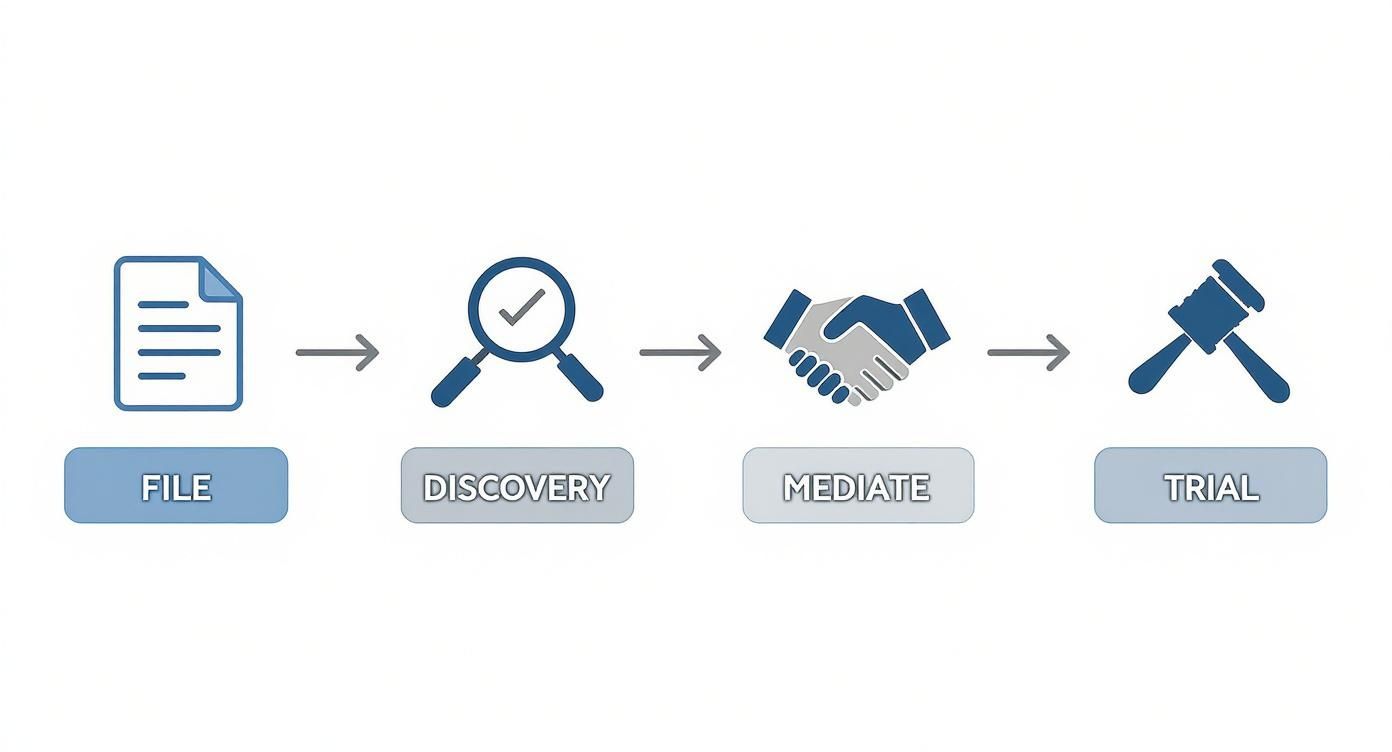
As you can see, the process has many steps, but it’s important to note that a huge number of cases are resolved through negotiation and mediation long before a trial ever becomes necessary.
What Is the Difference Between a Wrongful Death Claim and a Survival Action?
This is a legal distinction, but it has a real impact on how your family is compensated. In Florida, both claims are filed together in one lawsuit, but they cover two different types of losses.
The simplest way to think about it is this: the wrongful death claim compensates the family for what they lost, while the survival action compensates the estate for what the deceased person lost.
The wrongful death claim is for the survivors—the spouse, children, or other dependents. It’s meant to compensate for their personal losses, like their mental anguish, the loss of companionship, and the future financial support their loved one would have provided.
The survival action, on the other hand, belongs to the estate. It’s designed to recover the specific financial losses the deceased suffered between the moment of injury and the moment of death. This includes their last medical bills, lost wages during that time, and the costs of the funeral and burial.
Carrying the weight of a loved one’s death is more than anyone should bear, and you don’t have to navigate the legal aftermath alone. At Martin Hernandez, P.A., we combine compassionate support with fierce advocacy to help families find accountability and the financial security they deserve. To talk about your case with a dedicated Tampa wrongful death attorney, please contact us for a free, no-obligation consultation.