
What you do in the minutes and hours right after a crash can make or break your entire case. Before you even think about finding a lawyer, the actions you take at the scene are what lay the groundwork for getting the compensation you deserve under Florida law.
Your First Moves After a Tampa Accident
It’s chaos. Your adrenaline is surging, you’re shaken up, and it’s tough to think straight. But the steps you take right here, right now, are absolutely critical. They’re not just about protecting your health—they’re about preserving the evidence that will be the backbone of your personal injury claim.
First things first: your health. Nothing is more important. Even if you think you’re okay, some of the most serious injuries, like whiplash or internal bleeding, don’t show up for hours or even days. Getting checked out by a medical professional right away is non-negotiable.
Here in Florida, the clock is ticking immediately. You generally have just 14 days to get initial medical treatment to qualify for your Personal Injury Protection (PIP) benefits. If you wait, you could lose the ability to have your own insurance cover your medical bills.
A trip to the doctor or an urgent care clinic creates an official medical record. This paper trail is the single most powerful piece of evidence your lawyer will have to connect your injuries directly to the accident and prove your damages.
Document Everything at the Scene
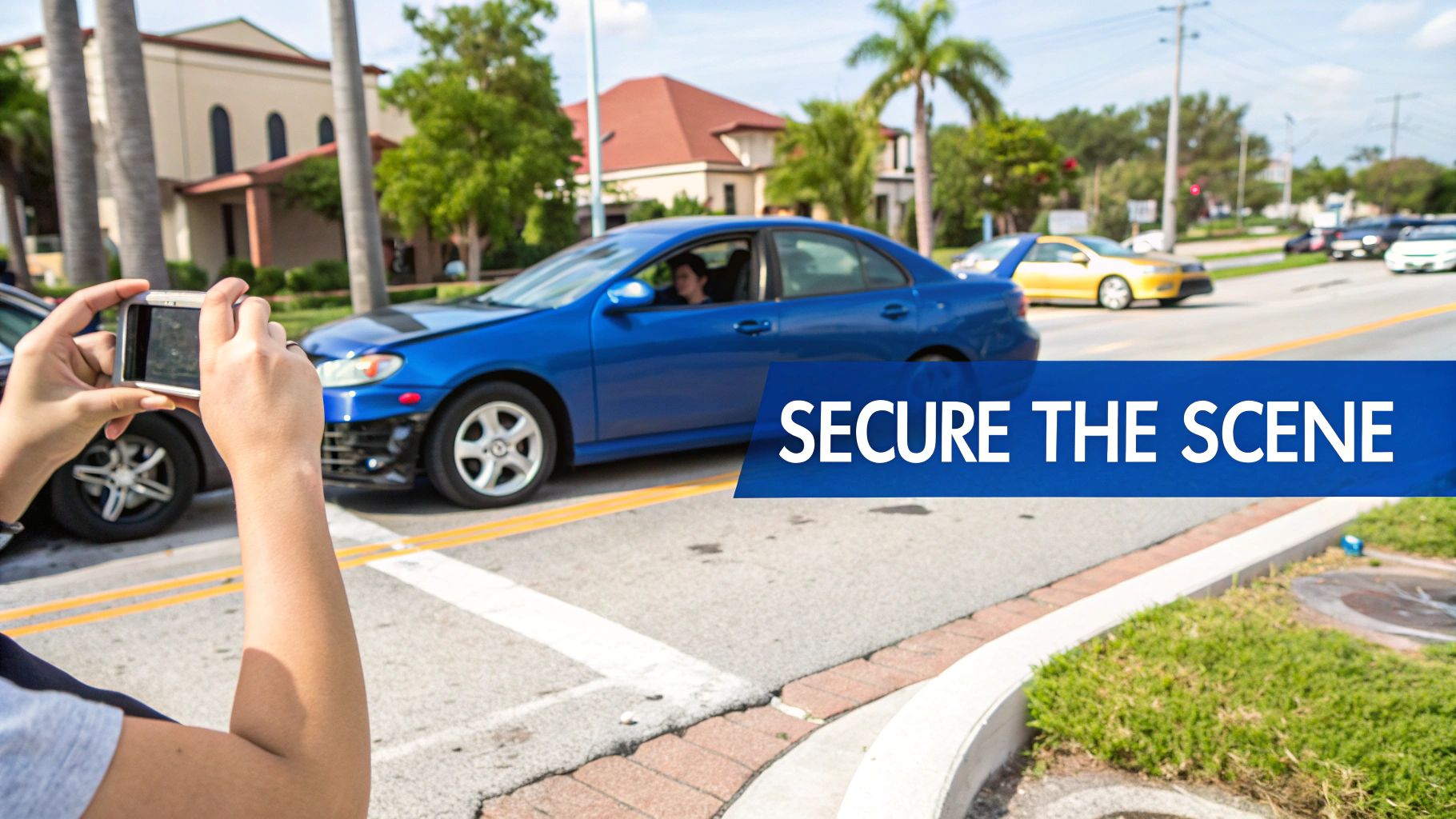
Your phone is your best friend right now. Before anyone moves the cars, start taking photos and videos. Get every angle you can think of—show where the cars ended up, snap pictures of the license plates, and get close-ups of the points of impact.
Zoom in on the damage to your car and the other vehicle. But don’t stop there. Look around and document the scene itself:
- Road Conditions: Are there potholes, construction zones, or slick spots?
- Traffic Signals: Capture any stop signs or traffic lights that were involved.
- Weather and Lighting: Note if it was raining, foggy, or dark.
- Skid Marks: Get clear pictures of any tire marks on the road.
This kind of visual evidence is gold. It helps accident reconstruction experts and your attorney put together the puzzle of how the crash really happened.
This chart lays out the three essential actions to take right away.
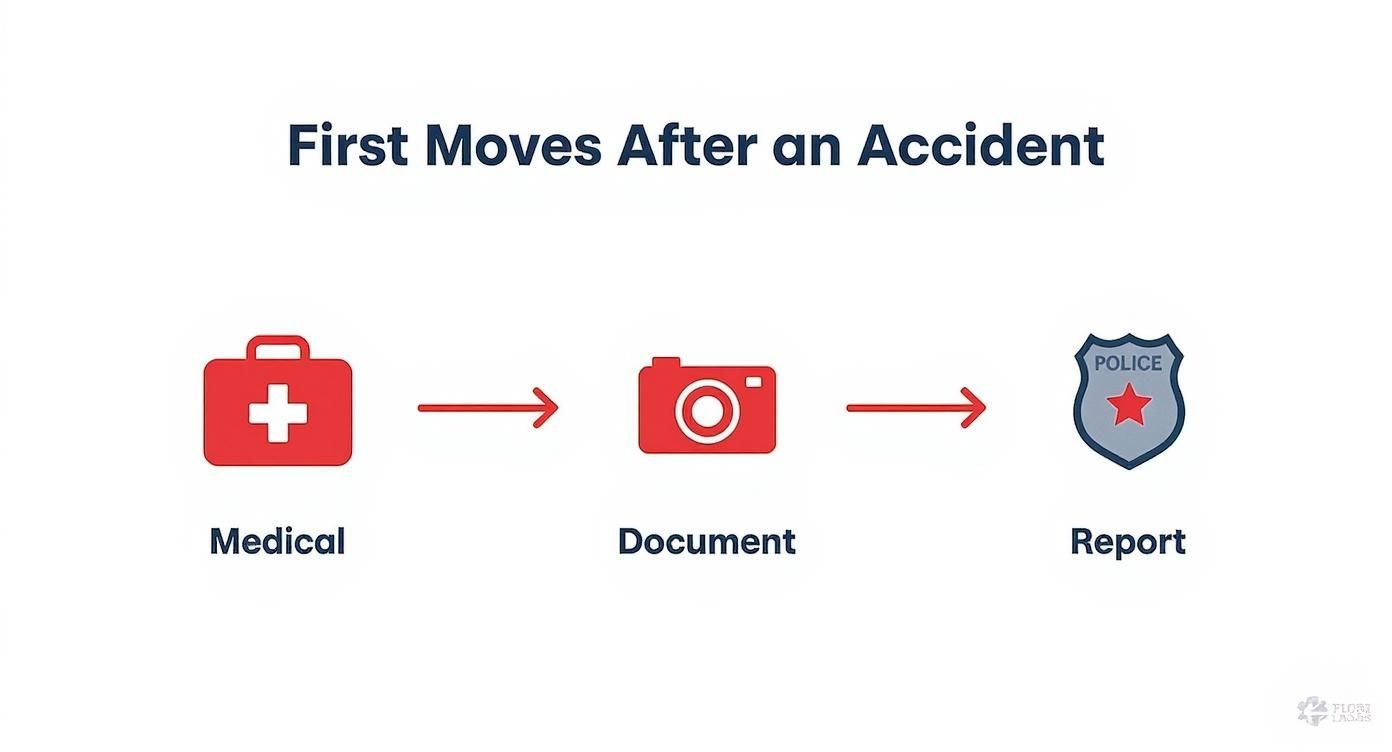
Think of it this way: medical care, evidence gathering, and official reporting are the three pillars you need to build a strong case.
The Importance of an Official Police Report
I don’t care if it’s a “minor” fender-bender—always call the police. An official police report provides an objective, third-party account of what happened. It’s packed with crucial details like driver statements, witness contacts, any tickets the officer wrote, and their initial opinion on who was at fault.
Insurance adjusters lean heavily on these reports. Without one, the other driver can easily change their story later, and your claim turns into a frustrating “he said, she said” battle. A police report gives your claim instant credibility.
These first steps are the foundation of your entire case. To dig deeper, you can learn more about what to do after a car accident in Tampa in our complete guide.
What to Look for in a Top Tampa Accident Attorney
After a crash in Tampa, you’re immediately bombarded with ads. Billboards, TV commercials, online banners—they all promise the world. But sorting through the noise to find a genuinely effective accident lawyer requires looking for specific, non-negotiable qualities.
This isn’t just about finding someone with a law degree. It’s about finding a dedicated advocate who lives and breathes Florida personal injury law and has a proven history of winning cases just like yours.
Relevant Experience and a Winning Track Record
First things first: you need a specialist. Personal injury law is a massive field, and you don’t want a “jack-of-all-trades” attorney who handles divorces one day and car accidents the next. A dedicated accident lawyer knows the insurance companies’ playbook inside and out and won’t be fooled by their lowball tactics.
Look for experience that mirrors your situation. Were you in a multi-car pileup on I-275? Hit by a delivery truck on Dale Mabry? Your attorney should have a deep well of experience with those exact scenarios.
A strong track record isn’t just about courtroom victories. In reality, most personal injury cases settle out of court. The real measure of success is a history of securing full and fair settlements that cover everything—medical bills, lost income, and the human cost of pain and suffering.
When you meet with a potential lawyer, ask them to talk about past results in cases similar to yours. A transparent, confident attorney will be able to discuss their experience without making guarantees about your outcome (which is a huge ethical red flag).
Remember, not all personal injury cases are created equal. Different types of cases have different success rates in court. This is why finding a lawyer whose specialty aligns with your specific accident case is absolutely critical.
The Home-Field Advantage: Local Tampa Knowledge
Don’t underestimate the power of local expertise. Hiring an attorney who regularly practices in Hillsborough County courts gives you a serious strategic advantage. They know the local judges, understand their tendencies, and have a feel for what arguments will connect with a Tampa-area jury.
This local insight also extends to the other side of the table. An established Tampa lawyer often has working relationships with the local insurance adjusters and defense attorneys. This familiarity can cut through the posturing, streamline negotiations, and ultimately lead to a better, faster resolution for you.
Firm Resources and Client Communication
Fighting a personal injury case takes more than just legal skill; it takes resources. A top-tier firm has the financial muscle to go toe-to-toe with massive insurance corporations. They can afford to front the costs for a full investigation, which often involves:
- Hiring accident reconstruction experts to scientifically prove what happened.
- Bringing in medical specialists to document the full scope of your injuries.
- Using professional investigators to find witnesses and uncover key evidence.
Just as important is how the firm communicates. After an accident, the last thing you want is to feel like you’re in the dark, chasing your lawyer for updates. A firm that prioritizes its clients will be responsive and accessible. Some even use a professional answering service for legal offices to make sure a potential client’s call is never missed—a small but telling sign of their commitment to service.
Finally, while most cases settle, the willingness to go to trial is an attorney’s biggest bargaining chip. Insurance companies keep tabs. They know which lawyers will cave and accept a low offer to avoid a courtroom battle and which ones are ready to fight all the way. As our guide on how important trial experience is when hiring a personal injury attorney explains, you need a lawyer who prepares every case for trial. That posture is what forces insurance companies to bring their best offer to the table.
To help you keep these key points in mind, here is a quick-reference checklist summarizing what to look for when evaluating potential attorneys in the Tampa area.
Key Qualities of an Effective Accident Lawyer
Here are the key attributes to verify when choosing an attorney.
- Specialization: You need an expert in Florida personal injury, not a generalist. Verify this by checking their website’s practice areas and asking what percentage of their caseload is accident-related.
- Local Tampa Experience: Familiarity with local courts and opposing counsel is a major advantage. You can verify this by asking how often they practice in Hillsborough County and looking for local bar association memberships.
- Proven Track Record: Past success in similar cases indicates an ability to secure fair compensation. Ask for non-guaranteed examples of past settlements and verdicts, and check client testimonials.
- Sufficient Resources: The firm must be able to fund expert witnesses and investigations. Ask about their process for building a case and if they have relationships with medical and accident experts.
- Trial-Ready Attitude: Insurance companies offer more to lawyers they know are not afraid of court. Ask about their trial experience and if they prepare every case as if it will go to trial.
- Clear Communication: You deserve to be kept in the loop. Gauge their responsiveness from the first call and ask who your primary point of contact will be.
Using this checklist as you meet with different law firms will help you cut through the marketing hype and focus on the factors that truly lead to a successful outcome.
Getting Ready for Your Free Legal Consultation

That first meeting with a potential lawyer is a big deal. It’s more than just a chance to tell your story; it’s your opportunity to interview them for one of the most important jobs in your life right now.
Think of it as a two-way interview. While the attorney is sizing up your case, you need to be doing the same with them. Are they a good fit? Do you trust their expertise? Showing up organized and ready to go helps you steer the conversation, get the answers you need, and walk away feeling confident about your decision.
What to Bring With You
The more information you have on hand, the better the advice you’ll get. A lawyer can give you a general opinion based on your story, but hard evidence lets them dig in and start spotting the real strengths and weaknesses of your claim right away.
Don’t panic if you don’t have every single piece of paper, but try to pull together as much of this as you can:
- The Official Police Report: This is ground zero for most accident claims. It has the officer’s initial thoughts, witness contact info, and any tickets that were handed out.
- Photos & Videos from the Scene: Every picture you snapped of the car damage, your injuries, the intersection—bring it all. Visuals pack a serious punch.
- Medical Records and Bills: Start a folder for everything related to your injuries. We’re talking ER summaries, doctor’s notes, physical therapy reports, and every bill that comes in the mail. Properly documenting your injuries is absolutely essential, as we cover in our guide on the critical role of medical documentation in Tampa personal injury cases.
- Insurance Company Letters: Any emails, letters, or claim numbers you’ve gotten from any insurance company are key. This gives the lawyer a snapshot of what’s already happened.
- Proof of Lost Wages: Grab a recent pay stub or a quick note from your boss detailing your time off and pay rate. This helps prove the immediate financial hit you’ve taken.
Having these documents ready turns a vague chat into a focused, strategic meeting about your specific situation.
Your goal during the consultation is to leave with a clear understanding of your legal options and a strong gut feeling about the attorney. Preparation is the key to achieving both.
The Best Questions to Ask a Potential Accident Lawyer
After the lawyer has looked over your documents and heard your side of the story, the ball is in your court. This is your chance to get past the website slogans and see how they really operate.
You want to ask open-ended questions that get them talking. Their answers will tell you everything you need to know about their experience, their process, and how they treat the people they represent.
Here are a few must-ask questions:
- Who will be my main point of contact? This is a big one. In some firms, you meet a top partner, but your case gets passed to a less experienced associate or a paralegal. You have a right to know who will actually be handling your case and answering your calls day-to-day.
- How will you keep me updated on my case? Do they prefer scheduled phone calls? Quick emails? Knowing their communication rhythm from the start prevents a lot of frustration and ensures you won’t feel left in the dark.
- From what you see so far, what’s your initial strategy? A seasoned lawyer should be able to sketch out a rough game plan. They might mention needing to talk to a certain witness or the arguments they’d start building. This question tests their experience on the spot.
- Can you walk me through your fee agreement? There should be zero confusion here. They need to clearly explain their contingency fee percentage and how case costs (like hiring an expert) are paid. If it feels fuzzy, that’s a red flag.
By arming yourself with the right paperwork and the right questions, you turn a simple free consultation into a powerful tool for finding the perfect advocate to have in your corner.
Making Sense of Legal Fees and Your Recovery
When you’re dealing with the fallout of an accident, the last thing you need is another bill. Your energy should be focused on getting better, not stressing about how you’ll pay for a lawyer. The good news is, personal injury law in Florida is set up to remove that financial burden entirely.
Nearly every reputable accident lawyer in the Tampa Bay area works on what’s called a contingency fee basis. Think of it as a risk-free partnership. This arrangement gives you access to high-quality legal help without having to pay anything upfront.
Simply put, your lawyer only gets paid if they win your case. Their fee is a set percentage of the settlement or court award they secure for you. If for some reason they don’t recover any money on your behalf, you owe them absolutely nothing for their work.
How Do Contingency Fees Actually Work?
This system is designed to put your lawyer’s goals in perfect alignment with yours. Because their payment is directly tied to the outcome, they are deeply motivated to fight for every last dollar you deserve. It’s a powerful incentive structure where you both succeed together.
So, what’s the standard? The typical contingency fee in Florida is about 33.3% of the recovery if your case settles before a lawsuit is filed. If the case requires going to court, that rate often increases to 40% to cover the immense amount of extra work and resources litigation demands. A good attorney will walk you through their specific agreement so there are no surprises, which is a key part of understanding how contingency fees work in a car accident.
This fee also covers the law firm’s investment in building a strong case for you. These are real costs the firm pays out of its own pocket, such as:
- Case Costs: Fees for filing documents with the court or ordering official police reports and all your medical records.
- Expert Witness Fees: Hiring and paying specialists like accident reconstructionists or medical experts to testify.
- Investigation Expenses: The costs of tracking down and deposing witnesses or gathering crucial evidence.
You won’t get a bill for any of this while your case is active. Your attorney fronts these expenses, allowing them to construct the most powerful argument for you without you having to worry about the tab.
Think of It as an Investment, Not an Expense
It’s common for people to wonder if they can save money by taking on the insurance company by themselves. I can tell you from experience, this is almost always a costly mistake. Hiring a skilled lawyer isn’t a cost—it’s an investment in your own financial recovery.
Insurance companies are not on your side. Their business model depends on paying out as little as possible on claims. They employ armies of adjusters and lawyers who are experts at minimizing your settlement or denying it altogether. Trying to face them alone is an uphill battle from the start.
The numbers don’t lie. Bringing in a lawyer doesn’t just increase your odds of getting paid—it dramatically increases how much you get paid. It’s about fighting for the full compensation you are truly owed, not just accepting whatever the insurer offers first.
Data from the Insurance Research Council proves this point. Studies have consistently shown that accident victims who hire an attorney receive settlements that are, on average, 3.5 times higher than those who go it alone. On top of that, 91% of people with a lawyer receive a payout, compared to only 51% of those without one. Even after the lawyer’s fee, clients almost always end up with far more money to help put their lives back on track.
Red Flags to Avoid When Hiring a Lawyer
Knowing what makes a great attorney is only half the battle. You also need to know what to run away from. Choosing the wrong lawyer can take a difficult situation and make it ten times worse, sometimes costing you the compensation you desperately need to get your life back on track.
https://www.youtube.com/embed/cM3ICyi2Ljg
Spotting the warning signs early on is your best defense. These aren’t just minor annoyances; they’re often indicators of an unethical practice or a business model that simply doesn’t have your best interests at heart. Learning to recognize these red flags is a critical part of finding an accident lawyer you can actually trust.
Guarantees That Sound Too Good to Be True
One of the biggest and brightest red flags is any lawyer who guarantees a specific outcome or promises you an exact dollar amount. Let’s be clear: no ethical attorney will ever do this. The legal system is unpredictable, filled with variables no one can control.
Making those kinds of promises isn’t just unrealistic—it’s a direct violation of professional conduct rules.
A confident, experienced lawyer will talk about their strategy, discuss potential scenarios, and point to their track record. A predatory one makes hollow guarantees just to get your signature on a contract.
Be extremely skeptical of any attorney who says, “I guarantee we’ll get you $100,000 for this.” A true professional will explain their approach and manage your expectations, not sell you a fantasy.
The “Settlement Mill” Problem
Be on the lookout for what are known in the industry as “settlement mills.” These are typically large, high-volume firms built to churn through a massive number of cases as quickly as possible. To you, this accident is a life-altering event; to them, your case might just be another number in a very, very tall stack.
Their business model hinges on settling fast, often for much less than what your case is truly worth. They’ll pressure clients to take the insurance company’s first lowball offer so they can close the file and collect a quick fee. You almost never get personalized attention, and most of your case will likely be handled by paralegals or case managers, not the actual lawyer.
It’s a night-and-day difference:
- At a settlement mill, getting your lawyer on the phone feels impossible. Updates are rare, and you’re constantly chasing them for information.
- At a dedicated firm, you have a direct line of communication and get proactive updates. The team takes the time to answer your questions, making you feel like a priority, not a case number.
Vague Fee Structures and High-Pressure Tactics
Your relationship with an attorney has to be built on trust, and that starts with total transparency, especially about fees. A reputable lawyer will have no problem giving you a clear, written contingency fee agreement and explaining every single clause until you understand it completely.
If a lawyer is evasive about their fee structure or won’t put it in writing, that’s your cue to leave.
Similarly, be wary of any high-pressure sales tactics. An attorney should never make you feel like you have to sign a contract on the spot. A good lawyer wants you to feel confident and comfortable with your choice. They’ll encourage you to go home, think it over, and even talk to other attorneys. Any sense of urgency or pressure is a huge signal that their priorities aren’t aligned with yours.
To help you tell the difference, here’s a quick guide to what you should and shouldn’t see when vetting a law firm.
Warning Signs vs. Positive Indicators in a Law Firm
When vetting a firm, you can contrast common red flags with positive signs of a trustworthy practice.
Red Flags to Avoid:
- Guarantees a specific dollar amount.
- Pushes you to sign immediately.
- Has a vague or confusing fee agreement.
- You mostly talk to non-lawyer staff.
- Poor reviews mention lack of communication.
- No courtroom or trial experience.
- Seems distracted or uninterested in your story.
Green Flags to Look For:
- Discusses potential outcomes and case strategy realistically.
- Encourages you to take your time and review all paperwork.
- Provides a clear, written contingency fee agreement and explains it.
- You have direct access to your attorney and their dedicated team.
- Positive reviews praise their responsiveness and clear communication.
- Has a proven track record of successfully litigating cases in court.
- Listens attentively, asks thoughtful questions, and shows genuine empathy.
Ultimately, your gut feeling is a powerful tool. If something feels off during your consultation, it probably is. Trust your instincts and keep searching until you find a firm that feels right.
Finding the Right Lawyer for Your Situation
Tampa is a true melting pot. We’ve got lifelong residents, a constant flow of commerce, and tourists from all over the world. This mix makes our city vibrant, but it also means a car accident here can come with unique legal hurdles depending on who you are and where you’re from.
Finding a great accident lawyer isn’t just about finding someone with a fancy degree. It’s about finding an advocate who gets you—whether you’re a local, a visitor from another state, or part of our thriving Spanish-speaking community. A lawyer who understands your specific circumstances is the difference between feeling lost in the system and feeling confident you have a real partner on your side.
Advice for Spanish-Speaking Accident Victims
After a crash, the last thing you need is a language barrier causing confusion. Every single detail matters—from how you describe your injuries to understanding the fine print on a settlement offer. Misunderstandings can be costly.
If Spanish is your first language, make it a priority to find a law firm where you can communicate clearly and comfortably.
Here’s what to look for:
- Bilingual Attorneys: Nothing beats speaking directly to your lawyer in Spanish. It ensures no nuance is lost and you can be certain they understand your story completely.
- Fluent Support Staff: Many of the best firms have dedicated Spanish-speaking paralegals or case managers. You’ll be talking to them a lot, so their fluency is just as important for those day-to-day questions.
- Translated Paperwork: Ask if they can provide critical documents, like your contract or fee agreement, in Spanish. It’s a sign of a firm that truly serves the community.
Don’t be shy about asking to have your first meeting in Spanish. It’s the quickest way to see if they’re a good fit and if you feel truly heard and respected.
Navigating a Claim as an Out-of-State Visitor
Getting hurt on your Tampa vacation is a nightmare. Suddenly, you’re not just dealing with an injury; you’re trying to manage a legal claim and doctors’ appointments from hundreds or thousands of miles away. It might be tempting to just call a lawyer in your hometown, but that’s a huge mistake.
Florida’s personal injury laws, insurance rules, and court systems are unique. An attorney from another state won’t know the lay of the land, and that puts you at a serious disadvantage.
A local Tampa lawyer is your anchor. They know Florida’s tricky no-fault insurance system inside and out. They’re familiar with the Hillsborough County courts and often have working relationships with the very insurance adjusters and defense lawyers you’ll be up against. That’s a home-field advantage you can’t afford to give up.
A local firm can do the legwork that’s impossible for you to handle remotely, like getting fresh photos of the accident scene, tracking down local witnesses, or showing up in court for you. They become your eyes and ears on the ground so you can focus on getting better back home. Our detailed guide offers more insights on how to find the best lawyer near you, even when you’re far away.
Why You Need a Skilled Negotiator
No matter who you are, the goal is always the same: getting the compensation you deserve. Most people picture dramatic courtroom scenes from movies, but that’s not how it usually works.
The truth is, nearly 95-96% of personal injury cases are settled before they ever see the inside of a courtroom. That statistic tells you everything you need to know: one of the most important skills your lawyer can have is the ability to negotiate. With car accident settlements often falling between $21,000 and $37,000 (and much more for severe injuries), a lot is riding on those negotiations.
This is why you need to find an attorney with a proven track record of fighting for—and winning—strong settlements. The best negotiators are the ones who prepare every single case as if it’s going to trial. That preparation gives them leverage and forces the insurance company’s hand, making them far more likely to offer a settlement that actually covers all your losses. As you vet potential attorneys, ensure they take their ethical duties seriously, especially when it comes to maintaining client confidentiality.
No matter your situation, the path to recovery starts with finding the right legal partner. At Martin Hernandez, P.A., we provide personalized, aggressive representation to help you secure the justice you deserve. Contact us today for a free, no-obligation consultation to discuss your case by visiting https://injurylawyersoftampa.com.