
When you’re trying to prove pain and suffering, your goal is to turn your physical and emotional turmoil into something an insurance company or a jury can see and understand. This means you need to be diligent about documenting your injuries with consistent medical treatment, keeping a detailed daily journal of your struggles, and collecting statements from people who have witnessed how the accident changed your life.
Understanding Pain and Suffering in Florida Law
After a bad accident in Florida, the damage isn’t just about the bent metal and the stack of medical bills. “Pain and suffering” is the legal term for the real, human cost of an injury—the part that doesn’t come with a neat price tag. It covers the physical agony, the emotional trauma, and the simple loss of being able to enjoy your life the way you used to.
Think about a serious crash on I-4. The aftermath isn’t just about the emergency room visit. It’s the chronic back pain that keeps you from picking up your kids, the jolt of anxiety you feel every time a car gets too close, or the frustration that sets in when you can’t go fishing on the weekend anymore. These are the intangible, yet very real, losses that you deserve to be compensated for. To get a better sense of what qualifies, you can explore the different types of damages in personal injury cases.
The Challenge of Proving Intangible Losses
Insurance companies are notorious for trying to downplay or outright dismiss these non-economic damages. Why? Because they’re subjective. An adjuster can look at a hospital bill and see a number. But how do you put a number on sleepless nights or a new-found fear of driving?
This is precisely why proving pain and suffering takes more than just saying you’re in pain. The whole strategy is about transforming your personal experience into objective evidence that an adjuster, judge, or jury can’t ignore.
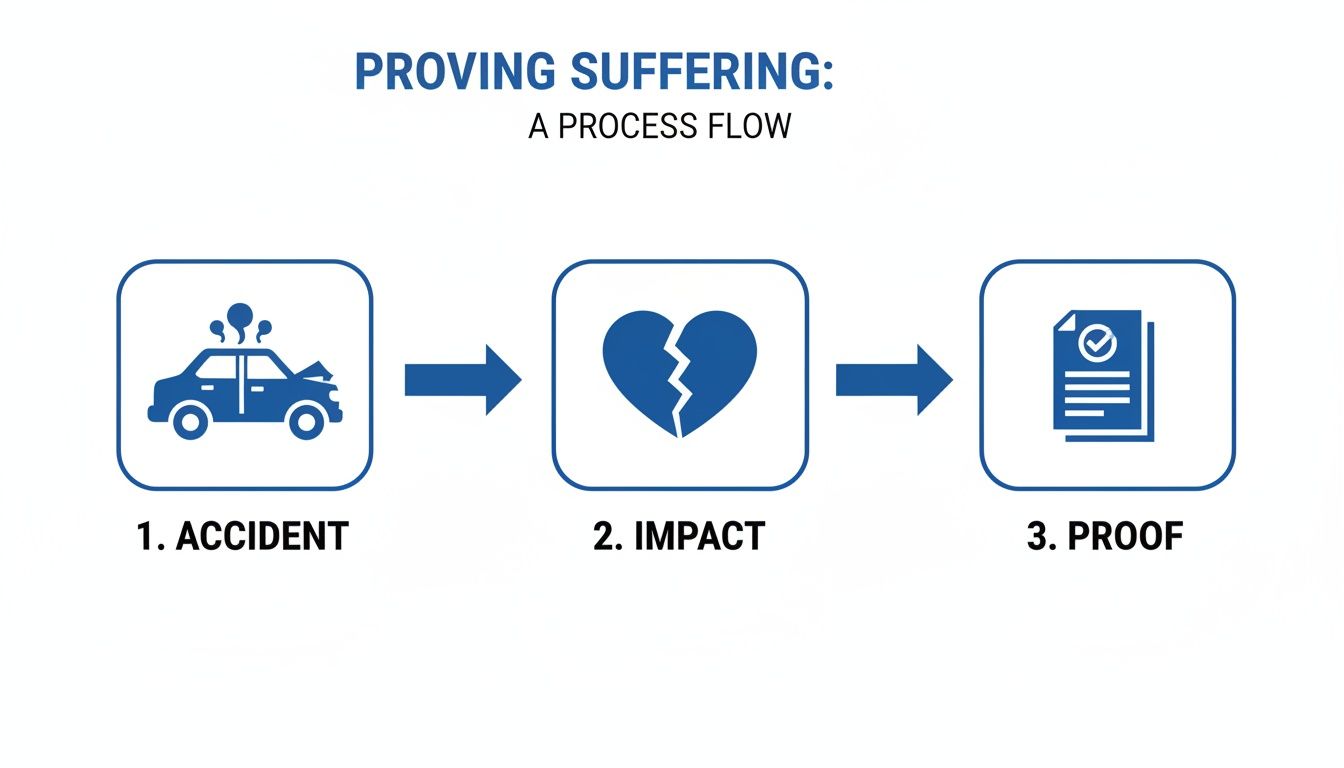
The image above lays it out perfectly: the accident creates a profound personal impact, which then needs to be supported by solid proof to hold up in a legal claim.
Why a Strategic Approach Is Essential
Building a powerful case for pain and suffering begins the moment the accident happens. Let’s say a rideshare crash in Tampa Bay gives you a concussion and recurring nightmares, making it impossible to work your construction job. Pain and suffering can be the biggest part of your settlement—average personal injury settlements can range from $55,056 to $113,391—but only if you can back it up.
The reality is that while only about 5% of claims ever see the inside of a courtroom, the median award for a car accident is a mere $16,000 if the evidence is weak. On the other hand, concussion settlements average $103,654 when supported by things like a neurologist’s report detailing your headaches and proof of lost wages. With 31 million Americans needing treatment for injuries each year, solid proof is what separates a fair recovery from a dismissed claim.
A successful claim for pain and suffering hinges on your ability to create a clear, consistent, and credible narrative of your life after the injury. Every doctor’s visit, every journal entry, and every witness account adds another layer of validation to your story.
This is why a methodical strategy is so crucial. It’s not just about telling your story; it’s about proving it with facts and documentation that are hard to dispute. The objective is to build a case that paints an accurate picture of the true human cost of your injuries, ensuring you get the full compensation you are owed.
Your Medical Records Are Your Strongest Ally

When you’re trying to build a case for pain and suffering, your medical file is the bedrock of your claim. Think of it as the objective, third-party proof that backs up everything you’re experiencing. Insurance adjusters are paid to be skeptical of what you say, but it’s a lot harder for them to argue with your doctor’s documented findings.
Every single entry—from that first ER visit to your most recent physical therapy session—builds a timeline. This professional narrative turns your personal experience of pain into a hard medical fact, which is why consistent treatment is absolutely crucial for a successful claim.
Turning Your Words into Medical Evidence
You have to learn how to communicate effectively with your doctors. They can only write down what you tell them, so you need to be specific and incredibly thorough. Don’t just say, “my back hurts.” That doesn’t give them—or an insurance adjuster—much to work with.
You need to paint a picture with your words. What kind of pain is it? Is it a sharp, stabbing feeling when you turn a certain way? A dull, constant ache that never goes away? A throbbing pain that flares up after you’ve been on your feet for a while? The more descriptive you are, the better your medical record will be. It’s also worth knowing that new technologies are making this easier; understanding the benefits of medical voice charting shows how doctors can capture more detailed, nuanced information during your appointments.
Most importantly, you have to connect the pain to how it affects your daily life. These are the details that truly define a pain and suffering claim.
- Impact on your job: “I can’t sit at my desk for more than 20 minutes at a time before the pain becomes unbearable.”
- Struggles at home: “I haven’t been able to lift my own laundry basket or stand long enough to cook a meal since this happened.”
- The emotional toll: “I’m having panic attacks when I get behind the wheel, and I haven’t slept through the night in weeks.”
When these specific complaints are written down by a doctor, they become powerful evidence. They draw a straight line from your physical injury to a real, tangible loss of your quality of life, which is exactly what you need to prove.
The Power of a Consistent Paper Trail
Let’s look at a real-world example. A motorcyclist gets rear-ended at a busy intersection in Hillsborough County and ends up with a herniated disc. At first, he decides to “tough it out,” only seeing a doctor when the pain is really bad. This leaves huge gaps in his medical history, giving the insurance company a perfect opening to argue that the injury wasn’t that serious.
Now, imagine that same rider gets medical help right away and diligently follows the entire treatment plan. He never misses a physical therapy appointment and is consistent about reporting his symptoms. His file is now packed with proof:
- Diagnostic Reports: An MRI that clearly confirms the herniated disc.
- Physical Therapy Notes: Detailed records of his limited range of motion and pain scores during every exercise.
- Prescription History: A log of the pain medications needed to manage his daily symptoms.
- Physician’s Notes: A specific entry from his doctor stating he can’t sit for long periods, which directly impacts his ability to do his office job.
This unbroken chain of documentation tells a story that’s hard to dispute. It shows you’re committed to getting better and provides concrete proof of how the injury is still affecting you. For anyone in Florida, it’s worth reading about the critical role of medical documentation in Tampa personal injury cases for more local insight.
The most powerful evidence is often buried in the details of a medical chart. One line in a doctor’s notes about your inability to pick up your child can be more convincing to an adjuster than an hour of your own testimony.
In the end, your medical file isn’t just a stack of papers; it’s the official, undeniable story of what you’ve been through. By being an active, honest, and detailed communicator with your doctors, you give them the tools to create a record that will powerfully support your claim.
Documenting Your Daily Struggles in a Pain Journal
In all my years handling personal injury cases, I’ve seen few pieces of evidence as powerful as a well-kept pain journal. It’s one of the most compelling tools we have because of its ability to bring a claim to life. When an insurance adjuster reads a clinical medical report, they see data. When they read your pain journal, they see the real person behind the claim number—someone whose life has been turned upside down.
This document becomes your day-to-day record of reality. It’s what bridges the gap between the pain you feel and the objective evidence needed to prove your case. A consistent, detailed journal makes your suffering tangible and much, much harder for an insurer to downplay or dismiss.

What to Include for Maximum Impact
An effective pain journal is more than just a diary; it’s a systematic log of how your injuries affect you physically and emotionally. To make it a powerful piece of evidence, every entry needs to be specific and consistent. Think of it as a daily snapshot that captures the details that truly matter in a personal injury claim.
Here are the key things to track in every entry:
- Pain Level: Use a simple 1-10 scale, where 1 is minimal and 10 is the worst pain you can imagine. This gives everyone an easy-to-follow metric of your daily suffering.
- Type of Pain: Get descriptive. Is it sharp, throbbing, dull, aching, or burning? Pinpoint the exact location. Does it radiate to other parts of your body?
- Activities Affected: This is absolutely critical. Note any and all activities you struggled with, had to change, or couldn’t do at all. This includes your job, household chores, personal care (like getting dressed), and hobbies.
- Emotional State: Pain isn’t just physical. Document your mood and mental well-being. Are you feeling frustrated, anxious, depressed, or irritable because of your pain and limitations? Did you have trouble sleeping?
- Medication: Log any pain medications you take, including the dose and time. Crucially, note whether the medication actually helped or not.
By recording these details every single day, you create a powerful pattern of evidence that vividly illustrates the day-in, day-out reality of life after your accident.
A Real-World Example of a Powerful Entry
Let’s look at an entry from a client who was in a truck accident and suffered from severe whiplash and a herniated disc. This is the kind of detail that makes a difference.
Date: October 26th
Pain Level: Started the day at a 7/10 in my neck and lower back. It spiked to an 8/10 after I tried to sit at my desk for work.
Pain Description: Sharp, shooting pain runs from my neck down my right arm every time I turn my head. My lower back feels like there’s a constant, deep ache, almost like a hot poker.
Activities: I couldn’t even lift the coffee pot this morning; my wife had to help. I only managed to sit at my computer for 15 minutes before the back spasms got unbearable. I had to lie down on the floor for an hour just to get some relief. We had to skip my son’s soccer game because I knew I couldn’t handle sitting on those hard bleachers.
Emotional State: I feel completely frustrated and useless. I snapped at my wife over something small, which I feel terrible about. I’m really feeling depressed about missing my son’s game. Woke up three times last night from the pain.
Medication: Took 800mg of Ibuprofen at 8 AM, but it barely touched the pain. Took one Percocet at 1 PM, which just made me too drowsy to even think about working.
See the difference? This entry doesn’t just say, “I was in pain.” It shows exactly how that pain wrecked a person’s work, family life, and emotional stability. This is the specific, humanizing detail that proves pain and suffering.
Common Mistakes to Avoid
Your journal’s credibility is everything. You can be sure that insurance adjusters and opposing lawyers will pick it apart, looking for any inconsistencies or exaggerations. To make sure your journal helps—not hurts—your case, steer clear of these common mistakes.
The first major error is inconsistency. Writing detailed entries for a week and then nothing for a month creates gaps that the other side will use against you. It implies your pain wasn’t as constant or severe as you claim. Make journaling a simple, daily habit, even if some entries are short.
The other big mistake is exaggeration. Be honest about your worst days, but avoid overly dramatic language or claims that just don’t seem believable. Stick to the facts. A credible, consistent account of a “7/10” pain level is far more powerful than a single, unbelievable entry about “10/10” agony that isn’t backed up by your medical records. The goal is to be truthful and reliable; that’s what makes your entire claim stronger.
Getting Testimony from Witnesses and Experts
Your own words, your medical records, and your pain journal are the bedrock of your claim. But to really drive the point home, you need outside voices to back you up. Getting statements from people who know you personally (lay witnesses) and from qualified professionals (expert witnesses) adds a powerful layer of credibility that insurance companies can’t easily ignore.
Think of it as building a chorus of voices that all tell the same story: your pain is real, and it has profoundly changed your life.

This kind of third-party validation helps an adjuster or jury see the full picture. It moves your claim beyond just your own words and into the realm of objective, observable fact.
Tapping into Your Personal Network: Lay Witness Statements
A lay witness is simply an ordinary person in your life who has seen how the accident and your injuries have affected you. Their strength isn’t in understanding medical terminology; it’s in painting a simple, human “before and after” picture.
So, who in your life has seen the changes up close?
- Your Spouse or Partner: They live with the day-to-day reality. They can speak to mood changes, your inability to help with chores, or the new strain on your relationship.
- Close Friends: Have you stopped joining them for your weekly golf game? Do you seem withdrawn or constantly uncomfortable? They notice these things.
- Co-workers or Your Boss: They can confirm your struggles with physical tasks that were once easy, your need for more breaks, or a drop in your overall productivity.
Their statements don’t need to be dramatic to be effective. In fact, simple, honest observations are often the most compelling. A friend saying, “She used to be in her garden every single weekend, but I haven’t seen her out there once since the crash,” says more about loss of enjoyment than a medical report ever could.
A spouse’s testimony about how you can no longer pick up your toddler is often far more powerful than a doctor’s explanation of a herniated disc. It connects the clinical injury to a deep, relatable human loss.
The Role of Expert Witnesses in Your Claim
While friends and family tell the personal story, expert witnesses provide the professional, data-driven analysis that ties your injuries to specific, quantifiable losses. These are specialists hired to give an authoritative opinion based on their deep knowledge in a particular field. Their testimony can be a total game-changer, especially when the case gets complicated.
An experienced attorney will know how to find the right experts for your specific situation. This could include:
- Medical Experts: Beyond your regular doctor, a specialist can testify about the long-term outlook for your injuries, the probability of needing future surgeries, and the permanency of your condition.
- Vocational Experts: If the injury prevents you from doing your job, a vocational expert can analyze your skills and limitations. Their report can powerfully demonstrate how your earning capacity has been damaged, both now and for the rest of your career.
- Mental Health Professionals: A psychologist or psychiatrist can formally diagnose conditions like PTSD, anxiety, or depression that have developed because of the trauma. This officially documents the emotional and psychological side of your suffering.
- Accident Reconstructionists: Sometimes you need a technical expert to break down exactly how the accident happened and how the forces involved led to your specific injuries. You can learn more about what an accident reconstruction expert witness does to see how vital this role can be.
Expert opinions translate your personal suffering into the language of logic and finance—a language that insurance companies are forced to respect.
As you gather these statements and depositions, using reliable legal transcription services is key. It ensures every spoken word is captured accurately, creating a precise written record that is crucial for both settlement negotiations and, if necessary, a trial.
How Pain and Suffering Damages Are Calculated
Putting a dollar amount on your pain, anxiety, and sleepless nights can feel impossible. Unlike a hospital bill or a lost paycheck, there’s no clean invoice for suffering. So, how do lawyers and insurance companies actually do it?
In Florida, there’s no magic legal formula. Instead, we use a couple of well-established methods as a starting point for negotiation. The whole goal is to take all that proof you’ve gathered—your doctor’s notes, your pain journal, your family’s testimony—and translate it into a number that reflects what this accident has truly cost you.
The Multiplier Method
Probably the most common approach you’ll see in Florida is the Multiplier Method. It’s a pretty straightforward concept. First, we add up all your concrete, calculable financial losses. These are called your “economic damages” and include things like medical bills, physical therapy costs, and lost wages.
We take that total and multiply it by a number, usually somewhere between 1.5 and 5. The key here is that the multiplier isn’t random; it’s directly tied to how severe and long-lasting your injuries are.
- For a minor injury with a full and quick recovery—say, a whiplash case that clears up in a couple of months—the multiplier might be low, like 1.5 or 2.
- If you’re dealing with something more serious, like a herniated disc that needs surgery and leaves you with chronic pain, you’re looking at a multiplier of 3 or 4.
- For a truly catastrophic, life-changing injury, such as paralysis or a severe traumatic brain injury, the multiplier will be 5 or, in some extreme cases, even higher.
This is where your evidence really comes into play. A strong, well-documented file with consistent medical records and a detailed pain diary makes it much easier for your attorney to argue for a higher multiplier.
The Per Diem Method
Another way to approach this is the Per Diem Method. “Per diem” is just Latin for “per day.” This method assigns a specific dollar amount for each day you’re in pain, starting from the day of the accident until you reach what doctors call maximum medical improvement (MMI)—the point where your condition has stabilized and is unlikely to get any better.
So, what’s a fair daily rate? Often, it’s based on what you earned per day at your job. The thinking is simple: if you can get paid a certain amount for a day of work, then a day spent suffering is worth at least that much. For example, if you were making $200 a day, your lawyer might argue for $200 for every day of your recovery.
While it makes sense, the Per Diem method is generally a better fit for shorter-term injuries with a predictable recovery timeline. It can get complicated and less persuasive when dealing with permanent or chronic pain, because how do you define an end date for suffering that will last a lifetime?
Keep in mind, these are just negotiating tools, not legal mandates. The final settlement is always shaped by the strength of your evidence, the skill of your lawyer, and the unique details of your case.
Why Strong Proof Is Your Best Negotiating Tool
Let’s get real for a moment. Most personal injury cases (95%, in fact) settle out of court. The insurance company’s goal is to pay as little as possible. Your goal is to get what you deserve. The battle is won with proof.
This is why having an experienced attorney matters so much. Studies consistently show that victims with legal representation receive settlements that are, on average, 3.5 times higher than those who go it alone. It’s not magic; it’s meticulous evidence-building.
For example, a severe spinal cord injury case can settle for anywhere from $500,000 to millions, but only with undeniable proof of chronic pain and lifelong limitations. The same goes for traumatic brain injuries, where settlements often top $500,000 when expert testimony clearly demonstrates the long-term cognitive damage.
Without that level of proof, a “soft tissue” injury claim might get a lowball offer of $2,000-$8,000. With the right documentation, that same claim can be worth significantly more.
Ultimately, you have to do more than just tell your story. You have to prove it. The more vivid and undeniable the picture of your suffering, the stronger your negotiating position will be. For a deeper dive, you can also read our detailed guide on how to calculate pain and suffering damages.
Common Questions on Proving Pain and Suffering in Florida
It’s completely normal to feel lost when you’re dealing with a personal injury claim, and proving your pain and suffering can be one of the most confusing parts. Let’s tackle some of the questions we hear most often from accident victims here in Florida.
Is There a Cap on Pain and Suffering Damages in Florida?
For most Florida car accident claims, the short answer is no. There is no legal cap on pain and suffering damages. Unlike some other states or case types, our laws don’t put a ceiling on what you can recover for your non-economic damages after a crash.
However, there are practical limits. The amount you can actually get is often tied to the severity of your injuries, the strength of your evidence, and, frankly, the at-fault driver’s insurance policy limits. This is where all that careful documentation really pays off—it gives you the leverage you need when you start learning how to negotiate with insurance companies.
Can I Claim Pain and Suffering if I Had a Pre-existing Condition?
Yes, absolutely. This is a common concern, but Florida law is on your side with what’s known as the “eggshell plaintiff” rule.
This legal concept basically says that the person who caused the accident has to take you as they find you. If you had a bad back that was manageable before the crash but is now debilitating, they are responsible for that increased pain and suffering.
You can and should seek compensation for any aggravation or flare-up of your old condition. The trick is proving how the accident made things worse.
To do that effectively, you’ll need:
- Clear Medical Evidence: Your doctor must be able to draw a line between your old condition and the new or worsened symptoms that started right after the accident.
- Consistent Treatment: Sticking to your treatment plan is powerful proof that the injury’s impact is real and ongoing.
- A Detailed Pain Journal: This log is your day-to-day evidence showing a clear increase in pain or new limitations you didn’t have before.
Without this proof, you can bet the insurance company will argue all your pain is from the old injury. With it, you build a powerful case for the additional suffering you’ve been forced to endure.
How Long Do I Have to File a Pain and Suffering Claim in Florida?
This is a critical deadline you absolutely cannot miss. The time limit to file a personal injury lawsuit in Florida, called the statute of limitations, recently changed.
For accidents that happened on or after March 24, 2023, you now have just two years from the date of the incident to file your lawsuit. If your accident occurred before that date, the older four-year deadline still applies to your case.
This isn’t a suggestion; it’s a hard deadline. If you miss it, the court will almost certainly throw out your case, and you’ll lose the right to recover a single dollar for your injuries, medical bills, or suffering.
Building a strong case isn’t something that happens overnight. It takes time to gather all the necessary evidence. That’s why it’s so important to speak with an attorney as soon as you can. You need to preserve evidence, talk to witnesses while their memories are sharp, and protect your legal rights before it’s too late.
Proving the true extent of your pain and suffering is the key to securing the fair compensation you deserve. At Martin Hernandez, P.A., we meticulously prepare every case as if it’s going to trial, ensuring no detail is overlooked. If you’ve been injured in an accident in the Tampa area, contact us for a free consultation to understand your rights and how we can help you move forward. Visit us at https://injurylawyersoftampa.com.