
When you get a copy of your Florida Traffic Crash Report after an accident, it can look pretty intimidating. The first thing you should do is take a breath and start with the basics on page one of the official HSMV 90010S form. Look for the date, location, and the names of everyone involved. This document isn’t designed to be a legal trap; it’s the official record of what happened, and getting familiar with its layout is the first step toward understanding your case.
Unlocking the Florida Traffic Crash Report
At first glance, the Florida Traffic Crash Report is a sea of boxes, codes, and official-sounding terms. It’s easy to feel overwhelmed. But you have to remember, this document is the cornerstone of your personal injury claim.
It holds all the essential facts that insurance companies and lawyers will use to reconstruct the accident. Think of it as a detailed snapshot taken by the responding officer right at the scene. Each section tells a piece of the story, from the simple logistics to the officer’s own observations.
To make sense of it all, it helps to understand what is data parsing, which is essentially the process of taking raw information and turning it into something useful. That’s exactly what we’re going to do with this report.
Finding the Core Facts
Right at the top of the report, you’ll find the fundamental information that sets the stage. These details might seem simple, but getting them right is absolutely critical. A wrong date or a misspelled street name can cause major headaches when dealing with an insurance adjuster later.
This initial section is loaded with key information, including:
- The exact date and time of the crash.
- The precise location, usually with street names, the city, and the county.
- Any special conditions the officer noted, like if it was a hit-and-run or if a fatality occurred.
Key Sections of a Florida Accident Report at a Glance
To give you a clearer picture, here’s a quick breakdown of the most important sections you’ll find on the report and why they are so vital for your case.
- Pages 1-2: Event & Road Info
- What to Look For: Date, time, location, road conditions, and lighting. Look for check-boxes indicating a hit-and-run or fatality.
- Why It’s Critical: This establishes the foundational facts of the accident. Inaccuracies here can create complications.
- Page 3: Vehicle/Driver Info
- What to Look For: Driver names, addresses, insurance details, and vehicle information (make, model, VIN).
- Why It’s Critical: This identifies all parties involved and their insurance carriers, which is necessary for filing a claim.
- Page 4: Occupant/Witness Info
- What to Look For: Names and contact information for passengers and any independent witnesses at the scene.
- Why It’s Critical: Witnesses can provide crucial third-party testimony to support your version of events.
- Page 5: Narrative & Diagram
- What to Look For: The officer’s written description of the accident and a hand-drawn sketch of the scene.
- Why It’s Critical: This is often the most important section, as it contains the officer’s opinion and visual reconstruction.
- Page 6: Commercial Vehicle Info
- What to Look For: Details specific to trucks or commercial vehicles, like carrier information and hazardous materials.
- Why It’s Critical: This is essential for accidents involving commercial trucks, as claims can be more complex and involve multiple parties.
- Page 7: Violations & Citations
- What to Look For: Any traffic citations issued to the drivers involved.
- Why It’s Critical: A citation issued to the other driver is a strong indicator of fault, but not definitive proof.
Each of these sections contains details that, when put together, create the official story that insurance companies will rely on.
Why Every Detail Matters
These initial facts are more than just data entry; they establish the “when and where” of the crash. In a place like Hillsborough County, which saw over 25,000 crashes in 2022, being able to pinpoint these specifics is essential for proving negligence. This information is a big deal, and you can learn more about how to get your specific report in our guide on Hillsborough County accident reports.
The report also clearly notes the number of people injured or killed. This helps a firm like ours at Martin Hernandez, P.A. immediately understand the severity of the situation and whether we might be looking at a wrongful death claim.
The sections dedicated to each party involved will list up to three drivers per page. You’ll find everything from driver’s license numbers and contact info to whether their airbags deployed—a key detail, since an airbag that didn’t deploy in a serious crash could point to a vehicle defect.
This report is a treasure trove of information. It documents who was wearing a seatbelt, the direction everyone was traveling, the posted speed limit, and the officer’s initial assessment of vehicle damage. Every single one of these data points helps build the comprehensive picture that will be closely examined throughout your claim process.
Cracking Open the First Page: What to Look For
The very first page of your Florida Traffic Crash Report is where the story of your accident begins. It lays out all the basic, undisputed facts. Think of it as the foundation for your insurance claim. If that foundation has even a tiny crack—a misspelled street name or a wrong date—it can create serious headaches later.
Every single box and code on this page matters. It all comes together to form the official record of what happened. Let’s walk through it section by section so you know exactly what you’re looking at and why it’s so important.
Nailing Down the “Where and When”
Right at the top of the form, you’ll see the basic logistics of the crash. It seems simple enough, but this is the very first place I tell clients to check for mistakes.
You need to verify these key pieces of information:
- Date of Crash: Is the month, day, and year completely accurate?
- Time of Crash: Check the time down to the AM or PM. It can be crucial.
- Location: This is a big one. Make sure the county, city, and specific street are correct. If you were on a highway like I-275 in Tampa, the report needs to list the right direction (northbound/southbound) and the closest mile marker or exit.
Why does this matter so much? Imagine your crash happened at an intersection with a red-light camera. If the report lists the wrong cross-street, pulling that critical video evidence becomes a massive, and sometimes impossible, chore. An adjuster could even use a location error to cast doubt on the whole report.
Identifying Everyone Involved
Just below the time and place, you’ll find the section listing all the drivers, their cars, and the vehicle owners. This is your roadmap for filing an insurance claim. To keep things clear, the officer will assign each vehicle a number, like Unit 1 and Unit 2.
For every single person and vehicle listed, you need to play detective and confirm:
- Their full legal name, current address, and driver’s license number.
- The correct insurance company and policy number.
- Accurate vehicle info: year, make, model, and the all-important Vehicle Identification Number (VIN).
This part of the report can get crowded, fast. In a three-car pile-up on Dale Mabry Highway, you’d see separate blocks for Unit 1, Unit 2, and Unit 3. I’ve seen cases get delayed for weeks just because of one wrong digit in an insurance policy number. Check this part with a fine-tooth comb.
Finding the Details That Define Your Case
The first page isn’t just about names and numbers. It also holds small but incredibly important observations made by the police officer at the scene. These details can have a huge impact on how an insurance company views your claim.
These aren’t just random checkboxes. They represent the officer’s professional, on-the-scene observations of what was happening inside each car. Insurance companies rely heavily on this information when they start deciding who was at fault.
Keep an eye out for codes or checked boxes related to:
- Seatbelt Use: The report will note if a seatbelt was used, not used, or if the officer couldn’t tell.
- Airbag Deployment: It will state whether the front or side airbags went off. Let’s say you suffered a severe facial injury, but the report says the airbag didn’t deploy—that could point to a separate claim against the car manufacturer.
- Estimated Speed: The officer often includes an estimate of each vehicle’s speed alongside the posted speed limit, based on statements and physical evidence.
For instance, if the report shows the other driver was going 15 mph over the speed limit and wasn’t wearing a seatbelt, that immediately paints a picture of recklessness. These aren’t just details for a government database; they are powerful pieces of evidence that build your case for who was at fault and how severe the crash was. Taking the time to scrutinize this first page is the first step in protecting your right to a fair recovery.
Interpreting the Crash Diagram and Officer Narrative
If the first page of the report sets the stage, the crash diagram and the officer’s narrative are the main event. This is where you get past the raw data and see the story of what happened, both in a picture and in the officer’s own words. Honestly, learning to read between the lines here is where you start to really understand who is likely at fault.
This is a critical part of the report, building on the basic facts to create a full picture of the accident.
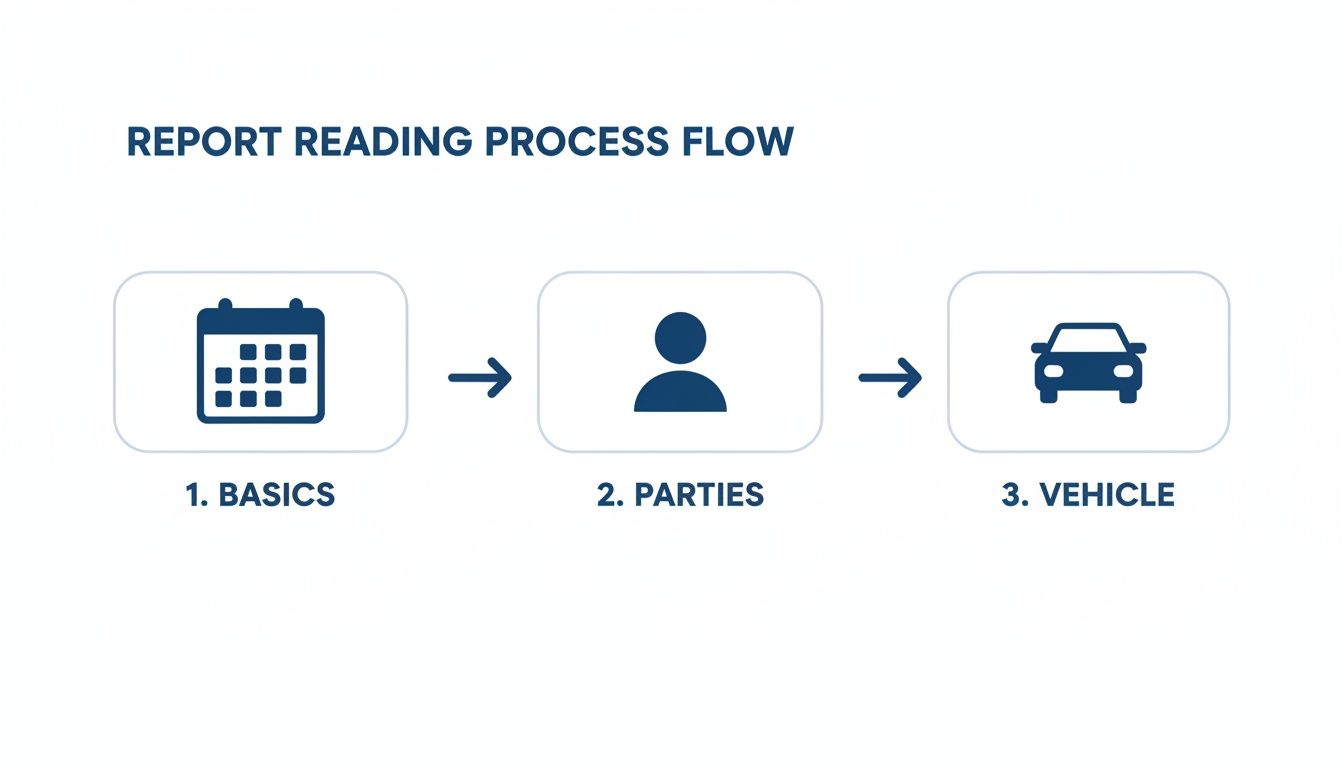
Each section of the report stacks on top of the previous one, and these final pieces are often the most influential for your claim.
Decoding the Crash Diagram
Think of the crash diagram as the officer’s bird’s-eye sketch of the collision. It might look simple, but law enforcement across Florida uses standardized symbols to pack a lot of information into a small space. Getting familiar with these symbols is your first step in seeing the accident through the officer’s eyes.
- Vehicles are almost always drawn as simple boxes or rectangles.
- Direction of Travel is shown with arrows, telling you which way each car was headed right before the crash.
- Point of Impact is usually a starburst symbol or an ‘X’ marking the exact spot of the collision.
- Final Resting Position shows where the vehicles ended up after all the motion stopped.
Let’s say you were in a T-bone crash at a busy Tampa intersection. The diagram would likely show one car’s arrow going straight and the other’s hooking left, with that ‘X’ right where the front of their car met the side of yours. By tracing these symbols, you can follow the officer’s visual breakdown of the event from beginning to end.
I always tell clients that pages two to four, containing the diagram and narrative, are absolute gold. They don’t just sketch out the crash; they document environmental and human factors that can completely change the fault determination.
For example, the officer will note things like slick road surfaces—a huge deal in Florida, where rain can significantly increase the risk of a crash. They’ll also document things like active construction, like the I-4 project around Tampa that was linked to over 1,200 incidents in 2022. This kind of context is invaluable. An accident reconstruction expert witness can often take these initial observations and build a powerful, scientific case from them.
Unpacking the Officer’s Written Narrative
After the diagram comes the narrative—the officer’s written account of the accident. This summary is built from physical evidence, measurements, and statements from everyone involved, including witnesses. It’s often the most subjective part of the report, but it’s also where an officer might give their clearest opinion on who caused the crash.
You need to keep an eye out for specific phrases that insurance adjusters jump on immediately:
- “Failed to yield right of way”
- “Improper lane change”
- “Exceeding the posted speed limit”
- “Following too closely”
The narrative also captures what people said at the scene. You might find something like, “Driver of Unit 1 stated he had a green light. Driver of Unit 2 stated Unit 1 ran the red light.” Right there, the report documents the conflicting stories from the very beginning.
Comparing the Diagram and Narrative
Here’s where a sharp eye pays off. The real insight comes from putting the diagram and the narrative side-by-side. Do they tell the same story? It’s not uncommon to find small inconsistencies, and those little gaps can become major points of leverage for your claim.
For instance, the narrative might say, “Unit 1 failed to yield while making a left turn,” but the diagram could place the point of impact deep inside Unit 2’s lane of travel. That could suggest Unit 2 was speeding or swerved. Spotting these discrepancies is critical. The diagram shows the physics; the narrative provides the context. When they don’t line up, it creates questions that demand answers.
Finding the Details: Injuries, Damages, and Witnesses

Once you’ve gotten the gist of what happened from the diagram and narrative, it’s time to dig into the details that can make or break your claim. The following pages are all about the consequences of the crash: the injuries, the vehicle damage, and any witnesses who saw it happen.
This is where the raw data lives. Insurance adjusters live in these sections, poring over every code and description to build their case. Knowing what you’re looking at is the best way to protect yourself.
Decoding Injury Codes and What They Mean for You
Every police report uses a set of codes to describe the physical state of everyone involved at the scene. It’s the officer’s quick assessment, ranging from “No Apparent Injury” all the way to “Fatal.”
Pay close attention to any code listed for you, especially something like “Possible Injury.” It’s easy to dismiss, but it’s a critical piece of evidence. The adrenaline after a crash can mask serious problems like whiplash or a concussion that don’t surface for hours or even days. That simple code connects your delayed pain directly back to the accident.
It’s crucial to remember that the officer’s injury code is not a medical diagnosis. It’s just an initial observation. No matter what the report says, you should always get checked out by a doctor after an accident. This creates the medical record you’ll need.
This part of the report will also specify who was hurt—a driver, a passenger, a pedestrian—and often notes if they were taken by ambulance to a local hospital. These are the foundational facts for building your injury claim.
Sizing Up the Vehicle Damage
Next, you’ll find the officer’s notes on the damage to the vehicles. You’re looking for descriptions of both the location and severity of the impact, like “major front-end damage” or “minor passenger-side scrape.”
This information does two important jobs. First, it has to line up with the story told in the narrative and diagram. If the report describes a T-bone crash, you’d expect to see a note about significant side-impact damage here. Any inconsistencies are a red flag.
Second, the severity of the damage helps paint a picture of the forces involved, which can directly support the seriousness of your injuries. A car noted as “totaled” provides powerful initial proof for both your property damage claim and the violent nature of the impact. Learning what to save is key, and you can find out more in our guide on what evidence to preserve after a car accident in Tampa.
Why Witness Information is Gold
This might be the most overlooked, yet most powerful, part of the entire report. An independent witness—someone who doesn’t know you or the other driver—can be the key to winning your case, especially if the other driver starts changing their story.
The report should have the full names and contact information for anyone who saw what happened. These are the objective third parties whose testimony can instantly resolve a “he-said, she-said” argument.
Page three of the Florida Traffic Crash Report is where you’ll find this dense log of information. It starts with anyone who was injured, detailing the extent of their injuries and where they were transported. For context, a major facility like Tampa General admitted around 4,500 crash victims in 2022 alone.
The report then lists any witnesses and uninjured passengers. Under Florida law, their statements are required if the crash results in more than $500 in damages. You’ll also see notes on safety equipment, like seatbelts. This matters because proper seatbelt use can reduce the risk of a fatal injury significantly, a crucial detail for an insurance company assessing the crash.
What To Do When The Police Report Gets It Wrong
Let’s be real: police officers are human. They’re trying to piece together a chaotic scene, often with conflicting stories and a lot of stress in the air. So, it’s not a huge surprise when mistakes find their way into the final crash report.
But a simple error—a wrong street name or a mixed-up license plate number—can throw a major wrench into your insurance claim. Think of checking your report for accuracy as your first, most critical task. Even a tiny mistake can give an insurance adjuster a reason to delay your claim or question your story.
Finding Common Mistakes in Your Report
Grab a pen and a highlighter, and get ready to put on your editor’s hat. You need to go through that Florida Traffic Crash Report line by line, comparing every single detail to what you know is true. You’d be amazed at how often small things are wrong.
Pay extra close attention to these sections:
- The Basics: Are the date, time, and location exactly right? Double-check street names, which direction you were traveling (e.g., northbound vs. southbound), and even the listed weather conditions.
- Identifying Info: Make sure all names, addresses, and driver’s license numbers are spelled correctly. Is the make, model, year, and VIN for every car involved 100% accurate?
- The Story: Read the officer’s narrative and any quotes from you or witnesses. Does it actually sound like what you told them happened?
A mistake that seems minor can have huge consequences. For example, if the officer lists the wrong cross-street, it might make it impossible for your attorney to get red-light camera footage that proves the other driver ran a red light.
Minor Typos vs. Major Problems
Not all errors are created equal. Some are simple fixes, while others can completely sink your personal injury claim.
A minor error is usually a clerical slip-up. Think of a misspelled last name or one digit being off in a license plate number. These are annoying, but they’re typically easy to correct and probably won’t derail your entire case.
A critical error is a whole different beast. This is a mistake that gets to the very heart of what happened. We’re talking about an inaccurate crash diagram, a narrative that completely misrepresents the events, or wrongly assigning you a citation. These are the kinds of errors you absolutely have to fight.
The Game Plan for Getting it Fixed
Found a mistake? You need to act on it immediately. Don’t just hope the insurance company will ignore it—they won’t. Your first step is to contact the law enforcement agency that issued the report, whether that’s the Tampa Police Department or the Hillsborough County Sheriff’s Office.
Here’s what that process usually looks like:
- Arm Yourself with Proof: Before you even make the call, gather everything you have to prove the report is wrong. This could be photos you took at the scene, your car’s registration, or the name and number of a witness who can confirm your version of events.
- Talk to the Officer: Your goal is to get in touch with the specific officer who wrote the report. When you do, be calm and professional. Clearly state what the error is and present the evidence you’ve gathered.
- Ask for a Supplemental Report: Officers almost never go back and change an original report. What they can do is file an “addendum” or a “supplemental report.” This new document notes the correction and gets attached to the original, becoming a permanent part of the official record.
Trying to correct a report can be incredibly frustrating, especially if the mistake is about who caused the crash. The officer might not be willing to change their story just based on your word. This is where having an experienced attorney step in can make all the difference. We know how to present evidence in a way that law enforcement will take seriously.
It’s also important to understand that how you handle this evidence matters. In fact, there are serious legal consequences for mishandling it, a concept known as spoliation of evidence.
How a Lawyer Turns the Accident Report into a Winning Case
Getting a copy of your Florida Traffic Crash Report is one thing; knowing how to use it is another. For an experienced personal injury attorney, that report isn’t just a piece of paper—it’s the blueprint for building your case. We don’t just glance over it; we tear it apart, piece by piece, looking for the critical details that establish fault and lay the groundwork for getting you the compensation you deserve.
Think of the report as the official opening chapter of your story. From the moment we get it, we’re analyzing every code, every measurement, and every word in the officer’s narrative to build a strategy aimed at recovering the full cost of your medical bills, lost wages, and suffering.
From Report to Strategy
The first thing a seasoned lawyer does is zero in on the a-ha moments in the report. We immediately scan for any violation codes the officer issued. If the other driver was ticketed for something like “failure to yield” or an “improper lane change,” that’s a massive head start. It’s a clear, official indicator of negligence that we can immediately use to pressure the insurance company.
Next, our eyes jump to the witness section. Those names and phone numbers are pure gold. We reach out to these independent observers right away to get their statements on the record. A good witness can completely shut down the “he said, she said” arguments that at-fault drivers often try to use later on.
To get an even deeper look, particularly in complex cases, we analyze every detail for inconsistencies. Some attorneys are even exploring how technologies like AI for document review can help sift through dense reports to find subtle patterns or contradictions that might not be obvious at first glance.
Building on the Foundation
The officer’s diagram and written narrative are the foundation, but we often have to construct the rest of the house. If the insurance company is trying to deny fault or the crash dynamics are complicated, we’ll bring in an accident reconstruction expert.
These specialists are engineers who can take the raw data from the report—skid mark lengths, debris fields, points of impact—and create a scientific animation of the crash. This isn’t just a cartoon; it’s a physics-based analysis that can definitively prove things like the other driver’s speed or their failure to brake in time. It’s powerful evidence that an adjuster can’t just wave away.
A police report is a snapshot in time, but your legal case is the full-length movie. We use the report to write the script, identifying every character, every action, and every piece of evidence needed to tell the complete story of how the other driver’s negligence impacted your life.
The report also acts as a powerful investigative guide.
- Did the officer note the other driver was in a commercial vehicle? That could mean their employer is also on the hook.
- Is there a mention of suspected drug or alcohol use? That tells us to immediately subpoena any toxicology reports.
Every checked box and handwritten note can open up a new avenue to pursue. For a deeper understanding of the initial steps after a collision, you might be interested in our guide on getting a lawyer after a car accident.
Ultimately, having a dedicated Tampa lawyer who treats every case as if it’s going to trial is what protects you. It tells the insurance company you’re not looking for a quick, lowball settlement—you’re serious about getting justice.
If you’re struggling to make sense of your accident report and want to make sure you’re protected, call the experienced team at Martin Hernandez, P.A.. We’ll review your case for free and show you how we can fight for you. Visit us at https://injurylawyersoftampa.com to get started.