
Insurance bad faith damages are the compensation policyholders can recover when an insurer acts unreasonably, dishonestly, or recklessly in handling a claim. If you’re reading this after an insurer denied, delayed, or underpaid your claim without a valid reason, you may be entitled to far more than just the original policy benefits. Understanding insurance bad faith damages explained in plain terms is the first step toward protecting what you’re owed. Florida law, including Florida Statute § 624.155, gives policyholders specific tools to fight back, and the Florida Department of Financial Services plays a direct role in that process.
What types of damages can you recover in an insurance bad faith claim?
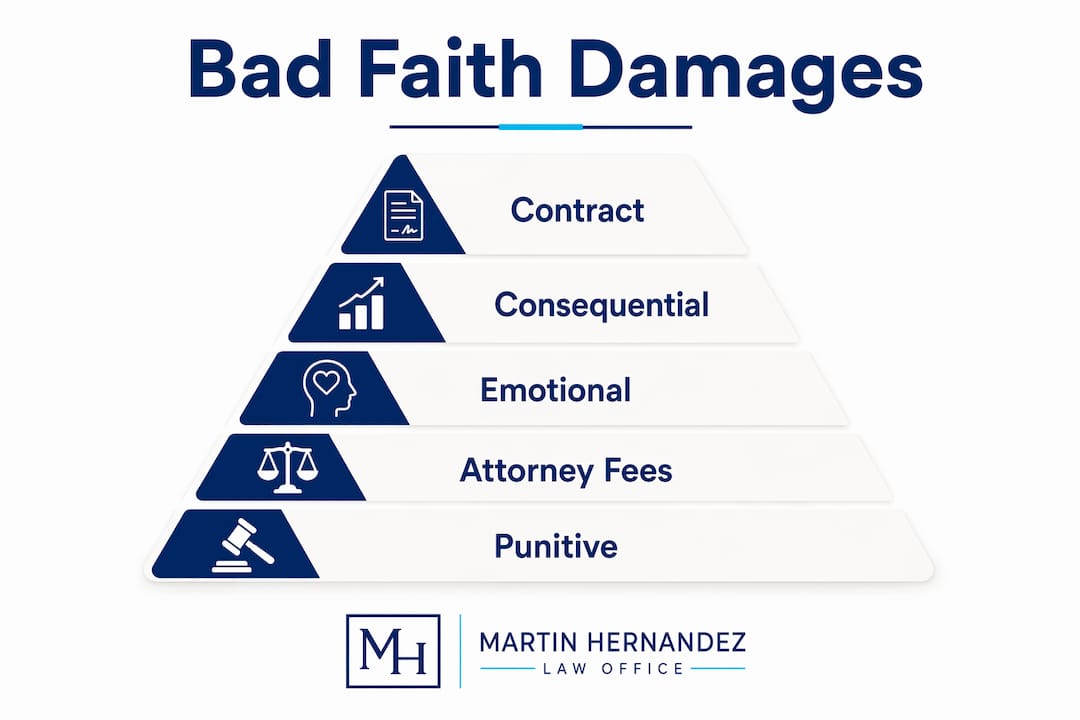
Bad faith claim damages typically fall into five categories, and each one addresses a different kind of harm the insurer caused you.
Contract damages are the foundation. These cover the unpaid policy benefits you were originally owed, plus interest that accrued while the insurer delayed or denied your claim. Think of this as the baseline: what you should have received from day one.

Consequential damages go further. These compensate for economic losses caused directly by the insurer’s misconduct, such as lost business income because a property claim sat unresolved for months, or credit damage from unpaid bills that piled up while you waited. Consequential damages can raise settlement values 50–300% above the unpaid claim amount. That multiplier effect is often where the real financial recovery lives.
Emotional distress damages apply in states, including Florida, that treat bad faith as a tort rather than a simple contract dispute. Treating bad faith as a tort allows recovery of emotional distress and punitive damages beyond contract benefits. Emotional distress awards in first-party bad faith cases range from $25,000 to $500,000, depending on how severe and prolonged the insurer’s misconduct was. You can learn more about how Florida courts calculate these awards on the emotional distress damages page.
Attorney fees are recoverable under Florida Statute § 624.155. This provision means the insurer, not you, bears the cost of the legal fight it forced you into.
Punitive damages are reserved for the most egregious conduct. Courts award them to punish the insurer and deter future misconduct. Punitive damages in bad faith cases range from $100,000 to over $155 million, though appellate courts typically limit awards to single-digit multiples of compensatory damages.
Pro Tip: Document every interaction with your insurer from the moment you file a claim. Dates, names, and exact statements create the paper trail that turns a weak case into a strong one.
How do courts determine whether insurer conduct qualifies as bad faith?
Bad faith is defined by the insurer’s unreasonable, deceptive, or reckless conduct, not by an honest mistake or a genuine valuation dispute. Courts draw a clear line between a good-faith disagreement about claim value and conduct that crosses into actionable bad faith.
To prove your insurer acted in bad faith, courts generally look for:
- No reasonable basis for denial or delay. The insurer must have lacked a legitimate reason to withhold payment. Ignoring medical records, misrepresenting policy terms, or refusing to investigate are classic examples.
- Knowledge or reckless disregard. The insurer either knew its conduct was wrong or acted with reckless indifference to your rights.
- Documented pattern of conduct. A single slow response rarely qualifies. Courts look at the full picture: repeated delays, contradictory communications, and failure to follow internal claims-handling standards.
- Causation. You must show the insurer’s conduct directly caused your damages, whether financial, physical, or emotional.
The standard of proof in most jurisdictions is clear and convincing evidence, which sits above the preponderance standard used in typical civil cases. That higher bar makes preparation critical.
Pro Tip: Focus your evidence on the insurer’s internal processes, not just the accident itself. Claims manuals, adjuster notes, and supervisor emails often reveal the unreasonableness courts need to see.
What procedural steps apply to bad faith claims in Florida?
Florida has one of the most specific procedural frameworks for bad faith claims in the country, and missing a step can end your case before it begins.
The process starts with a Civil Remedy Notice (CRN), filed with the Florida Department of Financial Services. This document formally notifies the insurer of the specific bad faith violation you are alleging. Florida law mandates filing a CRN and giving insurers 60 days to cure bad faith allegations before a lawsuit can proceed.
That 60-day window is not just a formality. Properly using the CRN cure period is both a procedural requirement and a tactical tool. If the insurer fails to fix the violation during those 60 days, that failure becomes powerful evidence of bad faith at trial.
For liability claims, a separate 90-day safe harbor provision applies. Failure to comply with either timeline can cause immediate dismissal of your bad faith action in Florida courts.
| Procedural Step | Requirement | Consequence of Failure |
|---|---|---|
| File Civil Remedy Notice | Required before lawsuit | Case dismissed |
| 60-day cure period | Insurer has 60 days to fix violation | Strengthens claimant’s evidence |
| 90-day safe harbor (liability) | Applies to third-party liability claims | Premature filing dismissed |
| Underlying coverage resolved | Coverage breach must be established first | Bad faith claim cannot mature |
| Attorney fees under § 624.155 | Statutory right if bad faith proven | Insurer pays claimant’s legal costs |
Florida also applies a comparative bad faith provision, which can reduce your damages if you contributed to the delay or dispute. Understanding why insurers deny claims in the first place helps you anticipate and counter these arguments before they arise.
How much money can you expect from a bad faith lawsuit?
Recovery amounts vary widely based on the type of claim, the severity of the insurer’s conduct, and the strength of your documentation.
Residential property bad faith cases typically recover between $75,000 and $500,000. Commercial claims range from $500,000 to $10 million. These figures reflect the unpaid benefits plus consequential and emotional distress damages layered on top.
Punitive damages can push totals far higher. A $500,000 compensatory award can support punitive damages between $1 million and $4.5 million under established case law precedent. That ratio, roughly 2x–9x compensatory damages, reflects the single-digit multiplier rule appellate courts apply.
“The true value of a bad faith claim rarely lives in the unpaid policy benefits alone. Consequential damages, emotional distress, and punitive awards routinely push total recovery well beyond what the original policy ever promised. Policyholders who document everything and pursue the full range of damages consistently recover more.”
Several practical factors shape where your case lands within these ranges. The duration of the insurer’s misconduct matters. A six-month delay with documented financial harm recovers more than a two-week delay with minimal impact. The clarity of the insurer’s wrongdoing also matters. Contradictory written communications and ignored medical evidence make punitive damages far more likely.
Pro Tip: Build a detailed timeline of every insurer action and inaction from the date of loss forward. Courts and juries respond to timelines because they make unreasonableness visible.
What challenges do claimants face when proving bad faith damages?
Proving bad faith is harder than proving the underlying insurance claim, and several barriers trip up policyholders who go in unprepared.
- Coverage must be established first. Courts typically reject bad faith claims) without an underlying liability or coverage breach. You cannot skip straight to bad faith. The coverage dispute must be resolved, or at minimum, a judgment must establish the insurer’s obligation.
- Proving intent or recklessness is difficult. Insurers rarely put “we are acting in bad faith” in writing. You build the case from circumstantial evidence: adjuster conduct, internal emails, and deviation from standard claims practices.
- Premature lawsuits get dismissed. Filing before the CRN cure period expires in Florida is an automatic loss. Timing is not optional.
- Punitive damages require extra steps. In Florida, pursuing punitive damages requires a separate motion and a showing of evidence before the court allows that claim to proceed. This adds cost and complexity.
- Documentation gaps hurt recovery. If you did not save emails, note phone call dates, or track financial losses as they happened, rebuilding that record later is difficult and sometimes impossible.
The strategic role of timing and professional legal advice cannot be overstated here. Knowing how to fight an insurance denial before you ever file a bad faith claim puts you in a much stronger position when the time comes.
Key Takeaways
Insurance bad faith damages extend well beyond unpaid policy benefits, and Florida’s procedural rules make preparation the single most important factor in recovery.
| Point | Details |
|---|---|
| Five damage categories | Contract, consequential, emotional distress, attorney fees, and punitive damages are all recoverable. |
| Consequential damages multiply recovery | Documented economic losses can raise total recovery 50–300% above the unpaid claim amount. |
| Florida CRN is mandatory | Filing a Civil Remedy Notice and waiting 60 days is required before any lawsuit can proceed. |
| Coverage breach comes first | Courts dismiss bad faith claims that lack an established underlying coverage or liability breach. |
| Documentation drives value | Detailed timelines and insurer communications directly increase settlement and verdict amounts. |
What I’ve seen after years of fighting insurers in Florida
After handling insurance-related disputes for clients across Tampa and Hillsborough County, the pattern I see most often is this: policyholders leave money on the table because they did not know what they were entitled to recover.
Most people assume bad faith means getting the original claim paid. That is the floor, not the ceiling. The emotional toll of a prolonged denial, the credit damage from unpaid medical bills, the business income lost while a commercial property sat unrepaired — these are real, compensable harms, and Florida law recognizes them.
What frustrates me most is when clients come in after the 60-day CRN window has passed without being used correctly, or after they filed too early and got dismissed. Florida’s procedural rules are unforgiving. One missed step can cost you the entire bad faith claim, even when the insurer’s conduct was clearly wrong.
My advice is direct: document everything from day one, treat every insurer communication as potential evidence, and do not assume a denial is final. The Civil Remedy Notice process exists specifically to give you leverage. Use it. And if the insurer refuses to cure the violation, that refusal becomes your strongest argument at trial.
Bad faith claims are complex, but they are winnable. The policyholders who recover the most are the ones who prepared the most.
— Martin Hernandez
How Martin Hernandez, PA approaches insurance bad faith cases
If your insurer has denied, delayed, or underpaid your claim without a legitimate reason, you have legal options that go far beyond simply resubmitting paperwork. Martin Hernandez, PA represents clients in Tampa and Hillsborough County who are facing exactly this situation, and the firm handles every case on a contingency fee basis, meaning you pay nothing unless your case is won.

The firm’s approach combines trial readiness with a thorough understanding of Florida’s bad faith statutes, including the Civil Remedy Notice process and the attorney fee provisions under § 624.155. If you are unsure whether your situation qualifies, the when to hire a personal injury lawyer guide is a practical starting point. For a direct conversation about your claim, contact Martin Hernandez, PA today. All staff speaks fluent Spanish.
FAQ
What is insurance bad faith in Florida?
Insurance bad faith in Florida occurs when an insurer acts unreasonably, dishonestly, or recklessly in handling a policyholder’s claim. Florida Statute § 624.155 governs first-party bad faith claims and requires filing a Civil Remedy Notice before suing.
What damages can you recover in a bad faith insurance claim?
You can recover contract damages, consequential damages, emotional distress compensation, attorney fees, and punitive damages. Total recovery often exceeds the original policy benefits by a significant margin when consequential and punitive damages apply.
How do you prove insurer bad faith?
You must show the insurer lacked a reasonable basis for denying or delaying your claim and acted with knowledge of that unreasonableness or reckless disregard for your rights. Adjuster notes, internal emails, and documented delays are the most effective evidence.
What is the Civil Remedy Notice in Florida bad faith cases?
The Civil Remedy Notice is a formal document filed with the Florida Department of Financial Services that notifies the insurer of a specific bad faith violation. The insurer then has 60 days to cure the violation before a lawsuit can proceed.
Can you sue for punitive damages in a bad faith insurance case?
Yes, but only for egregious conduct. Punitive damages in bad faith cases can range from $100,000 to over $155 million, though courts typically limit awards to single-digit multiples of the compensatory damages amount.
Recommended
- What is bad faith insurance claim? Florida Guide – Personal Injury Lawyers of Tampa
- Suing Insurance Company Bad Faith: Know Your Rights – Personal Injury Lawyers of Tampa
- Your 2026 Guide: How to Read Insurance Policy in Florida – Personal Injury Lawyers of Tampa
- Demand Letter Personal Injury: Your 2026 Florida Guide – Personal Injury Lawyers of Tampa