
TL;DR:
- The insurance claim dispute process involves internal appeals, regulatory complaints, and legal actions to seek fair resolution. Preparation and detailed documentation are crucial, and each step requires strict adherence to deadlines and specific strategies. When earlier efforts fail, mediation, arbitration, or litigation become options to recover rightful compensation.
The insurance claim dispute process is the structured method by which individuals challenge denied, delayed, or undervalued insurance claims to seek fair resolution. If you’re reading this after a crash or a frustrating denial letter, you are not alone, and the denial is not the end of the road. This guide walks you through every stage, from internal appeals to regulatory complaints and legal action, with the documentation strategies and timing knowledge that actually move the needle. Understanding this process is the first step toward getting what your policy promises.
What does the insurance claim dispute process involve?
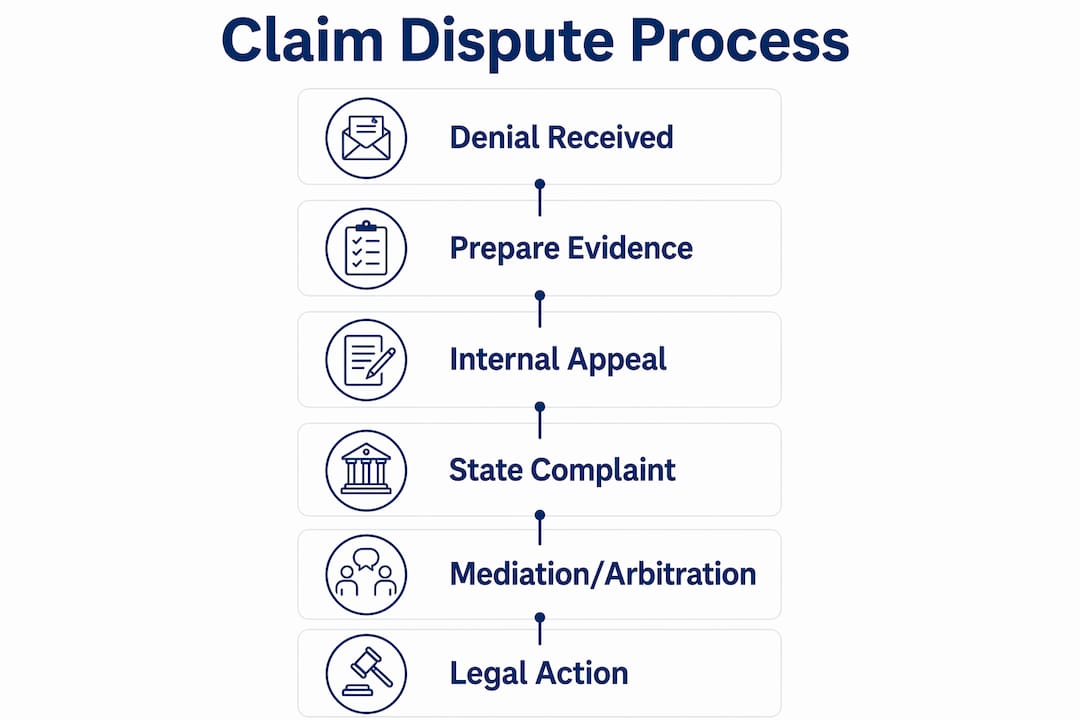
The insurance claim dispute process is formally known as the insurance appeal and dispute resolution process. It covers three escalating stages: internal appeal, regulatory complaint, and alternative dispute resolution or litigation. Most claimants never reach stage three because a well-prepared internal appeal resolves the conflict. The process applies to auto, health, homeowners, and personal injury claims alike.

Insurance claim disputes typically begin the moment you receive a written denial. That denial letter is not a final verdict. It is the starting point for a structured rebuttal. Knowing which stage to use, and when to move from one to the next, is what separates claimants who recover fair compensation from those who accept an unjust outcome.
What you need before starting the dispute
Preparation determines the outcome before you file a single appeal. The most common reason disputes fail is not a weak legal argument. It is missing or disorganized evidence.
Start by pulling out your full insurance policy. Read the declarations page, the coverage sections, and every exclusion. Many disputes originate from misunderstandings about coverage limits, deductibles, and exclusions. Comparing the denial letter word-for-word against your policy language often reveals that the insurer misapplied or misread a clause.
Next, build your evidence file. Every strong dispute file contains:
- The written denial letter with the specific policy clause cited
- Photos of vehicle damage, injuries, or property loss
- Repair estimates, medical bills, and treatment records
- A communication log with dates, names, and summaries of every call or email
- Any police reports, witness statements, or expert assessments
Written evidence is the foundation for regulatory audits and legal leverage. Oral summaries of phone calls carry almost no weight once a dispute escalates. Log every conversation in writing immediately after it happens.
Pro Tip: Request a written denial letter that cites the exact policy provision the insurer used to deny your claim. A vague denial letter is harder to rebut. A specific one gives you a clear target.
How to submit an internal appeal with your insurer
The internal appeal is the mandatory first step in the insurance claim dispute process. Skipping it and going straight to a regulator or attorney typically weakens your position. Insurers and regulators both expect you to exhaust internal remedies first.
Follow these steps in order:
- Obtain the written denial. If you received only a verbal denial, request a written explanation immediately. You need the specific policy language the insurer cited.
- Review the denial reason carefully. Identify every stated reason. Your appeal must address each one directly.
- Build a point-by-point rebuttal. Requesting a written denial that cites specific policy provisions and building a point-by-point rebuttal improves the clarity and success of your appeal. Match each denial reason with counter-evidence: a photo, an estimate, a medical record, or a policy clause that contradicts the insurer’s interpretation.
- Submit your appeal in writing. Send it via certified mail or a method that creates a delivery record. Keep a copy of everything you send.
- Track the deadline. Health insurers must notify the insured of their appeal rights and deadlines. Missing the appeal deadline, even by one day, can forfeit your right to reconsideration. Treat the deadline as the single most critical date in your dispute.
The most common mistake claimants make is writing a general appeal that says “I disagree with this denial.” That approach fails. Success in disputes depends on aligning your appeal argument specifically to the insurer’s stated denial reasons and providing counter-evidence. Think of your appeal letter as a contract interpretation argument, not a complaint.
Pro Tip: If the insurer’s adjuster is unresponsive, send a follow-up in writing and note the date. A documented pattern of non-response becomes useful evidence if you escalate to a regulator.
When and how to escalate to your state insurance department
If the internal appeal fails or the insurer ignores your submission, the next step is filing a complaint with your state insurance department. This is a free process that creates a public record and forces the insurer to respond in writing under a deadline.
Before you file, prepare the following:
- Copies of all correspondence, including your original claim, the denial letter, and your appeal
- A written timeline of events with dates
- Any estimates, medical records, or photos you submitted during the appeal
- The insurer’s written response to your appeal (or documentation that they did not respond)
Filing a complaint with your state insurance commissioner is free, creates a public record, forces insurers to respond in writing under a deadline, and can trigger carrier reassignment. It does not guarantee payment, but it significantly increases the chance of a thorough claim review.
Here is what to expect from the timeline:
| Stage | Typical timeframe |
|---|---|
| Complaint acknowledgment | 7–14 days |
| Insurer response deadline | 15–30 days |
| Full review completion | Up to 180 days for complex cases |
| Mediation referral (if applicable) | Varies by state program |
Some state departments offer mediation programs as part of their consumer assistance services. The Oklahoma Insurance Department, for example, offers free consumer assistance to review disputes, communicate with insurers, and facilitate mediation through its EAGLE program when complaints remain unresolved. Mediation through state programs involves signed agreements, and parties retain the right to litigate if no settlement is reached. Check your own state’s insurance department website for equivalent programs.
What are your options if earlier steps fail?
When internal appeals and regulatory complaints do not resolve the dispute, three paths remain: mediation, arbitration, and litigation. Each fits a different situation.
Mediation is a voluntary process where a neutral third party helps both sides reach a settlement. Mediation offers faster, voluntary settlement without formal court proceedings, and parties maintain the option to litigate if mediation fails. It works best when both sides are willing to negotiate but cannot agree on a number. Preparation matters here just as much as in the appeal stage. Bring your full evidence file and a clear summary of your damages.
Arbitration is more formal than mediation. An arbitrator reviews evidence and issues a decision, which may be binding or non-binding depending on your policy terms. Check your insurance policy for an arbitration clause. Many auto and homeowners policies include one, which means arbitration may be required before you can sue.
Legal action becomes the right choice when the insurer has acted in bad faith, meaning it denied a valid claim without reasonable basis, delayed payment without justification, or failed to investigate properly. Bad faith claims carry significant legal weight and can result in damages beyond the original claim amount. An attorney experienced in insurance disputes can assess whether your situation meets the bad faith standard.
Pro Tip: Before choosing between mediation and litigation, consider the complexity and dollar value of your dispute. A $3,000 auto repair dispute may resolve faster through mediation. A $150,000 injury claim with a bad faith pattern warrants an attorney from the start.
For those interested in how mediation resolves disputes in other legal contexts, the principles of preparation, documentation, and cooperative communication apply across dispute types.
Key Takeaways
The insurance claim dispute process rewards preparation, timeliness, and a point-by-point rebuttal strategy at every stage, from internal appeal through potential litigation.
| Point | Details |
|---|---|
| Documentation is the foundation | Collect denial letters, photos, estimates, and communication logs before filing any appeal. |
| Internal appeal comes first | Address every stated denial reason with specific counter-evidence before escalating externally. |
| Deadlines are non-negotiable | Missing an appeal deadline can permanently forfeit your right to reconsideration. |
| State regulators create leverage | A free complaint to your state insurance department forces a written insurer response under deadline. |
| Legal action is a real option | Bad faith denials and unresolved disputes can support lawsuits that recover more than the original claim. |
What I’ve learned after years of fighting insurance denials
I have seen the same pattern repeat itself in case after case. A client comes to me after accepting a denial as final, convinced the insurer had the last word. They didn’t know that the denial letter was actually an invitation to fight back.
The single biggest mistake I see is treating the first denial as a closed door. Insurance denial appeals are rights you must exercise. Accepting the first denial as final is a common mistake that reduces your chances of a favorable outcome. I cannot stress this enough.
The second mistake is relying on phone calls. I tell every client: if it is not in writing, it did not happen. Insurers have entire teams trained to manage claims. You need a paper trail that matches theirs. When you document losses carefully, you shift the balance of power.
The third thing I have learned is that escalation should be strategic, not emotional. Internal appeal first. Regulatory complaint second. Legal action third. Each stage builds on the last. Jumping straight to a lawsuit without exhausting earlier steps often hurts your credibility with a judge or arbitrator. Patience and process win more disputes than anger does.
— Martin Hernandez
How Martin Hernandez, PA can help with your dispute
Dealing with a denied or undervalued claim after a car accident is stressful enough without having to decode policy language and navigate appeal deadlines on your own.

Martin Hernandez, PA represents car accident victims and injured families throughout Tampa and Hillsborough County. The firm handles every stage of the dispute process, from organizing your evidence file and drafting appeal letters to filing regulatory complaints and pursuing litigation when insurers act in bad faith. If you are wondering when to hire a personal injury lawyer, the answer is usually earlier than you think. You pay nothing unless your case is won. Call Martin Hernandez, PA today for a free consultation in English or Spanish.
FAQ
What is the first step in the insurance claim dispute process?
The first step is filing an internal appeal with your insurer. Obtain the written denial, identify every stated reason, and submit a point-by-point rebuttal with supporting evidence.
How long does the insurance dispute timeline typically take?
State insurance departments typically acknowledge complaints within 7–14 days and require insurer responses within 15–30 days. Complex cases can take up to 180 days for full review.
What are the most common insurance claim denial reasons?
Insurers most often deny claims due to coverage exclusions, missed deadlines, insufficient documentation, or disputes over fault and damage valuation. Reviewing your policy against the denial letter reveals which reason applies.
Can I file a complaint with my state insurance department for free?
Filing a complaint with your state insurance commissioner is free and creates a public record that forces the insurer to respond in writing under a regulatory deadline.
When should I hire an attorney for an insurance dispute?
Hire an attorney when the insurer has acted in bad faith, when the claim value is significant, or when internal appeals and regulatory complaints have failed to produce a fair resolution.
Recommended
- Insurance Claim Dispute Lawyer: A Tampa Accident Guide – Personal Injury Lawyers of Tampa
- How to Document Losses in an Insurance Dispute – Personal Injury Lawyers of Tampa
- How to Fight Insurance Denial and Get Your Claim Paid – Personal Injury Lawyers of Tampa
- How to Dispute Insurance Claim Denial Effectively – Personal Injury Lawyers of Tampa