
TL;DR:
- Medical records are essential evidence that objectively prove injuries and causation in personal injury cases. Gathering and organizing comprehensive records from all providers, while actively tracking deadlines, strengthens your claim. Proper review and presentation of these records significantly influence case success and settlement outcomes.
Medical records are the foundational evidence in any personal injury case, providing objective documentation of your injuries, treatment, and the direct link between the accident and your harm. Without them, your claim rests on your word alone. Insurance adjusters do not settle based on your description of pain. They settle based on objective diagnostic proof like imaging results, physician notes, and itemized billing. If you are reading this after an accident in Tampa or anywhere in Florida, understanding how to gather and use your medical documentation is the single most important step you can take right now.
What medical records are essential for a personal injury claim?
A complete personal injury medical file is not a single document. It is a collection of records from multiple providers, covering every phase of your care from the moment of injury through your ongoing recovery.
The core records you need include:
- Emergency room and hospital records: Admission notes, discharge summaries, and attending physician reports establish the immediate impact of the accident on your body.
- EMS and ambulance reports: These capture your condition at the scene, which is powerful evidence of acute injury before any treatment began.
- Specialist consultations: Orthopedic, neurological, and pain management notes confirm the severity and complexity of your injuries.
- Imaging studies and actual image files: X-rays, MRIs, and CT scans are not just reports. The actual image files matter. Insurance adjusters seek objective diagnostic proof like imaging and range-of-motion tests to validate subjective injuries.
- Physical therapy and rehabilitation notes: These document your functional limitations and the ongoing effort required to recover.
- Pharmacy and prescription histories: Medication records corroborate the treatments your doctors prescribed and the severity of your condition.
- Itemized billing statements with CPT codes: Billing records are part of the designated record set and often require separate requests to confirm the medical expenses you are claiming.
A complete personal injury medical file includes emergency records, specialist notes, imaging, therapy records, and itemized billing ledgers with CPT codes. Each category serves a distinct legal purpose, and missing even one can create gaps that insurers will exploit.
| Record Type | Legal Purpose |
|---|---|
| Emergency and hospital records | Establishes immediate injury at time of accident |
| Imaging studies and image files | Provides objective proof of physical damage |
| Specialist consultation notes | Confirms severity, complexity, and ongoing impact |
| Physical therapy records | Documents functional limitations and recovery effort |
| Itemized billing statements | Verifies all claimed medical expenses with specificity |

How do you obtain medical records for your personal injury case?
Gathering your records is a process, not a single phone call. Follow these steps to do it efficiently and without costly delays.
Compile your complete provider list. Write down every doctor, hospital, urgent care clinic, imaging center, and pharmacy you visited after the accident. Include dates of service and facility addresses. Missing a provider means missing records.
Prepare a HIPAA-compliant authorization for each provider. Each facility has its own release form. The authorization must specify your name, date of birth, the accident date, and the exact scope of records requested. Vague authorizations cause delays and partial releases.
Assert your direct patient access rights. Under 45 CFR 164.524, patients have a federal right of access to their own medical records. Exercising this right directly can sometimes move faster than waiting for attorney-initiated requests.
Submit requests through each provider’s preferred method. Some facilities accept fax or email. Others require certified mail or an in-person visit to their medical records department. Confirm the method before submitting.
Track the 30-day HIPAA response deadline. HIPAA requires medical providers to respond to patient access requests within 30 calendar days, with one 30-day extension allowed only if they send written notice. That means you could wait up to 60 days legally. Mark your calendar and follow up before the deadline passes.
Follow up on incomplete or delayed responses. If a provider misses the deadline or sends partial records, contact their medical records department in writing. Document every communication. If the provider continues to delay, your attorney can escalate with a subpoena.
Pro Tip: Include a copy of your government-issued photo ID with every request. Providers commonly delay release even with proper authorization, and submitting ID upfront removes one of the most common excuses for non-compliance.
What challenges come up when retrieving medical records?
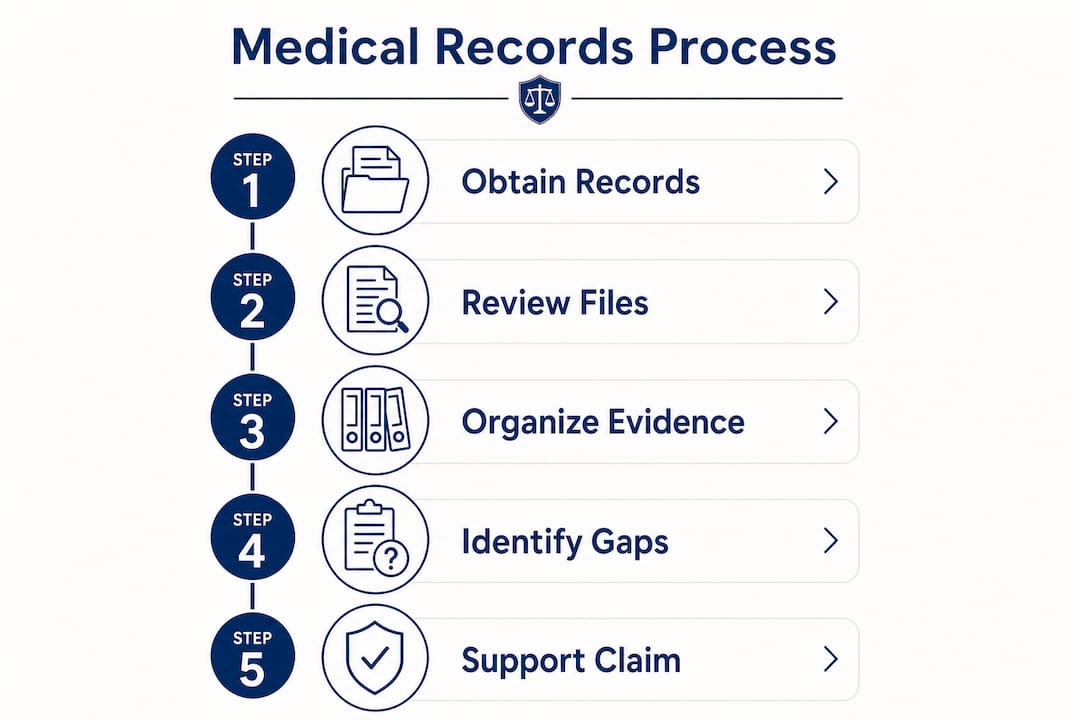
Record retrieval is rarely straightforward. Knowing the common obstacles in advance puts you in a much stronger position.
Fragmented storage across systems. Clinical notes, imaging files, and billing records are rarely stored in the same place. Medical records compilation requires multiple separate requests and active tracking because providers store these categories in different systems. Sending one request to a hospital and assuming you received everything is a mistake that delays cases by weeks.
Provider-specific forms and fee disputes. Many facilities will not process a generic release form. They require their own proprietary authorization. Some charge per-page copying fees, which vary by state law. Florida limits these fees, but providers do not always follow the rules without pushback.
Incomplete record scopes. If your authorization says “all records related to my treatment,” some providers interpret that narrowly and exclude imaging or billing. Specify each category explicitly in your request: clinical notes, imaging reports, actual image files, and billing statements.
Denials and partial releases. If a provider denies your request or releases only part of your file, do not accept it passively. File a complaint with the U.S. Department of Health and Human Services Office for Civil Rights, which enforces HIPAA. Your attorney can also issue a subpoena if litigation is underway.
“Gaps in treatment or delays in seeking care often reduce settlement value because insurers dispute causation. The burden falls on you to show that every gap had a legitimate explanation, and your records are the only way to do that.”
The most effective defense against retrieval problems is active ownership of the process. You or your legal team should maintain a tracking log with the provider name, request date, method used, and expected response deadline. Passive waiting is how cases stall.
How do you organize and use medical records to support your claim?
Collecting records is only half the work. Reviewing and organizing them strategically is what turns a stack of documents into a persuasive case.
Start by confirming your treatment timeline matches your account of events. Every gap between the accident date and your first medical visit, or between appointments, will be scrutinized. Gaps in treatment or delays in seeking care often reduce settlement value as insurers dispute causation. If you delayed care for a legitimate reason, document it.
Next, verify that your imaging and specialist notes explicitly connect your injuries to the accident. A doctor’s note stating that your lumbar herniation is consistent with the mechanism of a rear-end collision is far more powerful than a diagnosis alone. Medical records that explicitly link injury to accident are the most persuasive evidence available to your legal team.
Address pre-existing conditions head-on. Pre-existing conditions do not disqualify your claim, but they make detailed records necessary to distinguish a new injury from an old one. Your attorney needs records from before the accident to show the baseline, and records after to show what changed.
Pro Tip: A medical record review assesses whether your records support the injury story, treatment timeline, causation, and damages. Ask your attorney to walk through this review with you before any demand letter goes out.
Finally, cross-reference your billing statements against your clinical records. Every expense you claim must appear in the documented treatment. Billing for a procedure that does not show up in clinical notes creates credibility problems that insurers will use against you. Coordinate with your legal team to build a demand package that ties every dollar claimed to a specific documented treatment.
Key Takeaways
Medical records are the single most critical form of evidence in a personal injury claim, and their completeness directly determines your settlement value.
| Point | Details |
|---|---|
| Collect all record types | Request clinical notes, imaging files, and billing separately since providers store them in different systems. |
| Know your HIPAA rights | Providers must respond within 30 days; assert your direct patient access rights under 45 CFR 164.524 to speed up retrieval. |
| Track every request actively | Log provider names, submission dates, and deadlines to prevent delays from stalling your case. |
| Address gaps and pre-existing conditions | Document every treatment gap with a reason and use prior records to distinguish new injuries from old ones. |
| Review records before filing demands | Confirm that billing, clinical notes, and imaging all align before your attorney sends a demand letter. |
Why medical records make or break cases in my experience
I have handled personal injury cases in Tampa for years, and the pattern is consistent. The cases that settle well are the ones where the medical records tell a clear, unbroken story. The cases that struggle are the ones where the records are incomplete, contradictory, or arrive too late to matter.
Here is something most articles will not tell you: the records themselves are not enough. How they are reviewed and presented is what separates a strong demand from a weak one. I have seen clients with serious injuries receive low offers because their records contained unexplained gaps or vague causation language. I have also seen clients with moderate injuries receive fair settlements because their documentation was meticulous and their physician explicitly connected every symptom to the accident.
The other thing I want you to understand is that pre-existing conditions are not the liability most people fear. What actually hurts a case is when the records do not clearly show what changed after the accident. If you had a prior back issue and the accident made it significantly worse, your records need to show that progression in clinical terms. That is a winnable argument. Vague records are not.
My advice is to treat your medical records like your most valuable asset in this process. Get to every appointment. Follow your treatment plan. Ask your doctors to document your symptoms in detail. And work with a legal team that knows how to read, organize, and present what those records contain. At Martin Hernandez, PA, we review every record before a demand goes out, because that review is where cases are won or lost.
— Martin Hernandez
How Martin Hernandez, PA helps you build your medical evidence
If you are dealing with a personal injury claim in Tampa or Hillsborough County, the medical records process does not have to fall on your shoulders alone.
Martin Hernandez, PA handles the full scope of medical record retrieval and review for clients. The team identifies every provider, submits HIPAA-compliant authorizations, tracks deadlines, and follows up on incomplete releases. Once records arrive, the legal team reviews them for completeness, causation language, and alignment with your billing before any demand is prepared. You can learn more about personal injury law basics or review the steps in a Florida lawsuit to understand where records fit in the full process. The firm works on a contingency fee basis, meaning you pay nothing unless your case is won. Call Martin Hernandez, PA today for a personalized case evaluation.
FAQ
What medical records do I need for a personal injury case?
You need emergency room records, EMS reports, specialist notes, imaging studies and actual image files, physical therapy records, pharmacy histories, and itemized billing statements. Each category serves a distinct purpose in proving injury, causation, and damages.
How long does it take to get medical records for an injury claim?
HIPAA requires providers to respond within 30 calendar days, with one 30-day extension allowed if they send written notice. Active follow-up and submitting a government ID with your request reduces delays significantly.
Can a pre-existing condition hurt my personal injury claim?
A pre-existing condition does not disqualify your claim. Detailed records from before and after the accident are necessary to show what changed, distinguishing a new injury or aggravation from a prior condition.
What happens if a provider refuses to release my records?
You can file a complaint with the HHS Office for Civil Rights, which enforces HIPAA compliance. If litigation is underway, your attorney can also compel release through a subpoena.
Why do gaps in medical treatment hurt my case?
Insurance adjusters use treatment gaps to argue that your injuries were not serious or were not caused by the accident. Every gap needs a documented explanation, and your records are the only way to provide one.
Recommended
- The Role of Medical Documentation in Personal Injury Cases in Tampa: a Guide to Building a Strong Claim
- Car Accident Medical Bills Coverage: Your 2026 Guide – Personal Injury Lawyers of Tampa
- Steps In Personal Injury Lawsuit: Florida Guide To The ProcessIn 2025 – Personal Injury Lawyers of Tampa
- Demand Letter Personal Injury: Your 2026 Florida Guide – Personal Injury Lawyers of Tampa