
If you’re a Medicare beneficiary — or expect to enroll within the next 30 months — and you’re approaching a personal injury settlement that includes future medical expenses, you almost certainly need to address a Medicare Set-Aside (MSA) before you sign anything. Skipping this step doesn’t just create paperwork headaches; it can cause Medicare to deny injury-related claims outright until your entire settlement is spent down. The Medicare Secondary Payer (MSP) statute makes Medicare a secondary payer when settlement funds are available to cover injury-related care, and CMS enforces that rule aggressively.
Take these steps right now, before your settlement closes:
- Confirm your Medicare status. Are you currently enrolled in Medicare Parts A and B, or will you be within 30 months of settlement?
- Preserve all medical records tied to the injury, including prescription history for the past 6–12 months.
- Contact the Benefits Coordination & Recovery Center (BCRC) to identify any conditional payments Medicare has already made on your behalf.
- Do not commingle any funds earmarked for future injury-related care with your personal accounts.
- Consult a personal injury attorney or MSA specialist before finalizing settlement language.
What is a Medicare Set-Aside and how does it connect to the MSP rules?
A Medicare Set-Aside arrangement (MSA) is a portion of a personal injury or workers’ compensation settlement that is specifically allocated to pay for future injury-related medical expenses that Medicare would otherwise cover. Think of it as a dedicated account that stands between your settlement money and Medicare’s coverage obligation — you spend down those funds first on covered care, and only after they’re exhausted does Medicare step in as the primary payer.
The legal foundation is the Medicare Secondary Payer statute, which prohibits Medicare from paying when another source — including a liability settlement — is available to cover the same medical expenses. If you receive settlement funds that include compensation for future medical care and then immediately bill Medicare for that same care, you’re asking Medicare to pay primary when it’s legally required to pay secondary. CMS has both a priority right of recovery and a subrogation right against any party that received a third-party payment without protecting Medicare’s interest.
There are two main types of MSAs, and the distinction matters for your case. A Workers’ Compensation Medicare Set-Aside (WCMSA) applies to workers’ comp settlements and has an established CMS review process with a formal approval letter. A Liability Medicare Set-Aside (LMSA) applies to personal injury and other liability cases. Critically, there is no formal CMS portal or standard approval process for LMSAs — the burden of demonstrating a good-faith effort to protect Medicare’s interests falls entirely on the settling parties and their counsel. That distinction shapes everything about how liability cases are handled.
When should you consider an MSA for your personal injury claim?
Not every personal injury settlement requires a formal set-aside arrangement, but the threshold for needing one is lower than most claimants expect. The clearest triggers are:
- You are currently enrolled in Medicare (Parts A, B, or D).
- You have a reasonable expectation of enrolling in Medicare within 30 months of the settlement date (for example, you’re turning 65 soon, or you’re receiving Social Security Disability Insurance and approaching the 24-month waiting period).
- Your settlement includes compensation for future medical expenses related to the injury.
For workers’ comp cases, CMS will formally review a proposed WCMSA when the claimant is a Medicare beneficiary and the total settlement exceeds $25,000, or when the claimant expects Medicare enrollment within 30 months and anticipated future medical costs exceed $250,000. Liability cases have no equivalent formal thresholds, but those same dollar figures serve as a practical benchmark many practitioners use to decide whether to document an LMSA allocation.
The distinction between past and future medicals is critical here. Past medicals are expenses already incurred and paid (or owed) before settlement — those are addressed through conditional payment resolution with the BCRC, not through an MSA. The MSA focuses exclusively on future injury-related care that Medicare would cover. Understanding how settlement amounts are structured helps you and your attorney identify exactly which portion of your recovery needs to be set aside.
One narrow exception exists: a written certification from your treating physician that all injury-related treatment is complete can, in limited circumstances, support a position that no LMSA is needed. This exception is rarely applicable and requires thorough medical records to back it up — don’t rely on it without counsel.
Pro Tip: If your injury involves ongoing prescriptions, surgeries, or durable medical equipment, assume future medicals are present until a physician certifies otherwise in writing. Carriers and CMS will scrutinize any claim that future care is complete when the medical record says otherwise.
How is an MSA calculated and what documentation makes it defensible?
The core of any MSA is the medical cost projection — a line-item estimate of what injury-related care will cost over your remaining life expectancy, limited to services Medicare would cover. Vendors and attorneys build this projection from several inputs:
- Recent medical records directly tied to the injury (typically the past 2–3 years)
- Prescription history for the past 6–12 months
- Your current treatment plan and any surgical recommendations
- Your age and actuarially projected life expectancy
- Medicare reimbursement rates for each projected service
From those inputs, a vendor creates an allocation report that separates Medicare-covered services from non-covered ones and assigns a dollar value to each. Prescription drugs, follow-up surgeries, physical therapy, and durable medical equipment (wheelchairs, braces, CPAP machines) are common drivers that push allocations higher than claimants expect.
For liability cases, where CMS approval isn’t available, practitioners rely on an evidence-based medical cost projection paired with an attorney legal memorandum that documents how Medicare’s interest was considered during settlement. This combination functions as a compliance shield — proof that the parties didn’t simply ignore Medicare’s future payment responsibility. The memo should address the nature of the injury, the projected future care, the allocation methodology, and why the funded amount is reasonable given the facts.

Pro Tip: Ask your vendor to show their work. A defensible allocation report cites specific Medicare fee schedule rates for each line item, not just a lump estimate. Vague projections invite scrutiny and give CMS little to work with if questions arise later.
How do you fund and administer an MSA account?
Once an allocation amount is determined, you have three primary ways to fund and manage it.

| Funding Option | How It Works | Best For |
|---|---|---|
| Lump-sum, self-administered | Full MSA amount deposited at settlement into a dedicated account you manage | Smaller allocations; claimants comfortable with recordkeeping |
| Structured (annuity-funded) | Initial “seed money” deposit covers early high-cost items; annual deposits follow on a set schedule | Larger allocations; reduces upfront cash outlay |
| Professionally administered | A third-party administrator manages the account, pays bills, handles pharmacy, and files annual attestations | Complex medical needs; claimants who want oversight support |
The rules for all three options are the same: MSA funds must be held in a separate, interest-bearing account and never commingled with personal funds. Administration fees cannot be paid from the MSA itself — they must come from outside the account. For structured WCMSAs specifically, the WCMSA Reference Guide v4.5 requires an initial seed deposit to cover the first surgery or procedure for each body part plus the first two years of annual payments; unspent funds carry forward and must be exhausted before Medicare pays primary in any given period.
Your recordkeeping checklist, regardless of funding method:
- Keep every bill and itemized receipt for injury-related care paid from the MSA
- Maintain pharmacy records showing MSA-funded prescriptions
- Document interest earned on the account
- If professionally administered, retain annual attestation reports
- Keep a running balance showing deposits, expenditures, and remaining funds
For a deeper look at how lump-sum and structured options compare beyond the MSA context, the structured settlement vs. lump sum guide covers the broader tradeoffs worth understanding before you decide.
What does the MSA process look like and how long does it take?
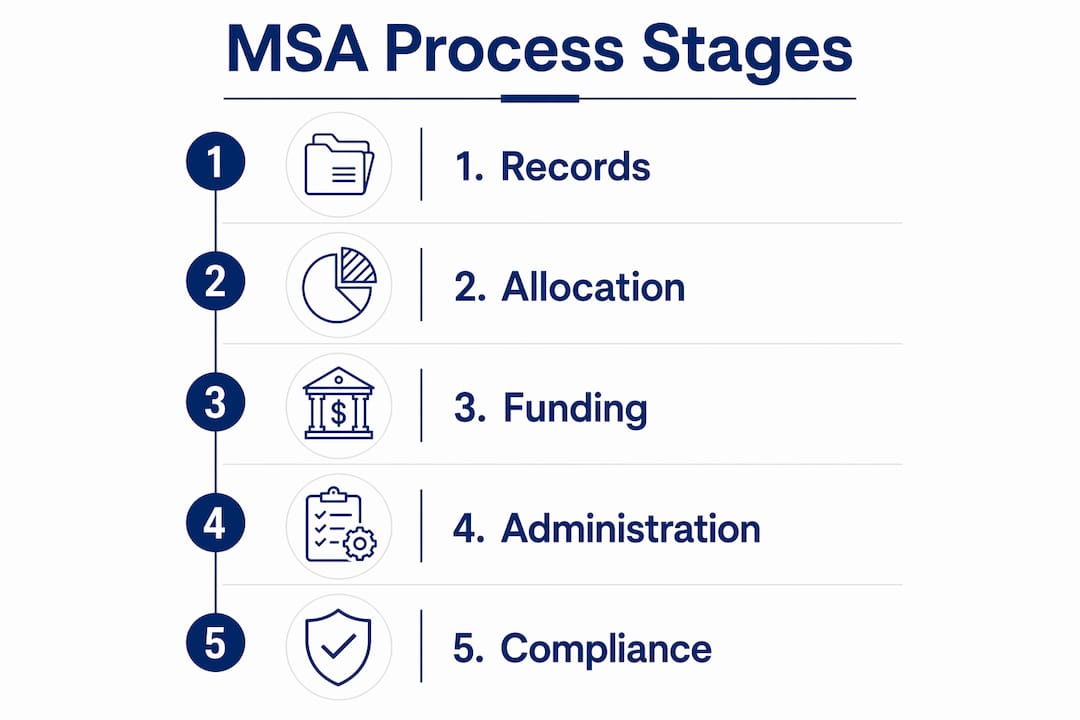
The process moves in four stages, and the timeline depends heavily on how quickly medical records are gathered and whether CMS review is involved.
| Stage | Activity | Typical Timeframe |
|---|---|---|
| Records collection | Gather medical records, prescription history, treatment plans | 2–6 weeks |
| Allocation report | Vendor prepares line-item medical cost projection | 2–4 weeks after records received |
| CMS/WCRC review (WCMSAs only) | Workers’ Compensation Review Contractor reviews proposal | ~30 days when case development is complete |
| Settlement and administration setup | Finalize language, fund account, establish administration | 1–3 weeks post-settlement |
For liability cases, there is no WCRC review step, so the timeline is shorter — but the documentation burden on counsel is higher. Vendor allocation fees typically range from a few hundred to several thousand dollars depending on case complexity. Professional administration carries ongoing fees, usually billed annually or per transaction. Structured funding adds annuity setup costs. Attorney time for drafting the legal memorandum is typically billed within the contingency fee structure when a personal injury firm handles the full case.
When a carrier resists funding an MSA, the most effective leverage is a well-documented allocation report and a clear attorney memorandum. Carriers who understand MSP exposure are generally more willing to negotiate when the documentation is thorough.
What happens if you skip or mismanage an MSA?
The consequences are concrete and can be financially devastating. When Medicare flags post-settlement injury-related claims from a beneficiary who received settlement funds, automated cross-referencing of claims and settlement reporting can trigger denials and recovery actions quickly. You won’t necessarily get a warning first.
The three most common outcomes when parties ignore Medicare’s interest:
- Medicare claim denials. Medicare may refuse to pay for any injury-related care until the entire settlement is exhausted, not just the MSA portion. This can leave you paying out of pocket for ongoing treatment.
- Conditional payment recovery actions. If Medicare made payments before your settlement closed, those conditional payments must be repaid from settlement proceeds. Failing to resolve them can result in CMS issuing a demand letter and placing a lien on your funds.
- Personal liability. When parties settle without protecting Medicare’s interest and Medicare later denies related claims, the beneficiary may face personal liability for costs Medicare seeks to recover — including through the appeals process.
If you’ve ever dealt with an insurance claim denial, you know how draining the appeals process is. A Medicare denial tied to an unresolved MSA issue is worse, because the underlying legal obligation doesn’t go away while you appeal.
How should your settlement be drafted to protect Medicare’s interest?
Settlement language is where protection becomes concrete. A well-drafted personal injury settlement agreement should include:
- An explicit allocation identifying the portion of the settlement designated for future injury-related medical expenses (the MSA amount)
- A separate identification of past medical expenses already incurred and how conditional payments will be resolved
- The funding mechanism for the set-aside (lump sum or structured)
- Residual funds language specifying what happens to unspent MSA funds if the beneficiary passes away or treatment needs change
On the documentation side, your file should contain: all medical records and prescription history, the allocation report, the attorney legal memorandum, conditional payment records, and all BCRC correspondence. When the settlement closes, you or your attorney must submit settlement information to the BCRC and document repayment of any conditional payments. Assuming the carrier will handle all reporting is a common and risky mistake — claimants bear independent notification obligations. Understanding what repayment obligations look like in practice helps you plan for the net recovery you’ll actually receive.
Residual funds — money left in the MSA when it’s no longer needed — should be addressed in the settlement. Some arrangements allow residual funds to revert to the claimant or their estate; others specify a different distribution. Whatever the parties agree to, it needs to be in writing.
When should you hire counsel or an MSA administrator?
Some situations genuinely call for professional help, and waiting too long is the most common mistake. Hire an attorney or MSA specialist when:
- You are a current Medicare beneficiary or will enroll within 30 months of settlement.
- Your injury involves ongoing prescriptions, surgeries, or long-term therapy.
- The settlement amount is large enough to trigger WCMSA review thresholds ($25,000 for current beneficiaries; $250,000 for those expecting enrollment).
- The carrier is resisting MSA funding or disputing the allocation amount.
- You’ve received a conditional payment notice from the BCRC and aren’t sure how to respond.
What a personal injury attorney does in this context goes beyond negotiating the settlement number. Counsel documents past versus future medicals, negotiates settlement language that explicitly protects Medicare’s interest, coordinates conditional payment resolution with the BCRC, and prepares the legal memorandum that serves as the compliance record for an LMSA. An experienced injury lawyer can also use a well-documented MSA as leverage — carriers who see thorough Medicare compliance work understand the case is trial-ready and that shortcuts won’t be accepted.
A professional MSA administrator adds a different layer: ongoing bill review, pharmacy management, annual attestation reporting, and structured fund oversight. For claimants with complex medical needs, the cost of administration is usually worth the protection it provides.
Pro Tip: Bring your Medicare card, any BCRC correspondence, your current treatment records, and a draft of the proposed settlement to your first attorney consultation. The more complete your file, the faster counsel can identify conditional payment exposure and MSA obligations.
Martin Hernandez, PA handles the full scope of this work for personal injury clients in Tampa and Hillsborough County — from documenting past and future medicals to coordinating with MSA vendors and drafting settlement language that holds up to scrutiny. The firm’s trial-ready approach means every case is prepared as if it’s going to court, which consistently produces better settlement outcomes. Questions about taxation on your net recovery are also worth addressing early; resources like this analysis of settlement taxation offer useful background, though Florida-specific tax questions should be confirmed with your attorney.
Key Takeaways
A Medicare Set-Aside in a personal injury settlement is not optional when you’re a Medicare beneficiary with future injury-related medical needs — skipping it puts both your coverage and your net recovery at risk.
| Point | Details |
|---|---|
| Check Medicare status first | Confirm enrollment or expected enrollment within 30 months before finalizing any settlement. |
| Separate future medical funds | MSA funds must be held in a dedicated, interest-bearing account, never commingled with personal money. |
| Document everything | Keep bills, pharmacy records, the allocation report, the attorney memorandum, and all BCRC correspondence. |
| Resolve conditional payments | Notify the BCRC and repay Medicare’s conditional payments from settlement proceeds before closing. |
| Martin Hernandez, PA | The firm handles MSA documentation, settlement language, and BCRC coordination for personal injury clients in Tampa and Hillsborough County. |
The part of MSA planning most attorneys get wrong
Most of the conversation around Medicare Set-Asides focuses on the dollar amount — how much to allocate, whether the vendor’s projection is too high, whether CMS will push back. That’s understandable, because the number is what everyone argues about at the settlement table.
What gets far less attention is the documentation trail that surrounds the number. For liability cases, there is no CMS approval letter to point to. If Medicare questions the settlement five years later, the only thing standing between your client and a denial or recovery action is the paper record: the allocation report, the attorney memorandum, the settlement language, the BCRC correspondence, and the account records. A well-funded MSA with sloppy documentation is almost as risky as no MSA at all.
The other thing practitioners underestimate is timing. Conditional payment resolution and MSA planning should begin well before the settlement conference, not the week before signing. Waiting until the last minute compresses the timeline, limits negotiating leverage, and increases the chance that something gets missed. Trial-ready preparation means having the Medicare compliance work done before you sit down to negotiate — not scrambling to catch up after a number is agreed to.
Ready to protect your Medicare benefits? Here’s how Martin Hernandez, PA can help
If you’re a Medicare beneficiary facing a personal injury settlement in Tampa or Hillsborough County, the difference between a protected recovery and a costly Medicare dispute often comes down to what happens in the 30–60 days after you retain counsel.

At Martin Hernandez, PA, the first phase of representation covers the work that protects your long-term care access: reviewing your medical records to separate past from future medicals, identifying and resolving conditional payments with the BCRC, coordinating with MSA allocation vendors, and drafting settlement language that explicitly documents Medicare’s interest. The firm works on a contingency fee basis — you pay nothing unless your case is won. Spanish-language support is available for every step of the process.
To schedule a consultation, bring your Medicare card, any BCRC or conditional payment correspondence, your current medical records, and any draft settlement documents you’ve received. The sooner counsel reviews those materials, the more options you have. Learn what personal injury representation covers and reach out to Martin Hernandez, PA to get started.
This article provides general information about Medicare Set-Asides and is not legal advice. MSA requirements depend on your specific medical history, Medicare status, and settlement facts. Confirm current CMS rules and your obligations with a qualified attorney or MSA specialist before finalizing any settlement.
Useful sources and further reading
The following primary and practitioner sources informed this article and are worth bookmarking for your own reference.
- WCMSA Reference Guide v4.5 (April 13, 2026) — CMS’s primary policy document on WCMSA purpose, funding structures ($25,000 and $250,000 review thresholds), and the WCRC review process.
- Medicare Secondary Payer overview (CMS) — The statutory foundation for why MSAs exist; explains Medicare’s secondary-payer status and recovery rights.
- BCRC recovery process (CMS) — Step-by-step guidance on conditional payments, demand letters, and how to notify Medicare of a settlement.
- Liability MSA update (Paramount Advisors) — Practitioner analysis of why LMSAs lack formal CMS review and what good-faith documentation looks like in liability cases.
- The New Frontier of Liability MSAs (2026 whitepaper) — Covers the narrow physician-certification exception and current practitioner standards for LMSA documentation.
- MSA rules and requirements (LegalClarity) — Plain-language summary of account rules, administration requirements, and consequences of mismanagement.
FAQ
How long does it take to get a Medicare Set-Aside?
For liability cases, the vendor allocation report typically takes 2–4 weeks after medical records are received; for workers’ comp cases requiring WCRC review, the average review time is approximately 30 days once case development is complete. Total timeline from records collection to funded account is commonly 6–12 weeks.
What happens if you don’t use the Medicare Set-Aside funds correctly?
If you spend MSA funds on non-injury-related expenses or fail to maintain a separate account, Medicare may deny future injury-related claims until your entire settlement is exhausted, and CMS can pursue recovery actions against you personally.
How is a Medicare Set-Aside calculated?
An MSA is calculated through a line-item medical cost projection that estimates the cost of all future injury-related care Medicare would cover, based on your medical records, prescription history, treatment plan, age, and life expectancy, using Medicare reimbursement rates for each projected service.
Is it illegal to spend Medicare Set-Aside money on non-medical expenses?
Spending MSA funds on anything other than injury-related medical expenses covered by Medicare violates the terms of the set-aside arrangement. Doing so can trigger Medicare claim denials and CMS recovery actions, and may expose you to personal financial liability for costs Medicare seeks to recover.
Do liability personal injury settlements always require a formal MSA?
No formal CMS approval process exists for liability MSAs, but if you are a Medicare beneficiary or expect to enroll within 30 months and your settlement includes future medical expenses, documenting a good-faith allocation through an evidence-based cost projection and attorney memorandum is the standard of care to protect your Medicare benefits.
Recommended
- When an Injury Lawyer Can Increase Your Settlement – Personal Injury Lawyers of Tampa
- Are Personal Injury Case Settlements Taxable? – Personal Injury Lawyers of Tampa
- Do I Have To Pay Back My Health Insurance For What They Paid After A Car Accident? – Personal Injury Lawyers of Tampa
- Structured Settlement vs Lump Sum: A Florida Guide – Personal Injury Lawyers of Tampa