
When you search for a “motorcycle accident attorney near me,” you’re not just looking for a name in a directory. You’re looking for a local advocate who can get to work immediately. Here in Tampa, that means finding a firm that truly gets Florida’s unique, often complicated laws and understands the specific dangers riders deal with on Hillsborough County roads.
Why a Local Tampa Attorney Is Your Strongest Ally After a Crash
The moments after a motorcycle crash are pure chaos. While you’re trying to figure out your medical situation, you can bet the insurance adjuster is already working to build a case against you. Their job is simple: pay out as little as possible. This is why getting a strategic legal partner in Tampa isn’t just a nice-to-have; it’s your most critical line of defense.
A local lawyer brings so much more to the table than just convenience. They have firsthand knowledge of the Hillsborough County court system, the local judges, and the go-to tactics used by the big insurance companies that write policies here. This isn’t something you learn from a book; it’s real-world insight from handling cases in our community for years. Of course, to be that strong local ally, a good lawyer needs to be visible online, which often involves mastering specialized SEO strategies for personal injury attorneys.
Fighting the Unfair Bias Against Riders
Let’s be honest: motorcyclists often face an immediate, unfair bias. Other drivers, insurance adjusters, and sometimes even potential jurors jump to the conclusion that the rider was being reckless or speeding. A sharp Tampa attorney knows exactly how to tear down that prejudice with cold, hard facts.
They’ll use powerful tools to prove what really happened, such as:
- Detailed accident reconstruction analysis
- Testimony from engineering and medical experts
- Black box data from other vehicles or nearby traffic camera footage
This aggressive, evidence-based approach is crucial. Your lawyer becomes your shield, taking over all communication with the insurance companies and stopping them from cornering you into a quick, lowball settlement that won’t even cover your bills. While every crash is different, you can get more details on the process in our guide for handling a Tampa car accident.
The Stark Reality of Motorcycle Risks
The dangers riders face aren’t just a perception; the statistics are sobering. Motorcyclists are exposed to dramatically higher risks on the road than people in cars. In a recent year, a record 6,335 motorcyclists died in crashes nationwide—the highest number ever recorded.
The fatality rate for riders is a staggering 31.39 deaths per 100 million vehicle miles traveled. To put that in perspective, it’s 28 times higher than the rate for people in passenger cars. As cars have become loaded with advanced safety tech, that gap has only gotten wider, leaving riders more exposed than ever.
A dedicated legal team prepares every single case for trial right from the beginning. That readiness sends a powerful message to the insurance company: we will not be bullied into accepting an unfair offer. It’s that leverage that forces them to the negotiating table in good faith and is often what secures the full and fair compensation you deserve.
How to Vet and Choose the Right Motorcycle Lawyer in Tampa
Okay, you’ve done the initial search. Now comes the most important part: moving from a list of names to finding the one advocate who will fight for you. It’s a huge decision, and frankly, not all personal injury attorneys are equipped for the unique challenges of a motorcycle accident case.
You’re not just looking for a lawyer; you’re looking for a specialist. This is someone who gets the physics of a two-wheel crash, understands the unfair biases riders face, and knows every trick in the insurance adjuster’s playbook. A generalist might handle car wrecks all day, but they often miss the nuances that can mean the difference between a lowball offer and a life-changing settlement.
Look Beyond the Billboard: What Truly Matters
When you start digging into different law firms, your focus should be on their actual, proven experience with cases like yours. A flashy commercial doesn’t win in court.
Here’s what you should be laser-focused on:
- Verifiable Case Results: Don’t just take their word for it. Ask to see examples of settlements and verdicts they’ve secured specifically for motorcycle accident victims. This isn’t about guaranteeing a number for your case, but it proves they can deliver when it counts.
- A Trial-Ready Reputation: Insurance companies keep score. They know which lawyers are afraid of the courtroom and will settle for less to avoid a fight. You want an attorney who prepares every single case as if it’s going to trial. That reputation alone gives you massive leverage in settlement negotiations.
- Access to a Network of Experts: A top-tier firm won’t go it alone. They’ll have a trusted network of accident reconstruction experts, Tampa-based medical specialists who understand traumatic injuries, and even financial planners to prove the full, long-term cost of your damages.
This path is pretty standard—from the crash itself to dealing with insurance and then, wisely, bringing in legal counsel.
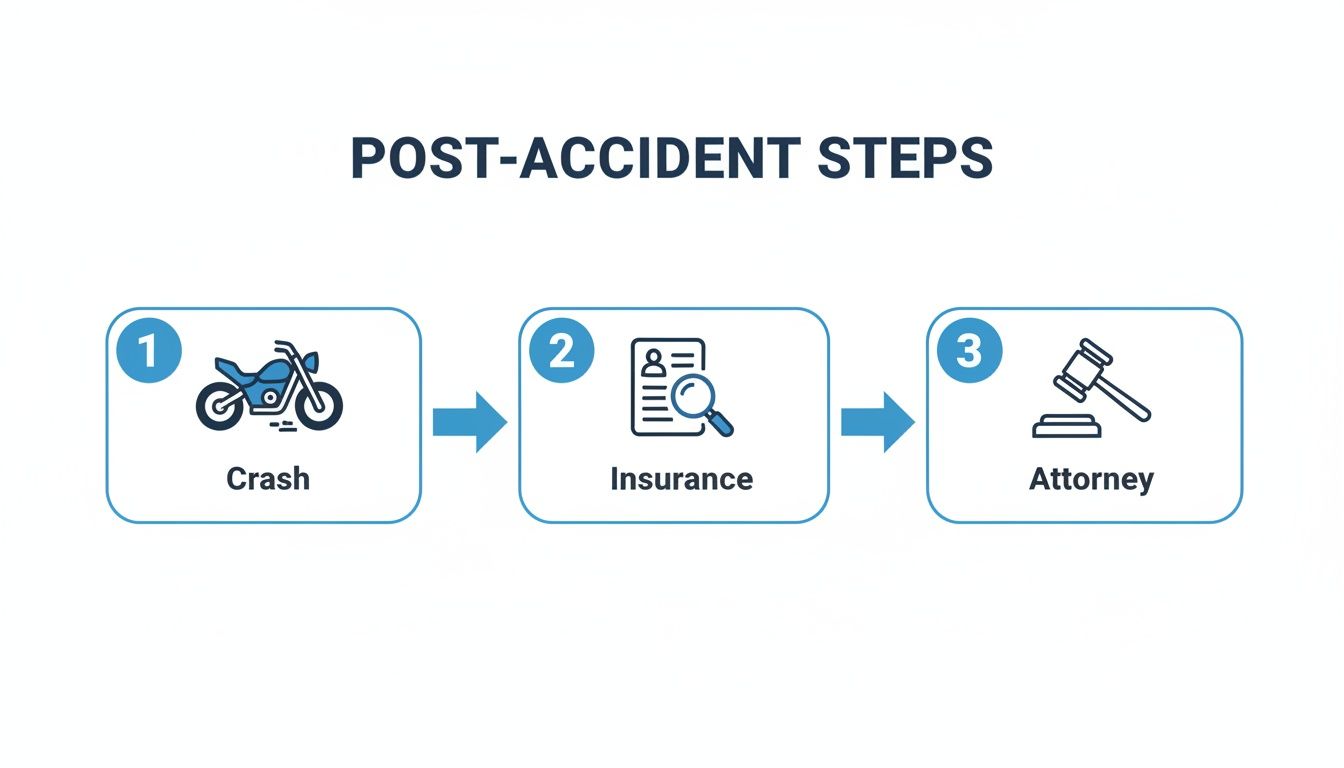
As you can see, getting a lawyer involved early is key. They can take over the frustrating back-and-forth with the insurance company right away, letting you focus on healing while they protect your claim.
Critical Questions for Your First Consultation
Think of your initial consultation as a two-way interview. You’re sizing them up just as much as they’re evaluating your case. Come ready with sharp questions that get past the sales pitch and reveal their actual strategy.
Expert Tip: Never hesitate to ask the hard questions. A confident, skilled attorney will welcome the chance to walk you through their process and prove their expertise. If they get defensive or give vague answers, that tells you everything you need to know.
Here are a few questions I’d have on my list:
- Who is my day-to-day contact? Will you be speaking directly with the attorney, or will your case be handed off to a paralegal or case manager you’ve never met? You deserve direct communication.
- How do you fight the “I just didn’t see the motorcycle” defense? This is a classic line used to blame the rider. Their answer will instantly show you how much experience they have with biker bias and their tactics for proving the other driver was negligent.
- What’s your experience with my specific injuries? An attorney who understands the long-term medical needs and financial strain of a severe road rash, a TBI, or a spinal injury is far better equipped to calculate the true value of your damages.
Pay close attention to how they treat you from that very first call. A firm’s responsiveness is a huge indicator of their client service. Research on Speed To Lead Law Firm Response Time shows that the best firms make communication a priority. If they’re slow to get back to you for a free consultation, imagine what it will be like once you’re a client.
For more foundational advice, you can also check out our guide on what to look for when you need an accident injury lawyer near me. In the end, choosing your advocate is the single most critical decision you’ll make for your physical and financial recovery.
What to Expect From the Legal Process in a Florida Motorcycle Crash
Knowing what’s coming down the road legally is the first step toward getting your life back on track after a motorcycle wreck. Florida’s laws have some specific quirks that apply directly to riders, and you can bet the insurance companies are experts at twisting these rules to their advantage.
One of the biggest hurdles for motorcyclists right out of the gate is insurance. In Florida, Personal Injury Protection (PIP) is not required for motorcycles. It might save you a few bucks on your premium, but it means that after an accident, you have no immediate “no-fault” medical coverage to pull from. This makes the at-fault driver’s Bodily Injury (BI) liability insurance the primary target for compensation, which is why proving their negligence is everything.
The Impact of Florida’s Comparative Negligence Rule
The first move an insurance adjuster will almost always make is trying to shift blame onto you, the rider. Their favorite weapon for this is Florida’s comparative negligence rule.
Under this law (Florida Statute 768.81), any compensation you receive gets reduced by your percentage of fault. Worse yet, if you are found to be more than 50% at fault for the crash, you get absolutely nothing. Zero.
Let’s say an adjuster claims you were speeding—even with zero evidence to back it up—and assigns you 30% of the fault. That move instantly slashes a $100,000 settlement down to $70,000. A skilled motorcycle accident attorney sees these baseless tactics coming from a mile away and knows exactly how to shut them down with facts and evidence.
Your attorney’s first mission is to build an ironclad case proving the other driver was the one at fault. They’ll use police reports, witness interviews, and sometimes even accident reconstruction experts to dismantle the insurance company’s arguments before they can even get off the ground.
Building Your Case During the Investigation Phase
The moment you hire an attorney, they kick off a deep-dive investigation that goes way beyond a simple glance at the police report.
Your legal team will get to work immediately to:
- Preserve All Evidence: They’ll lock down photos and videos from the scene, get recordings of 911 calls, and hunt for any nearby traffic or surveillance camera footage that might have captured the incident.
- Track Down Witnesses: They find anyone who saw what happened and get their formal statements locked in before memories start to get fuzzy.
- Work With Experts: For more complex wrecks, they often bring in accident reconstruction specialists who can analyze skid marks, vehicle damage, and other physical evidence to create a scientific breakdown of how the crash occurred.
- Document Every Single Loss: They will gather all your medical records, hospital bills, and proof of lost income to calculate the full, true value of your claim.
From this point, your case will head down one of two paths: settlement negotiations or trial. The stronger the evidence collected during this initial investigation, the more likely the insurance company will be to offer a fair settlement.
The vast majority of cases settle out of court. However, the size of that settlement offer is always influenced by how seriously the insurer takes your lawyer’s threat to go to trial. A law firm with a reputation for winning in the Hillsborough County court system negotiates from a position of power, sending a clear message that they are prepared to fight all the way. To get a better feel for the entire journey, you can see a breakdown of the typical steps in a personal injury lawsuit here. That readiness is your biggest advantage.
Getting Your Evidence Together: What You Need to Win
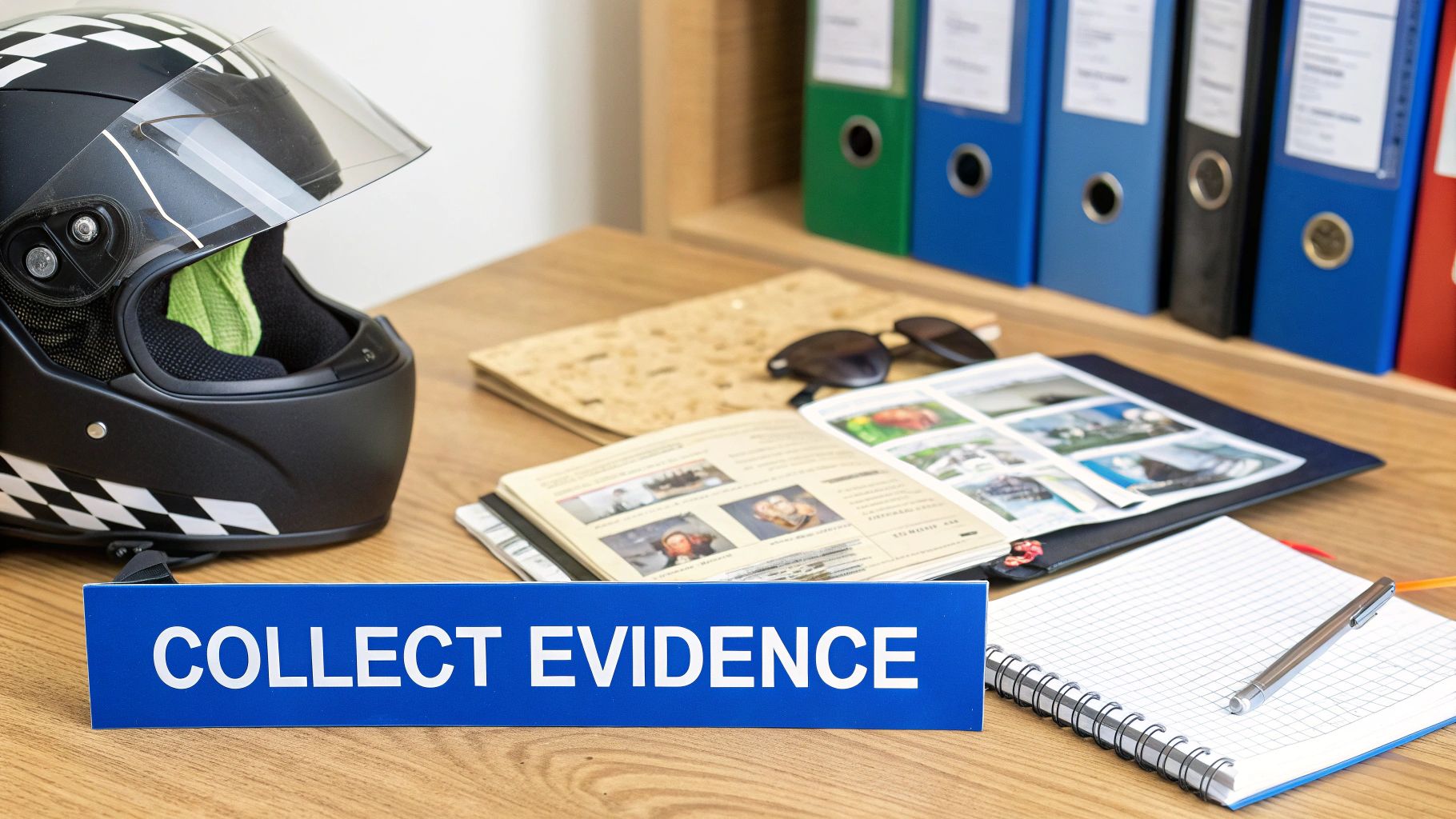
While your attorney is going to run a full-blown investigation, the documents and notes you start collecting right after the crash are pure gold. A winning case isn’t just about what happened at the scene; it’s built on a mountain of proof that shows exactly how this accident has turned your life upside down.
You are the only person who can truly document the day-to-day reality of your recovery. Every receipt, every photo, and every quick note you jot down becomes a piece of the puzzle. This isn’t busywork—it’s the ammunition your legal team needs to build the strongest possible case for you.
Start Your “Case File” Now
Don’t wait. Grab a folder, a box, or just create a dedicated folder on your computer. Start putting everything—and I mean everything—related to the accident and your injuries in one place. Staying organized from the start makes a huge difference later on.
Here’s what you need to start gathering immediately:
- The Police Report: Get your hands on a copy of the official crash report as soon as it’s filed. This is the first official record of what happened, containing the officer’s notes, witness contacts, and often a diagram of the scene.
- All Medical Paperwork: This is non-negotiable. Every single bill, explanation of benefits (EOB), and receipt needs to be saved. This includes everything from the ambulance and ER visit to follow-ups with specialists, physical therapy sessions, and even receipts for prescriptions or a pair of crutches.
- Proof of Lost Wages: How do you prove you lost income? You show them. Gather your pay stubs from before the wreck to establish your normal earnings, then get a letter from HR or your boss detailing the exact time you missed. If you’re self-employed, this might mean gathering past invoices, contracts, or tax returns to show the hit your business took.
Getting these documents together is a fantastic first step. For an even more detailed checklist, check out our guide on what evidence you should preserve after an accident.
Don’t Forget to Document the “Invisible” Injuries
Some of the most devastating impacts of a motorcycle wreck never show up on a bill. This is where your own personal record-keeping can make or break your case, especially when it comes to compensation for pain and suffering.
I tell every client this: a pain journal is one of the most powerful tools you have. It gives your experience a human voice that a stack of medical bills simply can’t.
It doesn’t have to be complicated. Just get a simple notebook or use a notes app on your phone. Every day, take a minute to write down a few things:
- Your pain level on a scale of 1 to 10.
- How the injuries are limiting you (e.g., “Couldn’t lift my daughter,” or “Had to ask for help carrying groceries”).
- Activities you missed out on, like a family party or a weekend ride.
- Your emotional state—are you feeling anxious, depressed, or having trouble sleeping?
This daily log becomes undeniable proof of your suffering. It’s the story of your recovery, and it’s exactly what’s needed to counter an insurance adjuster who will try to argue that you weren’t “that hurt.”
Understanding How Contingency Fees Actually Work
After a motorcycle crash, the last thing you should be worrying about is how to pay a lawyer. Medical bills are piling up, you might be out of work, and the stress is overwhelming. This is exactly why nearly every motorcycle accident attorney you’ll find works on a contingency fee basis.
It’s a system designed to give you a fighting chance, no matter your financial situation.
The concept is simple: we don’t get paid unless you get paid. Our fee is a percentage of the money we recover for you, whether that’s through a settlement with an insurance company or a verdict at trial. This puts us on the same team. The better you do, the better we do. It’s that straightforward.
No Upfront Costs, Period
When we say “no fee unless you win,” we mean it. You won’t see a single bill for our time or effort. There are no retainers to pay and no hourly rates to track. Your job is to focus on getting better; our job is to handle the legal battle.
This also covers all the expenses required to build a powerful case. Winning a complex motorcycle accident claim isn’t cheap. It often involves significant upfront investment in things like:
- Hiring accident reconstruction experts to prove the other driver was at fault.
- Paying court filing fees and costs for depositions.
- Retaining medical experts to testify about the severity of your injuries.
- Covering administrative costs for pulling police reports, medical records, and other evidence.
A good law firm fronts all of these costs for you. We take on 100% of the financial risk. If we don’t win your case, you owe us nothing for these expenses.
How the Percentages and Costs Break Down
Florida law regulates contingency fees, so they generally fall within a standard range. The fee is a pre-determined percentage of your total recovery, which we’ll agree on before we even start.
For example, if your case settles for $100,000 and our agreement is for 33.3%, the attorney’s fee would be $33,333.
A transparent fee agreement is the hallmark of an attorney you can trust. Before you ever sign a contract, we will sit down with you and explain every detail—the exact percentage, how case costs are handled, and what you can expect to receive. There should be absolutely no surprises.
Once the case is resolved, the case costs we advanced are reimbursed from the settlement, and then the attorney’s fee is calculated. We make sure you understand this breakdown completely so you feel confident moving forward.
You can get a more in-depth look by reading our guide on how contingency fees work in Florida accident cases. This model levels the playing field, giving you access to the same high-caliber legal resources that insurance companies have.
Common Questions About Hiring a Motorcycle Accident Attorney

Even when you know you need help, picking up the phone to call an attorney is a big move. It’s completely normal to have a few lingering questions before you take that step. We hear the same concerns from riders and their families all the time, so let’s tackle some of the most common ones head-on.
Feeling a bit of uncertainty is expected. The goal here is to arm you with solid information, making the whole process feel less intimidating so you can make clear-headed decisions about your future.
How Soon Should I Contact an Attorney?
As soon as you can after your immediate medical needs are handled. Seriously, the clock starts ticking the moment the crash happens.
Evidence has a very short shelf life. Skid marks get washed away by the next rainstorm, nearby security cameras often overwrite their footage within days, and witnesses’ memories get fuzzy surprisingly fast.
Just as importantly, the other driver’s insurance adjuster will likely be calling you almost immediately. They’re not calling to check on your well-being; they’re looking for a recorded statement where you might accidentally say something that hurts your case. Getting a lawyer on board right away puts a stop to that—they’ll handle all communications and protect you from the start.
What if the Other Driver Was Uninsured?
This is a scenario we see far too often here in Florida. If the person who hit you has no insurance—or not nearly enough to cover the true cost of your injuries—a good attorney knows this is just the beginning of the investigation.
The first place we typically look is your own policy for Uninsured/Underinsured Motorist (UM/UIM) coverage. If you have it, we can file a claim against your own insurance to make up the difference. We also dig deeper to see if anyone else shares the blame. Was a road construction company negligent? Did a faulty bike part contribute to the crash?
Your case is about much more than just the other driver. A thorough lawyer examines all potential sources of liability to ensure you have the best possible chance at a full financial recovery.
Will My Case Definitely Go to Trial?
It’s highly unlikely. The reality is that the vast majority of personal injury cases—well over 90%—settle before ever seeing the inside of a courtroom.
But don’t let that statistic fool you. The reason most cases settle for a fair amount is directly tied to the insurance company’s fear of losing at trial. When they know your attorney has a history of winning in court, they take your claim far more seriously.
Hiring a lawyer who is a genuine trial attorney gives you incredible leverage. Insurers are much more willing to offer what you deserve when they know that facing a Hillsborough County jury is a real possibility they’d rather avoid.
It’s a sad fact that most motorcycle crashes happen on busy city streets. In 2023, 64% of the 6,335 biker fatalities in the U.S. occurred on urban roads, with another driver’s failure to yield being a huge factor. In a high-traffic area like Tampa, that risk is everywhere, making skilled legal representation absolutely essential. You can find more details in these motorcycle crash statistics on injuryfacts.nsc.org.
If you’ve been injured in a motorcycle accident, you don’t have to face the legal system alone. The team at Martin Hernandez, P.A. is ready to fight for you. Contact us today for a free, no-obligation consultation to understand your rights and start your path to recovery. Visit us at https://injurylawyersoftampa.com.