
When you’re hurt in a motorcycle wreck, you’ll hear the word “settlement” a lot. But what does it actually mean? Think of it less like a lawsuit you see on TV and more like a structured negotiation.
A motorcycle accident injury settlement is simply an agreement. The at-fault driver’s insurance company agrees to pay you a specific amount of money for your injuries and other losses. In return, you agree not to take them to court over the accident. For most riders in Tampa, this is how their case gets resolved—it’s faster and far more predictable than a jury trial.
What a Motorcycle Accident Settlement Really Means
It’s crucial to understand that a settlement isn’t a windfall or a lottery ticket. It’s a carefully calculated number meant to make you whole again by covering the real costs—medical, financial, and personal—that the crash forced upon you.
This negotiation involves a few key people, all with different motivations:
- You, the Injured Rider: Your goal is simple: get fair compensation to cover everything you’ve lost.
- The At-Fault Driver: The person whose mistake caused the accident.
- The Insurance Companies: Specifically, the at-fault driver’s insurer. Their goal is to pay out as little as possible.
- Your Personal Injury Attorney: This is your champion. They build your case, handle the negotiations, and fight to protect you from the insurance company’s tactics.
The entire point is to land on a final figure that truly reflects your suffering and losses. Once you accept that payment, the case is closed for good, and you can’t ask for more money later. This finality is a core part of any settlement.
Florida’s Comparative Fault Rule
Here in Florida, there’s a huge factor that hangs over every negotiation: the “comparative fault” rule. This law can dramatically change how much money you walk away with if you’re found even slightly to blame for the crash.
Under Florida’s modified comparative negligence law, you can only recover damages if your share of the fault is 50% or less. And even then, your final award is reduced by your percentage of blame.
Let’s say your case is valued at $100,000, but the insurance company successfully argues you were 20% at fault for something minor, like not signaling a lane change quickly enough. Your $100,000 award would be cut by 20%, so you would only receive $80,000. You can bet the insurance adjuster will try to use this rule to their advantage.
Why Most Cases Settle Out of Court
It’s a fact that the overwhelming majority of personal injury cases, including motorcycle wrecks, end in a settlement instead of a courtroom battle. There are very good reasons for this.
Trials are a massive gamble. They are slow, incredibly expensive, and you never know what a jury will decide.
Settling, on the other hand, gives both you and the insurer some control and certainty. It gets money into your hands when you need it most, without waiting years for a trial that might not go your way. Understanding these basics—what a settlement is, who’s involved, and how Florida’s laws work—is the first and most important step on your road to recovery.
Calculating the Full Value of Your Damages

When you’re recovering from a motorcycle wreck, the first bills from the hospital start rolling in. It’s easy to think that’s all you’re dealing with, but those initial costs are just the tip of the iceberg.
A proper motorcycle accident settlement is meant to cover every single loss you’ve had to endure, not just the obvious medical expenses. In Florida, the law splits your compensation into two main buckets called “damages.” Understanding what goes into each bucket is the only way to make sure you get the full amount you’re rightfully owed.
Economic Damages: The Tangible Costs
Let’s start with the easy part: economic damages. These are all the losses that come with a clear price tag or a receipt. Think of them as the direct, measurable financial hits you took because of the crash.
You need to account for every dollar you’ve spent and, just as importantly, every dollar you’ll have to spend in the future. This includes:
- All Medical Bills: This isn’t just the ER visit. It’s the ambulance ride, the hospital stay, any surgeries, imaging like MRIs and X-rays, and every single follow-up appointment.
- Future Medical Care: Serious injuries don’t just heal overnight. Your settlement needs to anticipate the cost of future physical therapy, prescription drugs, or even additional surgeries years down the road.
- Lost Wages: For every hour of work you missed while recovering, you can claim that lost income. It’s a straightforward calculation based on your pay stubs.
- Loss of Future Earning Capacity: This is a huge one that often gets overlooked. If your injuries stop you from doing your old job or force you into a lower-paying field, you deserve compensation for that lifetime of lost income potential.
On top of major medical care, there are also the ongoing treatments needed for recovery. Learning about things like the remarkable benefits of heat therapy for pain relief and recovery helps show the full scope of what you’re going through. These are all critical pieces of your economic damages.
Non-Economic Damages: The Human Cost
Now for the part that’s harder to put a number on, but is often the most significant. Non-economic damages are designed to compensate you for the human toll the accident took on your life. There’s no bill for this kind of suffering, but its impact is profoundly real.
These damages are meant to acknowledge the profound ways an injury can alter your quality of life. An insurer will often try to downplay these losses, but they are a central part of any fair motorcycle accident injury settlement.
This is compensation for the personal impact of the crash, including things like:
- Pain and Suffering: This is for the physical pain, chronic discomfort, and pure agony you’ve had to live with since the accident.
- Emotional Distress: The trauma from a violent wreck can leave deep scars, causing anxiety, depression, PTSD, and a lingering fear. This category addresses that mental anguish.
- Loss of Enjoyment of Life: Maybe you can’t get on a motorcycle again. Maybe you can’t play with your kids the way you used to or enjoy the hobbies that once brought you joy. That loss has real value.
Think about it this way: A rider with a severe leg injury has economic damages for his surgery and missed work. But the non-economic damages are what compensate him for the chronic pain he now has to manage every day and for the fact that he can no longer take his cherished weekend rides through the Florida countryside.
A fair settlement has to address both sides of the coin. You can learn more about all the different types of damages in personal injury cases to get a complete picture of your rights.
How Insurance Companies Calculate an Offer
After a motorcycle crash, the phone finally rings. It’s the other driver’s insurance company with a settlement offer. This is the moment you’ve been waiting for, hoping for a number that will make things right. But I have to tell you, the hard truth is that first offer is almost always a lowball. It’s not a mistake; it’s a strategy.
Insurance adjusters work for the insurance company. Their main goal is to protect their employer’s profits by paying out as little as they possibly can on every claim. They have formulas and sophisticated software designed to produce offers that serve their bottom line, not your recovery.
Understanding their playbook is your first defense. Once you see how they come up with that initial number, you’ll understand why it’s just a starting point for a tough negotiation.
The Multiplier Method Explained
A very common tactic adjusters use to put a price on your “pain and suffering” is called the multiplier method. It sounds straightforward, but how it’s used can drastically change your final settlement amount.
Here’s a look at how it works:
- Add Up the Bills: First, the adjuster totals up all your hard financial losses. These are your economic damages—think medical bills, lost wages from being out of work, and any other money you spent because of the crash.
- Apply the “Multiplier”: Next, they take that total and multiply it by a number, usually somewhere between 1.5 and 5. This number is supposed to reflect how severe your injuries are and how much they’ve upended your life.
Let’s say you have $20,000 in medical bills and lost income. An adjuster, trying to save their company money, might slap a multiplier of 2 on it. That gives you $40,000 for pain and suffering, making the total offer $60,000. The problem is, that adjuster has been trained to use the lowest multiplier they think they can get away with.
Why Their First Offer Is Always Low
The insurance company wants one thing: to close your case as quickly and as cheaply as possible. They know you’re hurting, the bills are piling up, and you’re under a ton of financial pressure. They’re counting on you to feel desperate enough to take the first number they throw at you.
An insurance adjuster’s job is not to be fair; it is to resolve your claim for the lowest possible cost to their employer. They will use any argument they can to assign a low multiplier and minimize your payout.
They’ll argue your injuries weren’t that bad. They might claim you didn’t follow your doctor’s orders to the letter. They will almost certainly try to pin some of the blame for the accident on you. This is where having a seasoned personal injury lawyer in your corner changes the game. While the basic formula is similar for different crashes, you can see how these numbers work by playing with a truck accident settlement calculator to get a sense of what drives the final value.
Every single detail of your case matters. An adjuster might look at a minor fracture and assign a 1.5x multiplier. But an experienced attorney knows that an injury requiring surgery, causing permanent pain, and keeping you off your bike for good should demand a multiplier of 4x or 5x. Our job is to build a powerful case that proves the true depth of your suffering, leaving the insurer with no choice but to use a much higher, fairer number.
Real Florida Motorcycle Settlement Examples
Talking about insurance formulas and legal jargon is one thing, but seeing how it all plays out in the real world is what really clicks. A motorcycle accident settlement isn’t some random number pulled from a hat; it’s a direct reflection of the crash specifics—how bad the injuries are and how clear it is who’s at fault.
Let’s walk through a few common scenarios you might see on Florida roads. This will give you a much better feel for how different circumstances lead to wildly different settlement values.
Scenario One: A Moderate Injury Case
Picture this: a rider is heading down Dale Mabry Highway in Tampa when a distracted driver drifts into their lane, sideswiping them. The rider manages to avoid a direct, catastrophic hit but still goes down hard.
The injuries are serious but thankfully not life-altering. We’re talking a broken clavicle, nasty road rash down one leg that needs skin grafts, and a concussion. This means surgery for the collarbone, two months off from their construction job, and weeks of physical therapy.
In a situation like this, the settlement value is driven by a few key things:
- Clear Fault: The other driver got a ticket for an improper lane change. No question who caused it.
- Documented Economic Damages: There’s a clear paper trail: ambulance bill, ER visit, surgery costs, physical therapy invoices, and proof of lost wages. It’s all quantifiable.
- Significant Pain and Suffering: Road rash is excruciating, recovering from surgery is no walk in the park, and the rider is now dealing with real anxiety about getting back on their bike.
A case like this will almost certainly end in a solid five-figure settlement. The goal is to cover every penny of the medical bills and lost pay, plus an additional amount—calculated with a moderate multiplier—to make up for the pain, the permanent scarring from the road rash, and the temporary inability to enjoy life.
Scenario Two: A Catastrophic Injury Case
Now, let’s look at a much more grim scenario. A motorcyclist is legally riding through an intersection in St. Pete when a car blows a red light and T-bones them. The rider is thrown from the bike and suffers a spinal cord injury, leading to partial paralysis.
This changes the entire equation. The focus is no longer on short-term recovery. It’s about securing enough money to provide for a lifetime of care and to compensate for a devastating, permanent loss.
The value of this kind of settlement skyrockets for these reasons:
- Undeniable Liability: Running a red light is an open-and-shut case of negligence.
- Massive Future Medical Costs: The settlement has to cover decades of potential surgeries, wheelchairs and other mobility aids, in-home nursing care, and specialized therapy.
- Total Loss of Earning Capacity: The rider can’t return to their old job, and likely won’t be able to work at all.
- Extreme Non-Economic Damages: This is compensation for the permanent disability itself, chronic pain, the deep emotional trauma, and the complete loss of the ability to enjoy hobbies and normal daily life.
For a tragic case like this, the settlement would easily reach seven figures. It’s not a “win” by any means, but it’s a critical financial foundation to give the victim the resources they need for a lifetime of complex medical and personal challenges.
A settlement’s size is directly proportional to the severity of the loss. Minor injuries result in smaller, though still important, settlements, while catastrophic harm demands a life-altering amount of compensation.
A Real-World Florida Settlement Example
These scenarios aren’t just hypothetical. Think about a real case where a driver made a left turn right into the path of an oncoming motorcycle—one of the most common and deadly types of crashes for bikers. The impact left the rider with severe injuries to their spine, arm, and leg, putting them out of work for months.
That exact situation led to a $500,000 settlement. Case results from experienced injury law firms consistently show that getting this kind of compensation boils down to two things: proving clear liability and meticulously documenting the long-term impact of the injuries. For more insight into how these factors work, you can check out our guide on the average settlement for a motorcycle accident. In that specific collision, the half-million-dollar award was secured to cover the rider’s massive medical bills, substantial lost wages, and profound suffering.
From Crash to Check: A Step-by-Step Guide to the Settlement Process
Knowing what your claim might be worth is one thing, but how do you actually get from the side of the road to a settlement check in your hand? The path to a motorcycle accident settlement can feel like a maze, but it follows a clear, predictable sequence. Once you understand the steps, the whole process becomes a lot less intimidating and puts you back in control.
Think of it less like a sprint and more like building a house—each stage has to be done right to support the next. It all starts in the chaotic moments after the crash and moves through careful investigation, tough negotiation, and, finally, a resolution.
Phase 1: The First 48 Hours and Building Your Case File
What you do immediately after a wreck is critical. It lays the entire foundation for your injury claim. Your absolute first priority is your health. Get medical help right away, even if you think you’re okay. Adrenaline is a powerful painkiller and can easily mask serious internal injuries.
Once the immediate medical needs are handled, the next priority is to capture the facts before they disappear.
- Report It, Officially: Always call 911. An official police report is one of the most powerful pieces of evidence you can have. It provides an objective, third-party account of the incident.
- Become a Photographer: If you’re physically able, use your phone to take pictures and videos of everything. I’m talking about the damage to your bike, the other car, skid marks, road debris, traffic signs, and especially your injuries.
- Gather Intel: Get the other driver’s name, insurance information, and phone number. Just as important, get the contact info for anyone who saw what happened. Eyewitnesses can be invaluable.
After you’ve left the scene and seen a doctor, the evidence-gathering continues. You’ll need to start a file with every document related to the crash. For a complete rundown, it’s a good idea to review a guide on what to do after a motorcycle accident to make sure nothing slips through the cracks. This means methodically collecting police reports, every single medical bill and record, and documentation from your job proving your lost income.
Building a strong claim is all about documentation. The more evidence you have to support your story, the harder it is for an insurance company to poke holes in it. Below is a checklist of the essential documents you’ll need to start gathering.
Essential Documents for Your Case:
- Official Police Report: This provides an unbiased, authoritative account of the accident, often noting who was at fault.
- Medical Records & Bills: These prove the extent of your injuries, the treatments you needed, and the direct financial cost.
- Photos & Videos: This creates a visual, undeniable record of the accident scene, vehicle damage, and your injuries.
- Witness Statements: This corroborates your version of events from an impartial third-party perspective.
- Proof of Lost Wages: This documents the income you lost while recovering, a key component of your economic damages.
- Repair Estimates: This shows the cost to repair or replace your motorcycle and any other damaged property.
- Personal Injury Journal: A daily log of your pain, limitations, and emotional state provides powerful proof of your suffering.
This collection of documents is the bedrock of your claim. With this evidence in hand, you’re ready to move to the next phase.
Phase 2: Putting the Insurance Company on Notice
With your initial evidence organized, it’s time to make things official. The first step is simple: notify the at-fault driver’s insurance company that you are filing an injury claim.
But the real heavyweight in this phase is the demand letter. This is far more than just a note asking for money. It’s a comprehensive, professionally crafted legal document that your attorney will put together. It lays out the facts of the crash, uses the evidence to prove the other driver was liable, and details the full impact of your injuries. Most importantly, it calculates and justifies every dollar of your damages, both economic and non-economic.
Think of the demand letter as your opening argument. It’s a powerful, evidence-backed narrative that tells the insurance company precisely what your case is worth and shows them you have the proof to back it up.
Sending this letter officially fires the starting gun for negotiations. It tells the insurer you’re serious and prepared to fight for what you deserve.
Phase 3: The Negotiation Battle and Final Agreement
Once the insurance company gets your demand letter, an adjuster will review your file and respond. You can bet their first response won’t be a check for the full amount. Instead, they’ll come back with a counteroffer—one that is almost always drastically lower than what you demanded.
This is where the real work begins. It kicks off a back-and-forth negotiation process where your attorney will systematically dismantle the adjuster’s arguments, using the evidence you gathered to push back against their lowball tactics. This can be a lengthy process, often taking weeks or even months of strategic communication.
Ultimately, this phase ends in one of two ways:
- A Settlement is Reached: After some skilled negotiation, your lawyer and the adjuster land on a number that fairly compensates you. Once you give the final approval, you’ll sign a release form, and the insurer will issue the settlement check.
- A Lawsuit is Filed: If the insurance company simply refuses to be reasonable and negotiations hit a brick wall, the next move is to file a personal injury lawsuit. This sounds scarier than it is. Filing suit doesn’t guarantee a court battle; in fact, the pressure of an impending trial is often the exact motivation an insurer needs to finally come to the table with a fair offer.
After an agreement is reached, your lawyer handles the rest—settling any outstanding medical bills or liens from the settlement funds and then cutting you a check for the final amount.
This process highlights how the severity of your injuries is the single biggest factor driving the value of your settlement.
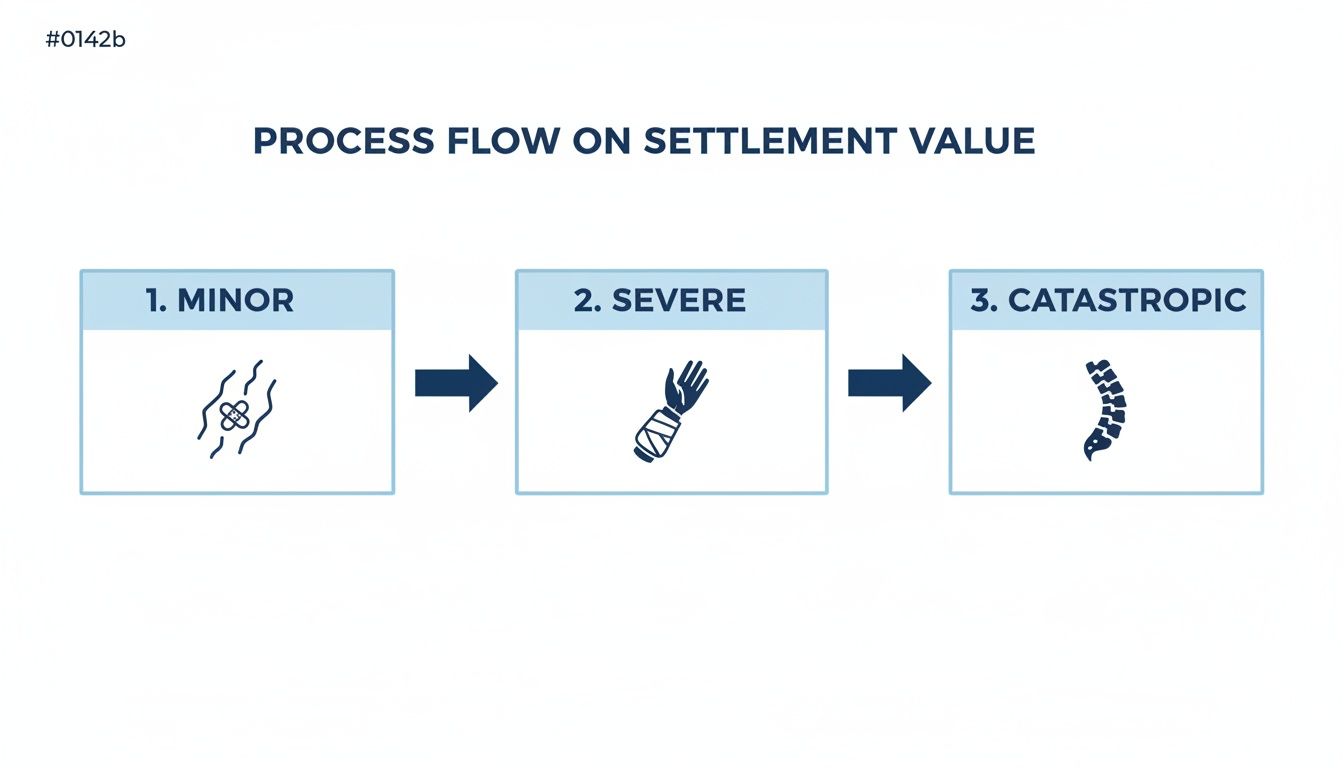
As you can see, minor injuries like scrapes and bruises will naturally lead to smaller settlements. But catastrophic harm, like a traumatic brain or spinal cord injury, rightfully results in a much larger, life-altering recovery.
Why a Florida Motorcycle Accident Lawyer Is Essential
Thinking about handling a serious motorcycle injury claim by yourself? That’s a massive gamble. The second you file that claim, you’re not just up against the other driver. You’re going head-to-head with a multi-billion-dollar insurance corporation, and their team of adjusters and lawyers are experts at one thing: protecting the company’s bottom line. Their job is to pay you as little as legally possible.
Hiring an experienced Florida motorcycle accident lawyer isn’t just about paperwork; it’s about leveling the playing field. They bring deep legal knowledge, investigative muscle, and seasoned negotiation skills to the table. Just having an attorney on your side sends a clear signal to the insurance company: you won’t be pushed around or tricked into taking a lowball offer.
Your Advocate and Investigator
From the very first phone call, a good attorney acts as both your shield and your sword. They’ll immediately take over all communications with the insurance company, stopping those persistent adjusters in their tracks. This protects you from giving a recorded statement where a seemingly innocent comment could be twisted and used against you later.
While they’re protecting you, they’re also launching a full-scale, independent investigation into your crash. This isn’t just a quick look at the police report. It often means:
- Hiring accident reconstruction experts to scientifically prove what really happened.
- Tracking down and interviewing witnesses while the details are still fresh in their minds.
- Preserving crucial evidence, like nearby security footage or the “black box” data from the vehicles involved, before it disappears.
This proactive approach is all about building a rock-solid case that clearly establishes the other party’s fault.
Maximizing Your Financial Recovery
This is where a lawyer really earns their keep. They know how to calculate the true, full value of your claim—not just the immediate medical bills, but the long-term costs as well. They’ll work with medical specialists and financial experts to project the cost of your future treatments, your lost earning capacity, and the real impact of your pain and suffering.
An attorney’s greatest weapon is the credible threat of a lawsuit. Insurance companies know that juries can award huge verdicts, and they’d much rather pay a fair settlement than take that risk in court.
They know every trick in the insurance adjuster’s playbook for downplaying injuries and will counter them effectively. By preparing your case as if it’s going to trial, they create the necessary leverage to negotiate a motorcycle accident injury settlement that actually covers everything you’ve lost. You can learn more about finding the right legal partner by reading about what to look for in a motorcycle accident lawyer near me.
Best of all, you don’t have to worry about the cost. Nearly all reputable personal injury attorneys in Florida work on a contingency fee basis. This means you pay zero upfront costs. The law firm only collects a fee if they win money for you, typically as a percentage of the final settlement or verdict. This system removes all financial risk from your shoulders and gives your lawyer every incentive to fight for the maximum compensation you deserve.
Answering Your Top Questions About Motorcycle Settlements
After a serious motorcycle wreck, your head is spinning with questions. It’s completely normal. Let’s walk through some of the most common concerns we hear from riders right here in Florida, giving you the clear, straightforward answers you need.
How Long Do I Have to File a Motorcycle Accident Claim in Florida?
In Florida, a legal countdown starts the second your accident happens. This is called the statute of limitations, and for most personal injury claims, it’s now two years from the date of the crash.
This isn’t just a suggestion—it’s a hard deadline. If you don’t file a lawsuit within that two-year period, the courthouse doors slam shut, and you forfeit your right to ever seek compensation for your injuries. This is why it’s so critical to speak with an attorney long before that clock runs out.
What If I Was Partially to Blame for the Accident?
This is a big one. Florida follows a “modified comparative negligence” rule, which sounds complicated but is actually pretty logical. It means you can still get compensation even if you were partly at fault, but only if your share of the blame is not more than 50%.
Here’s how it works in the real world: Say your case is valued at $100,000, but a jury finds you were 20% at fault for the crash. Your final recovery would be cut by that 20%, so you’d receive $80,000. You can bet the insurance adjuster will do everything they can to pin as much blame on you as possible to drive their payout down.
A key thing to remember is that most motorcycle accident cases are resolved through a negotiated settlement, never seeing the inside of a courtroom. It’s the attorney’s readiness and reputation for going to trial that provides the leverage needed to secure a fair offer.
Will My Claim End Up in Court?
Probably not. In fact, most personal injury cases never go to trial. A good lawyer’s first goal is always to negotiate a fair motorcycle accident injury settlement directly with the at-fault party’s insurance company. It’s faster, less stressful, and gives you a guaranteed outcome.
But here’s the secret: the best attorneys prepare every single case as if it’s heading to a jury. That level of detailed preparation sends a powerful message to the insurance company—it shows them you mean business and gives your lawyer the leverage needed to demand the absolute best settlement offer for you.
If you or someone you care about was hurt in a motorcycle accident, you don’t have to take on the insurance giants by yourself. The legal team at Martin Hernandez, P.A. is here to fight for the full and fair compensation you’re owed. Contact us today for a free, no-pressure consultation to talk about your rights and your options. Visit us at https://injurylawyersoftampa.com to get started.