
Motorcycle accident liability is defined as the legal responsibility one party holds for causing harm to another in a crash, determined primarily through the doctrine of negligence. If you’re reading this after a collision, or simply want to know your rights before one happens, understanding how fault is assigned can change everything about your claim. Negligence is the core legal theory in most U.S. motorcycle injury cases, requiring proof of four specific elements: duty, breach, causation, and damages. Injurylawyersoftampa works with riders in Tampa and Hillsborough County every day who are surprised to learn that a crash alone does not automatically mean the other driver is liable.
What does proving negligence in motorcycle accident liability require?
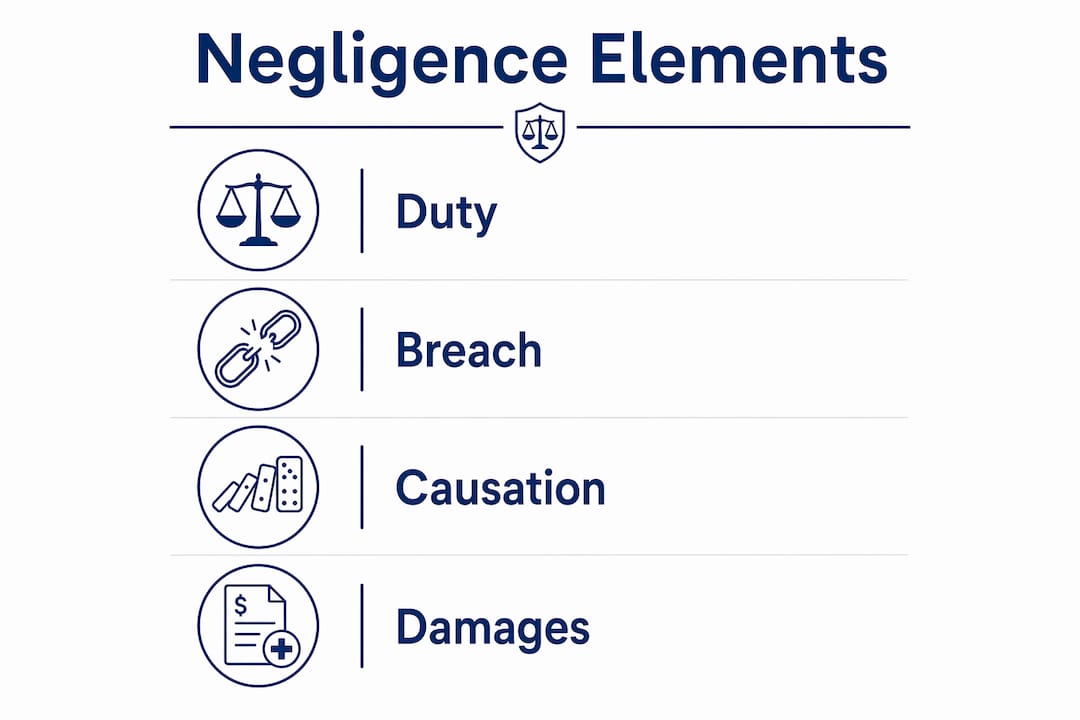
Negligence liability is about proving reasonable care standards and linking a breach of those standards to specific injuries. A crash by itself proves nothing. You must show four things, each connected to the next.
1. Duty of care. Every driver on a public road owes other road users a legal duty to act reasonably. That duty exists automatically. You do not need to prove it was created; you only need to show it applied.

2. Breach of duty. A breach happens when someone falls below that reasonable standard. Distracted driving, speeding, running a red light, and driving under the influence are all clear breaches. The breach must be specific and provable, not just a general sense that the other driver was careless.
3. Causation. This is where many claims get complicated. You must show that the breach directly caused your injuries, not that it merely contributed to a dangerous situation. A driver who was texting but whose texting had no connection to the crash does not meet the causation standard.
4. Damages. You must have suffered actual, measurable losses. These include medical bills, lost wages, property damage, and pain and suffering. Without documented damages, there is no viable claim even if the other driver was clearly at fault.
A common misconception is that a police citation issued to the other driver automatically establishes liability. Citations are evidence of a breach, but they are not binding on a civil court. You still need to connect that breach to your specific injuries and losses.
Pro Tip: Request a certified copy of the police report within days of the crash. It contains officer observations, citations issued, and witness contact information that form the foundation of your negligence claim.
Who can be held liable in a motorcycle accident besides the other driver?
Liability for motorcycle crashes can extend well beyond the driver who hit you. Identifying every potentially responsible party is one of the most consequential decisions in a motorcycle injury case.
- Other drivers and their employers. When a commercial driver causes a crash while on the job, the employer can be held liable under vicarious liability. A delivery driver, a trucking company employee, or a rideshare driver acting within the scope of employment all create employer exposure.
- Government entities. Dangerous road conditions, missing guardrails, faded lane markings, and poorly designed intersections can make a government agency liable. These claims follow different rules and shorter filing deadlines than standard negligence claims.
- Manufacturers and repair shops. Product liability applies when a defective motorcycle part causes or contributes to a crash, including design defects, manufacturing defects, and improper installation. The legal standard shifts from “was the driver careless” to “was the product unreasonably unsafe.”
- Multiple parties simultaneously. Liability theories are not mutually exclusive. A crash can involve a negligent driver, a defective tire, and a poorly maintained road all at once. Evidence must link each party to the specific harm they caused.
Identifying every liable party before settling is not optional. Settling with one party too early can release others from responsibility, leaving you with uncompensated losses that no one is legally required to cover.
The key to holding multiple parties accountable is evidence that connects each one to the crash. Surveillance footage, maintenance records, and crash reconstruction reports each serve a different evidentiary purpose depending on which party you are pursuing. You can read more about how defective parts affect claims in Florida motorcycle cases.
How do comparative fault rules affect your compensation?
Most states use comparative negligence laws with thresholds, typically 50% or 51%, that limit or bar recovery if the rider’s fault exceeds those thresholds. That single rule can determine whether you receive full compensation, reduced compensation, or nothing at all.
| Fault system | How it works | Effect on your claim |
|---|---|---|
| Pure contributory negligence | Any fault by the rider bars recovery | Even 1% fault eliminates your claim |
| Modified comparative negligence (50% rule) | Recovery barred if rider is 50% or more at fault | Damages reduced by your fault percentage up to 49% |
| Modified comparative negligence (51% rule) | Recovery barred if rider is 51% or more at fault | Damages reduced by your fault percentage up to 50% |
| Pure comparative negligence | Rider recovers regardless of fault percentage | Damages always reduced by your fault share |
Florida follows pure comparative negligence, meaning your damages are reduced by your percentage of fault no matter how high that percentage is. Fault disputes hinge on causation and proof, and insurers know exactly how to use ambiguous facts to push your fault percentage higher. A 20% fault assignment on a $200,000 claim costs you $40,000. That number makes the fight worth having.
Shared-fault laws cause widely different outcomes even for similar injuries, which is why legal strategy matters as much as the facts of the crash. Understanding Florida’s specific rules is the first step. You can review Florida’s pure comparative negligence rules in detail to see exactly how fault percentages translate into dollar amounts.
Pro Tip: Never admit any degree of fault at the scene or to an insurance adjuster. Statements made informally can be used to inflate your fault percentage during the claims process.
What evidence is most critical for establishing liability?
Early preservation of evidence is a strategic liability step, often decisive in fault disputes. Evidence degrades fast. Skid marks fade, surveillance footage gets overwritten, and witnesses forget details within days.
The most critical evidence categories in a motorcycle liability case are:
- Police reports and traffic citations. These documents record the officer’s observations, the positions of vehicles, any citations issued, and initial witness accounts. They are the first document any insurer or attorney will request.
- Eyewitness statements and surveillance footage. Independent witnesses carry significant weight because they have no financial stake in the outcome. Surveillance footage from nearby businesses or traffic cameras provides objective, time-stamped proof of what happened.
- Scene photographs and crash reconstructions. Photos taken immediately after the crash capture road conditions, vehicle positions, debris fields, and visible injuries. Crash reconstruction experts use measurements and physics to recreate the sequence of events when footage is unavailable.
- Medical records documenting injuries and treatment. Motorcycle injury medical documentation connects the crash to your specific injuries. Gaps in treatment give insurers an opening to argue your injuries were pre-existing or unrelated.
- Vehicle data and electronic records. Modern vehicles store event data that can show speed, braking, and steering inputs in the seconds before a crash. This data is time-sensitive and can be lost if not preserved quickly.
Insurers may try to shift fault onto riders by interpreting ambiguous events around speed or perception. Building an objective liability record with video and reconstructions directly counteracts that bias. The most common fatal multi-vehicle motorcycle crash involves another vehicle making a left turn across the rider’s path, accounting for 43% of such crashes. That scenario almost always produces a dispute about the rider’s speed, making objective evidence the deciding factor.
Key Takeaways
Motorcycle accident liability turns on four elements of negligence, and riders who understand this framework protect their claims from the start.
| Point | Details |
|---|---|
| Negligence requires four elements | Prove duty, breach, causation, and damages to establish fault in any motorcycle crash. |
| Multiple parties can share liability | Employers, manufacturers, and government entities may all bear responsibility beyond the at-fault driver. |
| Fault percentage directly reduces compensation | Under comparative negligence, every percentage point of assigned fault lowers your damage award. |
| Evidence preservation is time-sensitive | Surveillance footage, skid marks, and witness memories degrade within days of a crash. |
| Contributory negligence states are outliers | A handful of states bar recovery entirely if the rider holds any fault, making jurisdiction critical. |
What riders get wrong about liability (and what I’ve learned from it)
After years of handling motorcycle injury cases in Tampa, the pattern I see most often is this: riders assume the crash tells the story. They believe that because the other car turned left in front of them, or rear-ended them at a light, the liability question is settled. It rarely is.
Insurers are trained to find ambiguity. They will question your speed, your lane position, your reaction time, and your visibility. They do this not because the facts support it, but because shifting even a small percentage of fault onto you reduces their payout. I have seen riders with clear-cut cases lose significant compensation because they did not document the scene, spoke freely to adjusters, or waited weeks before seeking medical care.
The riders who protect their claims best are the ones who treat the crash scene like a legal proceeding from the first minute. They photograph everything, say nothing beyond the facts to anyone except their attorney, and get medical attention that day. That discipline creates the objective record that counters insurer bias and keeps fault percentages honest.
One more thing riders consistently underestimate: the long-term costs. A broken collarbone is not just a surgery. It is months of physical therapy, potential loss of income, and sometimes permanent limitation. When you calculate motorcycle accident damages, you need to account for future medical costs, not just the bills you have today. Settling too early, before the full picture of your injuries is clear, is one of the most expensive mistakes a rider can make.
— Martin
When liability gets complicated, legal help makes the difference
Motorcycle liability disputes are rarely simple. Fault percentages, multiple defendants, insurer bias, and evidence deadlines all create pressure that is hard to manage alone.
Injurylawyersoftampa handles motorcycle accident cases throughout Tampa and Hillsborough County, with a focus on building the objective liability records that hold insurers accountable. The firm investigates fault, preserves critical evidence, and negotiates with every potentially liable party on your behalf. If a wrongful death is involved, the team also handles Florida wrongful death claims with the same trial-ready approach. You pay nothing unless your case is won. Contact Injurylawyersoftampa for a free case review and find out exactly where your liability claim stands.
FAQ
What is motorcycle accident liability?
Motorcycle accident liability is the legal responsibility assigned to a party whose negligence caused a crash and resulting injuries. Courts and insurers determine liability by applying the four-element negligence test: duty, breach, causation, and damages.
Can I recover damages if I was partly at fault?
In most states, yes. Under comparative negligence rules, your damages are reduced by your percentage of fault. Florida uses pure comparative negligence, so you can recover even if you were significantly at fault, though your award is reduced accordingly.
Who besides the other driver can be liable in a motorcycle crash?
Employers of commercial drivers, government agencies responsible for road conditions, and manufacturers of defective motorcycle parts can all share liability depending on the facts and available evidence.
How long do I have to file a motorcycle accident claim in Florida?
Florida’s statute of limitations for personal injury claims is generally two years from the date of the crash. Missing this deadline bars recovery entirely, regardless of how strong your liability case is.
What is the most important thing to do immediately after a motorcycle crash?
Preserve evidence and seek medical attention the same day. Early evidence preservation is the single most effective step for protecting your liability claim, and documented medical treatment directly links your injuries to the crash.
Recommended
- Motorcycle Accident Injury Claim: A Tampa Rider’s Guide – Personal Injury Lawyers of Tampa
- BMW Motorcycle Recalls: A Florida Rider’s Injury Guide – Personal Injury Lawyers of Tampa
- 20 Car Pile Up: Florida Victim’s Guide to Liability – Personal Injury Lawyers of Tampa
- Bike Rack on Car: Florida Crash Laws & Your Rights – Personal Injury Lawyers of Tampa