
TL;DR:
- A permanent injury motorcycle crash claim seeks compensation for lifelong damages caused by injuries that do not fully heal.
- These claims require thorough documentation of lasting functional limitations, expert valuation, and timely filing within the statute of limitations.
A permanent injury motorcycle crash claim is a legal action that seeks compensation for lifelong damages caused by a motorcycle accident where injuries will not fully heal. If you’re reading this after a crash that left you with lasting physical limitations, you need to understand that these claims are fundamentally different from standard accident claims. Settlements for severe and permanent injuries typically range from $250,000 to over $1 million, with catastrophic cases like traumatic brain injuries reaching $4.8 million or more. The legal term used in personal injury law is “permanent impairment claim,” and knowing how that standard works is the first step toward protecting your financial future.
What qualifies as a permanent injury in a motorcycle crash claim?
Permanent injuries are those that leave lasting functional limitations after maximum medical improvement has been reached. In legal terms, maximum medical improvement (MMI) is the point at which your doctor determines your condition has stabilized and further recovery is unlikely. Reaching MMI does not mean you are healed. It means your injury is now the baseline for the rest of your life.
The injuries most commonly recognized as permanent in motorcycle crash claims include:
- Traumatic brain injury (TBI): Cognitive deficits, memory loss, and personality changes that persist beyond treatment
- Spinal cord injuries: Partial or complete paralysis, chronic pain, and loss of motor function
- Amputations: Loss of limbs requiring prosthetics and lifelong adaptive care
- Severe orthopedic injuries: Joint damage, fractures with hardware, and chronic instability that limits mobility
- Severe burns: Disfigurement, nerve damage, and skin grafting needs that continue indefinitely
- Vision or hearing loss: Sensory impairments caused by head trauma or blast force
The distinction between permanent and non-permanent injuries matters enormously in claim valuation. A broken arm that heals completely carries a fraction of the value of a spinal injury that leaves you unable to work or ride again. Permanent impairment triggers higher multiplier bands, often reaching 6x–7x economic damages instead of the 4x used for serious but recoverable injuries.
Pro Tip: Ask your treating physician to document your functional limitations in writing at every appointment. Vague notes like “patient reports pain” are far weaker than specific entries like “patient cannot stand for more than 15 minutes due to lumbar instability.”

How do you file a permanent injury motorcycle crash claim?
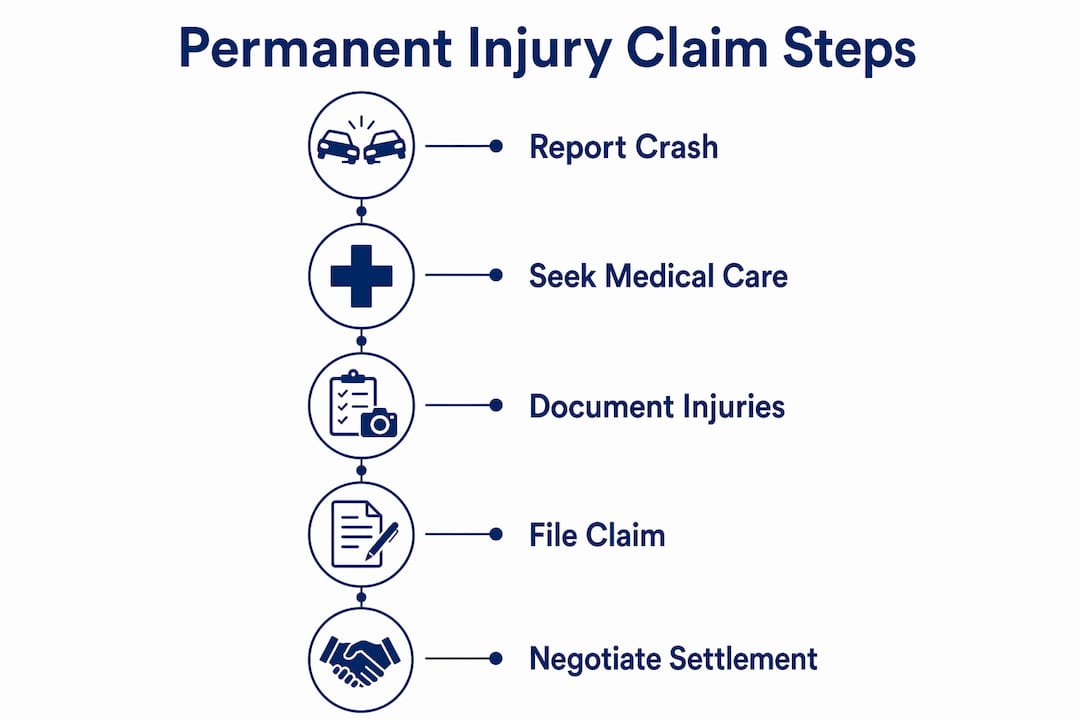
The motorcycle accident claim process for permanent injuries follows a clear sequence. Skipping any step creates gaps that insurers will exploit.
- Call 911 immediately. A police report establishes the official crash record. Without it, insurers will question whether the accident happened as you describe.
- Document the scene. Photograph road conditions, vehicle positions, skid marks, traffic signals, and your visible injuries before anything is moved.
- Seek medical care the same day. Delayed treatment is the single most damaging mistake in permanent injury claims. Insurers treat any gap between the crash and your first medical visit as evidence that you were not seriously hurt.
- Follow every treatment recommendation. Continuous medical records are the backbone of a strong claim. Missing appointments or stopping physical therapy gives adjusters ammunition to argue your injuries were minor.
- Notify your insurer of the crash. Report the accident, but do not give a recorded statement without an attorney present.
- Consult a personal injury attorney early. Early attorney involvement preserves crucial evidence, manages communications, and prevents costly legal missteps.
- Preserve physical evidence. Keep your damaged gear, helmet, and motorcycle exactly as they are. Do not repair or discard anything before your attorney reviews it.
- Collect witness statements. Names, phone numbers, and written accounts from bystanders carry significant weight with insurers and juries.
- Track every expense. Medical bills, prescriptions, transportation to appointments, home modifications, and lost wages all belong in your damages record.
- Respect the statute of limitations. Florida generally allows two years from the crash date to file a personal injury lawsuit. Missing this deadline ends your claim permanently.
Pro Tip: Create a dedicated folder, physical or digital, for every crash-related document from day one. Receipts, discharge summaries, insurance letters, and even your own daily pain journal all strengthen your claim when it reaches negotiation or trial.
How are damages calculated in a permanent injury claim?
Damages in a permanent injury motorcycle crash claim fall into two categories: economic and non-economic. Understanding both is critical because insurers calculate them differently, and undervaluing either category costs you real money.
Economic damages are the measurable financial losses tied directly to your injury:
- Past and future medical expenses, including surgeries, rehabilitation, and assistive devices
- Lost wages from time missed at work during recovery
- Lost earning capacity if your injury prevents you from returning to your previous occupation
- Future care costs, including in-home assistance, medication, and adaptive equipment
Economic experts use wage trends and life expectancy projections to quantify lost earning capacity accurately. Without that expert analysis, future earnings claims are routinely undervalued by insurers.
Non-economic damages cover the human cost of your injury. Pain and suffering, loss of enjoyment of life, emotional distress, and loss of consortium all fall into this category. These are harder to quantify, which is exactly why insurers fight them hardest.
The standard valuation method is the multiplier method. Insurers and attorneys apply a multiplier to your total economic damages to estimate non-economic losses. Insurance companies apply a multiplier of 1.5x–2x for minor injuries, while permanent disability cases typically use 4x–5x or higher. For example, $70,000 in economic damages at a 3x multiplier produces a $210,000 settlement figure. With documented permanency, that same $70,000 base could reach $420,000–$490,000 at a 6x–7x multiplier.
A well-prepared life care plan is the most powerful tool for proving future medical costs in catastrophic cases. Certified life care planners project medical, housing, and personal assistance expenses using medical, economic, and actuarial data. These plans often push total claim values into seven figures for the most severe injuries.
| Damage Type | What It Covers |
|---|---|
| Past medical costs | Bills already incurred from crash to settlement |
| Future medical costs | Projected care needs based on life care plan |
| Lost wages | Income lost during recovery period |
| Lost earning capacity | Reduced future income due to permanent limitations |
| Pain and suffering | Non-economic multiplier applied to economic base |
| Loss of enjoyment | Compensation for activities you can no longer do |
What are the most common challenges in permanent injury claims?
Permanent injury claims face more resistance from insurers than any other category of motorcycle accident claim. The higher the potential payout, the harder adjusters work to reduce it.
The most common tactics insurers use include:
- Exploiting treatment gaps: Insurance adjusters exploit any treatment gaps to argue injuries were minor or pre-existing. Even a two-week gap between appointments can be used against you.
- Requesting early recorded statements: Early recorded statements to insurers can harm claim value because you may not yet know the full extent of your injuries. Anything you say in the first days after a crash can be used to minimize your claim later.
- Disputing permanency: Insurers hire their own medical examiners to challenge your doctor’s permanency findings. These independent medical examinations (IMEs) are rarely independent in practice.
- Pushing quick settlements: A fast settlement offer before you reach MMI is almost always below the true value of a permanent injury claim. Once you accept, you cannot reopen the case.
Comparative negligence is another major challenge. Florida follows a modified comparative negligence rule, meaning your compensation is reduced by your percentage of fault. If you were found 20% at fault for a crash, your $500,000 award becomes $400,000. Comparative negligence reduces compensation proportionally but does not bar recovery entirely in most states, as long as your share of fault stays below the threshold.
“Permanent injury claims are not static. Ongoing care needs and future losses must be fully accounted for to avoid undervaluation. Accepting a settlement before MMI is reached is one of the most expensive mistakes an injured rider can make.”
Legal representation changes the outcome. Attorneys who prepare every case for trial consistently secure higher settlements because insurers know the case will not fold under pressure.
What are the filing deadlines for a permanent injury motorcycle claim?
Filing deadlines, called statutes of limitations, are the hard cutoff dates for pursuing a motorcycle accident injury compensation claim through the courts. Miss the deadline and your claim is gone, regardless of how strong your evidence is.
| State | Standard Deadline | Government Claim Deadline |
|---|---|---|
| Florida | 2 years | 3 years (notice within 3 years) |
| California | 2 years | 6 months (government notice) |
| Texas | 2 years | 6 months (government notice) |
| New York | 3 years | 90 days (notice of claim) |
| Colorado | 3 years | 182 days (government notice) |
| Tennessee | 1 year | 1 year |
| Missouri | 5 years | 90 days (government notice) |
Most U.S. states set statutes of limitations between 1 and 3 years for personal injury claims, with some states allowing up to 5 years. That range matters because permanent injuries often involve extended treatment periods, and riders sometimes wait too long before consulting an attorney.
Government entity claims carry the shortest deadlines. If a defective road, missing signage, or a government vehicle contributed to your crash, you may have as little as 6 months to file a formal notice of claim. Missing that notice deadline eliminates your right to sue the government entity entirely, even if you file a standard lawsuit on time.
The safest rule is to consult an attorney within 30 days of your crash. Evidence degrades, witnesses forget details, and surveillance footage gets deleted. Time works against you in every permanent injury case.
Key Takeaways
A permanent injury motorcycle crash claim requires documented permanency, expert valuation, and strict deadline compliance to reach full compensation.
| Point | Details |
|---|---|
| Permanent injury definition | MMI must be reached and functional limitations must be documented by your treating physician. |
| Damages valuation | Multipliers of 6x–7x apply to permanent cases; life care plans prove future costs. |
| Filing steps | Seek same-day medical care, preserve evidence, and consult an attorney within 30 days. |
| Common claim denials | Treatment gaps, early recorded statements, and quick settlements all reduce claim value. |
| Legal deadlines | Most states allow 1–3 years; government claims may require notice within 6 months. |
What I’ve learned after years of fighting permanent injury claims
I’ve handled enough permanent injury cases to know that the biggest threat to your compensation is not the other driver. It’s time. Riders who wait months before seeing an attorney, who accept the first settlement offer, or who stop treatment because they feel slightly better, consistently recover far less than their injuries warrant.
The long-term effects of motorcycle crashes are not always obvious in the first weeks. A spinal injury that feels manageable at month two can become debilitating by month twelve. That progression needs to be in your medical record, not just in your memory. Juries and adjusters respond to documented evidence, not to descriptions of how bad things got after you settled.
I also want to be direct about expert testimony. Expert testimony from life care planners and vocational experts is not optional in serious permanent injury cases. It is the difference between a settlement that covers your next five years and one that covers the rest of your life. Riders who try to negotiate these claims without expert support almost always leave significant money on the table.
The riders I’ve seen recover the most are the ones who treated their claim like a job from day one. They documented everything, followed every medical recommendation, and let their attorney handle every insurer communication. That discipline pays off at the negotiating table and in court.
— Martin Hernandez
How Martin Hernandez, PA can help with your permanent injury claim
Permanent injury claims demand a level of preparation that goes well beyond filing paperwork. Martin Hernandez, PA handles motorcycle accident cases in Tampa and Hillsborough County with a trial-ready approach, meaning every case is built as if it will go before a jury. That preparation is exactly what pushes insurers toward fair settlements.

If you’re dealing with a permanent injury after a crash, the firm offers a free consultation to evaluate your case, explain your rights, and outline a strategy for maximum compensation. You pay nothing unless your case is won. The team is fully bilingual in English and Spanish, and every client receives direct, personal attention throughout the process. To understand the legal foundation of your claim, the personal injury law guide on the firm’s website is a strong starting point. Reach out today and get the representation your injuries deserve.
FAQ
What is a permanent injury in a motorcycle crash claim?
A permanent injury is one that reaches maximum medical improvement but leaves lasting functional limitations. Common examples include spinal cord injuries, traumatic brain injuries, and amputations.
How much is a permanent injury motorcycle crash claim worth?
Severe and permanent injury claims typically settle between $250,000 and $900,000, while catastrophic cases involving TBI can exceed $1 million. Final value depends on documented damages, expert testimony, and the multiplier applied to economic losses.
What is pain and suffering in a motorcycle claim?
Pain and suffering is a non-economic damage category that compensates for physical pain, emotional distress, and reduced quality of life. It is calculated by applying a multiplier, typically 4x–7x for permanent injuries, to your total economic damages.
What are the most common reasons motorcycle injury claims are denied?
Common denials stem from treatment gaps, early recorded statements that understate injury severity, and failure to document permanency through medical records. Insurers also dispute claims where the rider shares fault for the crash.
How long do I have to file a motorcycle injury claim in Florida?
Florida’s statute of limitations for personal injury claims is two years from the crash date. Claims against government entities may require a formal notice within a shorter window, making early legal consultation critical.
Recommended
- Motorcycle Accident Injury Claim: A Tampa Rider’s Guide – Personal Injury Lawyers of Tampa
- What to do after motorcycle accident: A Tampa Rider’s Guide – Personal Injury Lawyers of Tampa
- Florida Motorcycle Accident Injury Settlement Guide – Personal Injury Lawyers of Tampa
- Motorcycle Accident Lawyer Near Me: Free Consultation & Immediate Help – Personal Injury Lawyers of Tampa