
When someone talks about permanent injury settlements in Florida, they’re not talking about a fixed number you can look up in a book. The reality is that these cases often resolve for amounts anywhere from six figures to multi-million dollar awards. Why such a huge range? Because the final number has to reflect a lifetime of costs, lost opportunities, and the very real human impact on the victim’s life.
A permanent injury isn’t just a bad injury. It’s one that fundamentally changes your future.
What a Permanent Injury Means for Your Florida Settlement

Think about it this way: a broken arm that heals in eight weeks is a chapter in your life. It’s a painful and inconvenient chapter, for sure, but it eventually ends. A permanent injury, on the other hand, is not a chapter. It’s the rest of the book. It’s the new reality you have to live with every single day.
Florida law recognizes this profound difference. Once a doctor determines your injury is permanent, it opens the door to a much more significant level of compensation. Suddenly, the goal isn’t just to cover a few months of recovery. The settlement needs to provide for a lifetime of consequences.
The Two Pillars of Your Settlement
To figure out what a permanent injury claim is worth, we essentially have to fill two big buckets. When you add them together, you get the total potential value of your case.
- Economic Damages: This is the math-heavy part. It includes every single tangible, out-of-pocket financial loss you’ve had and can reasonably expect to have in the future. If you can put a receipt or a dollar figure to it, it goes here.
- Non-Economic Damages: This bucket is for the human side of the injury. It’s much more subjective but is just as real. This is compensation for the pain, the suffering, and the life experiences the injury has stolen from you.
A permanent injury settlement is not just about paying back old bills. It’s about building a financial foundation to support a future that was permanently altered by someone else’s mistake.
Let’s dig into what goes into each of these categories.
Breaking Down the Financial Impact
Your economic damages are the bedrock of your claim, built piece by piece with hard evidence. We’re talking about a meticulous accounting of everything from the cost of the ambulance ride to the projected expense of care decades from now.
A skilled legal team will work to document:
- All Past and Future Medical Expenses: This is more than just hospital bills. It includes surgeries, physical therapy, prescription drugs, wheelchairs or other assistive devices, and even modifications to your home to make it accessible.
- Lost Wages and Earning Capacity: This calculates two things: the paychecks you’ve already missed while being out of work, and more importantly, the income you won’t be able to earn for the rest of your working life due to your disability.
These core components shape a Florida permanent injury settlement, showing how both the tangible and intangible losses are valued. For example, the economic damages might include a $1.2 million life-care plan to cover future surgeries, physical therapy, and in-home nursing care for a spinal cord injury victim. The non-economic damages could include a $750,000 award for a young parent who can no longer pick up their child or participate in family activities due to chronic pain.
Putting a number on these damages is a complex process. In Florida, a crucial step is often proving you’ve reached what’s called maximum medical improvement, which is the point where your condition has stabilized and is unlikely to get any better. This helps create a clearer picture of future needs.
While the economic side is about calculation, the non-economic damages are about telling your story—the human cost of the accident. This is where the true, personal impact of the injury is translated into a monetary value, which is often the largest and most critical part of the entire settlement.
What Does “Permanent Injury” Actually Mean Under Florida Law?
In Florida, a “permanent injury” isn’t just a medical term—it’s a critical legal threshold that can completely change the outcome of your accident claim. A lot of people assume any serious injury that takes a long time to heal will automatically qualify, but the law is much more specific. It demands concrete, objective medical proof that the damage you’ve sustained is truly for life.
Let’s use an analogy. A temporary injury is like a major road detour. It’s a huge hassle, it’s frustrating, and it messes up your plans, but eventually, the road reopens and you can get back to your normal route. A permanent injury, on the other hand, is like a landslide that wipes out the road entirely. The old path is gone forever, and you’re forced to navigate a new, often harder, one for the rest of your life.
This distinction is everything. Why? Because proving your injury is permanent is what opens the door to compensation for non-economic damages—the legal term for your pain, suffering, mental anguish, and loss of enjoyment of life. Without clearing this legal hurdle, you could be stuck recovering only your medical bills and lost wages.
The Four Ways to Prove Permanence
Florida Statutes lay out a strict standard. Your doctor must state, to a “reasonable degree of medical probability,” that your injury resulted in at least one of these four outcomes:
- Significant and Permanent Loss of an Important Bodily Function: This is about more than just a lingering ache. We’re talking about a major, irreversible problem, like losing so much strength in your arm that you can no longer work your trade, or suffering spinal damage that makes everyday tasks impossible without help.
- Permanent Injury Within a Reasonable Degree of Medical Probability: This is a catch-all for lasting injuries that aren’t necessarily visible. Think chronic, debilitating pain from a herniated disc, cognitive problems like memory loss after a traumatic brain injury (TBI), or permanent nerve damage that causes numbness or weakness.
- Significant and Permanent Scarring or Disfigurement: This covers the visible, lasting marks that can cause serious emotional distress. Severe burn scars from a vehicle fire or deep facial lacerations from an accident are prime examples.
- Death: In the most tragic circumstances, a wrongful death claim automatically satisfies the permanency requirement.
Proving your injury fits into one of these boxes is often the central fight in a high-value claim. Insurance companies know this, and they will almost always push back, arguing your injury isn’t truly permanent to limit what they have to pay.
Building the Case for Lifelong Impact
Getting the settlement you deserve involves more than just handing the insurance adjuster a note from your doctor. You have to build a powerful, evidence-backed story that clearly shows the lifelong consequences of the accident. This is where medical and vocational experts become your most important allies.
A skilled personal injury attorney doesn’t just take your doctor’s word for it; they assemble a team of specialists to paint the full picture.
Proving permanence isn’t just about what you can’t do today. It’s about convincingly demonstrating all the opportunities, abilities, and joys that have been stolen from your future.
For example, a neurologist can explain the devastating long-term effects of a TBI, connecting it to things like memory loss, personality changes, and an inability to focus. For someone with a severe back injury, a vocational expert can testify about why they can never return to their construction job, and then calculate their lost earning capacity over the next 20 or 30 years.
These experts are translators. They take complex medical jargon and turn it into a clear, human story that an insurance adjuster—or a jury—can’t ignore. They help answer the questions that determine the real value of your claim: What will your future medical needs be? How will this affect you day in and day out? What is the true financial cost of this lifelong change? This is the bedrock on which fair permanent injury settlement amounts are built.
Calculating the True Value of Your Injury Claim
How do you put a price tag on a lifetime of consequences? It’s one of the toughest, most important questions in any serious injury case. How can you possibly translate future surgeries, a lost career, and the constant, nagging pain into a single dollar amount? It’s not about pulling a number out of thin air. It’s a methodical process, carefully calculating every single loss you’ve suffered and will suffer in the future.
This detailed calculation is what ultimately determines a fair permanent injury settlement amount. We essentially fill two big buckets: one for economic damages and one for non-economic damages. Think of economic damages as the itemized, black-and-white bill for the accident. Non-economic damages, on the other hand, cover the very real human cost of it all.
This concept map really helps to visualize the difference between a temporary injury—which is like a detour on your life’s journey—and a permanent one, which carves out an entirely new and often more difficult path.
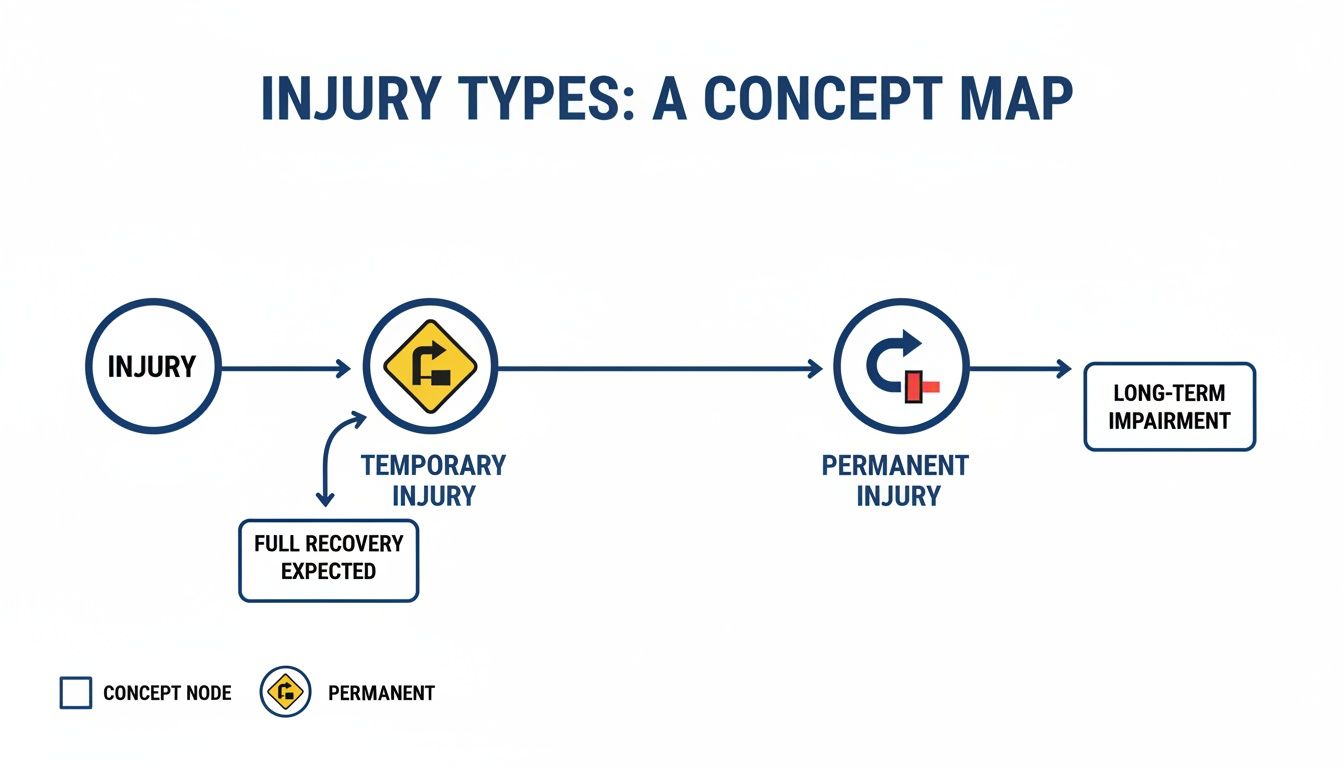
This is why the settlement math for a permanent injury has to look at the big picture—a lifetime of needs, not just a few months of recovery.
Economic Damages: The Financial Blueprint of Your Future
Economic damages are the cold, hard numbers that form the foundation of your claim. They represent every single dollar you’ve lost or will have to spend because of your injury, starting from day one and looking decades down the road. It’s so much more than just adding up the medical bills you have sitting on your kitchen table.
To build a solid case, we have to document and project several critical costs:
- Past and Future Medical Expenses: This is everything. It’s the initial ER visit, the surgeries, the physical therapy, the prescriptions, and all the follow-ups with specialists. It also includes future costs like a wheelchair, a hospital bed for your home, or even modifications to make your house accessible.
- Lost Wages and Future Earning Capacity: This is a two-part equation. First, we tally up the paychecks you’ve already missed because you couldn’t work. The second, and often much larger part, is calculating the money you won’t be able to earn over the rest of your working life because of your new limitations.
This is where we bring in the experts. A vocational specialist or an economist can provide powerful testimony showing how your injuries have derailed your career path, putting a real dollar figure on that lost potential.
A Life Care Plan is a game-changer. It’s a comprehensive, detailed report, usually put together by a certified specialist, that maps out a person’s expected medical and daily living needs for the rest of their life. It’s the roadmap we use to show an insurance company or a jury the true, long-term cost of your injuries.
This plan makes sure nothing gets missed—from regular doctor’s visits to the cost of replacing a prosthetic limb 20 years from now.
Non-Economic Damages: Valuing the Human Cost
While we calculate economic damages, we have to value non-economic damages. This is the compensation for the profound, personal toll the injury has taken on your day-to-day life. These losses don’t come with an invoice, but they are every bit as real and, frankly, often more devastating.
These damages are meant to cover intangible losses like:
- Pain and Suffering: This is for the actual physical pain, the chronic discomfort, and the emotional anguish you live with.
- Mental Anguish: This specifically addresses conditions like anxiety, depression, fear, or PTSD that have developed because of the trauma of the accident and your life-altering injuries.
- Loss of Enjoyment of Life: How do you put a price on not being able to pick up your grandchild, go for a run, or enjoy a hobby that once defined you? This is what we try to do here.
So, how do you assign a number to something so personal? Often, attorneys and adjusters will use a “multiplier” method. We take the total economic damages and multiply that figure by a number, usually between 1.5 and 5, depending on how severe and life-altering the injury is. A catastrophic injury that leaves someone permanently disabled will command a much higher multiplier. You can get a deeper look into this on our guide explaining how to calculate pain and suffering damages in Florida.
The personal injury landscape shows just how much these values can vary. While you might see average settlements for minor injuries in the $31,000 to $55,100 range, permanent injury cases are in a completely different league. For instance, it’s not uncommon for Florida firms to secure settlements like $3 million for car accidents that result in permanent, life-changing injuries.
Since medical bills are such a huge part of any claim, getting a handle on the process of appealing health insurance denials can be vital. Making sure every last medical expense—both what’s been paid and what’s projected—is accounted for is the only way to ensure your settlement will truly be enough to cover a lifetime of care.
Realistic Settlement Amounts for Catastrophic Injuries

It’s natural to wonder, “What is my case worth?” While every situation is different, looking at typical settlement ranges can give you a much-needed frame of reference. These figures aren’t a guarantee, but they do show the massive gap between a standard injury claim and one involving a life-altering disability.
The numbers attached to permanent injury settlement amounts can look huge, but there’s a good reason for that. They have to cover a lifetime of medical care, daily assistance, lost wages, and profound personal suffering. When an injury is permanent, that settlement becomes the only financial safety net a person has for the rest of their life.
Spinal Cord Injuries and Paralysis
Spinal cord injuries (SCIs) that lead to paralysis—like paraplegia or quadriplegia—are among the most devastating a person can suffer. The lifelong costs are simply astronomical, often climbing into the millions for medical care alone.
These settlements must account for everything: initial surgeries, hospitalizations, ongoing physical therapy, and specialized equipment like wheelchairs and modified vehicles. But it goes beyond that, covering home renovations for accessibility and even the potential for round-the-clock attendant care. On top of the tangible costs, the settlement has to reflect a total loss of earning capacity and the immense non-economic damages—the loss of mobility, independence, and the ability to enjoy life’s simple moments.
Severe Traumatic Brain Injuries
A severe traumatic brain injury (TBI) can completely change who a person is. It can impact their personality, cognitive function, and ability to live independently. The aftermath often includes devastating memory loss, impaired motor skills, emotional instability, and a permanent inability to work or even maintain relationships.
A settlement for a severe TBI has to be substantial enough to cover a wide range of needs:
- Long-term residential care if living alone is no longer an option.
- Ongoing rehabilitation, including speech, occupational, and cognitive therapies.
- Lifelong medications to manage symptoms like seizures or mood disorders.
- Guardianship costs if the victim can no longer manage their own affairs.
Because the effects of a TBI are so widespread and unique to the individual, a meticulously detailed life care plan is absolutely critical for proving the full value of the claim.
A catastrophic injury settlement isn’t a lottery win; it’s a lifeline. It represents the funds necessary to provide a person with the medical care and quality of life they deserve after a devastating accident.
Catastrophic injury cases command settlements that are exponentially higher than typical claims. The data backs this up. Cases involving complete spinal cord paralysis or a severe TBI requiring 24/7 care can settle for anywhere from $500,000 to $25 million or more.
According to the Insurance Research Council, catastrophic injury settlements average 15-25 times higher than minor injury claims. Spinal cord injury cases often settle from $1 million to over $25 million, while severe TBIs typically fall between $800,000 and $15 million. You can find more details in these compensation benchmarks for catastrophic injuries on chglawyers.com.
Here are some illustrative settlement ranges for catastrophic injuries in Florida, reflecting the need for lifelong care and compensation:
- Spinal Cord Injury (Paraplegia/Quadriplegia): Common settlement ranges are $2,500,000 – $25,000,000+. Key cost drivers include 24/7 attendant care, multiple surgeries, power wheelchairs, and home/vehicle modifications.
- Severe Traumatic Brain Injury (TBI): These can range from $1,500,000 – $15,000,000+. This covers costs like long-term residential facility care, cognitive therapy, guardianship, and lost executive function.
- Amputation (Loss of a Limb): Settlement ranges are often $500,000 – $5,000,000+. Costs include advanced prosthetics (with replacements), phantom limb pain treatment, and extensive therapy.
- Severe Burns (Disfigurement): These settlements can be from $750,000 – $10,000,000+. This accounts for multiple skin graft surgeries, infection management, chronic pain, and the psychological trauma from disfigurement.
Keep in mind these are just illustrations. The final settlement depends entirely on the specific facts of the case, the quality of the evidence, and the skill of the legal team presenting it.
Amputations and Severe Burns
Losing a limb or suffering disfiguring burns inflicts both incredible physical pain and deep psychological trauma. A fair settlement has to address the immediate medical crisis and the lifetime of adjustments that follow.
For amputations, this means covering the staggering cost of advanced prosthetic limbs, which can be tens of thousands of dollars each and need to be replaced every few years. It also includes the extensive therapy required to learn how to use them.
Severe burns involve excruciating treatments like skin grafts and often lead to permanent scarring, chronic pain, and a high risk of infection. The psychological toll, including severe depression and social anxiety, is a huge part of the non-economic damages we fight for. To see how these values are calculated in crashes that often cause such harm, you might want to review our guide on using a truck accident settlement calculator.
Ultimately, justifying these higher settlement values demands a powerful, evidence-based case that leaves no doubt about what the victim will need for the rest of their life.
What Else Shapes Your Settlement Value?
The severity of your injury is the starting point, but it’s far from the whole story. Several other critical factors can dramatically push your final settlement number up or down. Think of it less as a fixed calculation and more as a baseline value that gets adjusted based on the specific strengths and weaknesses of your case.
Knowing what these factors are is key. It explains why two people with what look like similar injuries can walk away with wildly different permanent injury settlement amounts. More importantly, it shows why you need a smart, evidence-driven strategy right from day one.
The Strength of Your Evidence
First and foremost, you have to prove the other person was at fault. This isn’t just about what you know happened; it’s about what you can prove with hard, undeniable evidence. A strong case is built on a narrative so clear that it leaves no room for the insurance company to argue.
Solid evidence usually includes things like:
- Witness Testimony: Nothing beats a credible, independent witness who can tell a jury exactly what they saw.
- Expert Analysis: In a complicated crash, an accident reconstruction expert can be your best friend, breaking down the physics to show precisely how the other driver was negligent.
- Visual Proof: In today’s world, video is king. Photos from the scene, dashcam footage, or video from a nearby security camera can often shut down any debate about liability.
The less wiggle room you give the insurance company, the less they can fight you on the value of your claim.
Insurance Policy Limits
Here’s a dose of reality that can be tough to swallow: the at-fault party’s insurance policy is often the ceiling for what you can recover. You might have a case that is legitimately worth millions, but if the driver who hit you only carries Florida’s minimum bodily injury liability coverage of $10,000, that’s often the absolute most their insurer will ever pay.
The defendant’s insurance policy is a hard cap on your potential settlement from that source. This is exactly why one of the first things a good attorney does is hunt for every possible source of recovery, especially your own Uninsured/Underinsured Motorist (UM/UIM) coverage.
A seasoned lawyer will immediately dig into all available insurance policies. We look for commercial policies, umbrella policies, and other potentially liable parties (like an employer if the person was on the clock). Skipping this step is one of the easiest ways to leave a huge amount of money on the table.
The Quality of Your Medical Records
Your medical records are the official biography of your injury, and they need to tell a compelling and consistent story. Every gap, every contradiction, and every delay in seeking treatment is an opening for an insurance adjuster to devalue your claim.
For example, if you wait a few weeks to see a doctor, they’ll argue you must have gotten hurt somewhere else in the meantime. If your doctor’s notes don’t consistently document your pain levels and how the injury impacts your daily life, it guts the foundation for your pain and suffering damages. You can learn more about the different kinds of compensation in our guide on the types of damages in personal injury cases.
Florida’s Comparative Negligence Rule
Florida follows what’s called a “modified comparative negligence” rule. In plain English, this means if you are found to be partially to blame for the accident, your settlement gets reduced by your percentage of fault. So, if a jury decides you were 20% at fault for the collision, your final award is automatically slashed by 20%.
But there’s a critical cliff: if you are found to be more than 50% at fault, you get nothing. Zero. Insurance companies are masters at finding ways to pin even a little bit of blame on you to save themselves money. Having an attorney to aggressively push back on these tactics is essential to protecting the full value of what you’re owed.
Why an Experienced Florida Injury Attorney Is Essential
Trying to handle a permanent injury claim by yourself is a recipe for disaster. Think of it like walking into a high-stakes negotiation against a room full of experts whose only job is to protect their company’s money.
Insurance companies aren’t in the business of generously paying out the full value of a claim. Their entire business model revolves around minimizing what they pay to maximize their own profits. They have teams of adjusters, investigators, and lawyers all working to find any reason—big or small—to undervalue your case.
When you’re facing a lifetime of medical bills and lost income, going up against that machine alone is an incredible risk. The difference in settlement money between what you can get on your own versus what a skilled attorney can secure is often massive.
Building a Case Designed to Win
A seasoned Florida injury lawyer does a lot more than just fill out forms. They become the architect of your case, carefully constructing a powerful, evidence-backed argument for the maximum compensation you deserve. This is the key to getting fair permanent injury settlement amounts.
Here’s what that looks like in practice:
- Bringing in the Best Experts: A good attorney has a network of top-tier professionals. They’ll hire medical specialists to confirm your injury is permanent, economists to project your lost future income, and life care planners to create a detailed map of every medical expense you’ll face for the rest of your life.
- Documenting Everything: They meticulously gather and organize every piece of evidence. This creates an undeniable record of how this injury has truly upended your finances, your career, and your daily life.
- Negotiating from Strength: Armed with a mountain of solid evidence, your lawyer can negotiate from a position of power. They know all the insurance company’s tactics and are prepared to shut down every lowball offer.
An attorney’s real value is in leveling the playing field. They force the insurance company to look at your claim based on its true, lifelong impact—not just what the insurer thinks they can get away with paying.
Ultimately, a dedicated lawyer is always prepared to take your case to trial if the insurance company refuses to offer a fair settlement. That willingness to fight it out in front of a jury is often the most powerful motivation for an insurer to finally pay what you are rightfully owed.
To learn more about what a professional can do for you, read our guide on hiring a personal injury lawyer and see how the right representation can protect your future.
Common Questions About Permanent Injury Settlements
When you’re dealing with a life-altering injury, the legal process can feel like a maze. It’s completely normal to have a lot of questions. Here are some straightforward answers to the questions we hear most often from our clients here in Florida.
How Long Does It Take To Settle A Permanent Injury Case?
There’s no one-size-fits-all answer here; it really depends. The timeline can be anywhere from several months to a couple of years.
What makes the difference? A few key things: the complexity of your injuries, how long it takes for your doctors to say you’ve reached “maximum medical improvement,” and frankly, how reasonable the insurance company decides to be. If they’re unwilling to negotiate in good faith, things can drag on. Always remember, a fast settlement is rarely the best settlement, especially when you’re looking at a lifetime of care.
Should I Accept The First Offer From The Insurance Company?
In my experience, accepting the first offer is almost always a bad idea. Think of it as the insurance company’s opening bid—and it’s intentionally low.
They’re testing the waters to see if you know what your claim is truly worth. That first number almost never reflects the reality of your future medical bills, the income you’ll lose over your lifetime, or the true cost of your pain and suffering.
The first offer is just a starting point for negotiation, not the final word. Accepting it means you could be leaving a massive amount of money on the table—money you’re going to need.
Can I Still Get A Settlement If I Was Partially At Fault?
Yes, you absolutely can. Florida operates under what’s called a “modified comparative negligence” rule.
In simple terms, you can still recover money as long as you weren’t more than 50% responsible for what happened. Your final settlement, however, will be reduced by whatever percentage of fault is assigned to you. For instance, if a jury decides you were 20% at fault, your total compensation would be cut by 20%.
Once you’ve secured a settlement for a permanent injury, your focus shifts to making sure that money lasts. Learning about protecting your assets from lawsuits is a smart next step to ensure your financial security for the long haul.
If you’re trying to navigate the aftermath of a serious accident, you don’t have to figure all this out by yourself. The legal team at Martin Hernandez, P.A. is here to give you the clear answers and strong advocacy you need. We build every case as if it’s going to trial, putting you in the best possible position to get the full compensation you deserve.
Contact us today for a free, no-obligation consultation to talk about your case by visiting https://injurylawyersoftampa.com.