
If you’ve just been in an Uber or Lyft accident, the first thing on your mind is probably, “I need to find a rideshare accident lawyer near me.” You’re right. Getting an expert who understands Florida’s complex insurance laws on your side from the very beginning is the most important move you can make. The steps you take right at the scene are crucial, and good legal advice prevents you from making costly mistakes.
What to Do Immediately After a Tampa Rideshare Accident
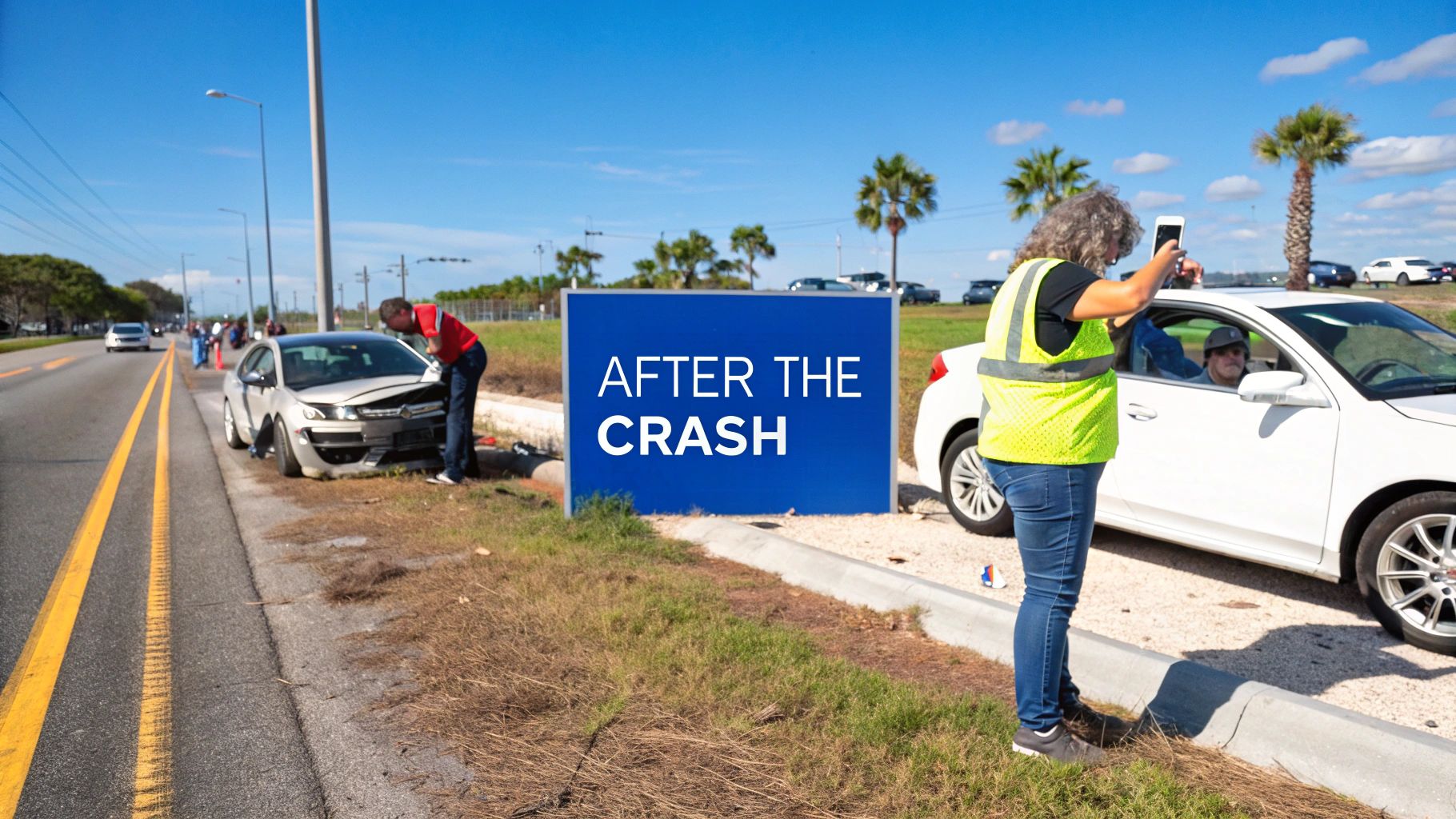
The moments after a crash are chaotic and confusing, especially on a busy Tampa road like Dale Mabry Highway or Fowler Avenue. Adrenaline is pumping, you’re shaken up, and it’s hard to think clearly. But what you do—and just as importantly, what you don’t do—can make or break your ability to get fair compensation later on.
Your absolute first priority is your health. Check on yourself and anyone else in the car. Even if you think you’re okay, you need to get checked out by a doctor. Adrenaline is a powerful pain-masker and can hide serious injuries like whiplash or even internal bleeding for hours, sometimes days.
Heading to an urgent care clinic or the ER does two things: it gets you the care you need, and it creates an official medical record. That record is the cornerstone of your injury claim, directly linking your injuries to the accident.
Insist on an Official Police Report
Whatever you do, don’t let anyone convince you to just “exchange information” and handle it without the police. Always call 911. Getting an official police report from the Tampa Police Department or the Hillsborough County Sheriff’s Office is non-negotiable.
This report is an objective, third-party account of what happened. It will include:
- The officer’s initial assessment of fault.
- A diagram of the accident scene.
- Statements from drivers and witnesses.
- Any traffic tickets that were issued.
Without that report, it becomes a messy “he said, she said” situation, and insurance companies will have a field day trying to deny your claim.
Crucial Tip: When you speak to the officer, stick to the facts. Don’t guess, don’t speculate on what happened, and never apologize. An innocent “I’m sorry” can be twisted into an admission of fault. Just state what you know for sure.
Document Everything You Can
Your phone is the best tool you have at the accident scene. Memories fade fast, but photos and videos don’t. While you’re waiting for the police, start snapping pictures.
Be sure to get clear shots and video of:
- The Damage: Get photos of all the cars involved from every angle. Take close-ups of the points of impact and wider shots showing where the cars ended up.
- The Scene: Capture the bigger picture—traffic lights, stop signs, road conditions, and any skid marks on the pavement.
- Your Injuries: Take pictures of any cuts, bruises, or scrapes. This creates a visual record of the physical harm you suffered.
- The Rideshare App: This one is unique to Uber and Lyft accidents and it’s critical. Take a screenshot of your phone showing the active trip in the app. This is your proof that the driver was working, which is what activates the rideshare company’s $1 million insurance policy.
Gathering this evidence yourself gives you control. Don’t count on anyone else to do it for you. You can learn more about these steps in our detailed guide on what to do after a car accident in Florida.
Exchange Information, But Watch What You Say
Make sure you get the contact info, license plate numbers, and insurance details for every driver involved—not just your Uber or Lyft driver. If there are any witnesses, get their names and phone numbers. Their independent testimony can be incredibly powerful.
Finally, be very careful with your words. As I mentioned, never say you’re sorry. It’s also wise to avoid saying things like “I’m fine” or “I’m okay.” Insurance adjusters are trained to use these common phrases against you, arguing that you weren’t really hurt. Just exchange the necessary information and let your lawyer do the talking later.
Rideshare Accidents Aren’t Rare Anymore—They’re a Tampa Reality
If you were just in an Uber or Lyft crash, you’re not alone. What might feel like a freak accident is, unfortunately, becoming a daily event on the roads in and around Tampa. The convenience of summoning a ride with a tap is undeniable, but it’s also introduced a whole new world of risk and complication when things go wrong.
This isn’t just a hunch; the statistics are startling. A study highlighted by the National Highway Traffic Safety Administration (NHTSA) showed a 137% jump in fatal crashes involving rideshare vehicles in just a few short years. And where are these happening? Over 90% of them are in urban areas, putting places like Hillsborough County right in the crosshairs.
What’s behind this alarming trend? It’s a mix of factors unique to the way ridesharing works.
A Perfect Storm for Driver Distraction
Think about what an Uber or Lyft driver is doing. They aren’t just driving. They’re juggling an app, accepting the next fare, following GPS directions, and communicating with passengers, all while navigating traffic. This creates a constant state of distraction.
Then there’s fatigue. To make a decent living, many drivers are on the road for long, grueling shifts, sometimes after finishing another job. A drowsy driver can be just as impaired as a drunk driver, with dangerously slow reaction times.
A quick glance at a phone to accept a ride might seem harmless. But at 55 mph, looking away for just five seconds means you’ve driven the length of a football field completely blind. For a rideshare driver, these “five-second glances” happen over and over again.
More Cars, More Chaos on Tampa’s Streets
The sheer number of rideshare vehicles on the road has turned up the heat on Tampa’s already congested streets. From the daily gridlock on I-275 to the packed streets of SoHo and Ybor City on a Friday night, thousands of extra cars are circling, stopping, and starting at all hours.
This constant churn naturally makes accidents more likely. We see the same scenarios play out all the time here in Hillsborough County:
- Sudden Stops: A driver spots their passenger and slams on the brakes in the middle of a busy street, causing a chain-reaction rear-ending.
- Unsafe Pickups: Drivers pull over in bike lanes or no-stopping zones, creating immediate hazards for cyclists and other cars.
- Aggressive Maneuvers: A driver trying to get to a pickup location on time weaves through traffic, cutting people off without signaling.
These situations are happening every day. Looking at Tampa’s broader accident statistics helps put into perspective just how much these rideshare-specific behaviors contribute to the danger on our local roads.
Why a Rideshare Crash Isn’t Just Another Car Wreck
This is the most important thing to understand: an accident with an Uber or Lyft is worlds apart from a crash between two private drivers.
The second a multi-billion-dollar corporation like Uber or Lyft gets involved, the entire game changes. You’re no longer dealing with a single driver’s insurance company. You’re up against powerful corporate legal teams and insurance adjusters whose entire job is to pay out as little as possible.
They will immediately start looking for ways to limit their liability. Was the driver’s app on? Were they waiting for a ride, on the way to a pickup, or actively driving a passenger? Each phase has a different level of insurance coverage, and they will use any gray area to their advantage.
This is exactly why you can’t treat this like a standard car accident. You need an attorney who has gone up against these companies before and understands their playbook. Your case isn’t just about a fender bender; it’s tangled up in corporate policy, complex insurance layers, and a growing public safety problem. Getting the right help from the very beginning is critical.
Navigating Florida’s Complex Rideshare Insurance Rules
After a crash involving an Uber or Lyft, one of the first and most confusing questions is always, “Whose insurance pays for this?” It’s never a simple answer. The correct response depends entirely on what the rideshare driver was doing in the app at the exact moment of the accident.
This isn’t just a technicality; it’s the most critical factor in your case. It determines whether you’re dealing with the driver’s personal policy or the rideshare company’s massive $1 million commercial liability policy. You can bet that the insurance companies involved—for Uber, Lyft, and the driver—will fight hard to point the finger at someone else, often by disputing the driver’s app status.
The Three “Periods” of Rideshare Insurance
Florida law breaks down a rideshare driver’s time into specific “periods,” and each one has its own insurance rules. If you’re looking for a rideshare accident lawyer in Tampa, understanding these periods is crucial, because your whole case hinges on proving which one the driver was in when the crash happened. The driver’s status dramatically changes the available coverage.
A deeper look at each period:
- Period 0: The App is Off
If the driver is just using their car for personal errands with the app off, they’re treated like any other driver on the road. Uber and Lyft have zero financial responsibility here. Your claim would be against their personal auto policy. - Period 1: Waiting for a Ride Request
This is the gray area. The driver has logged into the app and is available to accept rides but hasn’t connected with a passenger yet. In this phase, Florida law mandates that Uber and Lyft provide contingent liability coverage: $50,000 per person, $100,000 per incident for injuries, and $25,000 for property damage. This only applies if the driver’s own insurance denies the claim or isn’t enough to cover the damages. - Periods 2 & 3: On the Way to a Passenger or During a Trip
The game changes the second a driver accepts your ride request. From the moment they’re en route to pick you up (Period 2) through the entire time you’re in the car (Period 3), the full $1 million commercial insurance policy is active. This is the highest level of protection available.
As you can see, the difference between waiting for a ride and being on the way to pick someone up is enormous from an insurance perspective.
An experienced lawyer knows the first battle is proving the driver’s app status. Insurers might argue a trip was canceled a millisecond before impact or that the driver was in Period 1 instead of Period 2 to slash their payout. We know how to get the electronic data from the rideshare app to establish the hard facts.
The reality is that many factors can lead to these complex situations, from driver fatigue to simple distraction.
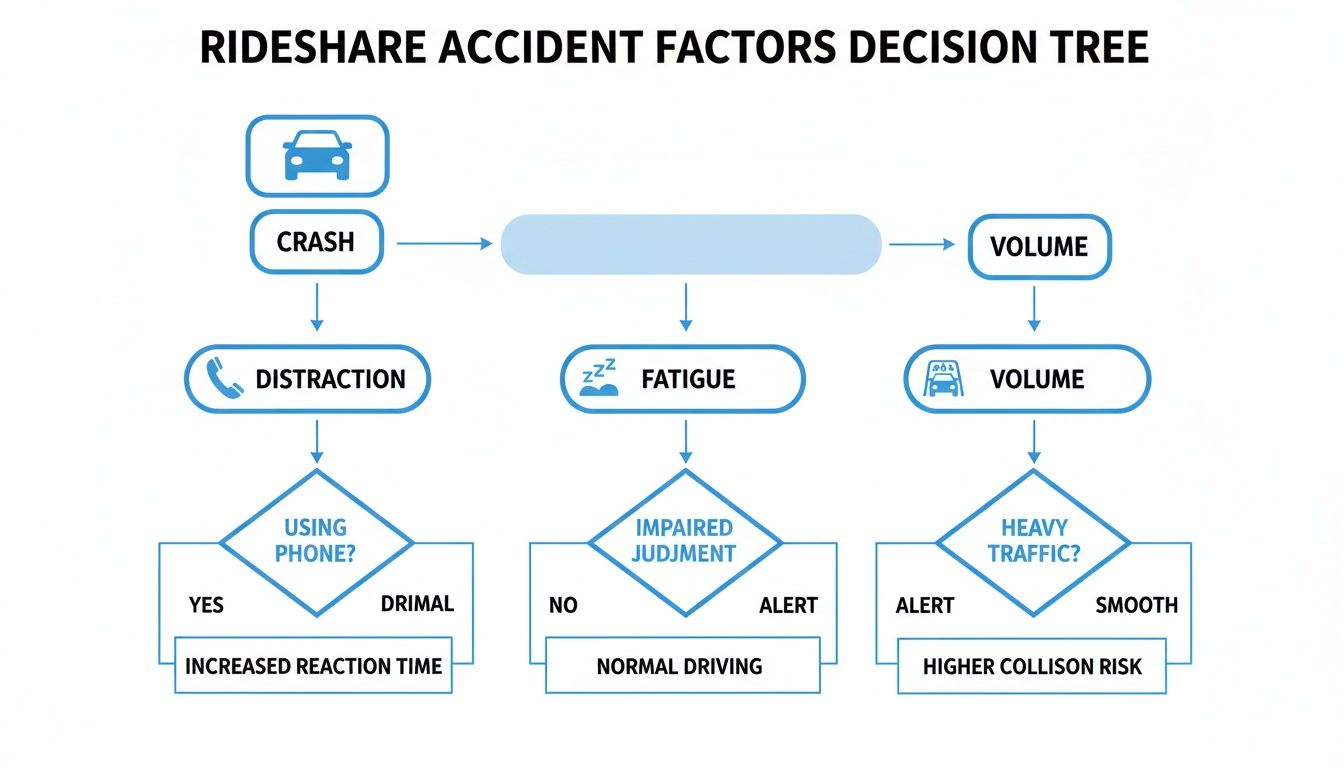
As this shows, the moments leading up to a crash are packed with variables that can complicate who is ultimately held responsible.
How Florida’s No-Fault System Fits In
Florida’s “no-fault” insurance system adds another wrinkle. No matter who caused the accident, your own Personal Injury Protection (PIP) is your first stop for medical bills.
Every vehicle owner in Florida must carry $10,000 in PIP coverage. It’s designed to get you immediate medical care without waiting for the insurance companies to fight over who’s at fault. If you were a passenger in an Uber and have your own car insurance, your PIP is the primary payer for your first $10,000 in medical costs.
Don’t have a car? You might be covered under the PIP policy of a relative you live with. If that’s not an option, the rideshare driver’s PIP coverage would then step in. It’s a confusing sequence, and understanding what PIP covers in Florida is a good first step.
A Real-World Tampa Scenario
Let’s say you’re in a Lyft heading down Kennedy Boulevard, and another driver blows a red light, T-boning your car. Your medical bills quickly surpass your $10,000 PIP limit. What happens next?
Since you were a passenger during an active trip (Period 3), your attorney would first go after the at-fault driver’s insurance. But what if that driver is uninsured or only has the minimum coverage? That’s where Lyft’s massive $1 million Uninsured/Underinsured Motorist (UM/UIM) policy comes into play. This corporate policy exists for this exact reason: to protect passengers from negligent drivers. Working through this chain of claims demands a solid grasp of Florida insurance law, which is why getting specialized legal help is so important.
How to Vet and Hire the Right Tampa Rideshare Lawyer

When you’re reeling from an Uber or Lyft crash, a quick search for a “rideshare accident lawyer near me” can feel overwhelming. You’ll see a long list of names, but how do you choose? Picking the right legal partner is about more than just finding the first name on the list. The difference between a general practice attorney and a true personal injury specialist can mean tens of thousands of dollars for your recovery.
Think of it this way: you wouldn’t ask your family doctor to perform heart surgery. In the same way, you shouldn’t trust a lawyer who just dabbles in personal injury to handle the intricate mess of a rideshare claim. These cases aren’t simple car wrecks; they involve battling corporate legal teams, digging into digital app data, and navigating incredibly complex, multi-layered insurance policies. You need an attorney with a proven record of going toe-to-toe with Uber and Lyft—and winning.
Look for a True Personal Injury Specialist
Your very first filter should be specialization. You need a lawyer whose entire practice revolves around personal injury law, specifically vehicle accidents. A real specialist lives and breathes this stuff. They understand the sneaky tactics insurers use to lowball victims and know the ins and outs of the Hillsborough County court system.
When you’re trying to find the right legal team, it’s useful to recognize the winning law firm marketing strategies that set the best ones apart. Their websites, reviews, and case histories should scream expertise in this specific area, not just a laundry list of a dozen different legal fields.
Key Takeaway: A lawyer who handles a divorce on Monday, a real estate closing on Wednesday, and your accident case on Friday simply doesn’t have the focused experience needed to get you maximum compensation from a billion-dollar rideshare company.
You have to verify their expertise. Look for client testimonials, case results, or articles that specifically mention Uber and Lyft accidents. This proves they’re not just throwing a keyword on their website; they are actively in the trenches, handling and winning these exact kinds of cases. For a deeper dive, take a look at our general tips on how to find a good injury lawyer.
Critical Questions to Ask During Your Free Consultation
That free consultation isn’t just a sales pitch; it’s your interview. This is your chance to really vet a potential attorney and see if they’re the right fit for you. Don’t be timid—ask direct, tough questions to get a real sense of their experience and commitment.
Walk in prepared. Here are a few must-ask questions to get you started:
- How many rideshare accident cases have you personally handled in the last year? This cuts right through the fluff and gets to their recent, hands-on experience.
- What’s your strategy for proving the driver’s app status at the exact moment of the crash? Their answer will immediately tell you if they understand the critical role of electronic data from Uber or Lyft.
- How do you fight back against the tactics used by these massive corporate insurance companies? You want to hear that they’re ready for a battle and won’t just roll over for the first lowball offer.
- Will you be the attorney actually handling my case, or will I be passed off to a junior associate? It’s so important to know who your day-to-day contact will be.
- How do you document damages beyond just my medical bills? A great lawyer will immediately talk about proving lost wages, future medical needs, and the very real impact of your pain and suffering.
Their answers should give you a clear feeling of confidence—or a warning sign.
Understanding the Contingency Fee Model
One of the first things people worry about is how they can possibly afford a good lawyer. The good news is that virtually all reputable personal injury attorneys, including us at Martin Hernandez, P.A., work on a contingency fee basis.
What does that mean for you? It means you pay absolutely nothing upfront. Zero. No hourly rates, no retainers to scrape together. The law firm fronts all the costs of building your case, from hiring accident reconstruction experts to paying court filing fees.
The attorney’s fee is simply a pre-agreed-upon percentage of the final settlement or verdict they win on your behalf. To put it plainly: if you don’t get paid, they don’t get paid. This model makes sure your lawyer’s interests are perfectly aligned with yours—to get you the absolute maximum compensation possible. It levels the playing field, making top-tier legal help accessible to everyone.
The stakes are enormous. Globally, 1.35 million people die in road accidents each year, and the explosion of ridesharing adds to the nearly 1,000 road fatalities in the U.S. every single day. Here in Tampa Bay, with drivers navigating the constant gridlock on I-275 and the chaos of nightlife hotspots, these dangers are very real. Victims get thrown into complicated liability fights against powerful insurers. A firm like Martin Hernandez, P.A. thrives in this arena, preparing every case for trial from day one and using investigators and medical experts to prove exactly what happened in Uber and Lyft crashes.
Building a Powerful Rideshare Accident Claim
There’s a massive difference between simply filing an insurance report and building a rock-solid legal claim that can’t be ignored. The first gets you a lowball offer; the second forces the insurance company to pay what you’re truly owed. A seasoned lawyer isn’t just a paper-pusher. We construct a case from day one that’s designed to dismantle the arguments of corporate legal teams.
It all starts with proving liability, leaving no room for doubt. Uber and Lyft have armies of lawyers ready to exploit any gray area. That’s why we move fast to secure the digital evidence from the rideshare app itself. That data—which shows the driver’s exact status at the moment of impact—is the key to locking in the company’s insurance liability.
Proving Fault with Expert Precision
Sometimes, the police report is just the starting point. To shut down the defense’s attempts to shift blame, we often bring in accident reconstruction experts. These aren’t just witnesses; they’re specialists who use physics and advanced tech to recreate the crash, analyzing every detail to prove exactly what went wrong and who was at fault.
This kind of expert testimony is a game-changer. It helps to:
- Pinpoint Speed and Impact Force: This scientifically links the severity of the crash directly to the severity of your injuries.
- Settle “He Said, She Said” Scenarios: When stories conflict, an expert provides an unbiased, scientific conclusion about who was negligent.
- Show a Jury What Happened: With detailed diagrams and animations, they can make even the most complex crash easy for anyone to understand.
When we invest in this level of detail, it sends a clear message to the insurance company: we are fully prepared to win this in court. If you’re searching for a “rideshare accident lawyer near me” here in Tampa, understanding this strategic advantage is critical. You can learn more about the role of an accident reconstruction expert witness and how they can make or break a case.
A powerful claim is built on irrefutable evidence. By meticulously gathering app data, police reports, witness statements, and expert analysis, your attorney removes the insurer’s ability to create doubt and deny responsibility.
Documenting Every Single Loss
Your claim is about so much more than the first emergency room bill. A truly comprehensive case accounts for every single way this accident has turned your life upside down.
This means we meticulously calculate and document everything:
- All Medical Expenses: We’re talking about the ambulance ride, the hospital stay, and all the care that comes after—physical therapy, future surgeries, medications, and specialist visits.
- Lost Wages and Future Earnings: If you couldn’t work, that lost income is part of your claim. If your injuries prevent you from returning to your old job, we fight for that loss of earning capacity, too.
- Pain and Suffering: This is compensation for the very real human cost—the physical pain, the emotional distress, and the loss of enjoyment in life that the accident caused.
In Tampa, getting fair compensation after a rideshare wreck can be a real fight. The driver’s app status—were they waiting for a ride, on the way to a pickup, or driving a passenger?—is often the central issue, determining which of several massive insurance policies applies. A firm like Martin Hernandez, P.A. thrives in this high-stakes environment. We prepare every single case as if it’s going to trial, leveraging technology and expert testimony to shut down insurance company tactics while documenting everything from ER visits to lost income.
Ultimately, building a powerful claim comes down to preparation. When an insurance company sees your attorney has an airtight case ready for a jury, they are far more likely to offer a serious settlement. This trial-ready strategy is your best weapon for securing the maximum compensation you deserve.
Common Questions We Hear About Tampa Rideshare Accidents
When you’re dealing with the fallout from an Uber or Lyft crash, it’s natural to feel overwhelmed and have a ton of questions. Let’s cut through the confusion and get straight to the answers we provide our clients every day here in Tampa.
How Long Do I Really Have to File a Lawsuit in Florida?
This is the most critical deadline you need to know: In Florida, the clock starts ticking the second the accident happens. The statute of limitations for most personal injury claims, including rideshare accidents, is now just two years.
Let me be clear—this isn’t a guideline. It’s a hard stop. If you try to file a lawsuit even one day after that two-year window closes, the court will almost certainly throw out your case. You lose your right to seek compensation forever. This is why it’s so important to talk to a lawyer right away. Building a strong case takes time, and we need to get started long before that deadline is looming.
What Kind of Compensation Can I Actually Get?
After a crash, you’re entitled to seek payment for all the ways this accident has cost you, which lawyers refer to as “damages.” We fight to make sure you’re compensated for every single loss, not just the obvious ones.
These damages fall into two main buckets:
- Economic Damages: Think of these as the direct, out-of-pocket costs. This includes all your medical bills (past and future), lost income from being unable to work, and even the loss of your ability to earn a living if your injuries are permanent.
- Non-Economic Damages: This is compensation for the human cost of the crash. It covers your physical pain, the emotional trauma and mental anguish you’ve been through, and the loss of enjoyment of life when you can no longer do the things you love.
We meticulously document every one of these losses to build the strongest possible case for the maximum financial recovery you deserve.
A huge mistake people make is thinking their claim is just about paying off medical bills. In reality, the compensation for pain, suffering, and life disruption often makes up the largest part of a settlement. It’s about acknowledging how an accident truly turns your world upside down.
What Happens If an Uninsured Driver Hits My Uber?
This is a scenario we see all too often on Tampa’s roads, and it’s exactly why rideshare companies are required to carry massive insurance policies. If an uninsured or underinsured motorist (UM/UIM) is at fault for the crash while you’re a passenger, you are protected.
We can file a claim directly against Uber or Lyft’s UM/UIM policy. This coverage is specifically designed to act as a safety net when the responsible driver has little or no insurance to cover your injuries. An attorney who handles these specific cases knows the exact process to tap into this coverage and make sure you’re not left with the bill.
Can I Still Get Compensation If I Was Partially to Blame?
Yes, absolutely. Florida follows what’s called a modified comparative negligence rule. In simple terms, this means you can still recover damages as long as you are not found to be more than 50% responsible for the accident.
Your final compensation will just be reduced by your percentage of fault. So, if a jury decides you were 10% at fault, your total award would be reduced by 10%. Insurance adjusters know this rule well and will do everything they can to shift blame onto you to reduce their payout. Having an aggressive lawyer in your corner to push back against these tactics is non-negotiable.
If you have more questions or need help right now after a rideshare accident in the Tampa Bay area, the team at Martin Hernandez, P.A. is ready to step in. We know how these complex cases work and are dedicated to getting you the justice and compensation you’re owed. Contact us today for a free, no-strings-attached consultation at https://injurylawyersoftampa.com.