
TL;DR:
- Wearing safety gear can improve injury outcomes and strengthen your claim, while non-use can lead to fault reductions. Legal standards evaluate gear impact on damages, fault, and employer liability, emphasizing documentation and causal proof. Insurers and courts scrutinize gear use evidence, considering its role in injury severity and fault apportionment during proceedings.
Whether you were wearing protective equipment at the time of your accident matters more than most people realize. The role of safety gear in a claim goes beyond simple compliance: it shapes how insurers calculate fault, how courts assess injury severity, and ultimately how much compensation you can recover. Wearing gear can strengthen your position; not wearing it can give the other side a powerful argument to reduce what you receive.
Here is what you need to know before you file.
- Wearing safety gear can reduce injury severity and support higher compensation demands.
- Failing to wear required gear can trigger comparative fault arguments that reduce your settlement.
- Workers’ compensation is generally a no-fault system, but willful misconduct exceptions exist.
- Employers must provide PPE and train workers on its use under federal OSHA standards.
- Evidence of gear use or non-use becomes part of the record during claim evaluation.
How safety gear affects injury severity and claim outcomes
Safety equipment in claims functions as a two-sided variable. When you wore gear and still suffered serious injuries, that evidence supports the argument that the accident itself caused the harm, not your own choices. When you did not wear gear, insurers will often argue that your injuries were worse than they would have been, and they will push to reduce your payout accordingly.
Courts and adjusters look at injury severity first. A motorcyclist wearing a helmet who sustains a concussion faces a very different claim calculation than one who was not wearing a helmet and suffered a traumatic brain injury. The gear does not change who caused the crash, but it directly affects how damages are measured. Gloves, for example, can mean the difference between a minor laceration and a permanent hand injury that requires surgery.
Pro Tip: Document your gear use immediately after an accident. Photographs of your helmet, vest, gloves, or other protective equipment taken at the scene can be critical evidence if the insurer later disputes whether you were wearing them.
What U.S. laws say about safety gear requirements
The legal framework governing protective equipment spans both federal workplace rules and state tort law. OSHA requires employers to assess workplace hazards, provide appropriate personal protective equipment (PPE), and train each worker on its proper use. When an employer fails to meet those obligations, that failure becomes a significant liability factor in any resulting claim.
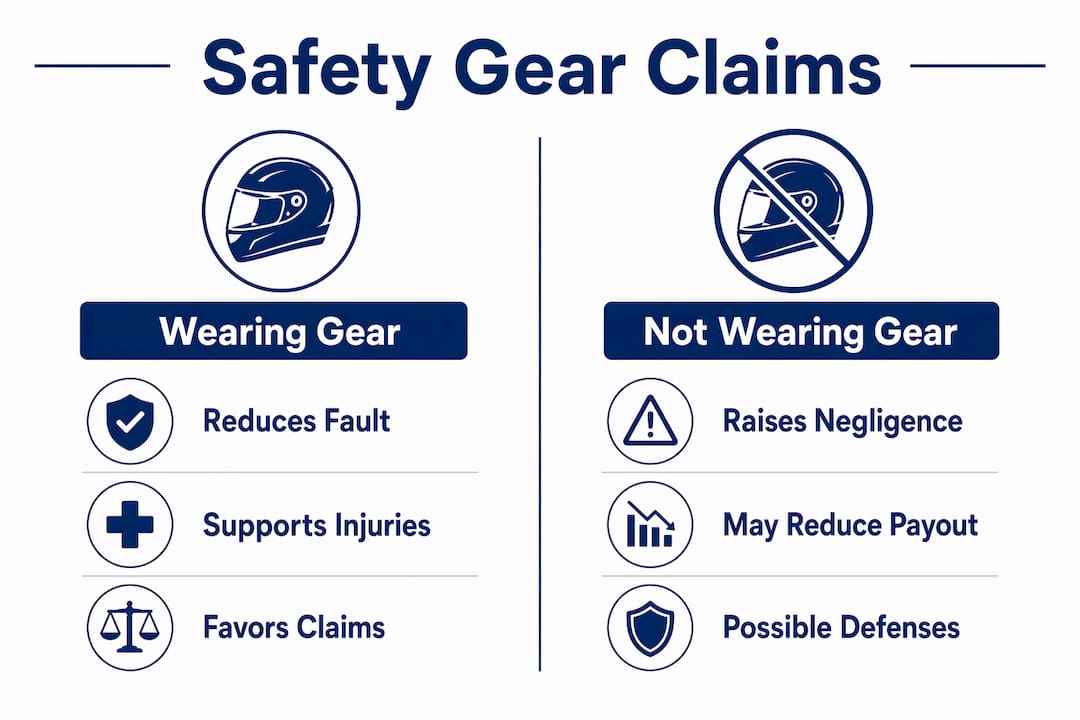
On the civil side, comparative negligence rules determine how fault is split between parties. Florida follows pure comparative negligence, meaning you can recover damages even if you were partially at fault, though your award is reduced by your percentage of responsibility. Under the 50% bar rule used in some states, you cannot recover at all if you are found to be 50% or more at fault. Four states and Washington, D.C. go further, applying strict contributory negligence that bars any recovery if you contributed even slightly to your own injury.
Workers’ compensation operates differently. It is a no-fault system in most states, so your failure to wear PPE generally does not eliminate your benefits. However, some states allow benefit reductions for PPE violations. Wisconsin, for instance, reduces benefits by 15% if an injury results from the employee’s failure to use a mandated, enforced safety device.
What happens to your claim when you were not wearing safety gear
Not wearing gear does not automatically end your claim, but it does hand the opposing side a ready-made argument. Insurers routinely argue that the absence of protective equipment contributed to the severity of your injuries, and they use that argument to justify lower settlement offers.
In personal injury cases, comparative fault may reduce your settlement in proportion to the degree your gear non-use is found to have worsened your injuries. The key word is “worsened.” The defense must show a direct causal link between the missing gear and the specific injuries you suffered, not just a general claim that gear is safer. If you broke your leg in a fall and were not wearing a hard hat, the absence of a hard hat is irrelevant to that injury.
Workers’ comp claims are more protected. Benefits are generally still payable unless the employer can prove willful misconduct, which is a high bar. Separately, if your employer failed to provide the required gear, that failure may open the door to a third-party liability claim outside the workers’ comp system entirely, potentially allowing for greater damages.
How evidence of safety gear usage shapes legal proceedings
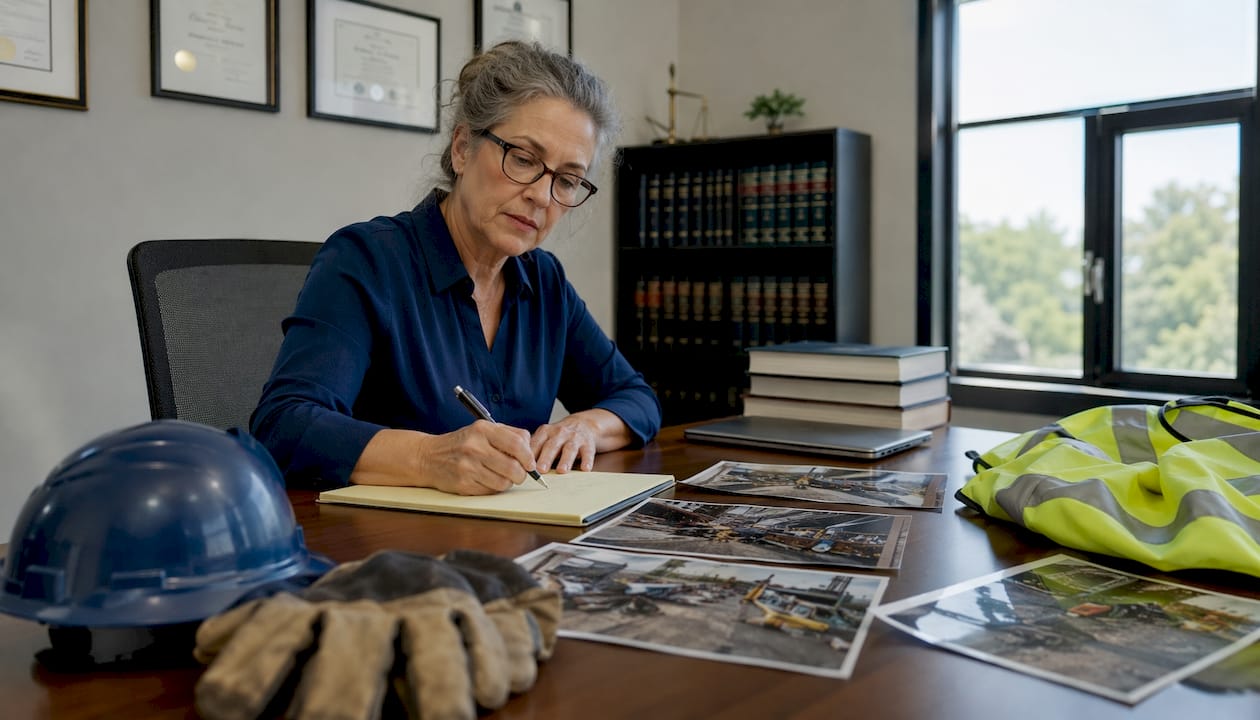
Evidence of whether you wore protective equipment enters the record through medical reports, accident scene photographs, police reports, and witness statements. Video footage, including dashcam recordings, can be decisive. Dashcam footage that captures the moments before and after an accident can confirm gear use or contradict an insurer’s claim that you were unprotected.
Expert witnesses also play a role. A biomechanical engineer or occupational safety specialist may testify about whether a specific piece of gear would have prevented or reduced a particular injury. That testimony directly influences how a jury apportions fault and calculates damage reductions under comparative negligence. The evidence you gather in the days immediately following an accident often determines whether an insurer’s gear-based argument succeeds or fails.
Types of injuries that safety gear prevents or reduces
The protective value of gear is well established across injury categories, and courts take that record seriously when evaluating claims.
Helmets are the clearest example. They prevent traumatic brain injuries and skull fractures in motorcycle, bicycle, and construction accidents. Protective clothing, including high-visibility vests and flame-resistant jackets, reduces abrasions, burns, and road rash. Gloves protect hands from cuts, chemical burns, and crush injuries that can permanently limit function. Safety glasses and face shields prevent eye damage from flying debris or chemical splashes. Steel-toed boots prevent crushing injuries and reduce slip-and-fall severity on industrial floors.
Each of these injury categories carries its own medical cost profile, and insurers know those numbers well. When gear was absent and the injury matches the type that gear prevents, expect the insurer to make that connection explicit in their valuation.
Legal insights from Martin Hernandez, PA on Florida safety gear claims
Florida’s pure comparative negligence system means that gear non-use rarely eliminates a claim outright, but it can meaningfully reduce what you recover. Martin Hernandez, PA has seen insurers use the absence of a motorcycle helmet or work gloves as leverage to push settlements far below fair value, particularly when the injured person does not have legal representation to challenge the causation argument.
Employer responsibility is a critical piece of the puzzle. Under both OSHA standards and Florida law, employers who fail to provide required PPE or enforce its use may face liability that extends beyond the workers’ compensation system. When an employer deliberately removes a safety guard or disables a protective device, Ohio’s Supreme Court has recognized a rebuttable presumption of intent to injure, which can transform a workers’ comp claim into an intentional tort with broader damages. Florida courts apply similar reasoning in egregious cases.
Pro Tip: Contact a personal injury attorney as soon as possible after your accident. Early legal involvement preserves evidence, prevents recorded statements that can be used against you, and positions your claim correctly from the start.
Exceptions and defenses when safety gear was not worn
The defense that gear non-use worsened injuries is not automatic. Courts applying comparative negligence require a two-step jury analysis: first, whether failing to wear gear was unreasonable under the circumstances; second, whether that failure directly caused the specific injuries at issue. If either answer is no, damages are not reduced.
Several exceptions protect claimants. If the employer never provided the gear or never enforced its use, the employee’s non-use is far less culpable. If the gear was defective or unavailable at the time of the accident, that shifts responsibility back to the employer or manufacturer. And in states like Wisconsin, legislation has specifically exempted motorcycle and ATV riders from helmet-based damage reductions in civil actions, overriding earlier common law.
Case precedents that illustrate how gear affects claim outcomes
The Wisconsin Supreme Court’s decision in Stehlik v. Rhoads is one of the most instructive examples in U.S. case law. The court held that helmet non-use in an ATV accident is governed by the same “second collision” methodology as seatbelt non-use: the jury first apportions fault for the accident itself, then separately evaluates whether the rider’s failure to wear a helmet caused additional injury. Critically, helmet negligence operates only to reduce damages, not to bar recovery entirely.
New Jersey courts reached a similar conclusion in bicycle helmet cases, finding that the absence of a mandatory helmet law does not mean riders face no legal consequence for going without one. The court in Nunez noted that there is a difference between the legislature leaving helmet use optional and the legislature saying that non-use will never carry legal consequences.
These precedents matter for Florida claimants because they show how courts across the country have consistently required a direct causal link between gear absence and specific injury worsening before reducing any award.
How insurance companies view safety gear in claims
Insurers treat PPE use as a cost-control variable. Their adjusters are trained to identify whether required gear was absent and to quantify how much of the claimed injury could be attributed to that absence. The goal is to reduce the settlement figure, and gear non-use gives them a documented, defensible basis to do so.
What insurers cannot do is simply assert that gear would have helped. Legal experts stress that absence of gear alone is insufficient to deny or reduce a claim. They must prove a stronger injury link. When you have an attorney who challenges that causation argument with medical records and expert testimony, the insurer’s leverage shrinks considerably.
Policy recommendations and practical steps for safety gear compliance
Compliance with gear requirements protects you physically and legally. Wearing OSHA-mandated PPE at work, wearing a helmet on a motorcycle, and using seatbelts in vehicles all reduce your exposure to comparative fault arguments if you are ever injured.
For employers, the stakes are even higher. Failing to provide required equipment or failing to enforce its use can increase employer liability and open the door to third-party claims that bypass the workers’ comp system’s damage caps. A documented PPE program, regular training, and consistent enforcement are the most direct ways to limit that exposure.
If you are already dealing with a claim where gear use is in dispute, the priority is documentation. Gather photographs, witness contact information, medical records that describe your injuries in detail, and any workplace safety logs that show whether gear was available and required. Understanding what negligence means in your specific situation is the first step toward building a claim that holds up.
If you were hurt in Tampa or Hillsborough County and have questions about how your gear use or non-use might affect your recovery, Martin Hernandez, PA offers consultations with no fee unless your case is won.
Reach out to Martin Hernandez, PA to discuss your personal injury claim and get a clear picture of where you stand.
Key Takeaways
Safety gear directly affects both injury severity and fault allocation in U.S. personal injury and workers’ compensation claims, and its absence gives insurers a documented basis to reduce your settlement.
| Point | Details |
|---|---|
| Gear use shapes fault calculations | Courts reduce damages proportional to how much gear non-use worsened specific injuries, not as a blanket penalty. |
| Workers’ comp is largely no-fault | PPE non-use rarely bars benefits, though some states like Wisconsin reduce them by 15% for mandated device violations. |
| Causation is required | Insurers must prove a direct link between missing gear and increased injury severity; general claims often fail. |
| Employer duties matter | Employers who fail to provide or enforce PPE face liability that can extend beyond the workers’ comp system. |
| Evidence is decisive | Photographs, dashcam footage, and expert testimony about gear use are often what determine a claim’s outcome. |
FAQ
Does not wearing safety gear automatically reduce my compensation?
No. Courts require proof that the missing gear directly caused your injuries to be worse, not just that gear would have been safer in general. Without that causal link, your compensation is not reduced.
What is the purpose of safety gear in a legal claim?
Safety gear serves as evidence of reasonable care. Wearing it supports your claim that the accident caused your injuries; not wearing it gives the defense an argument that your own choices worsened the outcome.
Can I still get workers’ compensation if I was not wearing PPE?
Generally yes, because workers’ compensation is a no-fault system. Benefits are only reduced or denied in cases of proven willful misconduct or, in states such as Wisconsin, by 15% for injury caused by failure to use a mandated, enforced safety device.
What role does PPE play in preventing workplace accidents?
OSHA treats PPE as the last line of defense after engineering and administrative controls. It minimizes exposure to chemical, physical, and mechanical hazards that cause serious injuries when other protections are not enough.
What if my employer never gave me the required safety equipment?
Your employer’s failure to provide required gear shifts significant liability onto them and may allow you to pursue claims outside the standard workers’ comp system, potentially recovering damages beyond typical benefit caps.
Recommended
- Motorcycles and Safety Gear – What Happens if You are in an Accident – Personal Injury Lawyers of Tampa
- The Role of Medical Documentation in Personal Injury Cases in Tampa: a Guide to Building a Strong Claim
- Navigating Legal Liabilities in Tampa Car Accidents: A Guide to Securing Justice & Compensation
- Understanding Legal Liabilities in Tampa Car Accidents | Securing Justice for Injuries