
When you’re trying to decide whether to get a lawyer after a car accident, the simplest answer for most crashes in Florida involving injuries or arguments over who’s at fault is a clear and resounding yes.
Hiring an attorney isn’t about being confrontational. It’s about leveling the playing field. Insurance companies have entire teams of experts whose job is to protect their bottom line—not to ensure you get what you need to recover.
Why You Need a Lawyer on Your Side After a Florida Car Accident
After a crash, your life gets turned upside down. You’re suddenly juggling doctor’s appointments, car repair estimates, and persistent calls from insurance adjusters. It’s overwhelming, and a single wrong move can put your financial future at risk.
Think of a personal injury attorney as your professional advocate. They step in to handle all the complicated legal and administrative headaches so you can put all your energy into what truly matters: getting better.
Their job is to make sure your rights are protected under Florida’s specific—and often confusing—car accident laws. They become a crucial shield between you and the other driver’s insurance company, whose main goal is always to settle your claim for as little money as possible.
Leveling the Playing Field Against Insurers
Insurance companies are not new to this. They process thousands of claims every single day and have a well-oiled machine designed to minimize what they pay out. Their adjusters are highly trained negotiators.
When you try to handle a claim on your own, you’re at a serious disadvantage from the start. An experienced lawyer recognizes the insurance company’s tactics and knows exactly how to push back.
Simply having a lawyer on your side sends a powerful message to the insurer: you won’t be bullied into accepting a lowball offer. It shows you’re serious about getting the full compensation you deserve for your medical bills, lost income, and pain.
The Financial Impact of Having a Lawyer
The difference a lawyer makes isn’t just about peace of mind; you can see it in the final settlement check. Study after study confirms that accident victims with a lawyer almost always walk away with more money.
In fact, people with legal help can receive settlements that are 3.5 times larger than what unrepresented victims get. That’s a statistic that can turn a small payout into a truly life-changing amount of compensation. You can read more about how a lawyer improves injury claim outcomes.
By managing all communications, gathering critical evidence, and building a strong case from day one, an attorney ensures every aspect of your loss is documented and valued correctly. This strategic approach is designed to maximize your recovery.
Ultimately, deciding to get a lawyer after a car accident is about protecting yourself. When you understand what a skilled attorney brings to the table, you realize you’re not just hiring help—you’re ensuring you don’t have to face a powerful insurance corporation alone during one of the most vulnerable times of your life.
7 Clear Signs You Need to Call a Lawyer Immediately
Some car accidents are more than a simple fender-bender. They’re immediate red flags—blaring signals that you need professional legal help. While you might feel fine handling a minor claim on your own, certain situations throw you into a complex game where you’re at a major disadvantage against seasoned insurance adjusters.
Knowing how to spot these signs is the first step in protecting yourself and your right to fair compensation.
1. Someone Was Injured (Even a Little)
This is the most critical reason to call a lawyer. If you, your passengers, or anyone else involved in the crash suffered an injury, you need legal counsel. Period. This is true even for injuries that seem minor at first, like a stiff neck, general soreness, or some bruising.
The reality is that symptoms for serious conditions like whiplash, internal bleeding, or even concussions can take days or weeks to fully appear. If you accept a quick settlement before you know the full extent of your injuries, you forfeit your right to get compensation for any future medical treatments. You can’t go back and ask for more later.
2. The Police Report Is Vague or Incorrect
Don’t assume the police report is gospel. Officers do their best, but they arrive after the fact and sometimes get details wrong. If the report is unclear about who was at fault, contains factual errors, or—even worse—incorrectly blames you for the crash, you’re in for a fight. An insurance company will use that ambiguity to deny your claim or drastically reduce their offer.
3. Fault Is Disputed
This is another huge red flag. If the other driver is pointing the finger at you, denying responsibility, or changing their story, you need an advocate. The insurance company’s goal is to pay out as little as possible, and a dispute over fault is the perfect excuse for them to do just that.
Under Florida’s comparative negligence rule, any percentage of fault assigned to you directly cuts down your compensation. A lawyer can immediately get to work gathering evidence—tracking down witnesses, securing traffic camera footage, and consulting with accident reconstruction experts—to build a rock-solid case that proves what really happened.
4. The Other Driver Was Uninsured or Underinsured
What happens when the driver who hit you has no insurance or just the bare-minimum policy that won’t cover your bills? You’d think your own insurance company would have your back, but getting them to pay up on your Uninsured/Underinsured Motorist (UM/UIM) coverage can be just as tough. A lawyer can force them to honor the policy you’ve been paying for.
5. A Commercial Vehicle Was Involved
Crashes involving semi-trucks, delivery vans, or any company car are in a different league. You’re not just up against a driver; you’re up against a corporation with a powerful legal team and a massive commercial insurance policy. These cases involve complex federal and Florida regulations, and their defense tactics are aggressive from the start.
6. More Than Two Vehicles Crashed
A multi-car pile-up creates a tangled mess of liability. Figuring out who hit whom and who is responsible for your injuries can be incredibly complicated. An attorney is essential to untangle the facts, identify all liable parties, and make sure you pursue compensation from every available source.
7. The Insurance Company Is Playing Games
Insurance adjusters are trained negotiators. Their job is to protect their company’s bottom line, not yours. If they are delaying your claim, giving you the runaround, making a ridiculously low offer, or pressuring you into a recorded statement, they are not on your side. These are classic tactics designed to get you to settle for less than you deserve.
This is your cue to get an advocate. Trying to navigate the system alone is a gamble you can’t afford to lose, especially when your health and financial stability are on the line.
Motor vehicle accidents are a dominant force in personal injury law, making up a significant portion of all claims. With thousands of crashes happening each year in Florida, countless unrepresented victims accept lowball offers that don’t come close to covering their medical bills and lost income.
This decision tree gives you a simple visual guide for when to bring in a professional.
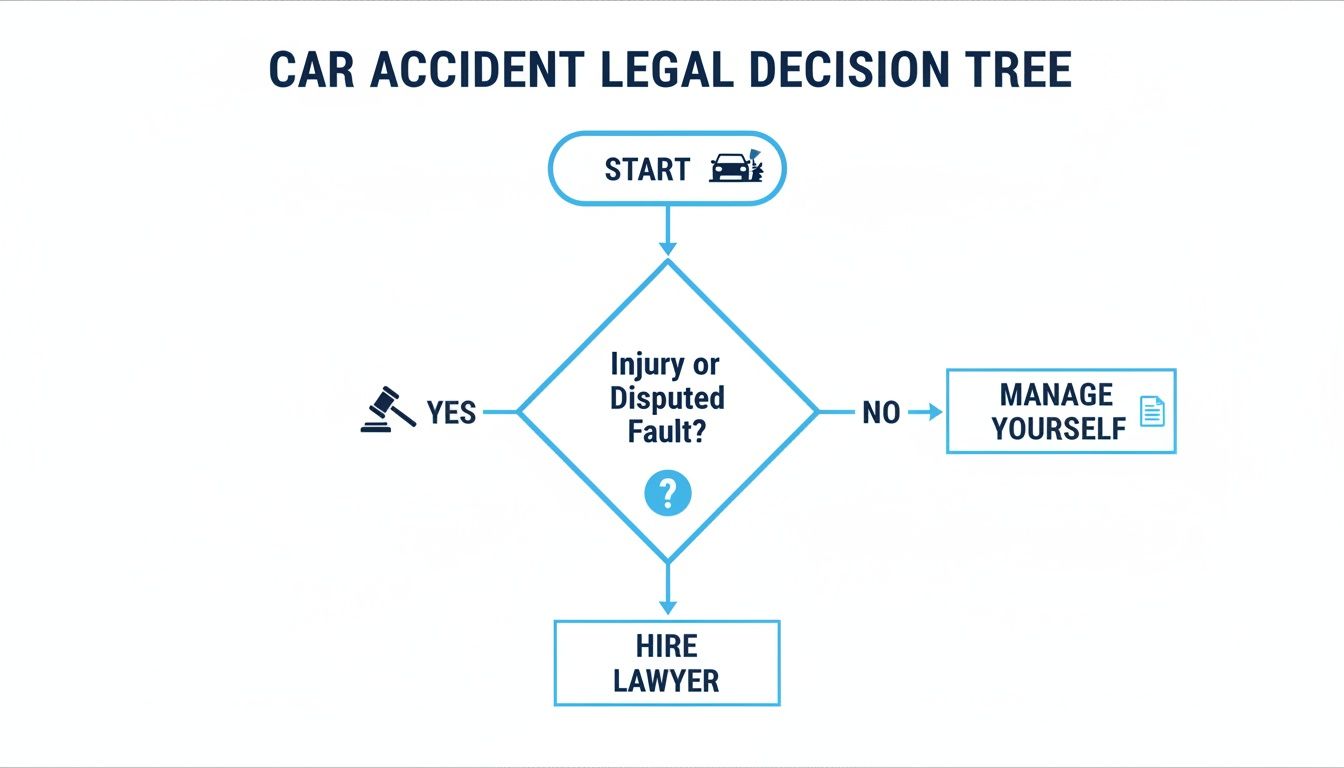
Ultimately, trying to handle a serious claim yourself is risky. The smallest misstep can jeopardize your entire case. By making common mistakes after an accident, you could lose your only chance to get the money you need to truly recover.
What an Accident Attorney Really Does for You

Bringing a lawyer on board after a car wreck isn’t just about paperwork; it’s a strategic move that levels the playing field. When you’re trying to recover from an injury, the last thing you need is a fight with a massive insurance corporation. An attorney steps in as your advocate, freeing you up to focus on what matters most: your health.
Think about it. The insurance company has a whole team—adjusters, investigators, and lawyers—all working to protect their bottom line. Hiring your own attorney means you have a skilled professional in your corner, someone legally and ethically bound to fight for your best interests.
This one decision can make all the difference for your financial future. You’ll have an expert guiding you through Florida’s complicated legal maze, pushing back against insurance company tactics, and fighting for every dollar you deserve.
Your Attorney as a Private Investigator
One of the first things your attorney does is become your personal investigator. You might think the police report has all the answers, but it’s really just the starting point. If that initial report helps their case, you can bet the insurance adjuster isn’t going to dig any deeper.
Your lawyer, on the other hand, is on a mission to build an ironclad case. They will:
- Hunt down video footage from traffic cameras, local businesses, or even a neighbor’s Ring doorbell that shows exactly what happened.
- Find and interview witnesses whose stories can back you up and add serious weight to your claim.
- Subpoena cell phone records to prove the other driver was texting or distracted right before the crash.
- Bring in accident reconstruction experts who use physics to prove fault, especially when the details are murky.
This evidence-gathering stage is all about leaving no room for doubt, strengthening your negotiating position right out of the gate.
Your Advocate as a Financial Analyst
Figuring out what your car accident claim is actually worth is far from simple. The first offer from an adjuster is almost always a lowball figure meant to cover your immediate medical bills and nothing more. They’re counting on you not knowing the full extent of your losses.
A good attorney acts like a financial analyst, meticulously calculating the true, total value of your claim. This often includes damages you wouldn’t even think to claim yourself.
A common mistake is to only consider current medical bills. A thorough claim valuation must also account for future surgeries, ongoing physical therapy, prescription costs, lost earning capacity, and the profound impact of pain and suffering.
An experienced lawyer knows how to document these “non-economic” damages, which are often the largest part of a settlement. They work with medical and financial experts to project your future needs, making sure the compensation you fight for covers your recovery for years to come, not just today.
Your Lawyer as a Master Negotiator
Finally, your attorney is your negotiator and your shield. They take over all communication with the insurance companies, so you never have to talk to an adjuster again. This is huge, as it stops you from accidentally saying something they could twist and use against you.
And this is where you see the real payoff. According to the Insurance Research Council, accident victims who hire an attorney receive settlements that are, on average, 3.5 times larger than those who go it alone. The gap can be tens or even hundreds of thousands of dollars. You can dig into more of these personal injury statistics and their impact.
Your lawyer knows every trick in the adjuster’s playbook and how to shut them down. They prepare your case as if it’s going to trial, a strategy that forces the insurance company to take your claim seriously. It’s this readiness to fight that ultimately leads to a fair settlement that reflects everything you’ve lost.
Navigating Florida’s No-Fault Law and Insurance Hurdles
Florida’s auto insurance system can feel like a labyrinth, especially when you’re trying to navigate it alone after a crash. The biggest source of confusion? The “no-fault” law.
This term trips a lot of people up. It doesn’t mean that no one is to blame for the accident. It simply dictates who pays your initial medical bills. In Florida, your own auto insurance policy is your first stop for medical coverage, no matter who caused the wreck. This is handled through your Personal Injury Protection (PIP) coverage, which is mandatory for every driver in the state.
But here’s the catch: your PIP coverage is limited and comes with some very strict, unforgiving rules. Just assuming it will cover everything is a huge mistake.
The Critical 14-Day Rule
One of the harshest realities of Florida’s no-fault system is the 14-day rule. This is an absolute, non-negotiable deadline. You must get initial medical treatment within 14 days of the car accident. If you show up on day 15, your insurance company has the legal right to deny every single dollar of your PIP medical benefits.
This rule is a dangerous trap for people who try to tough it out. You might feel sore and think, “I’ll just wait and see if it gets better.” By the time you realize the pain is serious and not going away, that two-week window has slammed shut, and you’ve lost your primary path to getting your medical bills paid.
Getting checked out by a doctor right after an accident isn’t just about your health—it’s a crucial move to protect your financial and legal rights. Missing that 14-day deadline hands the insurance company a golden ticket to deny your claim from the very beginning.
The ins and outs of these laws are incredibly detailed. For a closer look, you can get a more in-depth explanation of how Florida’s no-fault insurance works and see why having an expert on your side is so valuable.
Common Tactics Insurance Adjusters Use Against You
Beyond the legal deadlines, you’re also going to be dealing with an insurance adjuster. It’s critical to remember their job isn’t to help you—it’s to protect their company’s bottom line by minimizing your payout. Knowing their playbook is your first line of defense.
Here are a few of the classic strategies adjusters use to pay you less:
- The Quick, Lowball Offer: You might get a call with a settlement offer just days after the crash. It sounds great to get a check in hand so fast, but this offer is always a fraction of your claim’s real value. They make it before you even know how serious your injuries are. Once you cash that check, your claim is closed for good.
- Pressuring for a Recorded Statement: The adjuster will call and politely ask for a recorded statement, making it sound like a routine step. Don’t fall for it. They are fishing for you to say anything they can twist to undermine your story, question your injuries, or even shift some of the blame onto you.
- Blaming Pre-Existing Conditions: Did you have a back issue years ago? They’ll find it. The adjuster will comb through your medical records looking for any old injury they can blame for your current pain, giving them an excuse to deny treatment related to the crash.
- Disputing the Severity of Your Injuries: Even with a doctor’s diagnosis, the adjuster might push back. They’ll often argue that your injuries aren’t that bad or that the medical care you’re getting is excessive or unnecessary.
These tactics are designed to frustrate you, wear you down, and make you give up. An experienced car accident lawyer has seen it all before. We recognize these strategies immediately and know exactly how to shut them down, making sure your rights are protected every step of the way.
How Car Accident Lawyers Get Paid in Florida
The thought of legal bills is enough to make anyone think twice about calling a lawyer. It’s a huge source of anxiety, but thankfully, it’s based on a total misconception when it comes to car accident cases. Here in Florida, the system is designed so that anyone can get top-notch legal help, no matter what their bank account looks like.
You don’t need a single penny saved up to hire a great attorney. Seriously. You won’t pay anything out of pocket to get your case moving forward.
This is all thanks to what’s known as a contingency fee agreement. It’s the standard for personal injury law, and it’s a simple concept that gives you access to justice when you need it most.
The Power of the Contingency Fee
A contingency fee basically means your lawyer is investing in you and your case. They agree to handle everything—the investigation, the endless phone calls, the negotiations, and all the upfront costs—without asking you for an hourly rate or a retainer fee.
Their payment is contingent on winning your case. If they get you a settlement or a jury award, their fee is just a percentage of that total amount.
What does this really mean? If you don’t get paid, your lawyer doesn’t get paid. It’s that simple. This setup ensures their goal is perfectly aligned with yours: getting you the absolute maximum compensation possible.
This model takes all the financial risk off your shoulders. It lets you focus completely on your recovery, knowing a legal professional is fighting for you without sending you a bill every month. For a deeper dive, our guide explains exactly how contingency fees work in a car accident.
How It Works in Practice
During your initial free consultation, the lawyer will walk you through this agreement. The percentage is spelled out in a written contract before any work starts, so you’ll never face any hidden fees or surprises down the line.
Typically, this percentage covers:
- All legal work: This includes the countless hours your attorney and their team will spend investigating, building your claim, and battling the insurance company on your behalf.
- Case costs: Law firms usually cover the upfront expenses required to build a strong case—things like court filing fees, hiring expert witnesses, or gathering medical records. These costs are then reimbursed from the settlement.
So, if you’re wondering, “should I get a lawyer for a car accident?” you can put the financial worries aside. The contingency fee model empowers you to hire a powerful advocate who can level the playing field against the big insurance companies.
How to Choose the Right Florida Car Accident Lawyer

Deciding you need a lawyer is the first big step. The next one—choosing the right one—is just as crucial. Not all attorneys are created equal, and the outcome of your case can hinge on the advocate you have in your corner.
Finding the best fit in Florida means doing a little homework, but it’s an investment that pays off. You’re not just looking for someone with a law degree; you need an expert who knows Tampa’s legal landscape, understands the local courts, and won’t back down from insurance company adjusters.
Look for Specific Experience
First things first, narrow your search to specialists. You wouldn’t see a foot doctor for a heart problem, and the same logic applies here. Personal injury is a highly specialized field, and car accident claims in Florida come with their own set of rules and complexities.
Look for a law firm that lives and breathes car accident cases. Their website, client reviews, and case histories should make it obvious.
A lawyer who focuses on these cases every day brings a ton of valuable, real-world knowledge to the table, including:
- In-depth understanding of Florida’s tricky no-fault PIP system and its tight deadlines.
- Familiarity with the hardball tactics used by major auto insurance carriers in our state.
- Experience with the local judges and court procedures right here in Hillsborough County.
This kind of specialized background means they’re not learning the ropes on your time. They already have a game plan ready to go from day one.
Verify Their Track Record and Reputation
Experience is one piece of the puzzle, but a proven history of success is another. A good lawyer should be open about their results. While past performance never guarantees a future outcome, a strong track record of securing significant settlements and winning verdicts shows they know how to get the job done.
Check their website for case results and don’t be shy about asking about their experience with situations like yours during a consultation. Beyond that, dig into online reviews on sites like Google and Avvo. These are firsthand accounts from people who have been in your shoes.
Pay close attention to what past clients say about communication and professionalism. A great lawyer doesn’t just win cases; they treat their clients with respect and compassion through one of the most stressful times of their lives.
Ask the Right Questions During Your Consultation
The free consultation is your chance to interview potential attorneys. It’s a two-way street—while they’re evaluating your claim, you should be evaluating them. Go in prepared with a list of questions to make sure you get all the information you need. For a deeper dive, check out our guide with more essential tips and questions to ask a personal injury lawyer.
Here are a few must-ask questions to get you started:
- Who will be my main point of contact? Will I be working directly with you, the attorney, or will a paralegal or case manager handle most of the communication?
- What is your communication policy? How often will I get updates, and what’s the best way to reach out when I have a question?
- How many cases similar to mine have you handled? This helps you understand their direct experience with your specific type of accident.
- What is your fee structure? Confirm they work on a contingency fee basis, and get a clear breakdown of their percentage and how case expenses are managed.
Choosing the right lawyer comes down to finding a skilled professional you genuinely trust. By focusing on specific experience, a proven track record, and asking the right questions, you’ll find a powerful advocate ready to fight for you.
Frequently Asked Questions About Florida Car Accident Claims
After a car crash, your head is probably swimming with questions. It’s a confusing and stressful time, and getting clear answers is the first step toward feeling in control again. Here’s some straightforward guidance on the most common concerns we hear from people just like you.
How Long Do I Have to File a Car Accident Claim in Florida?
The clock starts ticking the moment the accident happens. In Florida, the law that sets this deadline is called the statute of limitations, and for most car accident injury claims, you now have two years to file a lawsuit.
This is a recent change—it used to be four years—so acting quickly is more important than ever. If you miss that two-year window, the court can refuse to hear your case, and you lose your right to compensation forever. This is why it’s so critical to talk to an attorney early on. It gives them the time they need to properly investigate your claim, track down witnesses, and build a strong foundation for your case. To get a broader look at legal deadlines, you can review this overview of personal injury statute of limitations by state, but always confirm the current law for Florida with a qualified attorney.
What if the Accident Was Partially My Fault?
This is a situation we see all the time, so don’t assume you don’t have a case. Florida law follows a modified comparative negligence rule. In plain English, this means you can still recover money even if you were partly responsible for the crash.
Here’s how it works: your final compensation is simply reduced by your percentage of fault. For instance, if a jury decides you were 20% at fault, your total award would be cut by 20%.
This is a key battleground where a good lawyer makes a huge difference. We fight to minimize any percentage of fault assigned to you, making sure the insurance company doesn’t unfairly shift the blame to reduce their payout.
Should I Get a Lawyer for a Minor Car Accident?
Even for what seems like a minor fender-bender, getting a free consultation is one of the smartest moves you can make. It’s completely free, and there’s no obligation. While a tiny parking lot tap with zero damage or soreness might not need a lawyer, many injuries have a sneaky way of showing up later.
That “minor” neck stiffness or headache you feel after the crash could easily turn into a chronic pain issue or a more serious condition days, or even weeks, down the road.
If you take a quick check from the insurance adjuster before you know the true extent of your injuries, you sign away your rights to any future compensation for that accident. A free case review lets an experienced attorney look at the details and give you honest advice, protecting you from accidentally closing the door on the compensation you might desperately need later.
If you’ve been injured in a car accident in Tampa, you don’t have to face the insurance companies alone. At Martin Hernandez, P.A., we are ready to fight for the justice and compensation you deserve. Contact us today for a free, no-obligation consultation to discuss your case by visiting https://injurylawyersoftampa.com.