
If you’ve been hurt in a car accident in Florida, there’s a critical deadline you absolutely need to know about. It’s called the statute of limitations, and for most negligence claims, it was recently cut in half—from four years down to a very strict two years.
Miss this deadline, and your right to get compensation is gone. Forever. It’s the legal point of no return for your injury claim.
The Ticking Clock on Your Florida Car Accident Claim
Think of it like this: a countdown timer starts the very second your car crash happens. That’s the essence of the statute of limitations in Florida. This isn’t just a friendly suggestion; it’s a hard, legally binding deadline for filing a lawsuit to recover money for your injuries.
This is so important because time is definitely not on your side after a wreck. Evidence gets lost, witnesses’ memories get fuzzy, and you can be sure the at-fault driver’s insurance company is working against you from day one. Waiting too long, even if you’re still within the legal window, can seriously hurt your case. The steps you take right after a crash are just as crucial as the legal deadlines you have to meet.
For a detailed walkthrough, take a look at our guide on what to do after a car accident in Florida.
Florida’s Recent and Dramatic Change
A major change in Florida law has made moving quickly more critical than ever before. In March 2023, the legislature passed a bill that completely changed the game for car accident victims. The biggest impact? It slashed the time limit for most personal injury claims from a relatively forgiving four years down to a much tighter two years.
This new two-year rule, found in Florida Statute § 95.11(4)(a), kicked in on March 24, 2023. If your accident happened on or after that date, your countdown is just 730 days. For example, if a crash occurred on April 1, 2023, a lawsuit must be on file with the court by April 1, 2025. This clock starts ticking from the date of the accident, not when your pain gets worse or when the insurance adjuster starts giving you the runaround.
To give you a quick reference, here are the key deadlines you need to be aware of.
Florida Car Accident Deadlines at a Glance
Here are the most common time limits for filing a lawsuit after a car accident in Florida:
- Personal Injury (Negligence): You have 2 years to file a lawsuit for accidents that occurred on or after March 24, 2023, under Florida Statute § 95.11(4)(a).
- Personal Injury (Negligence): You have 4 years for accidents that happened before March 24, 2023, under the old § 95.11(3)(a).
- Wrongful Death: The deadline is 2 years from the person’s date of death, as stated in § 95.11(4)(d).
- Claim Against Government: The limit is typically 3 years, but only after you have met strict initial notice requirements under § 768.28(6).
These deadlines are complex and have exceptions, so it’s always best to confirm the specifics of your situation with an experienced attorney.
Why This Deadline Is Not Optional
Statutes of limitation exist to create a sense of finality and prevent people from living under the threat of a lawsuit forever. For victims, however, it creates a powerful sense of urgency.
If you fail to file your lawsuit within that two-year window, the court will have no choice but to throw your case out.
The consequences are severe:
- You lose any legal right to seek compensation from the driver who caused your injuries.
- You can’t recover money for your medical bills, lost income, or future treatment needs.
- Your opportunity to hold the negligent driver accountable vanishes completely.
Understanding this deadline is the first and most important step in protecting your rights. A local Tampa law firm like Martin Hernandez, P.A. can help you navigate this unforgiving timeline before it’s too late.
Understanding Florida’s New Two-Year vs. Old Four-Year Filing Rules
A recent major change in Florida law has created a critical dividing line for anyone injured in a car accident. Whether you have four years or just two years to file a lawsuit now boils down to one single, crucial date: March 24, 2023.
Think of this date as a clear line in the sand. If your crash happened at any point before March 24, 2023, you’re still covered by the older, more forgiving four-year statute of limitations. But for any accident that occurred on or after that date, a much shorter two-year clock starts ticking. There’s no gray area here—the rule is absolute and depends entirely on the date of your accident.
This flowchart makes it easy to see which deadline applies to your situation.
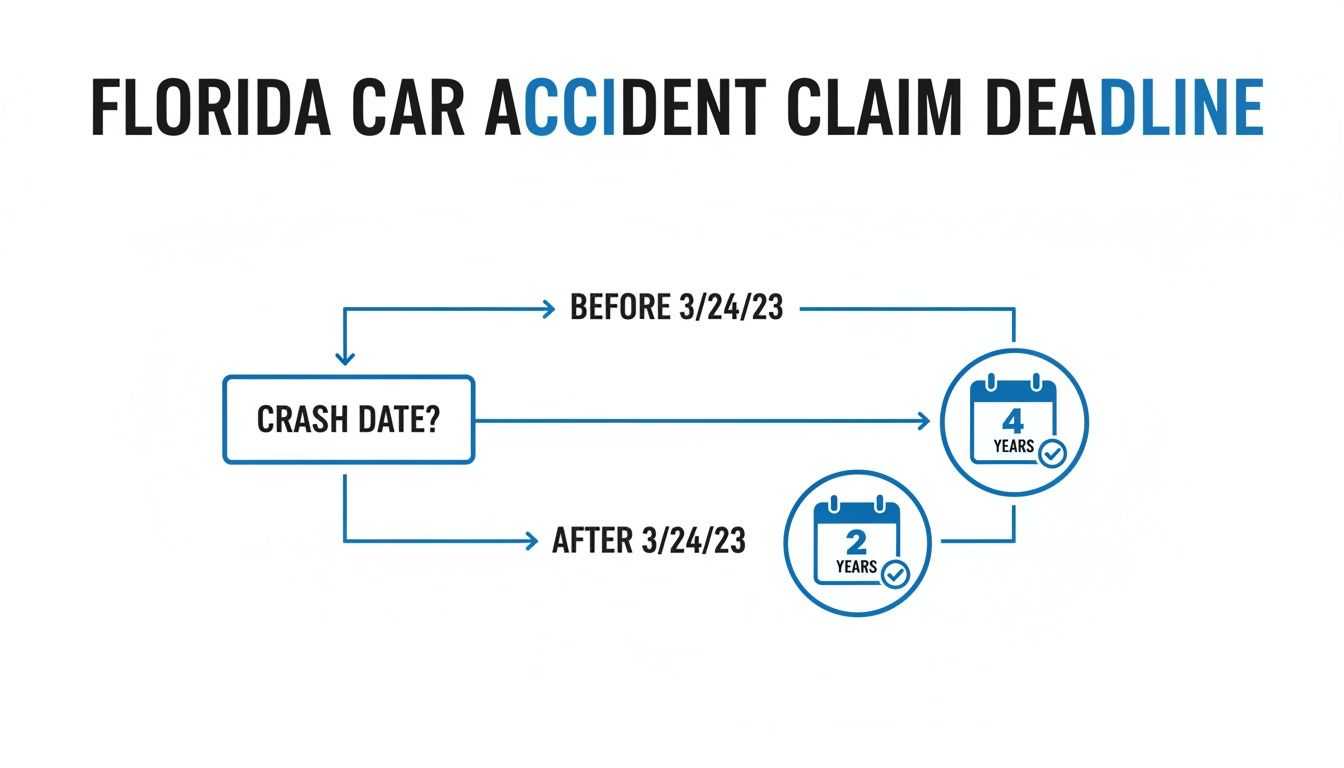
As you can see, the calendar date of the collision is everything. It’s the very first piece of information you need to lock down to understand your legal rights.
How to Figure Out Your Deadline: A Couple of Quick Examples
Let’s put this into a real-world context to make it perfectly clear. The only thing that matters when determining your filing deadline is the date the accident actually happened.
- Scenario 1: You were in a wreck on March 1, 2023. Since this was before the cutoff date, your case operates under the old rule. You have four years from March 1, 2023, to file a lawsuit.
- Scenario 2: Your crash took place on April 1, 2023. Because this happened after the law changed, you are now bound by the new, much tighter deadline. You only have two years from April 1, 2023, to initiate legal action.
It’s truly that simple. Once you know your accident date, you know your deadline. This is the foundational first step in protecting your ability to seek compensation. These car accident rules are specific; for a wider look at other timelines, feel free to read our guide on the statute of limitations for personal injury in Florida.
The Other Big Change: The 50 Percent Fault Bar
The law that cut the filing window in half also introduced another game-changing rule that dramatically raises the stakes for accident victims. Florida also moved from what was called a “pure comparative negligence” system to a “modified comparative negligence” system. This might sound like legal jargon, but its real-world impact is huge.
Under the old system, you could still recover some compensation even if you were mostly to blame for an accident. For instance, if you were found 80% responsible, you could still collect 20% of your damages.
That is no longer the case. The same 2023 law that slashed the filing deadline also established a strict 50% fault bar. Now, if a jury finds you 51% or more at fault for the collision, you are legally barred from recovering any money at all. Nothing.
This new fault rule means you can’t afford to wait or make mistakes. The other driver’s insurance company knows this, and they will work tirelessly to pin as much of the blame as they can on you. If they can successfully argue your share of the fault is over that 50% line, they walk away without paying a dime. This is exactly why it’s so critical to get an experienced attorney on your side right away to start building a strong case and fighting back against unfair accusations before your two-year window slams shut.
When the Standard Deadline Doesn’t Apply
While Florida’s new two-year deadline for car accident claims is a hard and fast rule in most cases, it’s not set in stone. The law accounts for real-life situations where it would be unjust or simply impossible for someone to file a lawsuit within that standard window. These scenarios trigger legal exceptions that can effectively pause the countdown.
Knowing about these exceptions is critical. If you just assume the standard two-year rule applies to your unique situation, you might walk away from a valid claim for compensation. These aren’t just legal loopholes; they are important safeguards built into the system to protect people in complex and difficult circumstances.
Wrongful Death Claims: A Different Timeline
One of the most significant exceptions comes into play when a car accident tragically leads to a person’s death. When this happens, the case is no longer a standard personal injury claim—it becomes a wrongful death claim.
This completely changes how the statute of limitations is calculated. The two-year clock doesn’t start ticking on the date of the crash. Instead, the countdown begins on the date the person passed away.
- Here’s how that works: Let’s say a driver is in a serious collision in Tampa on June 1, 2024. They are rushed to the hospital and fight for their life for weeks, but ultimately succumb to their injuries on July 15, 2024. For their family, the two-year deadline to file a wrongful death lawsuit starts on July 15, 2024—the date of death—not the original accident date.
This is a crucial distinction for grieving families already dealing with immense emotional pain and unexpected financial burdens. If you’re facing this heartbreaking situation, it’s vital to understand the nuances of the legal process. You can find more specific information in our guide to the Florida wrongful death statute of limitations.
Claims Against the Government
The rules get a lot more complicated if the at-fault driver was operating a government vehicle. Think of a city bus, a Hillsborough County school van, or a car owned by a state agency. You can’t just go straight to court.
Florida law has a special set of procedures and much shorter deadlines you have to meet before you can even think about filing a lawsuit. Under Florida Statute § 768.28, you are required to give the government agency a formal “notice of claim” first. Often, this has to be done within six months of the accident.
This is a trap that many people fall into. If you miss that initial notice deadline, you lose your right to sue the government entity forever, no matter how clear-cut your case is.
Once you’ve submitted the notice correctly, the government has 180 days to review it. Only after that period has passed can you file a lawsuit. The clock for the actual lawsuit is typically three years, but that initial notice period is the make-or-break first step.
Tolling: When the Clock Is Paused
“Tolling” is just a legal term for hitting the pause button on the statute of limitations. The law recognizes that some people are legally unable to file a lawsuit, and it protects their rights by stopping the clock.
This happens most often in two main situations:
- Injured Children: If a minor under the age of 18 is hurt in a crash, the statute of limitations is tolled. The clock doesn’t begin to run until they turn 18 and become a legal adult. This ensures a child’s future rights aren’t wiped out before they are old enough to pursue them.
- Incapacitated Victims: An accident can leave someone with a severe traumatic brain injury or in a coma, rendering them mentally incapacitated and unable to handle their own affairs. In these cases, the clock can be paused until they regain competency.
These tolling rules make sure that the law doesn’t unfairly punish the most vulnerable victims for being unable to act.
How the Legal Deadline Impacts Insurance Negotiations
A lot of folks think the statute of limitations only matters if you plan on taking someone to court. That’s a huge misconception. In reality, that legal deadline is the single most powerful tool you have when you’re negotiating with an insurance company.
Think of it this way: the adjuster knows that as long as you can legally file a lawsuit, their company is on the hook. The threat of a costly court battle is often the only thing that gets them to the table to negotiate in good faith. It’s your leverage.

Take that away, and your power evaporates. Once that deadline passes, the insurance company has absolutely no financial reason to offer you another cent. The conversation is over.
Using the Deadline as Leverage
Insurance adjusters are professional negotiators. Their job isn’t to be fair to you; it’s to protect their company’s profits by paying out as little as possible. And you can bet they know the exact date your right to sue expires.
It’s a classic move. As your filing deadline gets closer, the adjuster might start using delay tactics. Suddenly, they stop returning your calls. They ask for piles of unnecessary paperwork. They might even float a ridiculously low offer, just hoping you’ll get frustrated and run out of time. They know that if the clock runs out, they win.
This is exactly why getting an attorney involved early is a game-changer. When a law firm sends that initial letter, it tells the insurance company one thing loud and clear: we are ready for a fight. That simple step can completely change the dynamic, forcing the adjuster to stop playing games and start taking your claim seriously.
The Problem with Waiting Until the Last Minute
Florida’s roads are notoriously dangerous. In just one recent year, our state saw 394,865 crashes, leading to 252,240 injuries and 3,405 tragic deaths. This isn’t just a statistic; it means that serious injuries with sky-high medical bills are incredibly common, making a fair settlement absolutely essential for families to recover.
If you wait until the last minute to act, you’re putting your entire case at risk. Filing a lawsuit isn’t like filling out a form; it’s a detailed process that takes time to do right.
- Gathering Evidence: Your lawyer has to track down police reports, request all your medical records, and find and interview witnesses.
- Hiring Experts: For complex cases, you might need an accident reconstructionist to prove fault or a medical expert to explain the long-term cost of your injuries.
- Drafting the Lawsuit: The legal complaint itself has to be written perfectly and filed correctly with the court, or it could be thrown out.
Trying to cram all of this into the final weeks or days is a recipe for disaster. It leads to mistakes and signals to the insurance company that you’re disorganized, which only encourages them to stick with their lowball offers.
Uninsured Motorist Claims Have a Different Clock
Here’s another critical point: not every claim related to your accident falls under that same two-year clock. If the at-fault driver was uninsured or didn’t have enough coverage, you might need to file a claim with your own Uninsured/Underinsured Motorist (UM/UIM) policy. This type of claim operates on a completely different timeline.
Your UM/UIM policy is a contract between you and your insurance company. Because of this, it falls under contract law. Florida Statute § 95.11(2)(b) gives you five years from the date of the accident to sue your own insurer if they unfairly deny or underpay your UM/UIM claim.
This longer deadline is a vital protection, but it’s also a source of major confusion. People often assume all their deadlines are the same, causing them to miss out on the compensation they’re owed. It’s one more reason why getting advice from a legal professional is so important. If an insurer is giving you the runaround, you need to know how to fight an insurance denial effectively.
Protecting Your Claim Before Time Runs Out
Knowing the deadline for the statute of limitations in a Florida car accident is one thing, but actually meeting that deadline with a rock-solid case is how you get the compensation you deserve. It’s all about having a game plan from the moment the crash happens.

Here in the Tampa Bay area, I see it all the time—people are hurt, and their first and only thought is getting better. That’s completely understandable. But taking just a few key steps right after a collision can make all the difference in protecting your legal rights down the road.
Your Immediate Action Plan
What you do in the first few hours and days is critical. Every action helps preserve the evidence needed to prove who was at fault and what your damages truly are, long before a lawsuit is ever on the table.
Think of these as your non-negotiable first priorities:
- Seek Medical Attention: Your health comes first, always. Getting checked out by a doctor right away not only starts your recovery but also creates an official record connecting your injuries to the accident. This is absolutely vital for your claim.
- Document Everything at the Scene: If you’re physically able, turn your phone into an evidence-gathering tool. Snap photos and take videos of the vehicle damage, the road, traffic signs, and any visible injuries. Make sure you exchange information with the other driver and, just as importantly, get contact info from anyone who saw what happened.
- File a Police Report: Always, always call the police. A formal police report is an objective, third-party account of the crash, and it’s one of the most powerful pieces of evidence you can have.
These initial steps provide the raw materials an attorney will use to build a compelling story of what really happened.
Documenting Your Injuries and Losses
Creating a thorough record of your injuries isn’t just a good idea; it’s essential. Whiplash is a common injury that can lead to serious cervical spine issues and neck pain, so getting prompt medical care is crucial for both your health and your claim. You might even find helpful information on effective neck pain relief strategies as part of your recovery journey.
Keep a detailed file of every single medical visit, bill, prescription receipt, and doctor’s note. This paper trail is the bedrock of your claim—it proves the financial cost of your injuries and shows the insurance company (or a jury) just how severe they are.
This kind of meticulous record-keeping stops insurance adjusters from trying to downplay the impact the accident has had on your life and your wallet. For a complete look at the process, you can learn more about how to file a personal injury claim in Florida.
The Most Important Step: Consulting an Attorney
While everything I’ve mentioned is important, the single most valuable step you can take is to talk to a personal injury attorney right away. A good lawyer from a firm like Martin Hernandez, P.A. does so much more than just file paperwork before a deadline.
From day one, they kick off a strategic process to protect your claim:
- Preserving Evidence: They will immediately send out official spoliation letters. These legal notices tell the at-fault party they cannot destroy key evidence, like data from a truck’s black box or a driver’s logs.
- Engaging Experts: They know when to bring in the heavy hitters, like accident reconstructionists to analyze the crash dynamics or medical experts to powerfully explain the true extent of your injuries.
- Managing Communications: They take over all calls and emails with the insurance companies. This shields you from adjusters’ tactics designed to get you to admit partial fault or trick you into accepting a lowball offer.
A skilled attorney doesn’t just react to the statute of limitations; they get out in front of it, building a case designed for success from the very beginning. This positions you for a fair settlement long before that legal clock ever becomes a threat.
Why You Need a Tampa Injury Lawyer on Your Side
When you’re up against the new two-year deadline, a maze of legal exceptions, and insurance companies that profit from delay, one thing becomes crystal clear: you can’t afford to wait after a car accident. Trying to navigate Florida’s statute of limitations on your own is a huge gamble, but the right legal partner can turn that chaotic process into a clear plan for getting the justice you deserve.
Knowing the law is one thing. An experienced Tampa injury lawyer from a firm like Martin Hernandez, P.A. brings something more to the table: deep local knowledge and the resources to fight for you effectively.
Leveling the Playing Field
Let’s be honest—insurance companies have armies of adjusters and lawyers working around the clock with one goal: protecting their bottom line. That means paying you as little as possible. When you face them alone, you’re at a serious disadvantage from day one. A dedicated attorney changes that dynamic instantly.
The team at Martin Hernandez, P.A. doesn’t just hope for a fair settlement; they prepare every single case as if it’s headed for trial. This aggressive, forward-thinking approach shows the insurance company they’re up against a serious opponent who won’t be pushed around by lowball offers or stall tactics.
Your attorney acts as both your shield and your advocate. They handle all the deadlines and communications, letting you focus on the most important thing—your recovery. They make sure your rights are protected before that legal clock runs out for good.
Many law firms, especially in personal injury, rely on specialized legal intake services to manage the high volume of new client inquiries and process claims efficiently.
A No-Risk Promise for Your Peace of Mind
The financial stress after an accident is often overwhelming. The last thing you need is another bill, and the fear of legal fees keeps too many people from getting the help they need. That’s why the contingency fee model is so important for injury victims.
Firms like Martin Hernandez, P.A. work on a no-fee-unless-you-win basis. It’s a simple promise that means everything:
- No Upfront Costs: You won’t pay a single penny out of your own pocket to get your case started.
- No Hourly Bills: The firm fronts all the costs required to investigate, build, and pursue your case.
- Fees Are Paid from the Settlement: Legal fees are only taken as a percentage of the money they win for you.
This model completely removes the financial risk from your shoulders, giving you access to top-quality legal help when you need it most. It means your lawyer’s success is tied directly to yours.
The takeaway is simple and urgent. To protect your rights and make sure your claim is filed before the statute of limitations for a car accident in Florida closes the door, you need to talk to a knowledgeable attorney now. Schedule a free, no-obligation consultation to find out exactly what your options are before it’s too late.
Answering Your Questions About Florida’s Accident Deadlines
When you’re trying to recover from a car crash, the last thing you want to worry about is a legal countdown. But these deadlines are real, and understanding them is critical. Here are some straightforward answers to the questions we hear most often about Florida’s statute of limitations for car accidents.
Does the Two-Year Clock Start from the Accident or When I Realize I’m Hurt?
This is a common point of confusion, and the answer is crucial: the clock almost always starts ticking on the day of the crash itself. It doesn’t matter if you discovered the true extent of your injury days or even weeks later.
Think about it this way: you get into a wreck on May 1st. You feel a bit sore, but you don’t think much of it. On May 15th, the pain is unbearable, and a doctor diagnoses a serious spinal injury. That two-year deadline still traces back to May 1st. This is exactly why getting checked out by a doctor immediately after any collision is one of the smartest things you can do—it formally links your injuries to the accident right from the start.
What Happens If I Miss the Florida Statute of Limitations?
The consequences are severe and final. If you don’t file a lawsuit within the time limit, you lose your right to sue the at-fault party. The court will dismiss your case, and you are permanently barred from seeking compensation for your injuries.
It’s an absolute cutoff. This means you can’t recover a single dollar for your medical bills, lost wages, or the pain you’ve endured. There are no do-overs or second chances, which is why acting decisively is the most important step you can take to protect yourself.
Is the Deadline for My Car Damage Different from My Injury Claim?
Yes, and this is another trap that can catch people off guard. The recent change in Florida law only affected personal injury claims, not property damage.
Here’s how it breaks down:
- Personal Injury Claim: You have two years from the accident date to file a lawsuit (for any crash after March 24, 2023).
- Property Damage Claim: You still have four years from the accident date to sue for repairs or the loss of your vehicle.
While the timelines are different, it’s almost always best to handle both claims together. A skilled attorney will manage all the moving parts, making sure both your physical and financial recoveries are addressed long before any deadlines become an issue. Don’t let confusing timelines get in the way of your recovery; let a professional manage the deadlines so you can focus on getting better.
At Martin Hernandez, P.A., we know how stressful these deadlines can be. Don’t let time run out on your right to compensation. Contact us today for a free, no-obligation consultation to get your questions answered and secure your future.