
When you’re grieving the loss of a family member, legal deadlines are the last thing on your mind. But in Florida, the clock is already ticking. The statute of limitations for wrongful death is a strict two years, and understanding this deadline is the single most important first step toward getting justice for your family.
Understanding Florida’s Two Year Wrongful Death Deadline
Losing someone because of another person’s negligence throws a family into a state of shock and grief. The idea of a legal timeline can feel like an impossible burden, but it’s absolutely critical. Think of the “statute of limitations” as a legal stopwatch started by the state. If you don’t file your claim before that stopwatch runs out, the courthouse doors are closed to your case forever, no matter how strong your evidence is.
Why the Date of Death Is the Starting Point
A lot of confusion comes from pinpointing exactly when that two-year clock starts to run. In a Florida wrongful death case, the countdown begins on the date of death, not the date of the accident or injury that ultimately led to it. This is a vital distinction.
It’s especially important in situations where a loved one fights for their life for days, weeks, or even months after an incident. For example, if someone is critically injured in a Tampa car crash on January 15th but tragically doesn’t pass away until February 1st, the two-year deadline for the wrongful death claim is February 1st of the second year—not January 15th.
This timeline helps visualize how these key events connect to the final deadline.
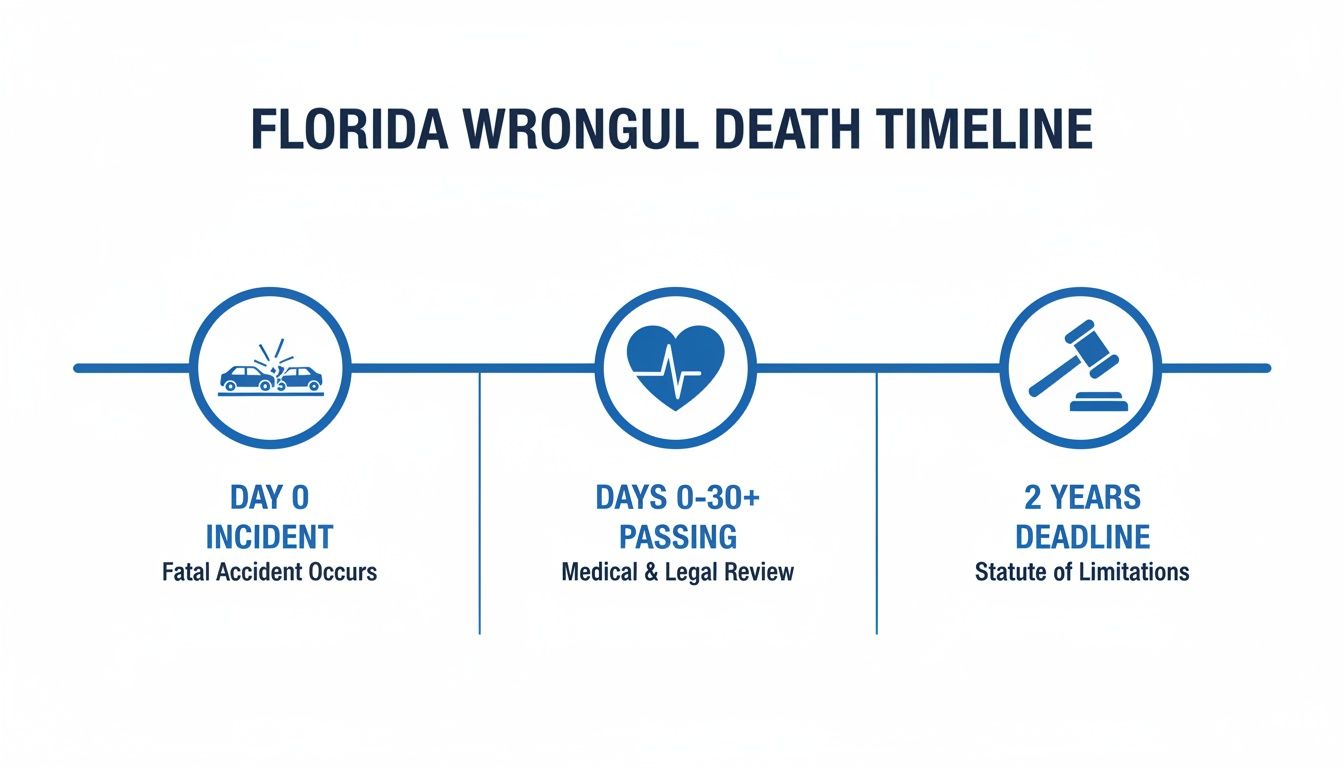
As you can see, the moment that triggers the legal countdown is the passing of your loved one. That event sets a firm, two-year deadline to take legal action.
The Legal Foundation for the Deadline
This two-year window isn’t just a guideline; it’s a hard-and-fast rule written into state law under Florida Statutes § 95.11(4)(d). This statute gives families a finite, 24-month period to file a lawsuit and seek compensation for their devastating loss.
This timeline is designed to give the personal representative of the deceased’s estate a reasonable period to gather evidence, identify who is responsible, and formally file a claim.
The two-year period provides a defined window for the personal representative of the deceased’s estate to gather evidence, identify all responsible parties, and formally file a lawsuit. Missing this deadline effectively forfeits the family’s right to pursue financial compensation through the courts.
It’s also worth noting that while the wrongful death clock is set at two years, the timelines for other claims related to the same incident can be different. It’s a good idea to also understand the separate statute of limitations for a car accident in Florida, as it governs claims for non-fatal injuries and works on a different clock. This is key if other family members were injured in the same event.
Who Has the Right to File a Wrongful Death Lawsuit?
Knowing about the two-year deadline is a critical piece of the puzzle, but it’s only half the story. The next question is just as important: who actually has the legal standing to file the lawsuit?
Florida law is very particular about this. To prevent a chaotic free-for-all where multiple relatives file competing claims, the state requires a single, unified legal action.
This lawsuit must be brought by the decedent’s personal representative. You might know this person by a more common term, “executor.” Think of them as the legal captain of the ship, responsible for steering the case forward on behalf of both the estate and every surviving family member impacted by the loss.
The Role of the Personal Representative
The personal representative isn’t just a title; it’s a formal appointment made by a probate court. If your loved one had a will, they likely named someone for this role.
But what if there’s no will? Or what if the named person can’t or won’t serve? In that case, the court steps in and appoints someone, following a priority list set by Florida law. This usually starts with the surviving spouse, followed by adult children.
This person has a serious legal obligation—a fiduciary duty—to act in the best interests of the estate and all survivors. Their job includes:
- Officially filing the wrongful death lawsuit.
- Identifying every survivor who has a right to compensation.
- Working with the legal team to gather evidence and build a strong case.
- Distributing the money from any settlement or court award to the survivors as required by Florida law.
This structured process makes sure one person is accountable for the case and that every eligible family member is represented.
Identifying the Survivors in a Florida Claim
While the personal representative is the one who files the suit, they aren’t filing it for themselves. They are acting on behalf of the “survivors.”
Florida law is extremely specific about who qualifies. This isn’t a loose term; it’s a legal definition that determines who gets compensated.
Under Florida Statute § 768.18, “survivors” are typically the decedent’s spouse, children, and parents. In certain situations, it can also include any blood relatives or adoptive siblings who were financially dependent on the person who passed away.
The compensation each survivor can receive often hinges on their relationship to the deceased. A surviving spouse, for example, can claim damages for the loss of companionship and protection. Minor children can claim for the loss of parental guidance and support. The parents of a deceased minor child also have a claim for their profound mental pain and suffering.
You can explore more details on what makes a claim valid in our guide to a wrongful death lawsuit in Florida. Making sure every single eligible survivor is identified from the very beginning is one of the most important first steps the personal representative must take.
When the Filing Deadline Can Be Extended
While the two-year deadline for a wrongful death claim in Florida seems rigid, it’s not always a hard stop. The law acknowledges that certain, very specific circumstances can make it impossible or fundamentally unfair for a family to file on time.
These exceptions can effectively hit the pause button on the legal stopwatch. This concept is known as tolling, and it can be a critical lifeline for families caught in unique situations. But be warned: successfully arguing for one of these exceptions is incredibly complex and almost always requires deep legal expertise to prove in court.
The Critical Discovery Rule
One of the most significant exceptions is known as the discovery rule. Think of it as a delayed start for the two-year countdown. Instead of starting on the date of death, the clock only begins to tick when the surviving family members know—or reasonably should have known—that negligence or a wrongful act was the true cause of death.
This rule is a powerful tool, especially when the cause of death isn’t immediately obvious or has been deliberately hidden.
- Medical Malpractice Example: Imagine a patient dies after a routine procedure. The hospital tells the family it was a rare, unavoidable complication. A year later, an internal whistleblower reveals the surgeon was impaired during the surgery. The family now realizes negligence was the cause. The two-year clock would likely start from the date of this new discovery, not the original date of death.
- Defective Product Example: A person passes away from an aggressive illness, which doctors attribute to natural causes. Eighteen months later, a federal recall reveals that a daily medication they were taking was tainted with a carcinogen. The discovery rule could give the family a new window to file a claim, as they had no reason to suspect a wrongful act until that information became public.
The discovery rule ensures that at-fault parties can’t escape justice just by hiding the truth until the standard deadline has passed.
Tolling for Minors and Incapacity
The statute of limitations can also be paused, or tolled, when a minor child is a survivor in the wrongful death claim. The law understands that children can’t pursue their own legal rights, so the timeline is often extended to give them a chance to file a claim after they become adults.
A similar pause can occur if a key surviving family member is legally incapacitated—for instance, if they are in a coma or suffering from a severe mental disability. This protects their rights until they regain capacity or a legal guardian can act for them. The rules here get complicated and often intersect with other legal timelines. You can learn more about how different claim deadlines work in our guide on the statute of limitations for personal injury.
Defendant Concealment or Absence
What happens if the person responsible for the death actively tries to avoid the lawsuit? If a defendant conceals their identity or leaves Florida to dodge being served legal papers, the court can toll the statute of limitations.
The legal system is designed to prevent defendants from simply “running out the clock” by disappearing. The clock will be paused for the entire period they are absent from the state or actively in hiding, making sure they can’t benefit from their evasive actions.
The Ultimate Exception: Murder or Manslaughter
Finally, there’s one scenario where the deadline is removed altogether. If a death was the result of an act that constitutes murder or manslaughter, there is no statute of limitations for the civil wrongful death claim.
This means the victim’s family can bring a lawsuit against the responsible person at any point in the future, no matter how many years have gone by. It’s a powerful exception that reflects the state’s unwavering commitment to holding those who commit the gravest offenses fully accountable.
Navigating Claims Against Government Agencies

When the at-fault party is a private citizen or a company, the legal process, while complex, follows a relatively standard path. But what happens when the entity responsible for your loved one’s death is the government? Everything changes.
The rules for suing a city, county, or state agency are completely different and far more rigid. This is because of a very old legal principle called sovereign immunity, which historically protected the government from being sued at all. While Florida has relaxed this rule, it has been replaced with a procedural minefield that grieving families must navigate with absolute precision. One misstep can be fatal to your case.
The Critical Pre-Suit Notice Requirement
Before you even worry about the standard two-year statute of limitations for wrongful death in Florida, there’s a much earlier and stricter deadline you have to meet. You are required by law to file a formal “pre-suit notice” with the government agency involved.
This isn’t just a quick phone call or an email. It’s a formal, detailed written claim that must be sent to the correct government department and the Florida Department of Financial Services. This step is non-negotiable, and the timeline is incredibly unforgiving.
For claims against a state-level agency, you generally have three years from the incident to file this notice. However, if your claim is against a city or county, the window can shrink dramatically, sometimes to as little as six months.
Don’t miss this deadline. If you fail to provide the proper notice within the required timeframe, your claim is permanently barred. It doesn’t matter how strong your case is; the court will have no choice but to dismiss it for failing to follow this mandatory first step.
The Government’s Investigation Period
Once you’ve correctly submitted the pre-suit notice, another timer starts ticking. The government agency gets a 180-day investigation period to review the claim. During these six months, you are legally forbidden from filing a lawsuit.
The agency might offer to settle, deny the claim outright, or do nothing at all and let the 180 days run out. Only after that period ends, or after you receive a formal written denial, can your family’s personal representative actually file the wrongful death lawsuit in court. It’s a frustrating but mandatory waiting game.
Understanding the Caps on Damages
Even if you successfully navigate the process and win your case, there’s another major hurdle: strict limits on how much money your family can recover.
Under Florida Statute § 768.28, the total amount of damages a family can receive from a government entity is usually capped at:
- $200,000 for any one person
- $300,000 total for a single incident
This means that no matter how devastating the financial and emotional losses are, the initial award cannot go above these statutory limits. To recover more, your attorney would have to lobby the Florida Legislature to pass a special “claims bill” for your specific case—a challenging, expensive, and deeply political process with no guarantee of success.
These tight notice deadlines, mandatory waiting periods, and damage caps make it crystal clear: if a government body was responsible for your family’s loss, getting experienced legal help immediately isn’t just a good idea, it’s essential.
Wrongful Death Claims Versus Survival Actions
When your family is reeling from an unexpected loss, the last thing you need is a bunch of confusing legal terms thrown your way. Two phrases that often get mixed up are “wrongful death claim” and “survival action.” They both stem from the same tragic event, but they are two distinct legal paths that address entirely different kinds of harm.
Think of it this way: a wrongful death claim is for the family’s loss, while a survival action is for the deceased person’s loss. They’re two sides of the same coin, and together they help account for the full and devastating impact of someone’s negligence.
What is a Wrongful Death Claim?
A wrongful death claim is filed by the estate’s personal representative specifically for the benefit of the surviving family members. The entire point is to compensate them for the profound losses they now have to live with because their loved one was taken from them. This claim isn’t about what the deceased person went through; it’s about the suffering of those left behind.
The damages sought in a wrongful death claim are deeply personal to the family and often include:
- Loss of the future financial support and services the decedent would have provided.
- Loss of companionship, guidance, and protection.
- Mental pain and suffering endured by a surviving spouse, minor children, or parents.
- Medical and funeral bills paid directly by a family member.
Basically, a wrongful death claim answers the question, “How has this loss shattered the lives of the family?” It’s a legal acknowledgment of the emotional and financial hole that the death has created.
How is a Survival Action Different?
A survival action, on the other hand, is also brought by the personal representative but on behalf of the deceased person’s estate. Just like the name suggests, the claim “survives” the person’s death, allowing the estate to recover the damages the person could have claimed themselves if they had lived.
This legal action seeks compensation for the harm the deceased person personally endured from the moment of the wrongful act until the moment of their death. The goal is to address the suffering and financial costs they incurred during that final period.
This action focuses on a totally different question: “What did the deceased person suffer before they died?” The compensation recovered goes to the estate, not directly to the family, and might include:
- Medical bills from the time of the injury until death.
- Lost wages the person would have earned during that same period.
- The conscious pain and suffering the deceased experienced before passing.
This money first goes into the estate to pay off any outstanding debts or creditors. Whatever is left is then distributed to the heirs according to a will or state law.
Learning more about this process by understanding wrongful death claims in Tampa can provide even more clarity. Grasping the distinction between these two types of claims is crucial. It ensures your family is in a position to seek full and fair compensation for every single aspect of your devastating loss.
Practical First Steps to Protect Your Legal Rights

In the chaos that follows losing a loved one, thinking about legal matters feels impossible. But taking a few small, deliberate steps right away can make a world of difference for your family’s future. While the statute of limitations for wrongful death in Florida gives you a two-year window, the strength of your case is built on what you do now.
The goal isn’t to add more stress. It’s about taking manageable actions that create a solid foundation for a potential claim, securing vital evidence before it disappears, and protecting your family from the tactics insurance companies often use to deny or devalue a case.
Create a Central File for Key Documents
The single most important thing you can do right now is start gathering paperwork. Just collect everything you can find and put it in one safe place—a folder, a box, anything. Don’t worry about what it all means yet.
Having everything organized in one spot will be a massive help for your legal team down the road. It ensures that crucial documents don’t get misplaced or thrown out during an already overwhelming time.
Start with these essential items:
- The Official Death Certificate: This is the cornerstone of any wrongful death claim. It officially establishes the date of death, which is what starts the statute of limitations countdown.
- Accident or Incident Reports: If the death was caused by a car crash, an accident at work, or some other incident, get a copy of the official police or incident report.
- Medical Records and Bills: Try to gather all medical paperwork from the time of the injury until their passing. This includes hospital bills, notes from doctors, and summaries of treatments.
- Financial Documents: Collect recent pay stubs, tax returns, and any employment records. These documents are key to demonstrating the financial losses your family is now facing.
Keeping this evidence safe is paramount. In fact, there are serious legal consequences for losing or destroying evidence, a concept known as spoliation of evidence, which can severely damage a case.
Avoid Speaking with Insurance Adjusters
It won’t be long before you get a call from an insurance adjuster representing the person or company at fault. Remember, their job is to pay out as little as possible for their company. They are highly trained to get you to say things that can hurt your claim.
It is absolutely crucial that you do not give a recorded statement or accept any quick settlement offer they throw at you. These initial offers are almost always a fraction of what your family truly deserves, and anything you say in a recording can and will be used against you.
You can simply say, “I’m not ready to discuss this until I’ve spoken with my family and our attorney.” That’s it. It’s a perfectly firm and polite response. You have no obligation to say anything more.
Taking these first steps puts your family in control. While you’ll want an attorney to handle the complex parts, understanding the process can be empowering. Learning about writing a demand letter for personal injury offers a glimpse into how your lawyer will formally kick off settlement talks, fighting to protect your family’s rights and pursue the justice you deserve.
Answering Your Questions About Florida’s Wrongful Death Laws
When you’re grappling with the loss of a family member, the legal system can feel overwhelming and confusing. It’s only natural to have questions. To help bring some clarity during this difficult time, we’ve put together straightforward answers to some of the most pressing questions we hear from families in and around Tampa.
What Happens if We Miss the Two-Year Deadline?
This is a critical point: if you miss the two-year filing deadline, the court will almost certainly throw out your case for good. It doesn’t matter how compelling your evidence is or how clear the fault may be.
Missing that window means your family permanently loses the right to seek financial justice for your loss. Florida law is incredibly strict on this, which is why acting quickly is so important for protecting your family’s rights.
Is the Deadline the Same for Medical Malpractice?
Yes, the two-year deadline is the starting point for wrongful death claims caused by medical malpractice, but these cases are a different beast entirely. They come with their own set of complex pre-suit investigation rules and specific timelines that have to be met before a lawsuit can even be filed.
Plus, the “discovery rule” might come into play if the medical mistake wasn’t something you could have known about right away. This could change when the clock officially starts ticking.
Because the procedural hurdles are so high and a single misstep can jeopardize your entire claim, it’s absolutely essential to work with an attorney who has deep experience in this specific area of law.
Can We Still File a Claim if Our Loved One Was Partially at Fault?
You can. Florida uses a legal principle called “modified comparative negligence.” This means you can still pursue a claim as long as your loved one was not more than 50% responsible for the incident that led to their passing.
However, any financial compensation your family receives will be reduced by their percentage of fault. For instance, if a jury determines your loved one was 20% at fault, the final award would be reduced by that 20%.
How Much Does It Cost to Hire a Wrongful Death Attorney?
This is a major concern for most families, and the answer should provide some peace of mind. Nearly all experienced wrongful death lawyers work on a contingency fee basis.
What does this mean for you?
- You pay zero upfront costs or hourly fees.
- The law firm covers all the expenses of building and litigating your case.
- The attorney only gets paid if they win your case, either through a settlement or a verdict at trial. Their fee is a pre-agreed-upon percentage of the total amount recovered.
If your family is navigating the aftermath of a devastating loss and you have questions about what to do next, you are not alone. The compassionate team at Martin Hernandez, P.A. is here to offer the clear guidance and dedicated representation you deserve. Contact us today for a free, no-obligation consultation to discuss your situation.