
TL;DR:
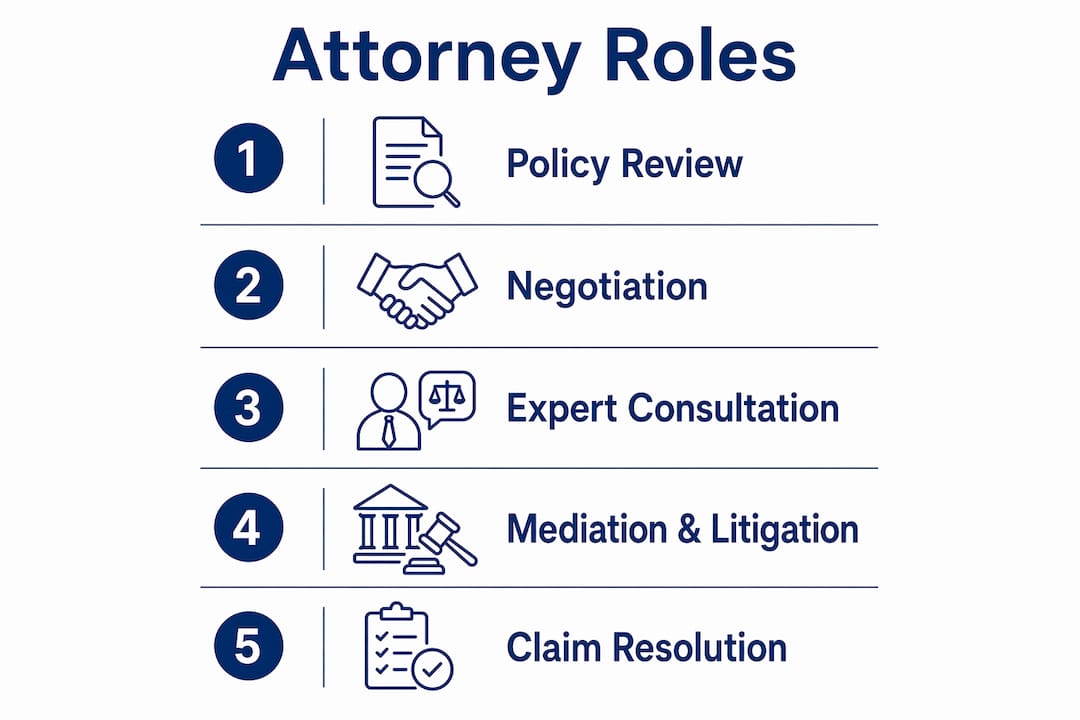
- An insurance dispute attorney represents policyholders by analyzing policies, managing insurer communications, and negotiating to secure full benefits. They use independent experts, enforce legal deadlines, and prepare for litigation to achieve better claim outcomes. Early legal involvement prevents insurer strategies from solidifying and leverages the threat of court action.
An insurance dispute attorney is defined as a licensed legal advocate who represents policyholders against insurers to secure the full benefits owed under a policy contract. If you’re reading this after a claim denial or a lowball settlement offer, you already know how disorienting the process feels. The role of attorney in insurance disputes goes far beyond filing paperwork. Attorneys analyze your policy, manage all insurer communications, coordinate independent experts, and apply legal pressure that changes what insurers put on the table. Insurers must acknowledge claims within 15 business days and decide payment within another 15 business days after receiving the required information. Knowing those deadlines exist is one thing. Having an attorney enforce them is another.
How does an insurance attorney analyze your policy and claim?
The first thing an attorney does is read your full policy contract, not the summary brochure the insurer sent you. Policy summaries omit exclusions, sub-limits, and conditions that directly affect your payout. A trained attorney reads every endorsement, rider, and definition section to find coverage you did not know you had.
This process also surfaces critical deadlines. Most policies require you to file a proof of loss within a set number of days after a loss event. Missing that deadline gives the insurer grounds to deny your claim outright, regardless of its merit. Attorneys track these dates from day one.
Early case evaluation also determines whether your dispute is a standard coverage disagreement or a potential bad faith insurance claim. Bad faith occurs when an insurer unreasonably delays, underpays, or denies a valid claim. That distinction matters because it changes both the legal strategy and the potential damages you can recover.
An attorney’s policy review typically examines:
- Coverage grants: What the policy actually promises to pay, not what the adjuster says it covers
- Exclusions and exceptions: Specific language that limits or eliminates coverage for certain causes of loss
- Conditions and duties: Steps you must take after a loss, including notice requirements and cooperation clauses
- Appraisal clauses: Built-in dispute resolution mechanisms that can resolve valuation disagreements without going to court
Pro Tip: Request a complete, certified copy of your policy from your insurer before your first attorney meeting. Adjusters sometimes work from outdated policy versions, and having the exact document your attorney will review speeds up the analysis significantly.
What strategic roles does an attorney play during negotiations?
Attorneys take control of insurer communications the moment they enter a case. One of the first steps is sending a Letter of Representation to the insurer. That letter legally prohibits the insurer from contacting you directly. All calls, letters, and requests for recorded statements must go through your attorney instead.

This matters more than most policyholders realize. Insurers are skilled at asking questions that produce answers used to reduce or deny claims. A statement like “the roof was old anyway” can be used to justify a depreciation deduction that cuts your payout in half. Your attorney prevents those conversations from happening without legal oversight.
Attorney-negotiated settlements consistently produce higher compensation than unrepresented claims. Insurers know that an attorney signals a credible threat of litigation. That threat changes the insurer’s internal risk calculation and pushes settlement offers upward.
The negotiation process an attorney manages typically follows this sequence:
- Demand letter: A formal written demand stating the full value of your claim, supported by documentation and legal authority
- Counter-offer review: Attorney evaluates the insurer’s response and identifies whether it reflects a genuine assessment or a tactical lowball
- Negotiation sessions: Direct communication between your attorney and the insurer’s claims team or in-house counsel
- Settlement agreement review: Attorney reviews all release language before you sign anything, preventing you from waiving future rights
Pro Tip: Never accept a first settlement offer without attorney review. Insurers routinely open with offers well below claim value, expecting negotiation. An attorney knows the realistic range for your type of claim and will not settle for less.
How do attorneys use independent experts to challenge insurer decisions?
Insurers hire their own adjusters and experts to assess damage. Those professionals work for the insurer, not for you. Their reports often minimize damage, dispute causation, or apply depreciation aggressively. An attorney counters this by hiring independent forensic experts who answer only to your legal team.
The type of expert depends on the dispute. A structural engineer can document that storm damage caused a roof failure, not pre-existing wear. A meteorologist can confirm that a specific weather event occurred at your property’s exact location on a specific date. An industrial hygienist can verify mold causation and scope. These professionals do not fabricate findings. They verify and document with the credibility that holds up in negotiations and in court.
The impact of independent expert involvement is significant. When an insurer’s adjuster says a loss is worth $40,000 and your attorney’s engineer documents $120,000 in structural damage, the gap becomes the center of negotiation. The insurer can no longer rely solely on its own report.
| Expert type | What they assess | How it helps your claim |
|---|---|---|
| Structural engineer | Building damage and causation | Counters insurer’s depreciation and scope disputes |
| Meteorologist | Weather event verification | Confirms covered peril occurred at your location |
| Industrial hygienist | Mold origin and extent | Establishes causation for remediation coverage |
| Medical expert | Injury causation and prognosis | Supports bodily injury and disability claims |
The role of expert witnesses in Florida injury and insurance claims is well established. Attorneys who regularly work with a network of credible experts bring that infrastructure to your case immediately, without the delay of building it from scratch.
What happens if insurance disputes escalate to mediation or litigation?
Most insurance disputes settle through negotiation rather than reaching trial. Settlement avoids the cost and delay of litigation for both sides. Mediation sits between negotiation and trial. A neutral mediator facilitates structured settlement discussions, and both parties retain the right to walk away if no agreement is reached.
Attorneys prepare for mediation the same way they prepare for trial. They organize all evidence, expert reports, and legal arguments into a mediation brief. That preparation signals to the insurer that your attorney is ready to litigate if mediation fails. That readiness alone often produces better mediation outcomes.
When disputes do proceed to litigation, attorneys use discovery to obtain the insurer’s internal documents. Claims manuals, adjuster notes, internal communications, and reserve records can reveal whether the insurer followed its own procedures. Discovery and depositions allow attorneys to question adjusters and experts under oath, exposing inconsistencies between what the insurer said publicly and what its records show.
Key litigation tools your attorney deploys:
- Interrogatories: Written questions the insurer must answer under oath, revealing its claims handling process
- Document requests: Formal demands for internal files, adjuster training materials, and reserve calculations
- Depositions: Sworn testimony from adjusters, engineers, and claims managers that locks in their positions
- Expert witness testimony: Retained professionals who testify on causation, valuation, and industry standards at trial
Pro Tip: If your insurer has denied a claim or significantly delayed payment, ask your attorney to evaluate whether the conduct qualifies as insurance bad faith. Bad faith claims carry additional damages beyond the original policy benefit, which changes the insurer’s settlement calculus entirely.
Key Takeaways
An attorney’s involvement in an insurance dispute shifts legal leverage from the insurer to the policyholder by combining policy expertise, expert evidence, and the credible threat of litigation.
| Point | Details |
|---|---|
| Early attorney involvement | Hiring an attorney before a denial preserves evidence and prevents insurer position hardening. |
| Letter of Representation | This document stops insurer direct contact and protects you from making damaging statements. |
| Independent expert coordination | Attorneys hire engineers and specialists whose findings counter insurer-hired adjuster reports. |
| Negotiation produces higher settlements | Attorney-represented claims consistently achieve better compensation than unrepresented claims. |
| Litigation tools change outcomes | Discovery and depositions expose insurer misconduct and strengthen your position before trial. |
What I’ve learned after years of watching policyholders fight insurers alone
The single most common mistake I see is waiting. Policyholders spend weeks or months responding to insurer requests, providing recorded statements, and accepting partial payments before they call an attorney. By that point, the insurer has built a file full of statements and documents that support its position. Reversing that narrative is harder than building the right one from the start.
Early legal involvement prevents the insurer’s position from hardening. When an attorney enters a case in the first week, the insurer knows it cannot rely on informal pressure tactics. The entire tone of the claim changes.
What most people do not understand is that insurers use internal adjusters and legal teams whose job is to protect the company’s bottom line. That is not cynicism. That is the business model. An attorney levels that playing field by bringing the same level of professional preparation to your side of the table.
The other thing I tell every client: the credible threat of litigation is often more powerful than litigation itself. Insurers settle cases they expect to lose in court. An attorney who is genuinely prepared to try a case signals that threat in every communication. That signal affects what the insurer offers, often before a single court filing is made.
If you are dealing with a denied claim, a delayed payment, or a settlement offer that does not reflect your actual loss, do not wait for the situation to resolve itself. It will not.
— Martin Hernandez
How Martin Hernandez, PA can help with your insurance dispute
Dealing with an insurer that undervalues or denies your claim is stressful. You should not have to fight that battle without experienced legal support on your side.

Martin Hernandez, PA represents clients in Tampa and Hillsborough County who are facing exactly this situation. The firm handles insurance disputes connected to personal injury cases, including auto accidents, truck collisions, and wrongful death claims. Every case is prepared for trial from day one, which gives clients real negotiating leverage. If you are unsure whether your situation warrants legal help, start by understanding when to hire a personal injury lawyer and what that process looks like in Florida. Martin Hernandez, PA works on a contingency fee basis, meaning you pay nothing unless your case is won. The firm’s staff also speaks fluent Spanish. Call today for a free consultation and get a clear picture of what your claim is actually worth.
FAQ
What is the role of an attorney in insurance disputes?
An insurance dispute attorney represents policyholders by analyzing policy language, managing insurer communications, coordinating expert evidence, and negotiating or litigating to secure fair claim outcomes. Their presence shifts legal leverage from the insurer to the insured.
When should you hire an attorney for an insurance dispute?
Hire an attorney as early as possible, ideally before responding to insurer requests or providing recorded statements. Early intervention preserves evidence and prevents the insurer from building a file that supports its own position.
How do attorneys handle insurance disputes differently than public adjusters?
Public adjusters assess and document damage but cannot provide legal advice or represent you in court. Attorneys handle coverage denials, bad faith claims, and litigation, making them the necessary choice when an insurer refuses to pay a valid claim.
Do insurance dispute attorneys work on contingency?
Attorney fee structures depend on the type of dispute. Bad faith cases often use a contingency fee arrangement, meaning no fee unless you win. Standard coverage disputes may be billed hourly. Martin Hernandez, PA uses a contingency structure for personal injury and related insurance claims.
What happens if my insurance dispute goes to trial?
Trials are rare because most disputes settle before reaching court. When a case does go to trial, your attorney presents expert testimony, insurer documents obtained through discovery, and legal arguments to a judge or jury. Trial readiness is itself a negotiation tool that often produces better pre-trial settlements.
Recommended
- Insurance Claim Dispute Lawyer: A Tampa Accident Guide – Personal Injury Lawyers of Tampa
- Insurance Claim Dispute Process: A Step-by-Step Guide – Personal Injury Lawyers of Tampa
- How to negotiate with insurance companies: A Pro Guide – Personal Injury Lawyers of Tampa
- The Role of Documentation in Insurance Disputes – Personal Injury Lawyers of Tampa